
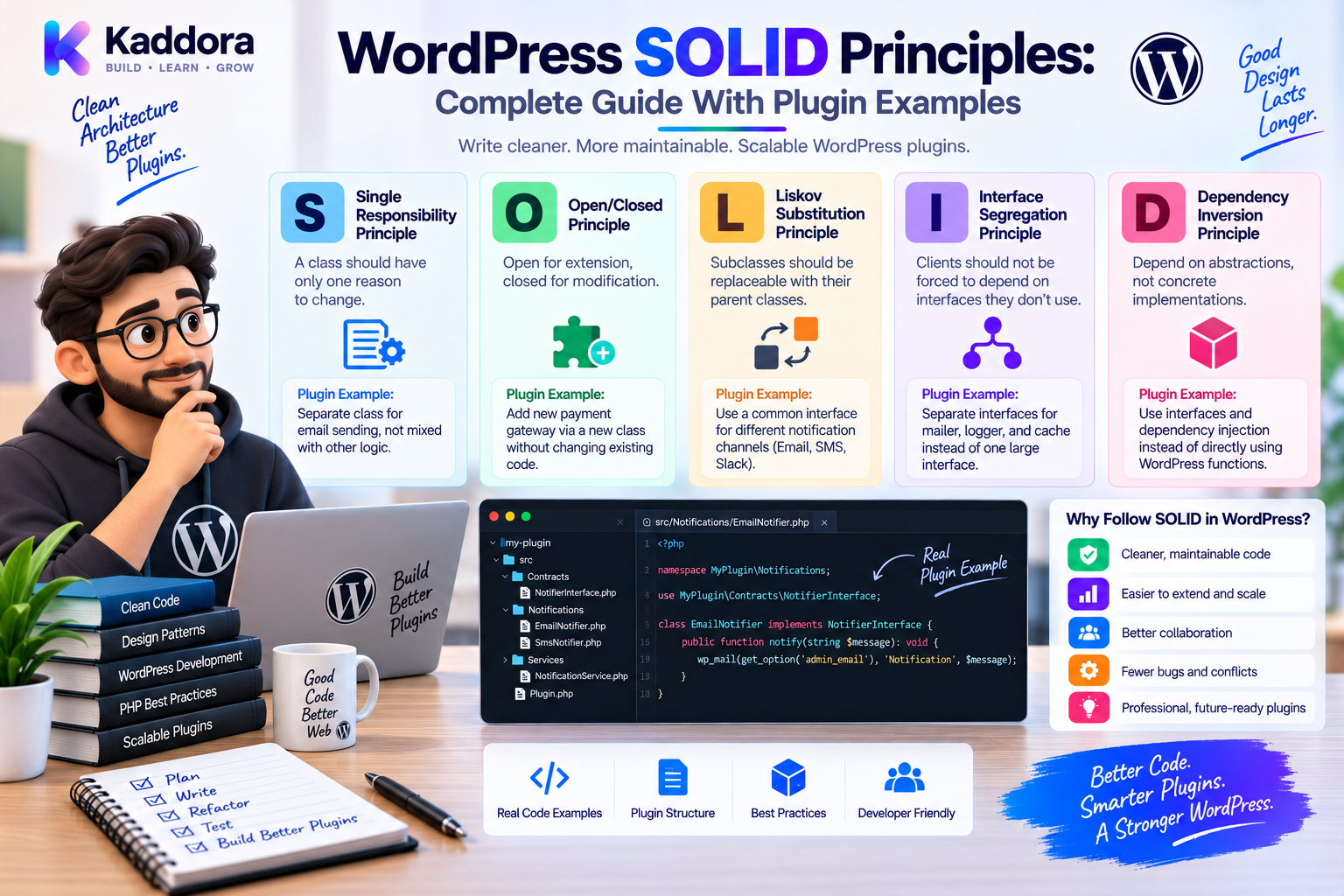
WordPress SOLID Principles: Complete Guide With Plugin Examples
Introduction
WordPress makes it possible to build everything from simple websites to large SaaS platforms, WooCommerce systems, enterprise plugins, and complex API integrations.
As a plugin grows, however, the codebase can become difficult to maintain.
A single plugin class may eventually handle:
Database operations
REST APIs
Admin pages
Validation
Notifications
Authentication
Analytics
WooCommerce logic
External integrations
This creates tightly coupled code that becomes harder to test and extend.
One of the best ways to improve a large PHP codebase is to apply the SOLID principles.
SOLID is a group of five object-oriented design principles that encourage code that is easier to understand, test, maintain, and extend.
In WordPress plugin development, SOLID works especially well with:
Namespaces
Composer
Dependency injection
Service classes
Repositories
Interfaces
Hook-based architecture
Modular plugin design
This guide explains all five SOLID principles with practical WordPress plugin examples.
What Does SOLID Mean?
SOLID represents five principles:
S → Single Responsibility Principle O → Open/Closed Principle L → Liskov Substitution Principle I → Interface Segregation Principle D → Dependency Inversion Principle
Together, they encourage developers to separate responsibilities and reduce unnecessary coupling.
A simplified architecture looks like:
WordPress Hooks ↓ Controllers / Listeners ↓ Services ↓ Repositories / Adapters ↓ Infrastructure
Instead of putting everything into one class, each layer has a clear responsibility.
Why SOLID Matters in WordPress Plugins
Small plugins may work perfectly without strict architectural rules.
Large plugins are different.
As complexity increases, SOLID can help:
Reduce tightly coupled code
Improve testability
Simplify maintenance
Make features easier to add
Improve dependency management
Support reusable services
Reduce regression risk
Make refactoring safer
The goal isn't to apply every principle mechanically.
The goal is to create code whose responsibilities and dependencies are clear.
1. Single Responsibility Principle
The Single Responsibility Principle (SRP) says that a class should have one primary responsibility and one reason to change.
A common WordPress anti-pattern is a giant plugin class:
final class Plugin { public function createOrder() {} public function sendEmail() {} public function saveCustomer() {} public function callCrmApi() {} public function renderAdminPage() {} public function generateReport() {} }
This class has too many responsibilities.
A better structure separates them:
OrderService CustomerService EmailService CrmService ReportService AdminPage
For example:
final class OrderService { public function create( array $data ): int { // Order business logic. } }
And:
final class EmailService { public function sendOrderNotification( int $order_id ): void { // Email logic. } }
Now each class has a clearer purpose.
SRP With WordPress Hooks
Hooks should also remain focused.
Instead of:
add_action( 'init', function () { // Register CPT // Call external API // Send email // Create database tables // Generate reports } );
use focused listeners:
WordPress Hook ↓ Specific Listener ↓ Specific Service
For example:
final class OrderListener { public function __construct( private OrderService $service ) {} public function register(): void { add_action( 'kdr_order_completed', [ $this, 'handle' ], 10, 1 ); } public function handle( $order_id ): void { $this->service->process( (int) $order_id ); } }
The listener handles the WordPress event.
The service handles the business logic.
2. Open/Closed Principle
The Open/Closed Principle (OCP) says software should be open for extension but closed for unnecessary modification.
Imagine a plugin that sends notifications.
A poor design might use a growing conditional structure:
if ( $type === 'email' ) { // Email } elseif ( $type === 'sms' ) { // SMS } elseif ( $type === 'webhook' ) { // Webhook }
Every new notification channel requires modifying the existing class.
A more extensible approach uses an interface:
interface NotificationChannelInterface { public function send( string $recipient, string $message ): void; }
Email implementation:
final class EmailNotification implements NotificationChannelInterface { public function send( string $recipient, string $message ): void { // Send email. } }
Webhook implementation:
final class WebhookNotification implements NotificationChannelInterface { public function send( string $recipient, string $message ): void { // Send webhook request. } }
Now the system can be extended with another implementation without rewriting the core notification logic.
OCP and WordPress Integrations
This principle is especially useful for third-party integrations.
Imagine a plugin supporting:
Salesforce
HubSpot
Zoho
Custom CRM
Instead of embedding all logic into one service, define an adapter contract:
interface CrmInterface { public function createContact( array $data ): string; }
Different integrations can implement the interface.
CrmInterface ├── SalesforceAdapter ├── HubSpotAdapter ├── ZohoAdapter └── CustomCrmAdapter
The application service can depend on the interface rather than a specific CRM.
3. Liskov Substitution Principle
The Liskov Substitution Principle (LSP) means implementations of an abstraction should be usable wherever that abstraction is expected without breaking the application.
Suppose:
interface PaymentGatewayInterface { public function charge( float $amount ): bool; }
You might have:
final class StripeGateway implements PaymentGatewayInterface { public function charge( float $amount ): bool { // Charge with Stripe. } }
and:
final class PayPalGateway implements PaymentGatewayInterface { public function charge( float $amount ): bool { // Charge with PayPal. } }
The payment service should be able to work with either implementation.
final class PaymentService { public function __construct( private PaymentGatewayInterface $gateway ) {} public function process( float $amount ): bool { return $this->gateway->charge( $amount ); } }
The service should not need special cases such as:
if ( $gateway instanceof StripeGateway ) { // Special behavior. }
If every implementation follows the contract correctly, swapping implementations becomes predictable.
LSP and WordPress Plugin Design
LSP is useful when building interchangeable:
Payment gateways
Cache drivers
Storage adapters
CRM integrations
Email providers
AI providers
Search providers
For example:
StorageInterface | +── WordPressStorage +── RedisStorage +── ExternalStorage
The consuming service should work with the abstraction rather than relying on implementation-specific behavior.
4. Interface Segregation Principle
The Interface Segregation Principle (ISP) says clients should not be forced to depend on methods they don't need.
A large interface can become problematic.
For example:
interface UserManagerInterface { public function create(); public function update(); public function delete(); public function export(); public function authenticate(); public function sendEmail(); public function generateReport(); }
A class that only needs authentication shouldn't have to depend on everything else.
Split the interface:
interface UserAuthenticatorInterface { public function authenticate( string $username, string $password ): bool; }
And:
interface UserRepositoryInterface { public function find( int $user_id ): ?array; }
And:
interface UserExporterInterface { public function export( int $user_id ): string; }
Now dependencies are smaller and more focused.
Why ISP Helps WordPress Plugins
Large plugins often have many modules.
A single giant interface can force unrelated modules to depend on functionality they never use.
Smaller interfaces make it easier to:
Mock dependencies
Replace implementations
Understand contracts
Test individual services
Keep modules independent
This is especially useful in plugins using dependency injection.
5. Dependency Inversion Principle
The Dependency Inversion Principle (DIP) says high-level business logic should depend on abstractions rather than low-level implementation details.
Consider:
final class OrderService { private CrmApi $crm; public function __construct() { $this->crm = new CrmApi(); } }
The service is tightly coupled to CrmApi.
Testing becomes harder because the service creates its own dependency.
A better approach is:
interface CrmInterface { public function syncOrder( int $order_id ): void; }
Then:
final class OrderService { public function __construct( private CrmInterface $crm ) {} public function sync( int $order_id ): void { $this->crm->syncOrder( $order_id ); } }
Now the dependency can be injected.
OrderService ↓ CrmInterface ↓ CrmAdapter
This dramatically improves testability.
Dependency Injection in WordPress
Dependency injection works especially well with Composer-based plugin architecture.
For example:
final class Plugin { public function __construct( private OrderService $orders, private OrderListener $listener ) {} public function register(): void { $this->listener->register(); } }
A service container can construct the required objects.
Container ├── OrderService ├── Repository ├── CrmAdapter └── OrderListener
This avoids creating dependencies throughout application code.
SOLID and WordPress Hook Architecture
SOLID does not replace WordPress hooks.
Instead, the principles help organize what happens behind the hooks.
A strong architecture looks like:
WordPress Event ↓ Listener ↓ Application Service ↓ Interface ↓ Repository / Adapter ↓ Infrastructure
For example:
woocommerce_order_status_completed ↓ OrderListener ↓ OrderService ↓ CrmInterface ↓ HubSpotAdapter
Each layer has a distinct job.
SOLID and Repository Architecture
Repositories are useful when database access should be separated from business logic.
For example:
interface OrderRepositoryInterface { public function find( int $order_id ): ?array; }
Implementation:
final class WordPressOrderRepository implements OrderRepositoryInterface { public function find( int $order_id ): ?array { // Query WordPress or WooCommerce data. } }
The business service can depend on the interface:
final class OrderService { public function __construct( private OrderRepositoryInterface $orders ) {} }
Now database implementation details stay outside the service.
SOLID and Service Layers
A large WordPress plugin can benefit from a service-oriented structure:
src/ ├── Listeners/ ├── Services/ ├── Repositories/ ├── Interfaces/ ├── Adapters/ ├── Admin/ ├── Rest/ └── Plugin.php
A typical request flow becomes:
REST Request ↓ Controller ↓ Service ↓ Repository ↓ Database
While event processing might look like:
WordPress Hook ↓ Listener ↓ Service ↓ Integration
This makes responsibilities easier to identify.
SOLID Does Not Mean More Classes Everywhere
One common misunderstanding is that SOLID means creating dozens of tiny classes.
That's not the goal.
Over-engineering can make a plugin harder to understand.
Use abstraction where it provides real value.
For example, a simple helper doesn't necessarily need three interfaces and four factories.
Consider SOLID when:
A class has many responsibilities
Dependencies are tightly coupled
Integrations need to be interchangeable
Testing is difficult
Features frequently require modifying existing code
Modules are becoming difficult to isolate
Architecture should match project complexity.
Refactoring a WordPress Plugin Toward SOLID
A practical refactoring path is:
Large Plugin Class ↓ Identify Responsibilities ↓ Extract Services ↓ Extract Repositories ↓ Define Interfaces ↓ Inject Dependencies ↓ Separate Hook Listeners ↓ Add Tests
Don't try to rewrite the entire plugin at once.
Refactor one responsibility at a time.
SOLID and Testing
SOLID architecture improves testing because dependencies can be replaced.
For example:
final class FakeCrm implements CrmInterface { public array $orders = []; public function syncOrder( int $order_id ): void { $this->orders[] = $order_id; } }
A test can inject the fake implementation into OrderService.
This allows testing business logic without making real API calls.
That is one of the biggest practical benefits of dependency inversion.
SOLID and Security
SOLID is not a security framework, but clean architecture makes security responsibilities easier to isolate.
For example:
REST Request ↓ Authentication ↓ Authorization ↓ Validation ↓ Service
Instead of mixing authorization logic into database and API classes, each responsibility can be kept near the correct boundary.
Never treat interfaces or abstractions as security controls by themselves.
Authentication, authorization, nonce validation, capability checks, escaping, and input validation still need to be implemented appropriately.
Common SOLID Mistakes in WordPress
Creating Interfaces Without a Need
Not every class requires an interface.
Making the Plugin Too Abstract
Too many abstraction layers can make simple code difficult to follow.
Using Inheritance Everywhere
Composition and dependency injection are often more flexible.
Keeping WordPress Logic Everywhere
Framework-specific code should be concentrated at integration boundaries when practical.
Ignoring Existing Hooks
You can use SOLID while still using the WordPress hook system.
Refactoring Everything at Once
Large rewrites increase regression risk.
Confusing SRP With Tiny Classes
Single responsibility means focused responsibility, not arbitrary class fragmentation.
SOLID Checklist for WordPress Plugins
Before releasing a larger plugin, ask:
Single Responsibility
Does each major class have a clear purpose?
Are hooks separated from business logic?
Open/Closed
Can new integrations be added without rewriting core services?
Liskov Substitution
Can implementations safely replace their abstractions?
Interface Segregation
Are interfaces focused and relevant to their consumers?
Dependency Inversion
Do business services depend on abstractions rather than concrete infrastructure?
Overall Architecture
Are dependencies injected?
Are repositories separated?
Are listeners thin?
Are external APIs isolated?
Are important services testable?
Recommended SOLID WordPress Plugin Architecture
For a growing plugin, a practical architecture can look like:
WordPress ↓ Hooks / REST / Admin ↓ Controllers / Listeners ↓ Services ↓ Interfaces ↓ Repositories / Adapters ↓ Database / External APIs
A Composer-based project might be organized as:
plugin/ ├── composer.json ├── plugin.php ├── src/ │ ├── Admin/ │ ├── Interfaces/ │ ├── Listeners/ │ ├── Repositories/ │ ├── Services/ │ ├── Adapters/ │ └── Plugin.php ├── tests/ └── vendor/
This architecture works particularly well for complex WooCommerce plugins, SaaS integrations, analytics tools, CRM integrations, and API-driven products.
SOLID and AI-Assisted WordPress Development
AI coding tools can help analyze a WordPress plugin for SOLID violations.
For example, AI can identify:
Large classes
Repeated responsibilities
Tight coupling
Concrete dependencies
Large interfaces
Duplicated integrations
Hook callbacks containing business logic
AI can also suggest service extraction, interfaces, dependency injection, and test scaffolding.
However, architectural refactoring should be reviewed carefully.
Changing a mature WordPress plugin can affect:
Hook execution
Database behavior
Public APIs
Backward compatibility
Plugin integrations
Existing extensions
AI should accelerate architectural work, not replace engineering judgment.
Why Choose ThemeKaddora?
ThemeKaddora's WordPress-focused product ecosystem benefits from clean, modular architecture as plugins become more advanced.
For complex products, applying SOLID principles can help separate:
WordPress Integration ↓ Business Logic ↓ Data Access ↓ External Integrations
For example, WooCommerce events can be handled by listeners, business operations by services, database access by repositories, and third-party systems through adapters.
Composer autoloading, namespaces, dependency injection, service containers, and automated testing can then support the architecture as the product grows.
The objective is not simply to make code look sophisticated.
The objective is to make WordPress products easier to maintain, test, extend, and evolve.
Conclusion
SOLID principles provide a practical foundation for building maintainable WordPress plugins.
The five principles are:
S — Single Responsibility: Keep responsibilities focused.
O — Open/Closed: Extend behavior without unnecessary modification of stable code.
L — Liskov Substitution: Implementations should respect the contracts they replace.
I — Interface Segregation: Prefer focused interfaces over large, unrelated contracts.
D — Dependency Inversion: High-level business logic should depend on abstractions rather than infrastructure.
In WordPress, these principles work especially well alongside hooks, Composer, namespaces, dependency injection, service layers, repositories, and adapters.
The best implementation is not the one with the most abstractions.
It is the one that keeps responsibilities clear, dependencies manageable, behavior testable, and the plugin easier to change safely.
Frequently Asked Questions
What are SOLID principles?
SOLID is a group of five object-oriented design principles that help developers build software that is easier to maintain, test, extend, and understand.
Should every WordPress plugin follow SOLID?
Not every small plugin needs a complex SOLID architecture. The principles become increasingly useful as a plugin grows in size, integrations, features, and development complexity.
What is the Single Responsibility Principle in WordPress?
It means a class should have one focused responsibility. For example, an order service should manage order business logic rather than also rendering admin pages and sending emails.
How does Open/Closed Principle help WordPress plugins?
It encourages architecture where new functionality can be added through new implementations or modules rather than repeatedly modifying stable core classes.
What is Liskov Substitution in PHP?
It means an implementation of an abstraction should be safely usable anywhere that abstraction is expected without breaking the consuming code.
Why is Interface Segregation useful?
Small, focused interfaces prevent classes from depending on methods they do not need and make testing and replacement easier.
What is Dependency Inversion in WordPress?
It means high-level services depend on abstractions such as interfaces rather than directly constructing concrete database, API, or integration classes.
Does dependency injection work with WordPress?
Yes. Dependency injection works well in object-oriented WordPress plugins, particularly when combined with Composer autoloading and a service container.
Do SOLID principles replace WordPress hooks?
No. WordPress hooks remain an important extension and event mechanism. SOLID helps organize the classes and services that execute when hooks fire.
Are SOLID principles useful for WooCommerce plugins?
Yes. They can help separate order processing, payment integrations, product logic, repositories, notifications, analytics, and other responsibilities.
Does SOLID improve WordPress plugin security?
SOLID does not directly provide security, but cleaner separation can make authentication, authorization, validation, database access, and external integrations easier to organize and review.
Does SOLID require many interfaces?
No. Interfaces should be introduced when abstraction and substitutability provide real value. Creating interfaces everywhere can lead to unnecessary complexity.
Is SOLID the same as Clean Architecture?
No. SOLID consists of five design principles, while Clean Architecture is a broader architectural approach. SOLID can support a Clean Architecture implementation.
Can SOLID help with legacy WordPress plugins?
Yes. SOLID provides useful guidance for gradually extracting responsibilities, separating dependencies, introducing services, and making legacy code more testable.
Can AI help refactor a WordPress plugin using SOLID?
Yes. AI can help identify large classes, tight coupling, duplicated responsibilities, and potential refactoring opportunities. Human review is still necessary to preserve behavior and compatibility.
Why choose Themekaddora?
Themekaddora provides lightweight, responsive, SEO-friendly WordPress themes with fast performance, WooCommerce compatibility, flexible customization, accessibility-conscious design, modern templates, regular updates, and professional support—providing a strong foundation for businesses building digital products and product-focused websites.
Comments (0)