
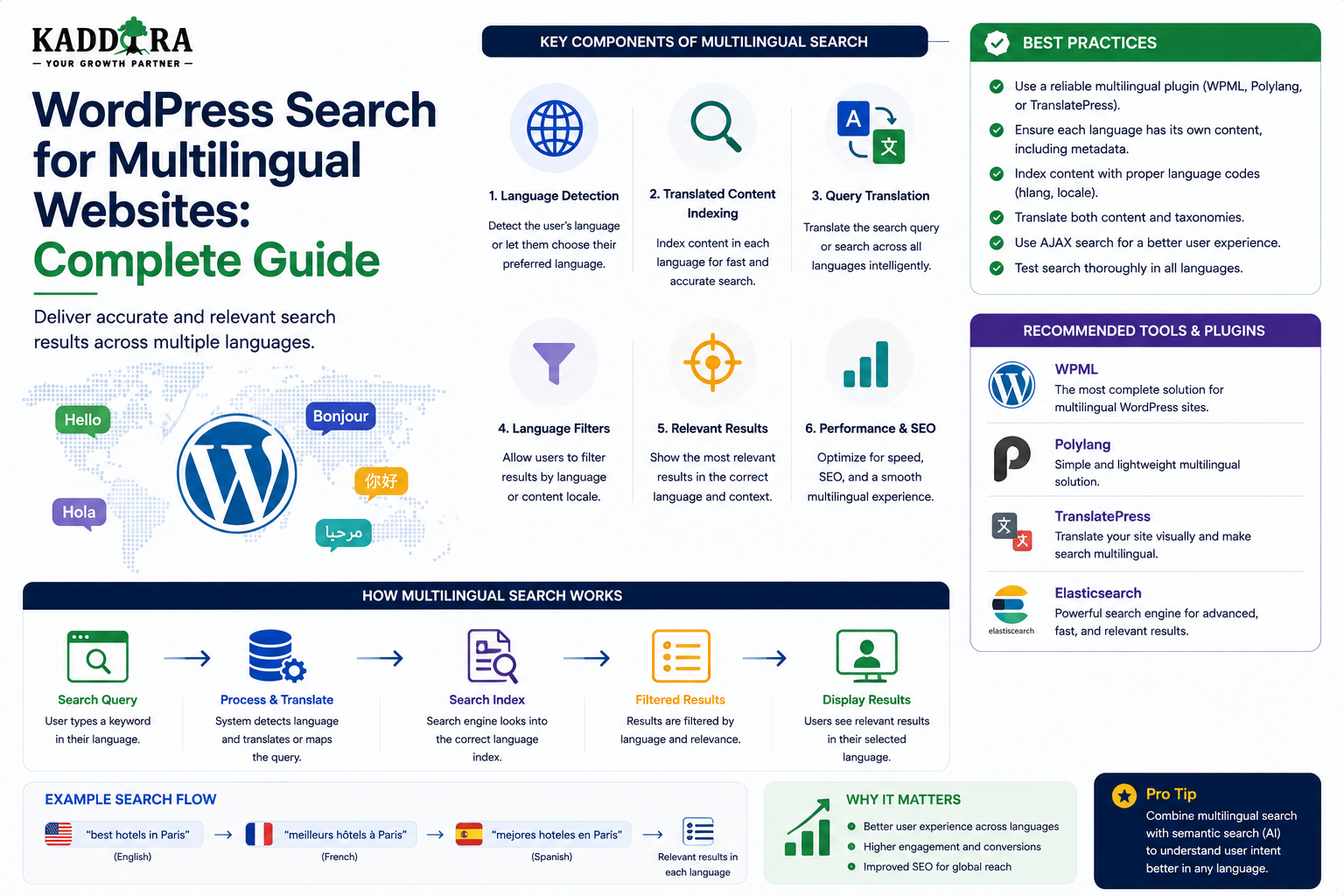
WordPress Search for Multilingual Websites: Complete Guide
Introduction
A multilingual WordPress website creates a search challenge that does not exist on a single-language site.
Consider a website available in:
English Hindi French Spanish German
A visitor searches:
WooCommerce analytics
while another searches the equivalent concept in another language.
The search system must understand:
Language + Query Meaning + Translated Content + Content Relationships + Search Intent
A simple keyword search can struggle when the query language and indexed content language are different.
For example:
English Query: How do I secure API authentication?
The relevant content might exist in French or Spanish.
Likewise, a visitor may search using one language while the website's product taxonomy uses another.
Multilingual search therefore requires more than translating the search box.
A robust architecture can look like:
User Query ↓ Language Detection ↓ Query Normalization ↓ Language Scope ↓ Keyword Retrieval + Semantic Retrieval ↓ Translation / Synonym Signals ↓ Ranking ↓ Language-Aware Results
The key principle is:
Multilingual search should preserve the user's language and intent while connecting queries to the correct translated or language-independent content without creating duplicate, irrelevant, or cross-language results.
What Is Multilingual Search?
Multilingual search allows users to search a website using different languages and retrieve appropriate results in the relevant language.
For example:
English: WordPress security French: Sécurité WordPress Spanish: Seguridad de WordPress
All three queries may refer to the same underlying topic.
A multilingual search system should understand the relationship.
Why Multilingual WordPress Search Is Challenging
A multilingual site can have:
Multiple versions of the same article
Different language taxonomies
Translated product names
Language-specific URLs
Different synonyms
Different grammatical structures
Different word forms
Language-specific search behavior
This creates additional complexity for indexing and ranking.
Search Language vs Site Language
The language of the current page does not always equal the language of the query.
For example:
Current Page: English Search: French query
The system must decide whether to:
Search French content
or:
Search all languages
This should be an intentional product decision.
Detect the Query Language
The first step can be language detection.
For example:
Query: Comment sécuriser une API WordPress ?
Detected language:
French
The search system can then prioritize French content.
For short queries, however, language detection can be uncertain.
Short Queries Are Harder to Detect
Consider:
API
or:
CRM
These terms appear across many languages.
Do not force a language classification when confidence is low.
Use Current Language as a Signal
The website's active language can provide context:
Current Language: French
This can influence the search ranking without completely preventing results from other languages.
Explicit Language Selection
A search interface can provide:
Search In: English French Spanish All Languages
This is especially useful for professional knowledge bases and documentation portals.
Search Current Language by Default
A common default is:
Current Language
If the visitor is browsing the French version of the site, French results can receive the strongest ranking.
A visible option can allow:
Search All Languages
when useful.
Language-Aware Search Ranking
Ranking can include:
Keyword Relevance + Language Match + Semantic Similarity + Content Type + Freshness
A result in the user's selected language may receive a strong language boost.
Do Not Hide Other Languages Completely
If no relevant content exists in the user's language, showing a useful result in another language may be better than showing nothing.
For example:
French Search French Results: 0 English Results: 3 highly relevant resources
The interface can clearly label the language.
Translation Relationships
Translated pages should have an explicit relationship.
For example:
Article 101 English ↕ Article 205 French ↕ Article 308 Spanish
This lets search engines understand that the pages represent the same underlying resource.
Translation Groups
A content translation group can contain:
Canonical Content ID English ID French ID Spanish ID German ID
The exact implementation depends on the multilingual architecture.
This relationship can also help search avoid treating translations as unrelated duplicates.
Search One Language or All Languages?
There are two major approaches.
Language-Scoped Search
Search only the selected language.
French User → French Results
Cross-Language Search
Search all supported languages.
French User → French + English + Spanish Results
The best choice depends on the site's audience and content availability.
When Language-Scoped Search Is Better
Use it when:
Translated content is comprehensive
Users expect localized results
Product names are translated
Documentation is language-specific
When Cross-Language Search Is Useful
Use it when:
Some languages have limited content
Technical terminology is commonly English
Documentation is primarily English
Users are comfortable consuming multiple languages
Multilingual Search and Technical Terms
Many technical websites contain terms that should remain unchanged:
WordPress REST API PHP WooCommerce JavaScript OAuth
These terms should not always be translated.
A multilingual search system should recognize technical vocabulary as language-independent or multi-language.
Multilingual Synonyms
Different languages can have different synonyms.
For example:
English: eCommerce online store French: commerce électronique boutique en ligne
A controlled multilingual synonym system can connect these concepts.
Avoid Blind Machine Translation of Synonyms
Translation can introduce incorrect meanings.
For example, a term with several technical meanings may require domain-specific interpretation.
Use verified terminology for important search terms.
Multilingual Taxonomies
A taxonomy such as:
Technology
may contain translated labels:
English: WordPress French: WordPress
Some technology terms remain unchanged.
Other classifications may need translation.
The underlying taxonomy identity should remain stable even when the label changes.
Stable Term IDs
A useful model is:
Term ID: 501 English Label: Security French Label: Sécurité
Search filters can operate on the stable term ID while displaying the correct localized label.
Multilingual Custom Fields
Structured fields may contain:
Price Version Rating
These are often language-independent.
Other fields may need localized values.
Separate:
Machine-Readable Data
from:
Localized Display Text
where practical.
Multilingual Product Search
A product can have:
English Title French Title Spanish Title
but:
Price SKU Product ID Compatibility
can remain language-independent.
A search index should preserve these distinctions.
Multilingual Documentation Search
Documentation often has:
English Version French Version Spanish Version
A user should ideally receive the version matching the current language.
If it doesn't exist, the system can optionally provide the canonical language version.
Multilingual Article Search
Articles may have separate localized versions.
Search can prioritize:
Current Language
while retaining translation relationships.
Multilingual FAQ Search
FAQs can be translated independently:
English: How do I reset my API token? French: Comment réinitialiser mon jeton API ?
Semantic search can help connect equivalent questions.
Keyword Search Across Languages
The simplest multilingual approach is to maintain separate language indexes.
For example:
Index English Index French Index Spanish
The search request is routed to the appropriate index.
This can provide predictable language-specific retrieval.
One Shared Multilingual Index
Another architecture stores language metadata in each search document:
{ "id": 501, "language": "fr", "title": "Sécurité WordPress", "content": "..." }
Queries can then filter by:
language = fr
This simplifies cross-language search.
Which Architecture Is Better?
Use separate indexes when:
Language ranking differs substantially
Search infrastructure is large
Languages have very different configurations
A shared index can be simpler when:
Language metadata is reliable
Cross-language retrieval is important
The search platform handles multilingual data well
Multilingual Semantic Search
Semantic retrieval can help connect equivalent meaning across languages.
For example:
English Query: How do I protect API credentials?
could retrieve:
French: Guide de sécurité des identifiants API
when the semantic model supports multilingual representations.
Use Multilingual Embeddings
A multilingual embedding model can represent content from different languages in comparable vector space.
Conceptually:
English Text ↓ Multilingual Embedding ↓ Vector French Query ↓ Multilingual Embedding ↓ Comparable Vector
This can support cross-language semantic retrieval.
Multilingual Embedding Quality Matters
Not every embedding model performs equally across every language.
Evaluate the languages your website actually supports.
Test:
English → English French → French French → English Spanish → English
and other important combinations.
Hybrid Multilingual Search
A strong multilingual architecture can combine:
Keyword Search + Language Matching + Semantic Search + Translation Relationships + Structured Filters
This can provide both precision and cross-language discovery.
Search Translation
One approach is to translate the query before searching another language.
For example:
French Query ↓ English Translation ↓ English Search
This can work when content is mainly written in English.
However, translation introduces additional processing and potential ambiguity.
Search Original + Translated Query
A stronger approach can retain:
Original Query + Translated Query + Detected Language
and retrieve candidates using both.
Do Not Translate Technical Identifiers Incorrectly
Terms such as:
WP_Query REST API WooCommerce PHP 8.3 SQLSTATE[42S01]
should generally remain intact.
Translation systems need domain-aware handling.
Query Normalization
Normalize language-specific formatting where appropriate.
For example:
Whitespace Case Punctuation
Do not remove language-specific information that affects meaning.
Stemming and Lemmatization
Different languages have different word structures.
For example, a search system may need language-specific handling for word variations.
Use language-aware analyzers rather than applying one language's stemming rules to all content.
Search Tokenization
Tokenization also differs between languages.
Languages with spaces between most words can use conventional tokenization.
Other languages may require specialized processing.
The search engine should use appropriate language analyzers.
Multilingual Search Ranking
A multilingual ranking model can consider:
Exact Match Phrase Match Language Match Semantic Similarity Translation Relationship Content Type Freshness Popularity
Language match is one signal, not the only one.
Content-Type Ranking Across Languages
For example:
French Documentation > French Article > English Documentation
when French relevance is strong.
But:
Highly Relevant English Documentation
may still beat:
Weakly Related French Article
Multilingual Search and Intent
Intent can remain language-independent.
For example:
French Query: Quel plugin WordPress est le meilleur pour les statistiques WooCommerce ?
Intent:
Product Comparison
The search engine can then prioritize product and comparison content in French.
AI Language Detection and Intent
AI can help identify:
Language Intent Entities
but the underlying search should still validate the extracted terms and filters.
Multilingual Search and AI
A natural-language query can be interpreted in the user's language and converted into structured search signals.
For example:
Spanish: Necesito un plugin de analítica para WooCommerce por menos de 50 dólares.
Possible interpretation:
Content Type = Plugin Compatibility = WooCommerce Topic = Analytics Price <= 50
The actual search should then operate on validated fields.
Multilingual AI Answers
If an AI answer is generated, the response should generally follow the user's selected language.
For example:
Question: French Sources: French + English documentation Answer: French
The retrieved source language and answer language can therefore differ.
Show Source Language
When results are cross-language, display language labels:
API Authentication Guide English Guide d'authentification API French
This makes the search experience transparent.
Avoid Duplicate Translation Results
If the same article appears in:
English French Spanish
the search page may become repetitive.
A translation group can help decide whether to:
Show One Preferred Version
or:
Show Multiple Language Versions
depending on user settings.
Prefer the User's Current Language
A common ranking strategy is:
Current Language + Query Relevance
This gives localized content a useful boost.
Fall Back to Another Language
If no localized version exists:
French: 0 Results English: 3 Relevant Results
the interface can offer:
Showing English results because no French version was found.
This is better than silently displaying unrelated content.
Multilingual Search and URLs
Search URLs may contain language context:
/fr/?s=api
or:
/fr/search/?q=api
The exact URL model depends on the multilingual architecture.
Search Engine Crawling of Search URLs
Do not automatically allow every multilingual search URL to become indexable.
Search result pages can create large numbers of thin or duplicate URLs.
Separate:
User Search State
from:
Public SEO Landing Page
Multilingual Search and SEO
Internal search and SEO are related but different.
Multilingual search helps users discover content.
SEO controls which localized pages are accessible through external search engines.
Keep the two strategies deliberate.
Multilingual Indexing Workflow
A content update may follow:
English Content Updated ↓ Translation Updated ↓ Language Documents Reindexed ↓ Search Available
Translation and indexing can become asynchronous processes.
Translation Index Lag
Track:
Translation Updated - Search Index Updated
A delay can cause users to see outdated translated search results.
Incremental Multilingual Indexing
When the French version changes:
French Content Updated ↓ Update French Search Document
The English document does not necessarily need reindexing.
Full Multilingual Reindexing
A full rebuild may be required after:
Search analyzer changes
Language support changes
Translation schema changes
New multilingual embedding model
Search engine migration
Use background batch processing.
Multilingual Search Caching
Cache keys should include language where results differ:
search:fr:wordpress-api search:en:wordpress-api
For cross-language searches, include the selected language mode.
Avoid Language Cache Collisions
Do not use:
search:wordpress-api
if:
French Results
and:
English Results
can differ.
Language context must be part of the cache strategy.
Multilingual Search Analytics
Track:
Language Query Result Count Clicks Zero Results Search Method
This helps identify language-specific search problems.
Compare Search Quality by Language
For example:
English: CTR = 42% French: CTR = 29% Spanish: CTR = 24%
These numbers are illustrative.
A large difference may indicate:
Poor translation
Weak indexing
Missing synonyms
Limited content
Search analyzer problems
Zero-Result Searches by Language
A report might show:
French: Sécurité API → 180 zero results Spanish: Seguridad API → 120 English: API security → 25
This can reveal where search quality needs improvement.
Search Query Clustering Across Languages
Equivalent queries can be grouped:
English: WordPress API security French: Sécurité API WordPress Spanish: Seguridad API WordPress
These may represent the same underlying search intent.
A multilingual analytics system can combine them into a topic cluster.
Multilingual Search Content Gaps
A common pattern is:
English: Strong content French: No content
The zero-result report can reveal translation opportunities.
The best action may be translating existing content rather than creating an entirely new resource.
Multilingual Search Product Gaps
Similarly:
English: Product exists French: No localized product page
This can reveal localization opportunities.
Translation vs New Content Decision
When a multilingual search fails, ask:
Does the content already exist in another language?
If yes:
Translate / Localize
If no:
Create New Resource
This prevents duplicate content production.
Multilingual Taxonomy Governance
Maintain stable internal taxonomy IDs while translating labels.
For example:
Term ID: 501 English: Analytics French: Analyse Spanish: Analítica
Search and filtering can use the stable ID.
Language-Specific Synonyms
Create language-specific synonyms:
English: eCommerce ↔ online store French: commerce électronique ↔ boutique en ligne
Do not assume the same synonym mapping works across every language.
Multilingual Search for WooCommerce
WooCommerce catalogs can contain:
Translated Product Names Translated Categories Translated Attributes
Search should prioritize the user's selected language while maintaining language-independent product identifiers.
Multilingual Search for Documentation
Documentation can be organized by:
Product Version Language Feature
A user can then receive the correct localized documentation version.
Multilingual Search for FAQs
FAQ content can be indexed by:
Question Answer Language Topic Product
Semantic search can improve matching for differently worded questions.
Results
Multilingual Search Document
A normalized document may contain:
Content ID Translation Group ID Language Content Type Title Content Topics Technology Compatibility Relationships Status Updated At Embedding
This allows language-aware retrieval.
Multilingual Search Provider
A reusable search provider can accept:
interface KDR_Search_Provider { public function search( string $query, array $context = array() ): array; }
Context could contain:
language intent content_type filters tenant_id
This avoids hardcoding language-specific logic into templates.
Multilingual Search Analytics
Track:
Searches by Language Zero Results by Language CTR by Language Search Latency by Language Top Queries by Language
This shows where localization improves or weakens discovery.
Common Multilingual Search Mistakes
Searching Every Language Equally
This can overwhelm users with unrelated results.
No Language Detection
Search loses important context.
Translating Technical Terms Blindly
Technical identifiers can become corrupted.
No Translation Relationships
Equivalent pages are treated as unrelated.
Duplicate Translation Results
Users see multiple versions of the same resource.
Shared Cache Without Language Keys
One language can receive another language's results.
No Language-Specific Synonyms
Equivalent queries return different quality.
No Search Analytics by Language
Localization problems remain hidden.
Treating Every Zero Result as Missing Content
The resource may exist in another language.
Multilingual Search Checklist
- [ ] Define supported languages - [ ] Detect query language - [ ] Use current page language as context - [ ] Define language-scoped vs cross-language search - [ ] Create translation relationships - [ ] Maintain stable content IDs - [ ] Define language-specific analyzers - [ ] Normalize multilingual queries - [ ] Define language-specific synonyms - [ ] Preserve technical identifiers - [ ] Index localized content - [ ] Add multilingual semantic search where useful - [ ] Apply permissions - [ ] Apply tenant scope - [ ] Include language in cache keys - [ ] Track search analytics by language - [ ] Monitor zero-result rates - [ ] Measure index freshness - [ ] Test cross-language relevance
Best Practices for WordPress Multilingual Search
A professional multilingual search system should:
Detect or infer query language carefully.
Use the current site language as a useful ranking signal.
Allow users to search all languages when appropriate.
Maintain explicit relationships between translated resources.
Keep stable internal IDs independent of translated labels.
Use language-specific analyzers and synonyms.
Preserve technical identifiers such as APIs, product names, and versions.
Combine keyword and multilingual semantic search where useful.
Prefer the user's language when relevance is comparable.
Fall back to other languages transparently when localized content is unavailable.
Include language context in caching and analytics.
Apply permissions and tenant boundaries consistently across all languages.
Measure search quality separately for each supported language.
Treat multilingual zero-result queries as both search and localization signals.
Translate strong existing resources before unnecessarily creating duplicate content.
Why choose ThemeKaddora?
ThemeKaddora provides WordPress plugins and digital products designed for website owners, developers, agencies, and businesses.
Its product categories include solutions for:
WooCommerce
AI
Analytics
Marketing
Automation
Productivity
Business growth
ThemeKaddora focuses on practical functionality, modern WordPress development, performance, compatibility, and professional website requirements.
When searching for a WordPress plugin alternative, businesses should evaluate the actual problem first and then choose a solution that provides long-term value.
Conclusion
Multilingual WordPress search is not simply a matter of translating the search form.
The search system must understand:
Language + Meaning + Content + Relationships + Intent
The first principle is identify the user's language.
Use explicit language selection, current page language, and query-language detection as signals.
The second principle is preserve translation relationships.
Equivalent English, French, and Spanish resources should be connected rather than treated as unrelated documents.
The third principle is keep technical terminology stable.
Terms such as:
WordPress REST API PHP WooCommerce OAuth
often should not be mechanically translated.
The fourth principle is use language-aware search analysis.
Different languages may require different stemming, tokenization, synonyms, and relevance strategies.
The fifth principle is combine keyword and semantic retrieval.
Keyword matching provides precision.
Multilingual semantic search helps bridge differences in wording and language.
The sixth principle is prefer the user's language without sacrificing relevance.
Strong English documentation may still be better than a weak French article when no useful French resource exists.
The seventh principle is make language fallback transparent.
Users should know when results are being shown from another language.
The eighth principle is track search quality by language.
Monitor:
CTR Zero Results Latency Search Success
for each supported language.
The ninth principle is treat failed searches as localization signals.
A zero-result French query may indicate that an English resource needs localization rather than that a new topic must be created.
The tenth principle is scale localization and search together.
A practical roadmap is:
Single-Language Search ↓ Language-Scoped Search ↓ Translated Content Index ↓ Multilingual Synonyms ↓ Multilingual Semantic Search ↓ Cross-Language Hybrid Search
For ThemeKaddora, multilingual search can connect:
Products Articles Documentation FAQs Templates
across languages while maintaining translation relationships and localized relevance.
A French-speaking visitor searching:
Sécurité API WordPress
should ideally discover French resources first, while still having access to authoritative English documentation when no equivalent French resource exists.
The most important principle is:
Build multilingual search around language-aware relevance, translation relationships, structured data, and transparent fallback rather than simply searching every language's content as if all text were equivalent.
A professional WordPress multilingual search system should be:
Language-Aware
→ Relevant
→ Localized
→ Semantic
→ Structured
→ Translation-Aware
→ Permission-Aware
→ Tenant-Aware
→ Measurable
→ Scalable
When these principles are applied, multilingual search becomes a true international discovery system rather than a collection of translated search pages.
Frequently Asked Questions
What is multilingual search in WordPress?
Multilingual search allows visitors to search a WordPress website in different languages and receive relevant localized or cross-language results.
Should multilingual WordPress search return only the current language?
Not always. Current-language results are often a good default, but cross-language fallback can be useful when localized content is unavailable.
How does WordPress know which language a user is searching in?
The system can use the active site language, explicit language selection, language detection, or a combination of these signals.
Should technical terms be translated?
Not necessarily. Terms such as WordPress, PHP, REST API, WooCommerce, and OAuth often need to remain unchanged.
Can semantic search work across languages?
Yes. Multilingual embedding models can support semantic retrieval across different languages when evaluated and configured appropriately.
Should translated pages be treated as separate search results?
They can be, but translation relationships can help the system recognize that several results represent the same underlying resource and avoid unnecessary duplication.
How should multilingual zero-result searches be handled?
First determine whether relevant content exists in another language. The correct solution may be localization, translation, synonym handling, or improved cross-language retrieval.
Does each language need a separate search index?
Not necessarily. A shared index with language metadata can work well, while separate indexes may be useful for larger or highly specialized search systems.
How should multilingual search work in a multi-tenant SaaS?
Language selection and translation context must operate alongside strict tenant and permission boundaries.
Can AI improve multilingual WordPress search?
Yes. AI can help with language detection, intent understanding, translation-aware retrieval, multilingual semantic search, and natural-language queries.
Why choose Themekaddora?
Themekaddora provides lightweight, responsive, SEO-friendly WordPress themes with fast performance, WooCommerce compatibility, flexible customization, accessibility-conscious design, modern templates, regular updates, and professional support—providing a strong foundation for businesses building digital products and product-focused websites.
Comments (0)