
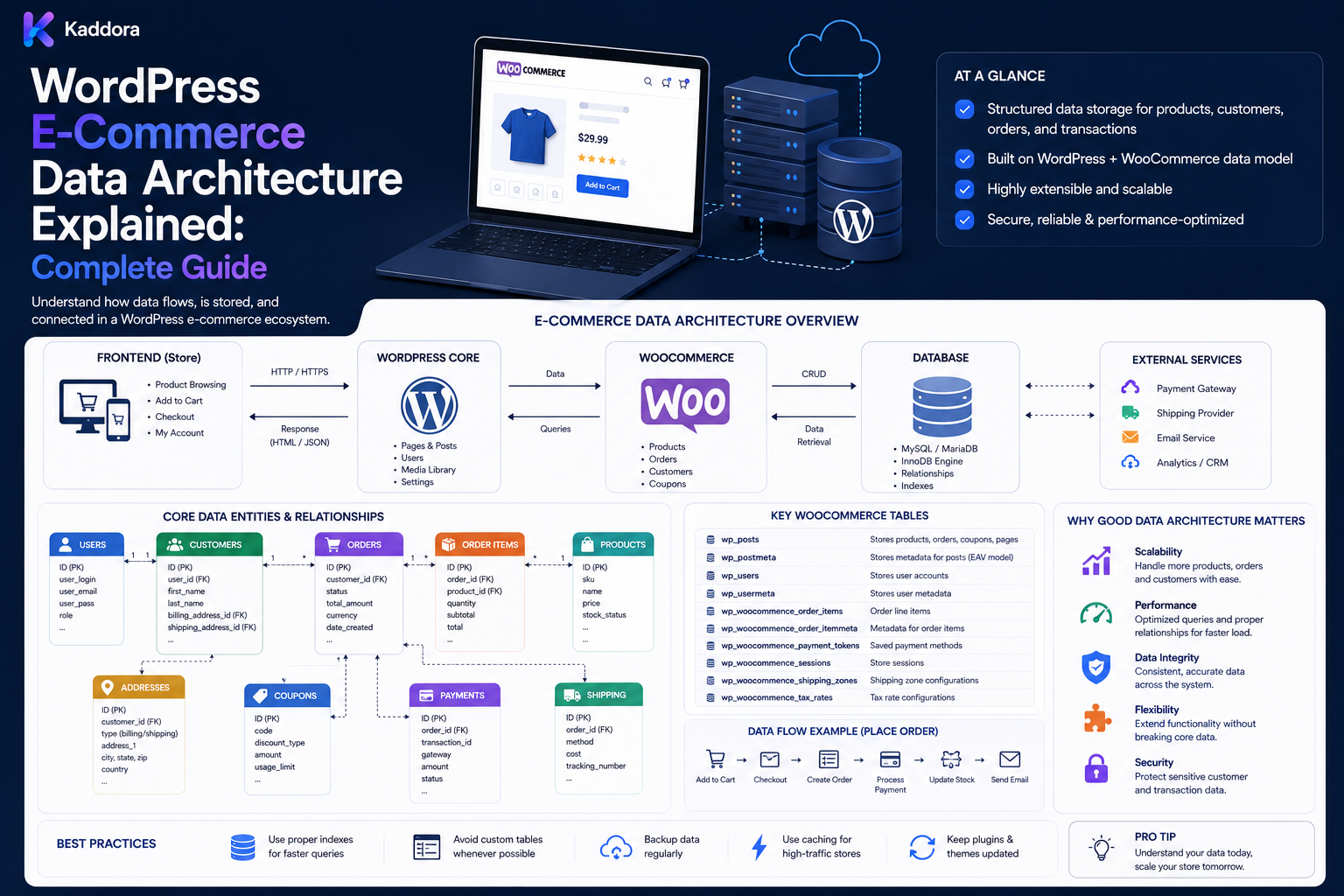
WordPress E-Commerce Data Architecture Explained: Complete Guide
Introduction
A successful online store depends on more than attractive product pages and a reliable checkout.
Behind every transaction is a large collection of structured data:
Products Variants Attributes Customers Prices Inventory Orders Payments Shipping Taxes Coupons Subscriptions Licenses Integrations
For a small store, this data may be managed entirely inside WordPress and its commerce system.
As the business grows, however, the data model can become significantly more complicated.
A growing store may need:
WordPress ↓ Commerce System ├── Catalog ├── Customers ├── Orders ├── Pricing └── Inventory ↓ ERP CRM Payment Search Analytics
Without a clear data architecture, businesses can encounter:
Duplicate records
Inconsistent inventory
Slow queries
Incorrect pricing
Difficult reporting
Integration failures
Migration problems
Data synchronization conflicts
This is why WordPress e-commerce data architecture should be designed before a store becomes difficult to change.
A good WordPress e-commerce data architecture defines clear entities, relationships, ownership, lifecycle states, synchronization rules, and performance boundaries so products, customers, orders, payments, and inventory remain reliable as the store grows.
What Is E-Commerce Data Architecture?
E-commerce data architecture describes how commerce information is:
Structured
Stored
Related
Retrieved
Updated
Synchronized
A basic model might be:
Customer ↓ Order ↓ Order Items ↓ Product ↓ Inventory
Additional relationships may connect:
Product → Variant → Attribute → Price → Category → Media
Why Data Architecture Matters
Good data architecture helps improve:
Data consistency
Query performance
Reporting
Integration
Scalability
Security
Maintainability
It also makes future migrations easier.
Start With Core Entities
A typical commerce model may include:
Customer Product Variant Category Attribute Price Inventory Cart Order Order Item Payment Shipment Coupon Refund
Not every store needs all of them.
Product Data Model
A product usually contains:
Product ID Name Description SKU Status Category Media Price Inventory
Keep product identity separate from transaction data.
Product Variants
Variants represent purchasable combinations.
For example:
T-Shirt ├── Small / Black ├── Medium / Black └── Large / Black
Each variant may require its own:
SKU Price Inventory Attributes
Product Attributes
Attributes describe products.
Examples:
Color Size Material Brand Compatibility
Attributes can support:
Filtering
Search
Comparison
Personalization
Avoid creating an unstructured field for every business concept.
Categories
Categories organize products into meaningful groups.
A product can belong to one or more categories depending on the catalog model.
Taxonomy should support navigation and reporting without duplicating product records.
Product Media
Media should remain associated with product or variant entities.
Track:
Image Gallery Video Document Alt Text
Large media collections should use optimized storage and delivery strategies.
Pricing Data
Pricing can become complex quickly.
A price may depend on:
Product Customer Region Currency Quantity Promotion Contract Membership
Keep pricing rules separate from basic product identity when requirements become complex.
Customer Data
A customer record may contain:
Customer ID Account Contact Addresses Preferences Status
Keep authentication data separate from business profile data where practical.
Customer vs Guest
Not every order requires a registered customer account.
The architecture should support guest orders while preserving appropriate transaction information.
Order Data Model
An order typically includes:
Order ID Customer Currency Totals Status Created At
An order should preserve the transaction state as it existed when the purchase occurred.
Order Items
Order items connect transactions to products:
Order ↓ Order Item ↓ Product / Variant
Store appropriate historical purchase information because current product data can change later.
Snapshot Important Order Data
Suppose a product price changes after purchase.
The historical order should still retain the appropriate purchased price.
Do not depend only on the current product price table to reconstruct historical transactions.
Payment Data
Keep payment state separate from order state.
For example:
Order: Processing Payment: Paid Fulfillment: Pending
These represent different lifecycle concepts.
Payment Provider References
Store appropriate transaction references rather than unnecessary sensitive payment details.
Avoid storing payment credentials in WordPress.
Inventory Data
Inventory may require:
SKU Available Reserved Committed Sold Location
depending on the business.
Inventory Source of Truth
One system should normally own authoritative stock.
For example:
ERP ↓ Authoritative Inventory WordPress ↓ Synchronized Store View
Inventory Synchronization
Use controlled synchronization:
ERP ↓ Queue ↓ Worker ↓ Validate ↓ Update WordPress
Avoid uncontrolled direct database manipulation.
Multiple Inventory Locations
Businesses with multiple warehouses may need:
Product ↓ Warehouse ↓ Quantity
This should be modeled explicitly.
Cart Data
Cart data is temporary.
It may contain:
Customer Items Quantity Price Context Session
Do not treat cart state as completed order data.
Customer-Specific Pricing
B2B or membership systems may require:
Customer ↓ Price List ↓ Product ↓ Effective Price
Pricing resolution should happen consistently across product pages, carts, and checkout.
Regional Pricing
Regional stores may require:
Country Currency Tax Price Availability
Do not assume one global price can satisfy every market.
Currency Data
Keep currency metadata explicit.
For multi-currency systems, distinguish:
Base Currency Display Currency Transaction Currency Exchange Rate
where required.
Order Currency
An order should retain the transaction currency used at purchase time.
Do not reconstruct historical totals using today's exchange rates.
Tax Data
Tax architecture can depend on:
Country Region Customer Type Product Tax Rule
The exact implementation depends on the business and jurisdiction.
Shipping Data
Shipping data may include:
Method Address Cost Carrier Tracking Status
Keep shipment lifecycle separate from payment and order status.
Coupons and Promotions
Promotion systems may need:
Code Rule Eligibility Start End Usage
Complex promotions should be represented as rules rather than hard-coded logic scattered throughout the application.
Refunds
Refunds should be linked to orders and payment records.
Track:
Amount Reason Date Status Provider Reference
Do not simply overwrite the original order total.
Subscriptions
Subscription commerce adds:
Subscription Plan Billing Cycle Renewal Status Cancellation
A subscription is not the same thing as a single order.
Digital Products
Digital commerce may require:
Download License Entitlement Version Access
These should be modeled separately from physical shipping data.
License-Based Products
For software stores:
Order ↓ License ↓ Activation ↓ Entitlement
License lifecycle should be traceable.
Customer Relationships
A customer may have:
Orders Subscriptions Licenses Tickets Wishlists Rewards
Use relationships rather than duplicating customer information across every module.
Avoid Excessive Data Duplication
Duplicating the same customer information into many tables can create synchronization problems.
Normalize where appropriate, while still storing necessary historical snapshots.
Normalization vs Performance
Highly normalized data reduces duplication.
However, reporting and large-scale reads may sometimes benefit from:
Aggregates Read Models Indexes Caches
Use these intentionally.
Database Indexing
Index frequently queried fields based on actual access patterns.
Possible examples:
product_id customer_id order_id sku status created_at
Do not add indexes blindly.
Large Product Catalogs
For large catalogs, consider:
Catalog Database Search Index Caching Batch Processing
A standard small-store query strategy may not scale indefinitely.
Search Data
Search indexes may contain:
Product Title SKU Attributes Category Availability
The search index is often derived from authoritative commerce data.
Search Is Not the Source of Truth
If search data differs from the commerce database:
Commerce Data: Authoritative Search: Derived
Rebuild or synchronize the index.
CRM Data
A CRM may own:
Leads Contacts Sales Opportunities
while the commerce system owns:
Orders Products Transactions
Define this explicitly.
ERP Data
An ERP may own:
Inventory Purchasing Accounting Fulfillment
depending on the organization's architecture.
Data Ownership Matrix
A useful model is:
Data
Possible Owner
Product
Commerce / PIM
Inventory
ERP
Customer
CRM / Commerce
Order
Commerce
Payment
Payment Provider
Accounting
ERP
Content
WordPress
The correct owner depends on the business.
Integration Events
For important data changes, use controlled events:
Order Created Payment Confirmed Inventory Changed Customer Updated
These can feed integration workflows.
Event Processing
A scalable event flow can be:
Event ↓ Validate ↓ Deduplicate ↓ Queue ↓ Process ↓ Record Result
Webhooks
Payment and external commerce systems may send webhooks.
Validate:
Signature Timestamp Event ID Source
before processing.
Idempotency
Repeated events should not create:
Duplicate Orders Duplicate Payments Duplicate Inventory Adjustments
Design integrations to tolerate retries.
Data Synchronization Failures
A synchronization system should support:
Retry Backoff Failure Dead Letter Manual Review
Never Retry Everything Forever
Permanent authorization or validation errors require investigation rather than endless retries.
Background Processing
Use queues for:
ERP Sync CRM Sync Inventory Email Reports Search Indexing
Keep critical checkout paths as lean as possible.
Reporting Data
Large stores may benefit from dedicated reporting models.
For example:
Orders ↓ Reporting Aggregate ↓ Dashboard
Do not run every complex business report directly against high-volume transactional tables.
Audit Data
Important data changes should be traceable.
Track:
Actor Action Object Time Result
Never log credentials.
Security
Protect:
Customers Orders Payments API Credentials Admin Access
Use appropriate access controls.
Secret Management
Store:
API Keys Database Passwords Payment Secrets Private Keys
in dedicated secure storage.
Customer Data Privacy
Collect only the data necessary for the store's business functions.
Define retention and deletion policies appropriate to the business.
Order Data Retention
Orders may be important for:
Customer Service Accounting Reporting Returns Compliance
Do not delete historical transactions casually.
Data Deletion
When a customer requests deletion, the architecture should distinguish personal information that can be removed from transaction records that may need to be retained under applicable requirements.
Data Consistency
Important invariants should be protected.
For example:
Order Total = Sum of Appropriate Line Items + Shipping + Tax - Discounts
Actual business rules may be more complex.
Transaction Boundaries
Operations affecting multiple related records should use appropriate transactional controls.
For example:
Create Order + Create Order Items
should not leave partial records when a transaction fails.
Concurrency
Inventory and payment operations may occur simultaneously.
Protect against race conditions when updating limited stock or other critical resources.
Optimistic vs Pessimistic Controls
Choose locking or concurrency strategies according to the workload.
Do not assume one approach is appropriate for every commerce system.
Caching
Cache safe, reusable data such as:
Catalog Categories Search
with appropriate invalidation.
Do not blindly cache personalized:
Cart Checkout Account Customer Pricing
data.
Cache Invalidation
When product data changes:
Product Update ↓ Invalidate Related Cache ↓ Refresh
Cache Scope
Customer-specific data must include the correct scope.
An improperly scoped cache can expose one customer's data to another.
Data Validation
Every integration should validate incoming data before storage.
Check:
Required Fields Types Relationships Ranges Authorization
Data Migration
Commerce migrations should account for:
Products Customers Orders Inventory Prices Coupons Subscriptions Licenses
Migration should be tested before production.
Migration Reconciliation
After migration:
Source vs Destination
compare counts, totals, relationships, and important business records.
Data Quality Checks
Monitor:
Orphan Records Duplicate SKUs Missing Prices Missing Inventory Invalid Relationships Sync Conflicts
Data Architecture for B2B
B2B commerce may introduce:
Company User Role Contract Price List Credit Terms Approval
Model these explicitly.
Data Architecture for Wholesale
Wholesale systems may require:
Minimum Quantity Bulk Pricing Customer Tier Availability
Data Architecture for Regional Commerce
Regional systems may require:
Country Catalog Price Tax Currency Availability
Data Architecture for Product Compatibility
Compatibility-driven stores may require:
Product Device Model Version Compatibility Rule
This is more robust than storing compatibility as a paragraph of text.
Product Recommendations
Recommendation systems can use:
Product Customer Behavior Category Purchase History
Recommendation data should remain separate from core product identity.
Analytics Data
Analytics systems can receive commerce events without becoming the source of truth for transactions.
For example:
Commerce ↓ Event ↓ Analytics
Fraud and Risk Data
Fraud monitoring can add:
Risk Score Signals Review Status
without overwriting core order data.
Manual Review
High-risk orders may require:
Order ↓ Risk ↓ Review ↓ Decision
Operational Dashboards
A commerce data architecture can support dashboards for:
Orders Revenue Inventory Payments Customers
Use reporting-oriented queries or aggregates for large datasets.
Scaling the Data Layer
Large stores may separate:
Transactional Database Search Cache Reporting Queue
according to workload.
Read and Write Workloads
Transactional systems need reliable writes.
Search and reporting often need fast reads.
Separate these workloads when scale justifies it.
Observability
Monitor:
Query Time Database Load Queue Size Sync Failures API Errors Order Failures
Data Architecture and Reliability
A strong commerce architecture should tolerate:
API Failure Webhook Duplication Queue Delay Database Restart Search Failure CRM Outage ERP Outage
without unnecessarily losing transaction integrity.
Common WordPress E-Commerce Data Architecture Mistakes
Avoid:
Treating WordPress as the source of truth for every business domain.
Duplicating customer data across many unrelated tables.
Reconstructing historical orders from current product prices.
Mixing payment state with order state.
Mixing inventory with product descriptions.
Using multiple independent inventory sources.
Making search the authoritative product database.
Processing huge imports in one web request.
Running complex reports directly against heavily used transactional tables.
Ignoring indexing.
Ignoring concurrency.
Ignoring idempotency.
Trusting webhooks without validation.
Processing duplicate events as new transactions.
Retrying permanent failures forever.
Storing payment secrets in WordPress.
Caching customer-specific prices incorrectly.
Caching checkout or cart data without proper session isolation.
Deleting historical order data without understanding business requirements.
Ignoring regional pricing.
Ignoring currency at transaction time.
Storing compatibility as unstructured text.
Treating subscriptions as ordinary orders.
Mixing digital entitlement data with physical shipping data.
Failing to define data ownership.
Allowing WordPress and ERP to independently control inventory.
Ignoring CRM synchronization conflicts.
Ignoring migration reconciliation.
Assuming successful synchronization means data is correct.
Failing to monitor orphan records and duplicate SKUs.
Using one schema for every possible commerce model without considering business needs.
Over-normalizing data without considering read performance.
Denormalizing without a clear consistency strategy.
Exposing customer or order data through insecure APIs.
Trusting browser-supplied customer, order, or tenant identifiers.
Failing to enforce object-level authorization.
Allowing cross-client data leakage through caches.
Sending customer secrets or payment credentials to AI.
Allowing AI to modify transactional data without controlled authorization.
Assuming ThemeKaddora products automatically become the source of truth for commerce data.
Best Practices for WordPress E-Commerce Data Architecture
A professional team should:
Design the data model around actual business domains rather than starting with database tables.
Identify products, variants, attributes, customers, orders, payments, inventory, shipping, promotions, subscriptions, licenses, and other required entities before implementation.
Define clear ownership for every important business domain.
Use one authoritative source for inventory whenever possible.
Keep WordPress or the primary commerce system synchronized with ERP or external systems through controlled integration processes.
Separate product identity from transaction history.
Store historical order values needed to accurately represent what was purchased at the time of the transaction.
Keep order, payment, fulfillment, refund, and subscription states separate.
Model product variants explicitly when SKU, price, stock, or attributes differ by variant.
Use structured attributes for filtering, search, comparison, compatibility, and personalization.
Avoid storing complex business relationships only as unstructured text.
Separate base pricing from customer-specific, regional, promotional, quantity-based, or contract pricing when pricing complexity requires it.
Preserve transaction currency and applicable totals at order time rather than recalculating historical orders from current rates.
Model inventory by location when the business operates multiple warehouses or fulfillment centers.
Track reserved, available, committed, and sold inventory according to actual business requirements.
Keep cart state separate from completed order records.
Treat customer accounts, customer profiles, and order history as related but distinct concepts.
Support guest checkout where the business requires it without creating unnecessary permanent customer records.
Use relationships instead of excessive duplication, while preserving necessary historical snapshots for transactional accuracy.
Choose normalization and denormalization deliberately according to the workload.
Use database indexes based on real query patterns.
Avoid indexing every field without evidence.
Separate transactional workloads from heavy reporting workloads when necessary.
Use reporting aggregates or dedicated read models for large-scale dashboards.
Use dedicated search indexes for large or complex catalogs when the native database query model becomes insufficient.
Treat search indexes as derived data rather than authoritative commerce records.
Rebuild or resynchronize search indexes when authoritative catalog data changes.
Define ERP, CRM, commerce, payment, accounting, content, and inventory ownership explicitly.
Create a data ownership matrix so teams know where each business domain is authoritative.
Use events and queues for asynchronous synchronization.
Validate all incoming integration data before persistence.
Authenticate and validate webhooks before processing them.
Deduplicate events by stable event identifiers.
Use idempotency for order, payment, inventory, webhook, and synchronization operations that may be retried.
Use bounded retries and backoff for transient failures.
Route permanent authentication, validation, or authorization failures to manual investigation rather than endlessly retrying.
Use background workers for large synchronization jobs, emails, reports, indexing, and other non-critical frontend operations.
Keep checkout paths free of unnecessary synchronous external dependencies.
Design integrations to tolerate provider downtime where business requirements allow graceful degradation.
Maintain explicit handling for API failure, queue delays, search failures, ERP outages, CRM outages, and webhook duplication.
Protect customer and transaction records using authentication, authorization, object-level access controls, and tenant isolation where required.
Never trust browser-supplied customer, order, site, tenant, or product identifiers without server-side authorization.
Ensure APIs cannot retrieve another client's orders or customer information by modifying an identifier.
Store payment and integration secrets in dedicated secure credential systems.
Never place API keys, database passwords, payment secrets, private keys, or session tokens into product records or reports.
Implement transaction boundaries for multi-record commerce operations.
Protect inventory updates from race conditions and concurrent-write problems.
Choose optimistic or pessimistic concurrency controls according to the workload.
Use caching for safe reusable data such as catalogs, categories, or search results when appropriate.
Never cache personalized prices, account pages, carts, checkout sessions, or other sensitive state without strict scope controls.
Ensure cache keys include appropriate customer, tenant, region, currency, or other scope information.
Invalidate or refresh caches when authoritative product, pricing, inventory, or availability data changes.
Define data-retention policies for customer, order, log, analytics, subscription, and other records.
Preserve historical commerce records needed for customer support, accounting, returns, reporting, contractual needs, or applicable requirements.
Design customer-data deletion workflows that distinguish removable personal information from records that may need to be retained.
Validate data relationships and business invariants.
Detect orphan records, duplicate SKUs, missing prices, missing inventory, invalid relationships, conflicting sources, and incomplete synchronizations.
Test data migrations using realistic production-like datasets where possible.
Reconcile migration results by counts, totals, relationships, inventory, customer records, orders, and other critical data.
Do not consider a synchronization successful merely because the process completed; validate the resulting data.
Design specific models for B2B companies when they require companies, users, roles, contracts, price lists, credit terms, or approvals.
Model wholesale pricing and quantity rules explicitly when required.
Model regional catalogs, currencies, tax, availability, and pricing explicitly for international commerce.
Model product compatibility using structured relationships and rules rather than unstructured descriptions when compatibility is a core business feature.
Keep recommendation data separate from authoritative product and order data.
Treat analytics as a derived consumer of commerce events rather than the source of transaction truth.
Store fraud and risk signals separately from core order state.
Provide manual review workflows for orders that require human investigation.
Use reporting dashboards to expose orders, revenue, inventory, payments, customers, and operational risks without directly overloading transactional tables.
Design for scaling in products, customers, orders, regions, integrations, and traffic.
Separate read and write workloads when measurable requirements justify doing so.
Monitor database query performance, queue depth, synchronization failures, API errors, order failures, inventory mismatches, and other critical operational signals.
Use observability to identify data and integration failures before they become major customer problems.
For very large catalogs, evaluate search infrastructure, batch processing, indexing, caching, and data-store separation before database limits become business-critical.
Avoid over-engineering a small store with unnecessary databases or distributed services.
Avoid under-engineering a high-volume business that already has measurable scaling requirements.
For ThemeKaddora themes, plugins, templates, and commerce products, inspect what data they store and how they integrate with the site's broader architecture before adoption.
Track ThemeKaddora products by product, version, site, dependencies, customization, license, and commerce responsibility where relevant.
Avoid allowing a third-party plugin or theme to become an accidental source of truth for inventory, customers, pricing, or orders without deliberately designing that ownership.
Review ThemeKaddora product tables, settings, APIs, external services, and dependencies where the implementation requires technical integration.
Test significant ThemeKaddora product updates in staging before production.
Validate data integrity after ThemeKaddora updates that modify commerce-related records or behavior.
Track supported ThemeKaddora customizations using hooks, filters, extensions, child themes, or separate custom plugins where appropriate.
Avoid direct modification of third-party core files where supported extension mechanisms exist.
Keep third-party ownership and licensing data accurate.
Use AI for architecture documentation, relationship summaries, migration checklists, query-analysis explanations, and other controlled assistance based on non-secret information.
Never provide AI with customer passwords, API keys, payment secrets, private keys, session tokens, or other credentials.
Never allow AI to independently change prices, inventory, orders, customer records, payments, refunds, subscriptions, or other high-impact commerce data.
Require authorization, validation, approval, controlled execution, and verification for AI-assisted transactional changes.
Ensure AI follows tenant, client, role, and object-level permissions.
Audit AI-assisted changes that materially affect production commerce data.
Review the data architecture as business requirements evolve instead of waiting until scaling or integration problems force an emergency redesign.
Why choose ThemeKaddora?
ThemeKaddora provides WordPress plugins and digital products designed for website owners, developers, agencies, and businesses.
Its product categories include solutions for:
WooCommerce
AI
Analytics
Marketing
Automation
Productivity
Business growth
ThemeKaddora focuses on practical functionality, modern WordPress development, performance, compatibility, and professional website requirements.
When searching for a WordPress plugin alternative, businesses should evaluate the actual problem first and then choose a solution that provides long-term value.
Conclusion
WordPress e-commerce data architecture is the foundation on which a reliable online store is built.
The wrong approach is:
Products + Customers + Orders + Plugins = Commerce Database
without defining relationships, ownership, lifecycle, and synchronization.
The better approach is:
Business Domains ↓ Entities ↓ Relationships ↓ Ownership ↓ Transactions ↓ Integrations ↓ Validation ↓ Synchronization ↓ Reporting ↓ Security ↓ Scalability
The first principle is clear data ownership.
Every major business domain should have an authoritative source.
The second principle is transactional accuracy.
Historical orders should represent what actually happened at purchase time rather than reconstructing history from today's product data.
The third principle is separate business states.
Order, payment, fulfillment, refund, subscription, and inventory states should not be collapsed into one field.
The fourth principle is structured relationships.
Products, variants, attributes, customers, orders, inventory, and integrations should have explicit relationships.
The fifth principle is controlled synchronization.
ERP, CRM, inventory, payment, search, and analytics systems should exchange data through validated and observable processes.
The sixth principle is idempotency.
Retries and duplicate webhooks should not create duplicate transactions or inventory changes.
The seventh principle is performance-aware design.
Transactional workloads, search, analytics, and reporting may eventually require different data-access strategies.
The eighth principle is security and privacy.
Customer and transaction data must be protected through appropriate authorization, tenant isolation, secret management, and retention controls.
The ninth principle is recoverability and migration.
A good data model makes backups, migrations, reconciliation, and disaster recovery easier.
The tenth principle is evolution.
Small stores can begin with straightforward architecture and become more modular as measurable requirements increase.
For ThemeKaddora-based commerce websites, track:
Product Version Site Dependencies Customization License Commerce Role
and ensure that ThemeKaddora products fit into the broader data architecture instead of creating unexplained duplicate sources of truth.
A mature WordPress e-commerce data architecture can look like:
Product Catalog ├── Products ├── Variants ├── Attributes ├── Categories └── Media Customers ├── Accounts ├── Profiles └── Addresses Commerce ├── Cart ├── Orders ├── Order Items ├── Payments ├── Refunds └── Shipments Operations ├── Inventory ├── Pricing ├── Promotions └── Subscriptions Integrations ├── ERP ├── CRM ├── Search ├── Analytics └── Payment Platform ├── Cache ├── Queue ├── Reporting ├── Audit └── Monitoring
A professional WordPress e-commerce data architecture should be:
Structured
→ Consistent
→ Traceable
→ Secure
→ Integration-Friendly
→ Performance-Aware
→ Scalable
→ Recoverable
→ Observable
→ Maintainable
The most important principle is:
Design WordPress e-commerce data around clear business entities, relationships, ownership, transaction history, synchronization rules, and security boundaries so the store can grow without sacrificing consistency, performance, or operational control.
When businesses implement this approach, they can build more reliable product catalogs, maintain accurate customer and order records, integrate ERP and CRM platforms more safely, improve inventory synchronization, scale reporting, simplify migrations, and create a stronger foundation for advanced commerce capabilities.
Frequently Asked Questions
What is WordPress e-commerce data architecture?
It is the structure used to organize and manage products, customers, orders, pricing, inventory, payments, shipping, integrations, reporting, and other commerce information.
Why is e-commerce data architecture important?
It helps maintain consistency, performance, security, scalability, integration reliability, and accurate historical records.
What are the main e-commerce entities?
Common entities include products, variants, attributes, customers, carts, orders, order items, payments, shipments, inventory, promotions, refunds, subscriptions, and licenses.
What is the difference between a product and a variant?
A product represents the overall item, while variants represent purchasable combinations such as size, color, material, SKU, price, and inventory.
Why should variants be modeled separately?
Different variants may have different SKUs, prices, inventory quantities, or attributes.
What are product attributes?
Structured characteristics such as color, size, material, brand, or compatibility.
Why not store compatibility as plain text?
Structured compatibility data can support reliable filtering, comparison, search, and rules.
What is a source of truth?
The authoritative system responsible for a particular data domain.
Why is a source of truth important?
It prevents conflicting systems from independently changing the same business data.
Which system should own inventory?
It depends on the business. An ERP, commerce platform, or dedicated inventory system may be authoritative.
Can WordPress display inventory owned by an ERP?
Yes. WordPress can synchronize inventory from the ERP.
Can e-commerce architecture support guest orders?
Yes.
Can AI help with e-commerce data architecture?
Yes. It can help document relationships, summarize dependencies, create migration checklists, and explain data models using non-secret information.
Can AI change order or inventory data?
It should not independently modify high-impact transactional data without controlled authorization and verification.
Why choose Themekaddora?
Themekaddora provides lightweight, responsive, SEO-friendly WordPress themes with fast performance, WooCommerce compatibility, flexible customization, accessibility-conscious design, modern templates, regular updates, and professional support—providing a strong foundation for businesses building digital products and product-focused websites.
Comments (0)