
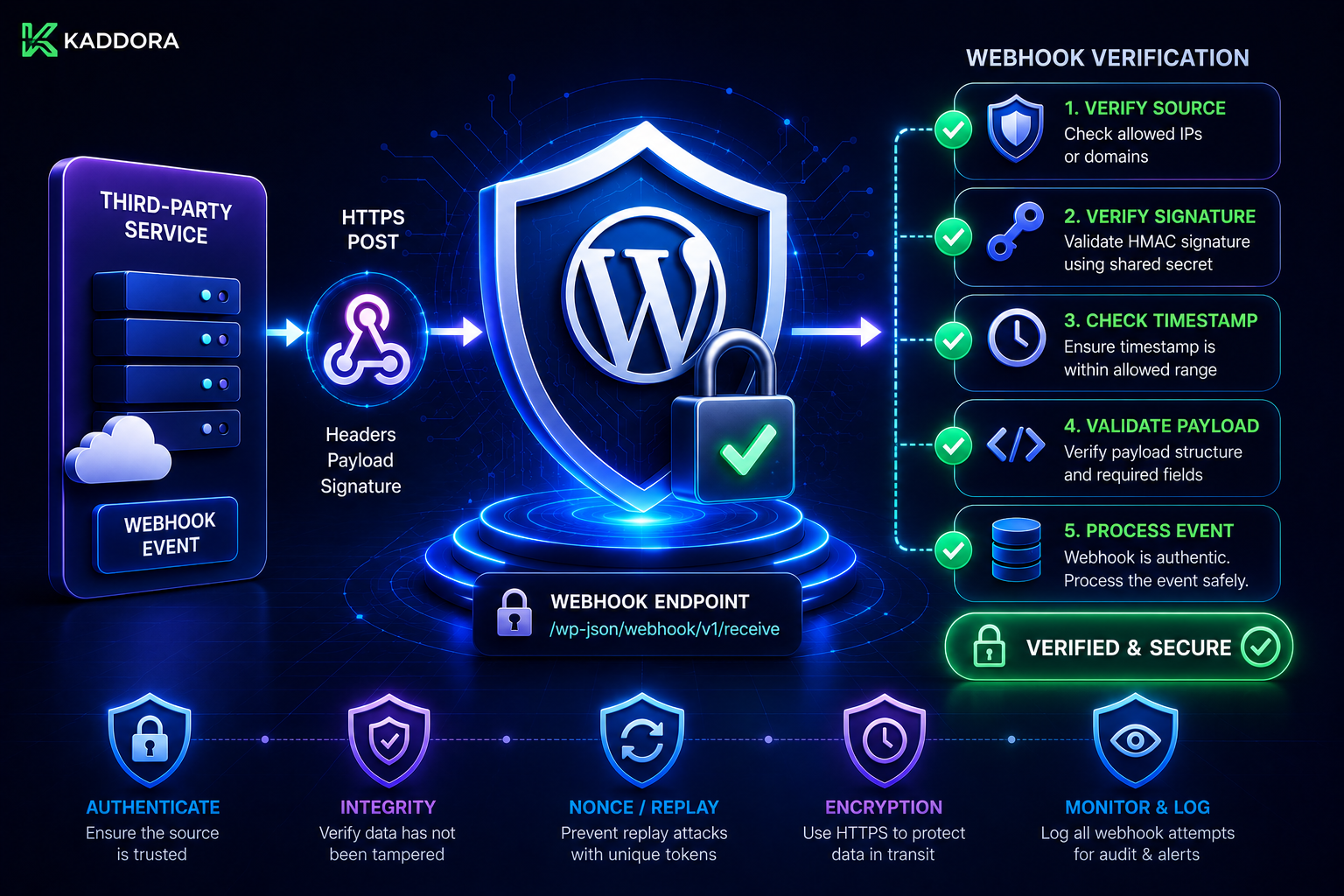
WordPress API Webhook Verification Explained: Complete Security Guide
Introduction
Modern applications increasingly use webhooks to notify WordPress when something happens in an external system.
Instead of WordPress repeatedly asking:
"Did something change?"
the external service can send:
Something Changed
directly to a WordPress endpoint.
The basic architecture is:
External Provider ↓ Webhook Request ↓ WordPress ↓ Verify ↓ Validate ↓ Process
Webhooks are useful for events such as:
Payment updates
Order changes
Subscription events
CRM changes
Inventory updates
AI job completion
Analytics events
Customer updates
SaaS notifications
Automation triggers
But a webhook endpoint is also an externally reachable entry point.
An attacker can potentially send a request that looks like:
POST /webhook
The endpoint therefore needs to answer:
Did this request actually come from the expected provider, and is it safe to process?
This is the purpose of webhook verification.
A secure webhook architecture commonly follows:
Incoming Request ↓ Identify Provider ↓ Read Raw Body ↓ Verify Signature ↓ Validate Timestamp / Replay Controls ↓ Parse JSON ↓ Validate Schema ↓ Check Event ID ↓ Store / Queue ↓ Process
The order matters.
For example, parsing and normalizing the JSON before verifying a signature can cause signature mismatches because many signature schemes are calculated over the exact raw request body.
A webhook should therefore not be treated as trusted merely because:
it came to the correct URL,
it contains valid JSON,
it includes a familiar event name,
or it says "source": "provider".
Those are data fields, not cryptographic proof.
This guide explains how webhook verification works, why raw-body handling matters, how HMAC signatures work, how to validate timestamps and event IDs, how to protect against replay attacks, how to design webhook endpoints in WordPress, how to process events asynchronously, how to prevent duplicates, how to log safely.
What Is a Webhook?
A webhook is an HTTP request sent by one system to another when an event occurs.
For example:
Customer Places Order ↓ Payment Provider ↓ Webhook ↓ WordPress
Instead of continuously polling:
WordPress ↓ "Has the order changed?"
WordPress receives the event when something happens.
Why Webhooks Are Useful
Webhooks can provide:
Near-real-time notifications
Lower polling traffic
Faster updates
Lower API usage
Simpler event-driven workflows
For example:
Payment Completed ↓ Webhook ↓ Update Local Order
can be much more efficient than continuously checking payment status.
Why Webhooks Are Security-Sensitive
A webhook endpoint is usually reachable from the public internet.
For example:
https://example.com/wp-json/kdr/v1/webhook
Anyone who knows or discovers the endpoint may attempt to send requests to it.
Therefore:
Webhook URL ≠ Trusted Request
Verification must happen before the event is accepted.
Webhook Authentication vs Validation
These are different.
Authentication / Verification
Answers:
Did the request come from a trusted source?
Validation
Answers:
Is the request structurally and semantically valid?
The correct flow is:
Verify Source ↓ Validate Data ↓ Process
Not:
Parse Data ↓ Trust Source
Common Webhook Verification Methods
Providers may use:
HMAC signatures
Signed headers
Shared secrets
Bearer tokens
Basic Authentication
Asymmetric signatures
Timestamped signatures
Provider-specific signing schemes
The provider's documentation determines the correct method.
HMAC Webhook Signatures
One of the most common approaches is HMAC.
The basic model is:
Webhook Body + Shared Secret ↓ HMAC Signature ↓ Provider
The receiving WordPress application performs the same calculation:
Raw Body + Shared Secret ↓ Expected Signature ↓ Compare
If the signatures match:
Verify
Otherwise:
Reject
Why HMAC Works
HMAC provides a way for both sides to prove knowledge of a shared secret without sending that secret as part of each webhook request.
The provider knows:
Secret
and WordPress knows:
Same Secret
An attacker who does not know the secret should not be able to generate a valid signature.
The Raw Body Is Important
This is one of the most important webhook-verification rules.
Suppose the provider calculates:
HMAC(raw_body)
WordPress must calculate the signature over the same raw bytes.
Do not first:
JSON Decode ↓ Modify Array ↓ Re-Encode JSON ↓ Verify
because the serialized representation may change.
Use the exact incoming body for signature calculation.
WordPress Raw Request Body
For REST-style endpoints, the raw body can be obtained from the incoming request.
Conceptually:
$raw_body = file_get_contents( 'php://input' );
The exact integration approach depends on how the WordPress endpoint is registered.
Do Not Use the Parsed Array for HMAC Verification
Avoid:
$data = json_decode( $body, true ); $json = wp_json_encode( $data ); $signature = hash_hmac( 'sha256', $json, $secret );
This may produce different bytes from the provider's original signed payload.
Instead:
Raw Body ↓ HMAC ↓ Verify ↓ JSON Decode
Signature Headers
Providers may place the signature in headers such as:
X-Webhook-Signature X-Signature X-Hub-Signature-256 Authorization
The exact header is provider-specific.
Never assume a universal header name.
Signature Format
A provider may send:
sha256=abcdef...
or:
timestamp=...,signature=...
or another format.
Parse according to the provider's documented specification.
HMAC Algorithm
A provider may require:
SHA-256
or another approved HMAC algorithm.
Do not substitute a different algorithm simply because it is convenient.
Constant-Time Signature Comparison
When comparing signatures, use a constant-time comparison function where appropriate.
In PHP:
hash_equals( $expected, $provided );
This helps avoid timing side-channel issues associated with naive string comparison.
Example HMAC Verification
A simplified example:
$raw_body = file_get_contents( 'php://input' ); $expected = hash_hmac( 'sha256', $raw_body, $secret ); $provided = isset( $_SERVER['HTTP_X_WEBHOOK_SIGNATURE'] ) ? trim( sanitize_text_field( wp_unslash( $_SERVER['HTTP_X_WEBHOOK_SIGNATURE'] ) ) ) : ''; if ( empty( $provided ) || ! hash_equals( $expected, $provided ) ) { return new WP_Error( 'invalid_webhook_signature', 'Webhook verification failed.' ); }
This is a simplified example.
The exact header handling and signature format depend on the provider.
Do Not Sanitize the Raw Body Before Signing
This is another important rule.
Do not perform:
Trim Normalize HTML Decode JSON Re-Encode
on the body before signature verification unless the provider's specification explicitly requires such processing.
Signatures usually depend on the exact original bytes.
Timestamps in Webhook Signatures
Some providers include a timestamp:
timestamp=1780000000
The signature may cover:
timestamp + "." + raw_body
The receiving application verifies both:
Signature + Timestamp Freshness
Why Timestamps Matter
Suppose an attacker captures a valid webhook:
Valid Request
and sends it again later:
Replay
The signature may still be valid because the body and secret have not changed.
A timestamp can limit how long a signed request remains acceptable.
Replay Attacks
A replay attack occurs when a valid request is captured and submitted again.
For example:
Provider ↓ Valid Webhook ↓ Attacker Captures ↓ Sends Same Webhook Again
Without replay protection, WordPress might process the event twice.
Timestamp Window
A common pattern is:
Current Time - Webhook Timestamp
If the difference exceeds the provider's allowed window:
Reject
Use the provider's documented tolerance rather than inventing an arbitrary value.
Clock Skew
Server clocks can differ slightly.
A verification window should therefore account for reasonable clock skew while still limiting replay opportunities.
A reliable server time source and monitoring are important.
Event IDs
Providers often include a unique event ID:
event_id = evt_12345
Store this identifier after verification.
Then:
Same Event Again ↓ Already Processed ↓ Do Not Process Twice
This is a powerful duplicate-protection mechanism.
Webhook Idempotency
Webhook delivery is often at-least-once rather than exactly-once.
Therefore:
Same Event → May Arrive Multiple Times
Your processing must be idempotent.
Event Deduplication
A simple model is:
Receive Event ↓ Verify ↓ Check Event ID ├── Already Processed → Acknowledge └── New → Store + Process
Do not perform the business operation before the duplicate check when the event identifier is reliable.
Store Before Processing
A strong architecture is:
Verify Webhook ↓ Store Event ↓ Queue Processing ↓ Respond Quickly
This makes event recovery easier.
Why Queue Webhooks?
Suppose the provider sends:
Order Paid
The webhook handler could immediately:
Call CRM Call ERP Update WooCommerce Send Email Generate Invoice
This creates a long-running request.
Instead:
Webhook ↓ Verify ↓ Store ↓ Queue ↓ Respond
Then a worker performs the heavy processing.
Fast Acknowledgment
Many providers expect a successful HTTP response quickly.
The webhook handler should therefore:
Verify ↓ Persist ↓ Queue ↓ Respond
rather than waiting for unrelated external operations.
Webhook Status Codes
A provider may use:
2xx → Accepted 4xx → Rejected 5xx → Retry Later
The exact semantics depend on the provider.
Returning a 2xx before the event has been durably stored may cause data loss if the application crashes afterward.
Don't Acknowledge Before Verification
Avoid:
Webhook ↓ 200 OK ↓ Verify Later
If the provider treats 200 as successful delivery, the event may not be resent.
Verify and durably record the event first.
Don't Process Before Verification
Also avoid:
Webhook ↓ Update Order ↓ Verify Signature
The business operation should not occur until authenticity is established.
Recommended Processing Order
A strong workflow is:
1. Receive Request 2. Capture Raw Body 3. Read Required Headers 4. Verify Signature 5. Validate Timestamp 6. Parse JSON 7. Validate Schema 8. Check Event ID 9. Store Event 10. Queue Work 11. Return Success
Webhook Schema Validation
After signature verification:
JSON ↓ Expected Event Structure
For example, require:
id type created_at data
if those fields are part of the provider's documented contract.
Event Type Validation
Do not blindly process any event name received.
For example:
order.created order.updated order.deleted
The plugin should explicitly support the event types it knows how to process.
Unknown Event Types
When a provider introduces:
order.refunded_new_version
the plugin should not automatically execute unknown business logic.
Possible responses include:
Store for Inspection Ignore Safely Return Provider-Appropriate Response
The correct action depends on the provider's webhook contract.
Webhook URL Design
A webhook endpoint can use:
https://example.com/wp-json/kdr/v1/webhook/provider
Use a dedicated route and isolate provider-specific processing.
Don't Use the WordPress Login Page as a Webhook Endpoint
A webhook is server-to-server communication.
It should have its own endpoint and verification mechanism.
REST API Webhook Route
A WordPress plugin can register a REST route with register_rest_route().
Conceptually:
register_rest_route( 'kdr/v1', '/webhook/provider', array( 'methods' => 'POST', 'callback' => 'kdr_receive_webhook', 'permission_callback' => '__return_true', ) );
The endpoint may need to be publicly reachable, so cryptographic webhook verification must happen inside the callback or an appropriate request-validation layer.
Use the smallest practical route exposure and verify every request.
Public Endpoint Does Not Mean Unverified Endpoint
A webhook endpoint may intentionally be public at the network level:
Internet ↓ Webhook Endpoint
but application-level verification must determine whether the request is authentic.
Webhook Tokens
Some providers use a secret token:
X-Webhook-Token: SECRET
The receiver compares it to a stored secret.
This is simpler than HMAC but provides different security properties.
Use the provider's recommended mechanism.
Bearer Authentication for Webhooks
Some providers may use:
Authorization: Bearer WEBHOOK_TOKEN
This credential should be kept secret and verified before processing the request.
Basic Authentication for Webhooks
A provider may use:
Basic Auth
Require HTTPS and validate the credentials server-side.
Asymmetric Signature Verification
Some advanced systems use digital signatures rather than a shared secret.
The provider signs the payload with a private key.
WordPress verifies using the provider's public key.
Conceptually:
Provider Private Key ↓ Signature + Payload ↓ WordPress Public Key ↓ Verify
This can avoid sharing one secret between both systems.
Public Key Rotation
If a provider uses asymmetric signatures, understand its key-rotation strategy.
The provider may publish a key set or key identifier.
Do not hardcode one public key forever if the provider rotates signing keys.
Key IDs
The webhook header may specify:
kid=key_2026_01
The receiver selects the corresponding public key.
Validate the key against the trusted provider configuration.
Webhook Provider Identity
If a plugin supports multiple providers:
Provider A Provider B Provider C
each webhook route should know which provider's verification rules apply.
Do not use Provider A's secret to validate Provider B's payload.
Provider Mix-Up
If multiple providers share similar endpoint structures, explicitly bind the webhook to:
Provider Connection Tenant
where necessary.
Multi-Tenant Webhook Verification
For SaaS products, the webhook may correspond to a specific tenant.
For example:
Webhook ↓ Connection ID ↓ Tenant 101 ↓ Tenant Secret
The integration must not accidentally verify using another tenant's secret.
Tenant Secret Lookup
A secure workflow can be:
Provider Event ↓ Connection Identifier ↓ Lookup Tenant Connection ↓ Load Correct Secret ↓ Verify Signature
The connection identifier itself should not be considered authentication.
The signature still must verify.
Tenant Isolation
Even after signature verification, confirm that:
Event + Connection + Tenant
are consistent with the stored integration.
Webhook Signature and Tenant Discovery
A tricky case occurs when the request itself does not identify the tenant.
Possible approaches include:
Dedicated webhook endpoint per connection
Provider account identifier
Signed metadata
Connection-specific path
Trusted provider routing mechanism
Do not guess the tenant based on unverified request fields.
Path-Based Connection Routing
For example:
webhook/provider/connection-123
The connection ID selects the candidate secret.
But the signature must still be validated with that connection's secret.
Webhook Secrets and Storage
Webhook secrets are sensitive credentials.
Protect them like:
API Keys Refresh Tokens Client Secrets
Never expose them in admin HTML unnecessarily.
Do Not Log Webhook Secrets
Avoid logging:
X-Webhook-Secret
or complete authentication headers.
Use:
[REDACTED]
Do Not Log Complete Webhook Payloads by Default
Payloads can contain:
Customer information
Email addresses
Order details
Payment data
Internal IDs
Personal information
Log only what is needed for diagnosis.
Webhook Data Privacy
Before processing a webhook, determine:
What data is received? Why is it stored? How long is it retained? Who can access it?
Store only what the integration actually needs.
Event Storage
A webhook event table might contain:
id provider connection_id event_id event_type received_at signature_verified status processed_at attempt_count
Avoid storing secrets.
Event Payload Storage
If the full payload is retained:
Raw Payload
protect it appropriately.
For some applications, storing only normalized fields and a minimal audit reference is safer.
Event Status
A webhook event can use:
received verified queued processing processed retrying failed ignored
This provides operational visibility.
Event Processing Flow
Webhook ↓ Verify ↓ Store ↓ Queue ↓ Worker ↓ Load Event ↓ Business Processing ↓ Mark Processed
Duplicate Webhooks
Suppose the provider sends:
event_100
three times.
The event ID should allow:
First → Process Second → Ignore / Acknowledge Third → Ignore / Acknowledge
Database Uniqueness
A database-level uniqueness constraint can provide robust duplicate prevention:
UNIQUE(provider, event_id)
The exact schema depends on your application.
Idempotent Business Processing
Even with duplicate event IDs, business processing should be safe.
For example:
Order Already Completed
should not create another payment or another invoice.
Webhook and Transaction Boundaries
A useful sequence is:
Verify ↓ Store Event ↓ Commit ↓ Queue
The queue should only reference a durably stored event.
This prevents an acknowledged webhook from disappearing because of a process crash.
Webhook Queue Design
A job may contain:
event_id connection_id attempt_count next_attempt_at
No need to copy the entire secret or token into the job.
Retry Webhook Processing
If business processing fails temporarily:
Stored Event ↓ Process ↓ Temporary Failure ↓ Retry Later
This is different from requesting the provider to resend the webhook.
Provider-Level Webhook Retries
Providers may automatically retry delivery when WordPress returns an error.
Your processing layer must therefore tolerate:
Provider Retry + Application Retry
without duplicate side effects.
When to Return a 2xx
Only acknowledge the event as received according to the provider's documented semantics.
A common robust pattern is:
Verify ↓ Persist ↓ Queue ↓ 2xx
This means the application has accepted responsibility for the event.
When to Return a 4xx or 5xx
Use provider-appropriate behavior when:
Signature verification fails
Request is malformed
Required data is missing
The event cannot be safely accepted
Temporary infrastructure failure prevents durable storage
Do not blindly return 200 for everything.
Signature Failure Response
If verification fails:
Reject
and do not process the event.
The provider may retry or mark delivery failed depending on its webhook protocol.
Rate Limiting Webhook Endpoints
An attacker can send large volumes of fake webhook requests.
Even though invalid signatures should be rejected, the endpoint itself can still consume resources.
Consider:
Network / WAF Controls + Application Verification + Request Size Limits + Rate Limiting
where appropriate.
Request Size Limits
Webhook payloads should have a reasonable maximum size.
Large unexpected bodies can consume memory and processing resources.
Validate provider-supported payload sizes before processing.
Content-Type Validation
If the provider documents:
Content-Type: application/json
the endpoint can reject unsupported formats when appropriate.
Do not rely on Content-Type alone for authenticity.
JSON Parsing
After signature verification:
$data = json_decode( $raw_body, true ); if ( JSON_ERROR_NONE !== json_last_error() ) { // Reject malformed payload. }
Schema Validation
Verify fields such as:
event_id event_type created_at data
according to the provider contract.
Event Timestamp Validation
If timestamps are part of the signed event:
Webhook Timestamp ↓ Allowed Window
Reject events outside the documented window where replay protection requires it.
Do Not Use WordPress Nonces for External Webhook Authentication
A WordPress nonce is designed for WordPress application contexts such as CSRF protection.
An external provider cannot normally generate a valid WordPress nonce for a public webhook.
Use the provider's signature or authentication mechanism instead.
Webhook Authentication vs WordPress Authentication
These are different:
WordPress Admin Request → WordPress User + Nonce External Webhook → Provider Signature / Secret
Do not require a normal WordPress login for a public provider webhook unless the integration specifically uses another secure mechanism.
Webhook and WordPress REST Permission Callback
A public webhook route may need a permissive route-level callback because the provider does not have a WordPress user session.
Security then occurs through provider-specific signature verification inside the request processing flow.
Keep the business actions behind verification.
Webhook and REST Authorization
Even if the endpoint is publicly reachable, the code that processes the event should only operate on the verified provider connection and authorized tenant.
Webhook Security Architecture
A robust architecture looks like:
Internet ↓ Webhook Endpoint ↓ Request Size Check ↓ Raw Body Capture ↓ Signature Verification ↓ Timestamp / Replay Check ↓ Schema Validation ↓ Event Deduplication ↓ Durable Event Storage ↓ Queue ↓ Business Processing
ThemeKaddora Webhook Architecture
A reusable ThemeKaddora webhook system can use:
Webhook Endpoint │ ▼ Provider Verifier │ ┌─────────┴─────────┐ ▼ ▼ HMAC / Token Replay Check │ │ └─────────┬─────────┘ ▼ Event Validator │ ▼ Event Repository │ ▼ Queue │ ▼ Event Processor │ ▼ Business Service
This keeps verification separate from business logic.
ThemeKaddora HMAC Verifier
A verifier can expose:
interface KDR_Webhook_Verifier { public function verify( string $raw_body, array $headers ): bool; }
Provider-specific implementations can handle their own signing rules.
ThemeKaddora Webhook Event Repository
A repository can manage:
find_event() store_event() mark_processed() mark_failed()
This allows duplicate protection and operational history.
ThemeKaddora Webhook Processor
The processor should operate on verified events:
Verified Event ↓ Load Event ↓ Check Business State ↓ Process ↓ Mark Success
It should not perform signature verification itself for every business action.
ThemeKaddora Payment Webhooks
A payment architecture can be:
Payment Provider ↓ Signed Webhook ↓ Verify ↓ Deduplicate ↓ Store ↓ Queue ↓ Update Payment State
For payment events, idempotency and reconciliation are especially important.
ThemeKaddora CRM Webhooks
CRM ↓ Webhook ↓ Verify ↓ Store ↓ Queue ↓ Sync Changed Customer
The webhook identifies the change; the API can provide authoritative data.
ThemeKaddora ERP Webhooks
ERP ↓ Verified Event ↓ Order / Inventory Job ↓ API Fetch ↓ Validate ↓ Update Local State
ThemeKaddora AI Webhooks
For long-running AI operations:
AI Job ↓ Completed Webhook ↓ Verify ↓ Store Event ↓ Fetch Result ↓ Save Output
ThemeKaddora SaaS Webhooks
For multi-tenant systems:
Webhook ↓ Connection ↓ Tenant ↓ Tenant Event ↓ Queue
Every step must preserve tenant context.
Tenant-Specific Webhook Secrets
Where each tenant has a separate external connection:
Tenant A → Secret A Tenant B → Secret B
The correct secret must be selected before signature verification.
The tenant itself must not be trusted merely because an unverified payload says:
tenant_id = B
Signature Verification and Connection Routing
If the provider sends a connection or account identifier, use it to identify the candidate credential, then cryptographically verify the request.
This creates:
Candidate Connection ↓ Signature Verification ↓ Trusted Connection
Webhook Secret Rotation
A provider may allow rotating webhook secrets.
A safe migration can support:
Old Secret + New Secret ↓ Verify Either During Transition ↓ Update Provider ↓ Remove Old Secret
Only use dual-secret validation when the provider's rotation process supports it.
Never Accept Arbitrary Secrets From the Request
Avoid mechanisms such as:
?secret=<client supplied>
where the request determines what secret should be used.
The verification secret must come from trusted server-side configuration.
Webhook Replay Prevention With Event IDs
A strong design uses both:
Signature + Event ID
Signature proves authenticity.
Event ID prevents duplicate processing.
These solve different problems.
Timestamp + Event ID
For stronger replay protection:
Signature + Timestamp + Event ID
can provide:
Authenticity
Freshness
Duplicate detection
when supported by the provider.
Do Not Use Only Event IDs for Authentication
An attacker can invent:
event_id = fake
unless the request is cryptographically authenticated.
Event IDs are identifiers, not proof of origin.
Do Not Use Only Timestamps for Authentication
A timestamp proves nothing about who sent the request.
It should be combined with a signature or other authentication method.
Do Not Use IP Address Alone
IP allowlisting can provide an additional control, but it is not generally a complete replacement for cryptographic webhook verification.
Providers may change infrastructure.
IP Allowlisting as Defense in Depth
If the provider publishes reliable IP ranges, you may optionally combine:
IP Check + Signature Verification
The signature remains the stronger identity control where available.
Webhook Security and WAF
A Web Application Firewall can help with:
Request floods
Abusive traffic
Oversized requests
Known malicious patterns
But a WAF does not replace provider-specific signature verification.
Webhook Monitoring
Track:
Events Received Signatures Valid Signatures Invalid Duplicates Queued Processed Failed Retrying
Signature Failure Monitoring
A sudden spike in invalid signatures may indicate:
Provider secret rotation
Misconfiguration
Attack attempts
Wrong endpoint
Multiple provider configurations
Alert administrators when appropriate.
Webhook Delivery Monitoring
Track:
Provider Event Type Received Time Processed Time Latency Result
This helps troubleshoot delayed or failed integrations.
Do Not Log Full Signatures Blindly
A signature itself may be sensitive depending on the scheme.
If stored for diagnostics, prefer a truncated or derived representation where possible.
Webhook Payload Redaction
If operational debugging requires payload logging, remove:
Passwords Tokens Payment Secrets Personal Data
before storing it.
Webhook Storage Retention
Do not retain webhook payloads forever by default.
Define:
Retention Period
based on business, audit, and privacy requirements.
Webhook Processing Retries
If business processing fails:
Event Stored ↓ Attempt 1 ↓ Temporary Failure ↓ Attempt 2
The original verified event remains available for recovery.
Dead-Letter Webhook Events
If processing repeatedly fails:
Retry ↓ Retry ↓ Retry ↓ Dead Letter
Administrators can review and replay after fixing the issue.
Webhook Replay Tool
An admin interface can provide:
Replay Event
but it must verify:
User capability
Event exists
Event is trusted
Replay is idempotent
Do not let unauthorized users trigger historical business operations.
Manual Webhook Replay
A replay should ideally create a new processing job referencing:
event_id replay_id requested_by requested_at
for auditability.
Webhook and Event Ordering
Events may arrive out of order.
For example:
order.updated
may arrive before:
order.created
depending on provider behavior.
The processing system should not assume perfect ordering unless the provider guarantees it.
Event Sequence Numbers
Some providers provide:
sequence = 101
Use documented sequence information where available.
Handling Out-of-Order Events
Possible approaches include:
Fetch authoritative resource state
Compare event timestamps
Use sequence numbers
Queue briefly
Reconcile current state
The correct strategy depends on the provider.
Webhook Eventual Consistency
The webhook may arrive before the updated resource is fully visible through the API.
For example:
Webhook ↓ GET Resource ↓ Old Data
A short delayed retry may be necessary where the provider documents eventual consistency.
Webhook + API Verification
A robust integration often uses:
Webhook → Notification API → Source of Truth
This reduces reliance on trusting webhook payload data for every field.
Webhook Security Decision Framework
Before building a webhook, ask:
1. How does the provider sign requests? 2. Is there a timestamp? 3. Is there an event ID? 4. What is the replay window? 5. How should invalid signatures respond? 6. How quickly must the endpoint respond? 7. Can events be duplicated? 8. Can events arrive out of order? 9. What data should be stored? 10. What happens when processing fails?
Webhook Verification Checklist
☑ HTTPS ☑ Raw Body Captured ☑ Provider Signature Verified ☑ Constant-Time Comparison ☑ Timestamp Checked ☑ Event ID Checked ☑ JSON Validated ☑ Schema Validated ☑ Tenant / Connection Validated ☑ Event Persisted ☑ Duplicate Protected ☑ Heavy Work Queued ☑ Secrets Redacted ☑ Request Size Controlled ☑ Monitoring Enabled
Common Webhook Verification Mistakes
Trusting the Webhook URL
Anyone can potentially send a request to a public endpoint.
Parsing Before Signature Verification
Changing the payload can invalidate or weaken verification.
Using Re-Encoded JSON
The signed bytes may differ from the re-encoded representation.
String Comparison Without Constant-Time Protection
Use an appropriate constant-time comparison mechanism such as hash_equals() in PHP.
No Replay Protection
A valid request can be reused.
No Event Deduplication
The same event can trigger duplicate business actions.
Returning 200 Before Durable Storage
A crash after the response can lose the event.
Processing Heavy Work Inside the Webhook
This increases timeout and retry risk.
Logging Secrets
Credentials and sensitive payloads can leak.
Trusting Tenant IDs From Unverified Data
Unverified fields cannot establish tenant identity.
No Rotation Strategy
Webhook secrets can become difficult to replace safely.
Relying Only on IP Addresses
Provider infrastructure can change.
Best Practices for WordPress API Webhook Verification
A professional WordPress webhook implementation should:
Use HTTPS.
Capture the exact raw request body.
Verify the provider's documented signature before parsing or processing.
Use constant-time comparison for signatures.
Validate timestamps when the provider supports timestamped signatures.
Track unique event IDs for deduplication.
Validate JSON and required schema fields after authentication.
Keep provider-specific verification logic inside dedicated adapters.
Resolve the intended connection or tenant from trusted configuration.
Never trust an unverified tenant or account identifier.
Persist verified events before acknowledging them when reliable delivery matters.
Move heavy business processing to a background queue.
Make event processing idempotent.
Handle provider retries and local retries safely.
Limit request sizes and abusive traffic.
Redact secrets and sensitive payloads from logs.
Monitor verification failures and processing failures.
Support webhook-secret rotation where the provider permits it.
Provide secure replay and recovery workflows for administrators.
Practical WordPress Webhook Verification Example
A simplified HMAC endpoint can look like:
function kdr_receive_webhook( WP_REST_Request $request ) { $raw_body = $request->get_body(); $signature = $request->get_header( 'X-Webhook-Signature' ); if ( empty( $signature ) ) { return new WP_Error( 'missing_signature', 'Webhook signature is missing.', array( 'status' => 401, ) ); } $secret = kdr_get_webhook_secret(); $expected = hash_hmac( 'sha256', $raw_body, $secret ); if ( ! hash_equals( $expected, trim( $signature ) ) ) { return new WP_Error( 'invalid_signature', 'Webhook verification failed.', array( 'status' => 401, ) ); } $payload = json_decode( $raw_body, true ); if ( JSON_ERROR_NONE !== json_last_error() ) { return new WP_Error( 'invalid_json', 'The webhook payload is invalid.', array( 'status' => 400, ) ); } // Validate schema, event ID, and business fields. // Persist verified event. // Queue processing. return new WP_REST_Response( array( 'received' => true, ), 202 ); }
The exact response code and signature format should follow the provider's webhook requirements.
A Better Production Webhook Flow
Receive ↓ Raw Body ↓ Signature ↓ Timestamp ↓ Connection ↓ Schema ↓ Event ID ↓ Persist ↓ Queue ↓ Acknowledge
This separates authentication from business processing.
Example Webhook Event Processor
function kdr_process_webhook_event( array $event ) { if ( empty( $event['event_id'] ) ) { return new WP_Error( 'missing_event_id', 'The webhook event ID is missing.' ); } if ( kdr_event_already_processed( $event['event_id'] ) ) { return true; } switch ( $event['type'] ?? '' ) { case 'order.created': return kdr_process_order_created( $event ); case 'order.updated': return kdr_process_order_updated( $event ); default: return true; } }
The event should already have passed signature verification before this business processor is called.
Why Verification and Processing Should Be Separate
Verification answers:
Is this authentic?
Processing answers:
What should we do?
Separating the two allows the same verified event to be replayed safely without duplicating authentication logic.
ThemeKaddora Reusable Webhook Framework
A reusable framework can expose:
Verifier Event Store Deduplicator Queue Processor Retry Manager Monitor
Then each provider implements:
Signature Rules Event Mapping Provider Errors
ThemeKaddora Payment Webhook Framework
Payment Provider ↓ Signature Verification ↓ Event Store ↓ Deduplication ↓ Queue ↓ Payment State Processor ↓ Reconciliation
This is useful for payment-critical integrations.
ThemeKaddora CRM Webhook Framework
CRM Event ↓ Verify ↓ Store ↓ Queue ↓ Fetch Customer ↓ Update WordPress
ThemeKaddora ERP Webhook Framework
ERP Event ↓ Verify ↓ Store ↓ Queue ↓ Fetch Authoritative Data ↓ Update Local State
ThemeKaddora AI Webhook Framework
AI Completion Event ↓ Verify ↓ Store ↓ Queue ↓ Fetch / Validate Result ↓ Store Output
ThemeKaddora SaaS Webhook Framework
Webhook ↓ Identify Connection ↓ Verify Connection Secret ↓ Resolve Tenant ↓ Store Event ↓ Queue
The tenant association must remain explicit and isolated.
Webhook Security and API Synchronization
A webhook should often trigger a synchronization action rather than directly becoming the local source of truth.
For example:
Webhook → "Order Updated" WordPress → Fetch Current Order Provider API → Authoritative Order WordPress → Update Local Order
This can help protect against incomplete or outdated webhook payloads.
Webhook Security and API Rate Limits
Webhook events can arrive in bursts.
A queue protects the external API:
100 Webhooks ↓ Queue ↓ Rate Limiter ↓ API
The webhook endpoint itself should remain lightweight.
Webhook Security and Retry Logic
Webhook delivery and business processing should be treated separately:
Provider Delivery → Verify + Persist Business Processing → Retry Independently
This avoids confusing provider retries with local processing retries.
Webhook Security and Circuit Breakers
If a downstream service is unavailable:
Verified Event ↓ Queue ↓ CRM Down ↓ Retry Later
The webhook itself does not need to remain open.
Webhook Security and Caching
Cache may be used for auxiliary lookups, but do not use stale cache as a substitute for signature verification.
Authentication always comes first.
Webhook Security and Observability
Track:
Received Verified Rejected Duplicate Queued Processed Failed Retried
This gives a clear event lifecycle.
Webhook Incident Response
If the signing secret is exposed:
Rotate Secret ↓ Update WordPress ↓ Update Provider ↓ Review Historical Events ↓ Review Logs
Follow the provider's rotation procedure carefully to avoid downtime.
Webhook Secret Rotation With Dual Validation
If supported:
Old Secret + New Secret ↓ Accept Either During Transition ↓ Provider Switched ↓ Remove Old
This can enable safer rotation.
Do not invent dual-secret behavior if the provider does not support it.
Final Webhook Architecture
A professional WordPress webhook system should look like:
External Provider │ ▼ HTTPS Webhook │ ▼ Raw Body │ ▼ Signature Verifier │ ┌───────┴───────┐ ▼ ▼ Valid Invalid │ │ ▼ ▼ Replay Check Reject │ ▼ Schema Validation │ ▼ Event Store │ ▼ Queue Job │ ▼ Business Processor │ ▼ Local Database
This architecture minimizes the amount of trusted code exposed directly to the internet.
Conclusion
Webhook verification is one of the most important security boundaries in an API integration.
A webhook endpoint is publicly reachable, so the first assumption should be:
Every incoming webhook is untrusted until its authenticity has been verified.
The correct processing order is:
Receive Raw Body
→ Verify Signature
→ Validate Timestamp
→ Validate Connection
→ Parse JSON
→ Validate Schema
→ Check Event ID
→ Persist
→ Queue
→ Process
This order is important.
For HMAC-based webhooks, the signature should generally be calculated over the exact raw request body:
Raw Body + Secret ↓ HMAC ↓ Compare
Do not re-encode JSON before verification unless the provider explicitly defines a canonical serialization procedure.
Use constant-time comparison:
hash_equals()
rather than naive string comparison.
For replay protection, combine signature verification with:
Timestamp + Event ID
when supported.
The signature proves authenticity.
The timestamp limits freshness.
The event ID prevents duplicate processing.
These are different security controls.
A mature webhook endpoint should also separate:
Verification
from:
Business Processing
The webhook handler should verify and durably store the event quickly:
Webhook ↓ Verify ↓ Store ↓ Queue ↓ Respond
Heavy work should happen asynchronously.
This is especially important for ThemeKaddora products that receive events for:
Payments
WooCommerce
CRM
ERP
AI
Analytics
SaaS
For critical operations, webhook events should be idempotent.
If the same event arrives three times:
event_123 event_123 event_123
the result should normally remain:
One Business Operation
rather than:
Three Operations
A database uniqueness constraint such as:
UNIQUE(provider, event_id)
can add another layer of duplicate protection.
For multi-tenant products:
Webhook ↓ Connection ↓ Tenant ↓ Correct Secret ↓ Signature Verification
The unverified tenant identifier from the payload should not itself determine which credential is trusted.
The system needs a trusted way to select the candidate connection and then cryptographically verify the request.
For payment, inventory, and order workflows, a verified webhook often should trigger an API reconciliation rather than blindly treating the webhook payload as the complete source of truth:
Webhook → Order Changed API → Fetch Current Order WordPress → Update Local State
This can protect against incomplete payloads, ordering issues, and eventual consistency.
Webhooks should also be monitored.
Track:
Events Received Signature Failures Duplicates Queued Processed Failed Retrying
A sudden increase in signature failures could indicate:
Secret rotation
Configuration problems
Wrong provider endpoint
An attack attempt
A sudden increase in processing failures could indicate:
Provider API problems
Database failures
Schema changes
Internal application issues
For ThemeKaddora products, a reusable framework can standardize:
Verifier + Event Store + Deduplicator + Queue + Processor + Retry Manager + Monitoring
while provider adapters implement their own verification schemes.
The most important principle is:
Authenticate the webhook before trusting its data, persist it before acknowledging it when reliable delivery matters, and make downstream processing idempotent so duplicate or delayed delivery cannot corrupt business state.
A professional WordPress webhook architecture should be:
Cryptographically Verified
→ Replay-Protected
→ Idempotent
→ Tenant-Safe
→ Queue-Based
→ Privacy-Aware
→ Observable
→ Recoverable
→ Provider-Aware
When these principles are followed, WordPress plugins can safely accept real-time events from external systems without turning a public HTTP endpoint into an uncontrolled business-operation interface.
Frequently Asked Questions
What is webhook verification?
Webhook verification confirms that an incoming HTTP request was genuinely sent by the expected external provider before the application processes its data.
What is HMAC webhook verification?
HMAC verification uses the raw request body and a shared secret to calculate a cryptographic signature. WordPress calculates the expected signature and compares it with the provider's signature.
Why is the raw webhook body important?
The provider may calculate its signature using the exact original bytes. Parsing and re-encoding JSON can change those bytes and cause verification to fail.
Should I parse JSON before verifying the webhook?
For signature schemes based on the raw body, verify the raw body first and parse it afterward.
What is replay protection?
Replay protection prevents an attacker from capturing a valid webhook and sending it again later. Timestamp validation and event-ID deduplication are common protections.
Is an event ID enough to authenticate a webhook?
No. An event ID identifies an event but does not prove who sent the request. It should be combined with cryptographic verification or another provider-supported authentication mechanism.
Should I use WordPress nonces for external webhooks?
No. WordPress nonces are designed for WordPress application request protection, while external webhooks require provider-specific authentication such as HMAC or signed requests.
Should webhook processing happen inside the incoming HTTP request?
Keep the verification and durable event-storage step lightweight. Heavy business processing should generally be moved to a background queue.
Why should I store a webhook before returning success?
If the endpoint returns success and the process crashes before the event is persisted, the provider may believe delivery succeeded even though WordPress lost the event.
How do I prevent duplicate webhook processing?
Use unique event IDs, database uniqueness where appropriate, and idempotent business operations.
Can webhook events arrive out of order?
Yes, depending on the provider. Use documented sequence information, current API state, timestamps, or reconciliation when ordering matters.
Should webhook payloads be logged?
Avoid logging complete payloads by default because they may contain personal, financial, or credential information. Log only the information needed for diagnostics.
How should ThemeKaddora secure webhooks?
ThemeKaddora products should use provider-specific signature verification, replay protection, event deduplication, tenant-aware connection lookup, durable event storage, background processing, retries, monitoring, and secure secret rotation.
What is the most important webhook-security principle?
Never trust a webhook because it reached the correct URL: verify its authenticity using the provider's documented security mechanism before accepting or processing any business data.
Comments (0)