
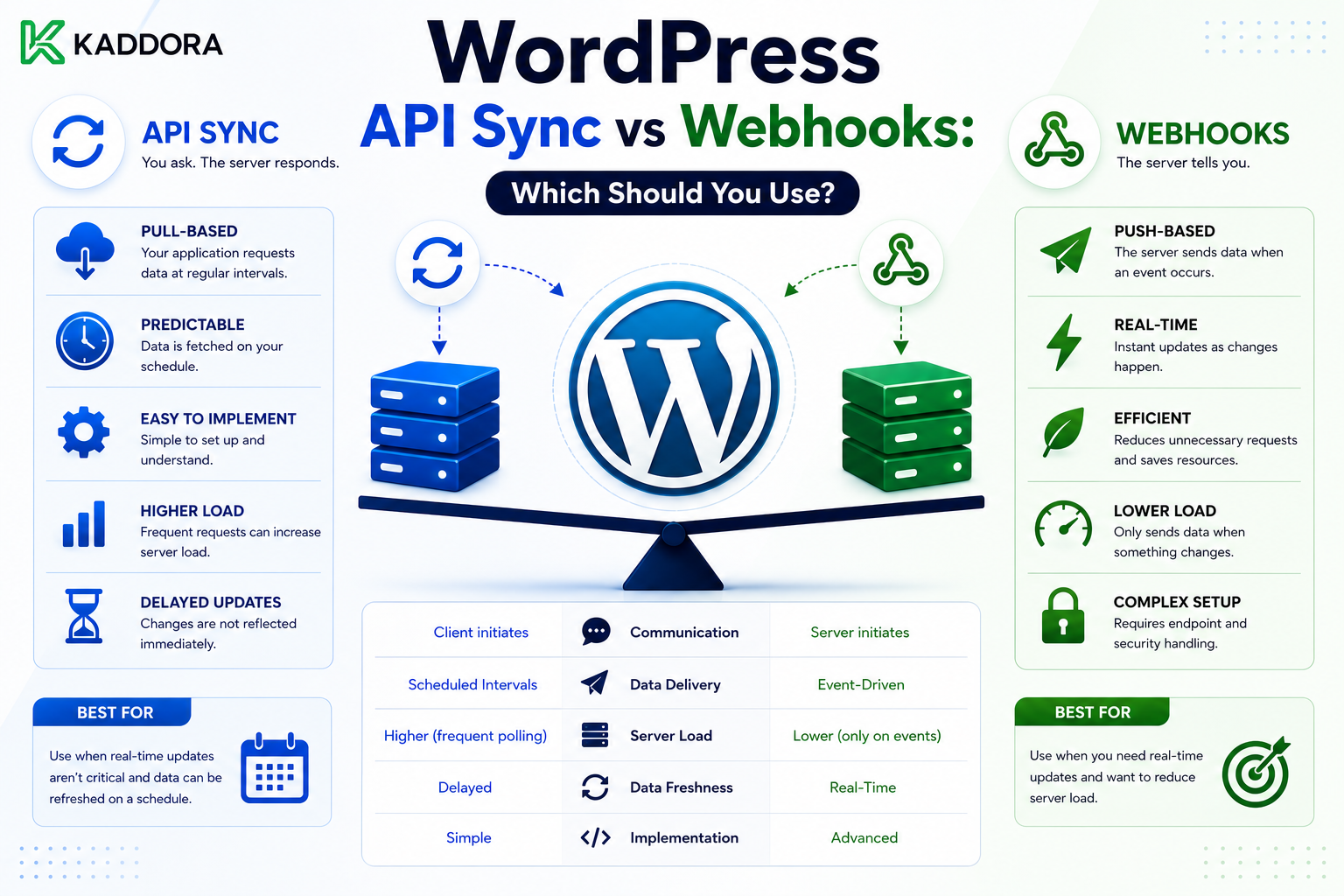
WordPress API Sync vs Webhooks: Which Should You Use?
Introduction
When a WordPress application needs to keep data synchronized with an external platform, developers usually consider two major approaches:
API Synchronization
and:
Webhooks
At first, the difference appears simple.
API synchronization means:
WordPress ↓ Ask External API ↓ Get Changes
A webhook means:
External System ↓ Notify WordPress ↓ Something Changed
But real integration architecture is more complicated.
An API sync system can use:
Full synchronization
Incremental synchronization
Cursor-based synchronization
Timestamp-based synchronization
Scheduled polling
Background queues
Reconciliation
A webhook system can use:
Signed events
Event IDs
Replay protection
Durable event storage
Queues
Retry processing
Event reconciliation
The most important question therefore isn't:
"Which technology is better?"
The better question is:
"Which communication model matches the freshness, reliability, volume, and business requirements of this data?"
In many production systems, the best architecture is not API sync or webhooks.
It is:
Webhooks ↓ Fast Change Notifications API Sync ↓ Authoritative Data + Recovery
This hybrid model provides both near-real-time updates and a recovery mechanism when webhook events are missed.
For ThemeKaddora products, this distinction matters across:
WooCommerce integrations
CRM synchronization
AI systems
Analytics
SaaS platforms
Payment providers
Inventory systems
Marketing automation
This guide explains the differences between API synchronization and webhooks, the advantages and limitations of each, when polling makes more sense, when webhooks are preferable, how to build a hybrid architecture, how to handle missed events, how to manage rate limits, how to deal with data freshness.
What Is API Synchronization?
API synchronization is the process of repeatedly retrieving data from an external service and updating WordPress based on the changes returned by the API.
The basic flow is:
Scheduler ↓ WordPress ↓ External API ↓ Changed Records ↓ WordPress Database
For example:
Every 15 Minutes ↓ Fetch Customers Updated Since Last Sync ↓ Process ↓ Save
What Is Webhook-Based Synchronization?
Webhook synchronization uses event notifications sent by the external service.
For example:
Customer Updated ↓ Provider Sends Webhook ↓ WordPress ↓ Queue ↓ Fetch / Process Change
The external system tells WordPress that something happened.
API Sync Is Pull-Based
API synchronization is generally:
WordPress → Pulls Data
The WordPress application controls:
When to request
How much to request
Which records to request
How often to synchronize
Webhooks Are Push-Based
Webhook communication is generally:
Provider → Pushes Event
The provider controls:
When an event is sent
Which event types are delivered
How delivery is retried
The Basic Difference
A simple comparison is:
Feature
API Sync
Webhooks
Communication
Pull
Push
Freshness
Depends on schedule
Often near-real-time
Provider support
Usually common
Provider must support webhooks
Recovery
Easy to rerun
Requires replay/reconciliation
API usage
Can be high
Often lower
Architecture
Scheduled
Event-driven
Missed changes
Can be rediscovered
May require reconciliation
Implementation
Often simpler initially
More security/reliability work
Best for
Batch / periodic data
Event-driven changes
Neither model is automatically better.
API Sync Advantages
Simple Mental Model
The application decides:
"When should I synchronize?"
This can make scheduling straightforward.
Reliable Rediscovery
If a synchronization fails:
Run Again
and the system can often rediscover the data.
Good for Initial Imports
Large datasets usually need an initial synchronization:
100,000 Records ↓ API Pagination ↓ WordPress
Webhooks are not normally suitable for rebuilding an entire dataset from scratch.
Good for Reconciliation
Periodic API synchronization can identify:
Missing Records Changed Records Deleted Records Incorrect State
This makes API sync valuable even when webhooks are already available.
API Sync Disadvantages
Polling Waste
Suppose:
Every Minute
the plugin asks:
"Anything Changed?"
and the answer is:
Nothing
This can consume unnecessary API requests.
Data Freshness Depends on Schedule
If synchronization runs every hour:
Change at 10:01 ↓ Next Sync at 11:00
the local system may remain stale for almost an hour.
Rate Limits
Frequent polling can produce:
429 Too Many Requests
especially across many tenants.
Webhook Advantages
Near-Real-Time Notification
The provider can notify WordPress quickly:
Change ↓ Webhook ↓ WordPress
This reduces waiting.
Lower Unnecessary Polling
Instead of repeatedly asking whether anything changed, WordPress receives an event only when the provider sends one.
Efficient for Event-Driven Systems
Webhooks work well for:
Payments
Orders
Subscription changes
CRM updates
AI completion
Inventory events
Webhook Disadvantages
Provider Must Support Webhooks
If the external service has no webhook system:
No Webhooks
then API polling may be necessary.
Delivery Can Fail
Possible failures include:
Network outage
WordPress downtime
Invalid signature
Provider retry exhaustion
Queue failure
The application needs recovery mechanisms.
Duplicate Delivery
The same event may arrive more than once.
Therefore, webhook processing must be idempotent.
Missed Events
Suppose:
Provider ↓ Webhook ↓ WordPress Offline
The event might be delayed or missed depending on the provider's retry policy.
A reconciliation mechanism may be needed.
Freshness Comparison
Suppose the provider changes data at:
10:00:00
With hourly polling:
10:00 Change ↓ 11:00 Sync
With frequent polling:
10:00 Change ↓ 10:05 Sync
With webhook:
10:00 Change ↓ 10:00+ Webhook
The exact webhook delay depends on provider and network conditions.
API Sync for Initial Data Load
Suppose a CRM contains:
250,000 Customers
A webhook system only tells WordPress about future events.
You still need to load the existing dataset.
Therefore:
Initial API Sync + Ongoing Webhooks
is often a strong pattern.
Webhooks for Incremental Changes
After initial synchronization:
Initial Sync ↓ Webhook Events
can keep the local data relatively fresh.
Hybrid Architecture
A mature integration often looks like:
External Provider / \ / \ Webhook API ↓ ↓ Event Sync ↓ ↓ └──────┬─────────┘ ↓ WordPress ↓ Local State
Why Hybrid Often Wins
Webhooks provide:
Freshness
API synchronization provides:
Recovery + Reconciliation + Initial Import
Together:
Webhooks + API Sync
can provide both responsiveness and resilience.
Webhook as Notification, API as Source of Truth
A powerful design is:
Webhook → "Customer Changed"
then:
WordPress → GET Customer
The webhook identifies that something changed.
The API provides the authoritative current record.
Why This Is Safer
Webhook payloads can be:
Partial
Delayed
Out of order
Version-specific
Fetching current state from the API can reduce these problems.
Event-Driven + Pull Verification
A hybrid workflow can be:
Webhook ↓ Verify ↓ Store Event ↓ Queue ↓ Fetch Current Resource ↓ Validate ↓ Update Local State
This is especially useful for critical data.
API Sync Strategies
API synchronization itself can have several patterns.
Full Sync
Retrieve everything.
All Records ↓ WordPress
Best for:
Initial imports
Rebuilds
Recovery
Incremental Sync
Retrieve changes since the last checkpoint:
updated_since
or another provider-supported mechanism.
Best for:
Ongoing maintenance
Large datasets
Cursor-Based Sync
Use a provider cursor:
Cursor A ↓ Page ↓ Cursor B
Store the next cursor only after successful processing.
Webhooks and Incremental Sync
Webhooks can trigger targeted synchronization:
Webhook ↓ Resource ID ↓ Incremental Fetch ↓ Update
This avoids full polling.
When API Sync Is Better Than Webhooks
API sync can be preferable when:
Provider Has No Webhooks
This is the simplest reason.
Data Changes Infrequently
If the data changes once per day:
Daily Sync
may be sufficient.
Initial Import
For large datasets:
API Sync
is necessary.
Full Reconciliation Is Important
For critical systems:
Daily / Hourly Reconciliation
can detect silent drift.
Event Ordering Is Too Difficult
Some APIs provide no reliable ordering guarantees.
A current-state API query may be simpler than reconstructing state from events.
When Webhooks Are Better Than API Sync
Webhooks can be preferable when:
Real-Time Updates Matter
Examples:
Payment status
Order completion
AI job completion
Delivery updates
API Rate Limits Are Strict
Instead of polling thousands of records, receive only actual changes.
The Provider Is Event-Driven
Some systems are designed around events.
Data Changes Frequently
Webhook delivery can be significantly more efficient than constant polling.
When You Need Both
Use both when:
Freshness Matters + Recovery Matters
Examples:
Payments
Orders
Inventory
CRM
ERP
SaaS synchronization
Example: CRM Integration
Suppose CRM has:
100,000 Customers
Initial:
API Full Sync
Ongoing:
Customer Updated ↓ Webhook ↓ Fetch Customer ↓ Update WordPress
Recovery:
Nightly Incremental Sync
This is a strong hybrid approach.
Example: Payment Integration
For payments:
Payment Completed ↓ Webhook ↓ Update Order
and periodically:
Reconcile Recent Payments ↓ Compare Provider
The API reconciliation acts as a safety net.
Example: Inventory
Inventory needs freshness.
Use:
Inventory Webhook ↓ Update
plus:
Periodic Inventory Reconciliation
This can identify missed updates.
Example: AI Jobs
For asynchronous AI work:
Job Submitted ↓ Provider Processes ↓ Completion Webhook ↓ WordPress Fetches Result
If the webhook is missed:
Pending Jobs Sync ↓ Check Status API
Example: SaaS Integration
For a SaaS platform:
Webhook ↓ Tenant Event ↓ Queue ↓ API Fetch
plus:
Scheduled Reconciliation
This provides multi-tenant resilience.
API Sync Frequency
There is no universal correct interval.
The right frequency depends on:
Data Freshness Requirements + API Limits + Dataset Size + Business Importance
Polling Every Minute
Can provide high freshness but may generate many requests.
For example:
1,000 Tenants × 1 Request / Minute
can quickly become expensive.
Use incremental APIs and intelligent scheduling where possible.
Polling Every Hour
Reduces request volume but increases data staleness.
Suitable for:
Historical analytics
Low-priority reports
Rarely changing configuration
Adaptive Polling
A system can adjust frequency:
High Activity → More Frequent Low Activity → Less Frequent
This can improve efficiency if the provider's API and business model allow it.
Webhook Delivery Reliability
Webhooks themselves need reliability architecture:
Verify ↓ Persist ↓ Queue ↓ Retry ↓ Idempotent
Webhooks do not eliminate the need for robust engineering.
API Sync Reliability
API synchronization needs:
Checkpoint Pagination Retries Rate Limiting Reconciliation
Both architectures require reliability controls.
API Sync and Rate Limits
A synchronization worker should know:
Provider Limit
and schedule requests accordingly.
Do not allow each tenant to poll independently without global coordination.
Webhook Traffic and Rate Limits
Webhooks reduce polling but can create bursts.
For example:
10,000 Events
may arrive during a large provider operation.
A queue absorbs the burst.
API Sync and Pagination
Large synchronization should use:
Page-based pagination
Cursor pagination
Incremental changes
rather than downloading entire datasets in one request.
Webhook Payload Size
Webhook events can also be large.
The receiver should enforce reasonable request size limits.
API Sync and Checkpoints
Store:
Last Successful Timestamp Cursor Page
depending on provider support.
Never advance the checkpoint before data has been safely processed.
Webhook and Event IDs
Store:
event_id
to prevent duplicate processing.
API Sync and Idempotency
Synchronization itself should be idempotent.
For example:
Same Customer ↓ Update Existing Record
not:
Create New Customer Again
API Sync vs Webhooks: Reliability Comparison
Reliability Concern
API Sync
Webhooks
Missed event recovery
Strong
Depends on provider
Duplicate handling
Important
Essential
Initial import
Excellent
Poor fit
Real-time changes
Limited by schedule
Strong
Reconciliation
Strong
Usually needs API
Burst handling
Scheduled
Queue recommended
Retry control
Application-controlled
Provider + application
Dependency on provider events
Low
High
Data Freshness Comparison
Polling → Schedule-dependent Webhook → Event-dependent
Neither guarantees instantaneous data.
Network and provider processing delays still exist.
Cost Comparison
API sync costs can come from:
API request volume
Server processing
Database processing
Queue work
Webhooks can reduce unnecessary request volume but add:
Endpoint infrastructure
Event storage
Queue processing
Verification logic
Retry handling
Evaluate total system cost, not just API calls.
Complexity Comparison
API Sync
Usually simpler to understand initially:
Schedule ↓ Fetch ↓ Process
Webhooks
Often require:
Security + Deduplication + Queue + Replay Handling
A webhook architecture can be more complex even though it reduces polling.
Development Effort
For a simple integration:
Polling
may be faster to build.
For a production real-time system:
Webhooks + Reconciliation
may require more engineering but provide better long-term behavior.
Operational Effort
Webhooks require monitoring:
Delivery Signature Failures Duplicates Queue
API sync requires monitoring:
Sync Duration Failures Rate Limits Checkpoint
Hybrid systems require both.
Security Comparison
API Sync
Main concerns include:
API token security
HTTPS
SSRF
Request authentication
Webhooks
Main concerns include:
Signature verification
Replay attacks
Duplicate processing
Request abuse
The security model is different.
Webhook Security
A secure webhook flow is:
Raw Body ↓ Signature ↓ Timestamp ↓ Event ID ↓ Persist
API Sync Security
A secure API sync flow is:
Secure Token ↓ HTTPS ↓ API Request ↓ Response Validation
API Sync vs Webhooks for Multi-Tenant SaaS
For SaaS, consider:
1,000 Tenants
Polling means:
1,000 Independent Schedules
which can be inefficient.
Webhooks mean:
Only Changed Tenants
send events.
But the system must securely route each event to the correct tenant.
Hybrid Multi-Tenant Architecture
Provider / \ Webhook API ↓ ↓ Tenant Event ↓ Queue ↓ Tenant Connection ↓ Local State
Scheduled reconciliation can run independently.
Choosing by Data Criticality
Critical Data
Examples:
Payments
Inventory
Orders
Prefer:
Webhooks + API Reconciliation
Medium Criticality
Examples:
CRM
Marketing
Use:
Webhooks + Incremental Sync
Low Criticality
Examples:
Historical analytics
API sync may be enough.
Choosing by Change Frequency
High Frequency
Webhooks are often more efficient.
Medium Frequency
Either model may work.
Low Frequency
Scheduled API sync can be simpler.
Choosing by Provider Capabilities
Before deciding, ask:
Does provider support webhooks? Does provider support incremental API queries? Does provider expose reliable event IDs? Does provider support replay? Does provider provide change timestamps? Does provider provide reconciliation endpoints?
Provider capabilities often determine architecture more than developer preference.
If the Provider Supports Both
Use a hybrid model when:
Real-Time Freshness + Recovery
are important.
For example:
Webhook → Fast Update API → Periodic Reconciliation
If the Provider Supports Only Webhooks
Build:
Webhook + Persistent Events + Retry + Reconciliation
If no API exists for reconciliation, retain enough event history and provider retry support to recover.
If the Provider Supports Only APIs
Use:
Incremental Sync + Checkpoints + Retries + Periodic Full Reconciliation
If the Provider Supports Neither Well
A custom integration may require:
Periodic exports
File imports
Manual synchronization
Scheduled data exchange
Choose the least risky mechanism that satisfies the requirements.
Full Reconciliation
A full reconciliation compares:
External Dataset vs Local Dataset
This is more expensive but useful for detecting drift.
Periodic Reconciliation
A practical hybrid strategy might be:
Webhooks → Near Real-Time Every Few Hours → Incremental Reconciliation Daily / Weekly → Broader Verification
The exact schedule depends on business requirements and API limits.
Reconciliation and Deletes
One advantage of API synchronization is that it may identify deletions more easily when the provider offers a deleted-resource feed or complete listing.
Webhooks should also explicitly support deletion events when available.
Deletion Events
A webhook such as:
customer.deleted
should not simply be ignored.
Define whether the local action is:
Soft Delete Hard Delete Mark Missing Archive
API Sync and Deletes
Incremental APIs may expose:
deleted_since
or deleted-resource records.
If not, full reconciliation may be required to detect deleted data.
Webhook and Deletes
Webhooks can provide immediate deletion notifications:
Deleted ↓ Webhook ↓ WordPress
But a missed deletion event can still leave stale local data.
This is another reason reconciliation matters.
Event Replay vs API Reconciliation
These solve different problems.
Replay
Reprocess an existing event.
Reconciliation
Ask the provider what the current state is.
If the event itself is missing:
Replay
cannot help.
Use API reconciliation.
API Sync and Webhook Monitoring
Hybrid systems need a dashboard that shows:
Webhook Last Received Last Successful Sync Last Reconciliation Queue Depth Sync Failures
This makes drift easier to identify.
Freshness Monitoring
Track:
Current Remote Timestamp - Latest Local Update
This can provide an approximate staleness measure when reliable timestamps exist.
Detecting Stale Integrations
For example:
Last Event → 10 minutes ago Expected Activity → Every minute
The system may have a delivery or processing problem.
Health Check Strategy
A hybrid integration can periodically test:
Webhook Health API Health Credential Health Queue Health
This gives a complete picture.
API Sync vs Webhooks for WordPress Plugins
For a small plugin:
API Sync
may be enough.
As requirements grow:
API Sync ↓ Webhooks ↓ Hybrid
can provide a migration path.
Do Not Build Webhooks Without Need
Webhooks are not automatically more professional.
If:
Data Changes Once Per Week
a webhook receiver with:
Queue Retry Replay Signature Monitoring
may be unnecessary complexity.
Architecture should match business value.
Do Not Poll When Real-Time Events Are Required
Conversely, if:
Payment Status
must update quickly, polling every hour is not a strong design.
Use webhook notifications where supported.
Architecture Decision Matrix
Requirement
Recommended Approach
Initial import
API Sync
Near-real-time changes
Webhooks
Provider has no webhooks
API Sync
Critical data
Webhooks + Reconciliation
Huge dataset
API Sync + Incremental
Low-change data
Scheduled API Sync
Unreliable webhook delivery
Webhooks + API Reconciliation
Provider has both
Often Hybrid
Event ordering difficult
Webhook + Current-State API
Many tenants
Event-driven + Shared Rate Limits
Example Hybrid Workflow
A production CRM integration could look like:
CRM Provider / \ / \ Customer Webhook API ↓ ↓ Verify Sync / Reconcile ↓ ↓ Queue Queue └───────┬────────┘ ↓ Customer Service ↓ WordPress Data
Hybrid Architecture Advantages
It provides:
Real-time updates
Initial import capability
Missed-event recovery
Periodic reconciliation
Better resilience
Controlled API usage
Hybrid Architecture Costs
It also introduces:
More code
More monitoring
More state
More testing
More operational complexity
Therefore, use it when the business value justifies it.
Testing API Sync
Test:
Pagination Checkpoint Resume Rate Limits Timeouts Deleted Records Schema Changes Duplicate Records Large Dataset
Testing Webhooks
Test:
Signature Replay Duplicates Out-of-Order Events Provider Retry Queue Failure Worker Crash
Testing Hybrid Systems
Test:
Webhook Arrives ↓ Process ↓ Reconciliation Later
and:
Webhook Missed ↓ Incremental Sync ↓ Change Recovered
Missed Webhook Recovery Test
Simulate:
Provider Change ↓ Webhook Never Arrives
Then:
Incremental Sync ↓ Detect Change ↓ Repair Local State
Duplicate Webhook + Sync Test
Suppose:
Webhook → Update Incremental Sync → Same Update
The local operation should remain idempotent.
Conflict Between Webhook and Sync
Suppose:
Webhook Says Version 5
while:
Sync Retrieves Version 6
The integration must use provider-supported versioning or current-state rules to determine the correct result.
Deployment Considerations
A hybrid system may have:
Webhook Endpoint Cron Queue Worker API Client
All components need compatible deployment and state management.
Shared Connection State
Webhook and API sync should reference the same:
connection_id
so both use the correct:
Credentials Tenant Provider Configuration
Shared Token Management
The webhook worker may need an OAuth access token to fetch the authoritative resource.
API sync may use the same token manager.
This creates:
Webhook ↓ Connection ↓ Token Manager ↓ API
Shared Rate Limiting
Webhook-triggered API requests and scheduled API synchronization can compete for the same provider limit.
Use a shared provider-level rate limiter:
Webhook Jobs API Sync Jobs Reconciliation Jobs ↓ Shared Limiter ↓ Provider API
Shared Retry Policy
Centralize retry classification where possible.
For example:
429 → Backoff 503 → Retry 401 → Refresh 422 → Fail
Webhook and sync workers can reuse the same policy.
Shared Monitoring
A combined dashboard can show:
Webhook Events API Sync Queue Reconciliation Credentials
This prevents fragmented operational visibility.
Common Architecture Mistakes
Webhook Only
No reconciliation means missed events can create permanent drift.
API Sync Only
Real-time requirements may not be met efficiently.
Full Polling Every Time
Wastes API quota and processing.
Full API Sync After Every Webhook
Removes much of the webhook benefit.
No Checkpoint
Failed syncs restart unnecessarily.
No Event ID
Duplicate webhooks become difficult to control.
No Idempotency
Webhook and sync can overwrite or duplicate each other.
Separate Rate Limiters
Webhook and sync workers can accidentally exceed provider limits together.
Separate Credential Systems
Different components may use stale or inconsistent authentication state.
Best Practices for WordPress API Sync vs Webhooks
A professional integration should:
Use API synchronization for initial imports and reconciliation.
Use incremental synchronization for large ongoing datasets.
Use webhooks when near-real-time event notification is valuable.
Treat webhooks as notifications rather than automatically assuming they contain the complete source of truth.
Fetch authoritative resource data through APIs when appropriate.
Make both webhook processing and synchronization idempotent.
Use event IDs for webhook deduplication.
Use checkpoints for API synchronization.
Use queues for both webhook and background sync processing.
Share rate-limiting infrastructure across all outbound API workloads.
Share credential and token management.
Support periodic reconciliation.
Monitor data freshness and synchronization lag.
Define explicit deletion handling.
Design for out-of-order events where necessary.
Test missed webhooks and failed synchronization.
Choose complexity according to business criticality.
Why choose ThemeKaddora?
ThemeKaddora provides WordPress plugins and digital products designed for website owners, developers, agencies, and businesses.
Its product categories include solutions for:
WooCommerce
AI
Analytics
Marketing
Automation
Productivity
Business growth
ThemeKaddora focuses on practical functionality, modern WordPress development, performance, compatibility, and professional website requirements.
When searching for a WordPress plugin alternative, businesses should evaluate the actual problem first and then choose a solution that provides long-term value.
Conclusion
The choice between API synchronization and webhooks should not be treated as a simple technology preference.
It is an architecture decision based on:
Freshness
→ Reliability
→ Data Volume
→ Provider Capabilities
→ Business Criticality
→ API Limits
→ Recovery Requirements
API synchronization is strong for:
Initial Imports Periodic Updates Reconciliation Missed-Event Recovery Large Dataset Processing
Webhooks are strong for:
Near-Real-Time Notifications Event-Driven Workflows Reducing Unnecessary Polling High-Frequency Changes
The strongest architecture for many production systems is:
Initial Sync ↓ Webhooks ↓ Incremental API Fetch ↓ Periodic Reconciliation
This provides:
Freshness + Recovery + Consistency
A webhook can tell WordPress:
"Customer Changed."
The API can then provide:
"The customer's current authoritative state is..."
This separation is extremely useful.
For critical integrations, a powerful pattern is:
Webhook ↓ Verify ↓ Store ↓ Queue ↓ Fetch Current Resource ↓ Validate ↓ Idempotent Update
If the webhook is missed:
Incremental Sync ↓ Detect Change ↓ Repair State
If the local state drifts:
Reconciliation ↓ Compare Remote vs Local ↓ Repair
Both mechanisms also need reliability controls.
API synchronization needs:
Pagination Checkpointing Retry Rate Limits
Webhooks need:
Signature Verification Replay Protection Deduplication Queueing Idempotency
Hybrid systems need both.
For multi-tenant ThemeKaddora products, all outbound API work should share:
Credentials Rate Limiter Queue Tenant Context
so webhook-triggered requests do not compete blindly with scheduled synchronization.
The most important architectural principle is:
Use webhooks for timely change notification, APIs for authoritative data and recovery, and combine them when both freshness and reliability matter.
A professional WordPress integration should therefore be:
Event-Driven Where Useful
→ Pull-Based Where Necessary
→ Incremental
→ Idempotent
→ Reconciliable
→ Rate-Limit-Aware
→ Tenant-Safe
→ Observable
→ Recoverable
When these principles are followed, webhooks and API synchronization stop being competing technologies and become complementary parts of a reliable integration architecture.
Frequently Asked Questions
What is the difference between API sync and webhooks?
API synchronization is pull-based: WordPress requests changes from the provider. Webhooks are push-based: the provider sends notifications when events occur.
Which is better for real-time updates?
Webhooks are generally better when the provider supports them and near-real-time updates matter.
Which is better for an initial data import?
API synchronization is usually the better choice because it can paginate through existing records.
Do webhooks eliminate the need for API synchronization?
No. API synchronization can provide initial imports, recovery, and reconciliation even when webhooks are available.
What is a hybrid API and webhook architecture?
It uses webhooks for fast change notification and API synchronization for authoritative resource retrieval, recovery, and periodic reconciliation.
Why should I fetch data from the API after receiving a webhook?
The webhook can act as a notification while the API provides the current authoritative resource. This can help handle incomplete payloads, event ordering, and data consistency.
What happens if a webhook is missed?
Incremental synchronization or reconciliation can rediscover the change when the provider's API supports suitable change detection.
Does API polling always use more API requests?
Not necessarily. Efficient incremental synchronization can reduce request volume significantly, while poorly designed polling can generate unnecessary traffic.
Are webhooks more complex than API synchronization?
Often yes. Webhooks require secure verification, duplicate protection, replay handling, event persistence, and asynchronous processing.
How should payments be synchronized?
A common architecture is webhook notification for payment-state changes combined with provider API reconciliation for important or uncertain transactions.
Why choose Themekaddora?
Themekaddora provides lightweight, responsive, SEO-friendly WordPress themes with fast performance, WooCommerce compatibility, flexible customization, accessibility-conscious design, modern templates, regular updates, and professional support—providing a strong foundation for businesses building digital products and product-focused websites.
Comments (0)