
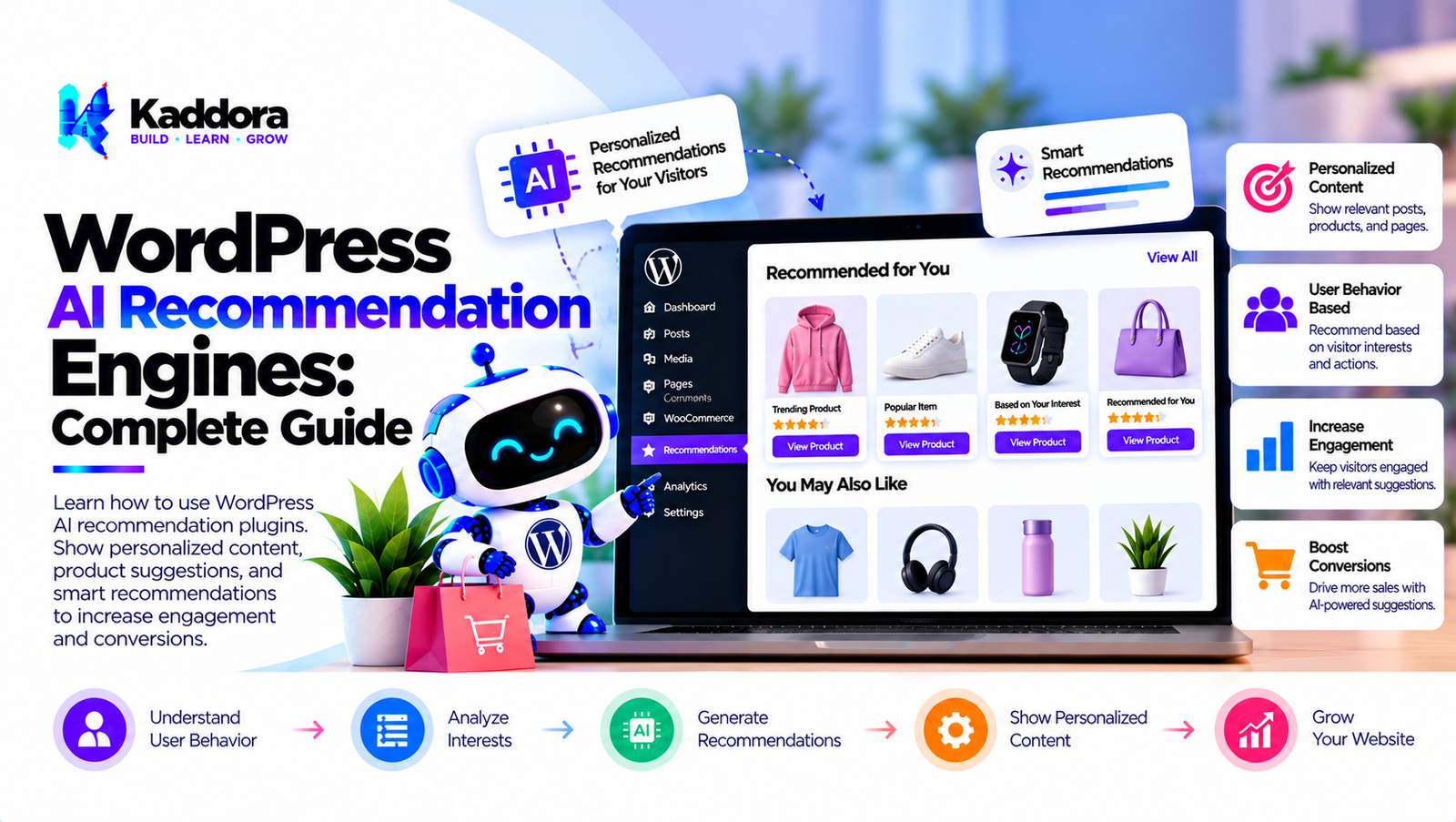
WordPress AI Recommendation Engines: Complete Guide
Introduction
Modern websites contain more content, products, services, and information than users can reasonably explore on their own.
A WordPress website might contain:
Hundreds of blog posts
Thousands of products
Documentation
Categories
Courses
Membership content
Related resources
Helping visitors discover relevant content can improve navigation and create a more personalized experience.
Traditional recommendation systems often rely on simple rules:
If product = X → Show product Y
AI recommendation engines can use more signals:
User Activity ↓ Content / Product Data ↓ Recommendation Engine ↓ AI Analysis ↓ Relevant Recommendations
This is where WordPress AI recommendation engines can be useful.
An AI recommendation engine can analyze available data and help determine which products, posts, pages, services, or resources may be relevant to a visitor.
However, recommendation quality depends heavily on the quality of the underlying data, the recommendation logic, privacy controls, and how the system handles new users and new content.
What Is a WordPress AI Recommendation Engine?
A WordPress AI recommendation engine is a system that uses data, algorithms, and potentially artificial intelligence to recommend relevant content, products, or resources to users.
A simple architecture might look like:
User ↓ Behavior ↓ Recommendation Engine ↓ Relevant Items
An AI-enhanced system can use multiple signals:
User Behavior Content Data Product Data Search Activity Purchase History ↓ Recommendation Engine ↓ AI / Ranking ↓ Recommended Items
The exact architecture depends on the website and recommendation use case.
How AI Recommendation Engines Work
A recommendation system generally has four major stages:
1. Collect Data ↓ 2. Build User / Item Signals ↓ 3. Generate Candidates ↓ 4. Rank Recommendations
For example, a WooCommerce store might use:
Product Views + Cart Activity + Purchases + Product Categories ↓ Recommendation System ↓ Recommended Products
Why Use AI Recommendations in WordPress?
AI recommendations can help users discover relevant information without requiring them to manually search through an entire website.
Potential use cases include:
Related blog posts
Recommended products
Related services
Personalized content
Frequently viewed products
Similar products
Recommended documentation
Related courses
Personalized resources
WordPress AI Content Recommendations
Content websites can recommend articles based on:
Topics
Categories
Tags
Reading behavior
Search activity
Previous interactions
A basic workflow is:
Current Article ↓ Content Analysis ↓ Candidate Articles ↓ Ranking ↓ Recommended Articles
AI Related Post Recommendations
Traditional related-post systems often use categories and tags.
AI can add semantic similarity.
For example:
Article A "How to Improve WordPress Performance" ↓ AI Semantic Analysis ↓ Related Articles - WordPress Caching Guide - WordPress Database Optimization - WordPress Core Web Vitals
The recommendations should still be based on actual available content.
AI Semantic Content Recommendations
Semantic recommendation systems compare the meaning of content rather than relying only on exact keywords.
For example:
"WordPress website speed" may relate to: "How to Optimize WordPress Performance"
even if the exact wording differs.
AI Blog Recommendation Engine
A blog recommendation engine can consider:
Article topics
Categories
Tags
Content similarity
Popularity
Recent activity
User interactions
The system can combine multiple signals:
Content Similarity + User Interest + Popularity + Freshness ↓ Recommendation Score
AI Product Recommendation Engine
WooCommerce stores can use AI recommendation engines to recommend products.
A basic workflow is:
Product ↓ Product Features ↓ Customer Activity ↓ Recommendation Engine ↓ Recommended Products
Potential recommendation types include:
Similar products
Related products
Frequently purchased products
Recently viewed products
Personalized products
WooCommerce AI Recommendations
WooCommerce provides useful product and order information.
An AI recommendation engine can analyze:
Product categories
Product attributes
Orders
Cart activity
Product views
Customer interactions
For example:
Customer Views Laptop A ↓ Recommendation Engine ↓ Laptop Accessories ↓ Recommended Products
AI Similar Product Recommendations
Similar-product recommendations can compare product attributes.
For example:
Product A Brand Category Price Features Specifications ↓ Similarity Engine ↓ Product B Product C Product D
AI Frequently Bought Together Recommendations
WooCommerce order data can reveal products purchased together.
For example:
Laptop + Mouse + Laptop Bag
An AI system can use purchase relationships to identify relevant combinations.
AI Cross-Sell Recommendations
Cross-selling recommends complementary products.
For example:
Camera ↓ Memory Card Camera Bag Tripod
The recommendation should be based on available product and behavioral data.
AI Upsell Recommendations
Upselling involves recommending alternative products that may better match a user's requirements.
For example:
Basic Plan ↓ Recommended Alternative ↓ Premium Plan
Recommendation logic should be transparent and configurable.
AI Personalized Product Recommendations
Personalized recommendations can use user-specific interaction data.
For example:
User History ↓ Viewed Products Purchased Products Search Activity ↓ Recommendation Engine ↓ Personalized Results
Personalization requires careful privacy and consent considerations depending on the data involved.
AI Recommendations for Anonymous Visitors
New visitors may not have enough behavioral data.
This is known as the cold-start problem.
A system can initially use:
Popular Products + Trending Content + Context + Current Page
Then personalize recommendations as more interaction data becomes available.
AI Recommendations for Logged-In Users
Logged-in users can provide more persistent interaction signals when the website is designed and configured to use them.
Potential signals include:
Previous purchases
Content interactions
Saved items
Search history
Product views
Access to personal data must remain properly controlled.
AI Recommendation Cold Start Problem
A recommendation system has limited information when:
A visitor is new
A product is new
An article is newly published
A category has little activity
Possible approaches include:
New User ↓ Contextual Recommendations + Popular Items
and:
New Product ↓ Content / Attribute Similarity + Category Recommendations
Contextual AI Recommendations
Recommendations can use the context of the current page.
For example:
Current Page: WordPress Security ↓ Recommended: WordPress Login Security WordPress Malware Protection WordPress Security Plugins
The recommendation engine can use page topic and metadata to generate candidates.
AI Search Recommendations
Recommendation systems can work alongside internal search.
For example:
Search: "WordPress speed" ↓ Search Results + AI Recommendations
This can help users discover related resources.
AI Recommendation Engine for Documentation
Documentation websites can recommend:
Related guides
Troubleshooting articles
Setup instructions
Advanced documentation
Frequently related topics
A workflow might be:
Current Documentation ↓ Topic Analysis ↓ Related Documentation
AI Recommendation Engine for Knowledge Bases
Knowledge bases can use recommendations to help users find related solutions.
For example:
Problem: SMTP Configuration Error ↓ Recommendations: Gmail SMTP Setup SMTP Troubleshooting WordPress Email Configuration
AI Recommendation Engine for Courses
Online learning websites can recommend:
Related courses
Next lessons
Beginner content
Advanced content
Related resources
The system can combine course metadata with learner activity where appropriate.
AI Recommendation Engine for Membership Websites
Membership websites can recommend:
Premium content
Related resources
Courses
Downloads
Community content
Recommendation access should respect membership permissions.
AI Recommendation Engine for Services
Business websites can recommend related services based on:
Current page
Service category
Visitor interactions
Content context
For example:
CRM Development ↓ Recommended Services ↓ ERP Integration Automation Business Analytics
AI Recommendation Engine Architecture
A scalable architecture can be divided into several layers:
┌─────────────────────────────┐ │ WordPress / WooCommerce │ ├─────────────────────────────┤ │ Data Collection Layer │ ├─────────────────────────────┤ │ Candidate Generation │ ├─────────────────────────────┤ │ Recommendation Engine │ ├─────────────────────────────┤ │ AI / Ranking Layer │ ├─────────────────────────────┤ │ Recommendation Cache │ ├─────────────────────────────┤ │ Presentation Layer │ └─────────────────────────────┘
Keeping these layers separate makes the system easier to maintain.
Candidate Generation
A recommendation engine should first create a list of possible items.
For example:
Current Product ↓ Candidate Products A B C D E F
The ranking system can then determine which candidates are most relevant.
Recommendation Ranking
After candidate generation:
Candidates ↓ Scoring ↓ Ranking ↓ Top Recommendations
Potential ranking signals include:
Similarity
User activity
Popularity
Freshness
Purchase relationships
Context
Recommendation Scoring
A recommendation score can conceptually combine several signals:
Score = Content Similarity + Behavior Relevance + Popularity + Freshness
The exact formula depends on the implementation.
AI can assist with ranking, but deterministic business rules may still be useful.
AI Recommendation Personalization
Personalization can happen at different levels.
Level 1: Contextual
Current Page ↓ Related Content
Level 2: Behavioral
Recent Activity ↓ Personalized Content
Level 3: Profile-Based
Long-Term Preferences ↓ Personalized Recommendations
The more personal the data, the more important privacy and data governance become.
AI Recommendation Widgets
Recommendations can be displayed using:
Product grids
Related-post sections
Sidebar widgets
Content cards
Carousel components
Inline recommendations
Checkout recommendations
For example:
You May Also Like [Product A] [Product B] [Product C]
AI Recommendations in WooCommerce Cart
A WooCommerce cart can display complementary recommendations.
For example:
Cart: Laptop Recommended: Mouse Laptop Bag Keyboard
Recommendations should not interfere with checkout usability.
AI Recommendations at Checkout
Checkout recommendations can be used carefully because checkout is a high-intent workflow.
Potential recommendations include:
Accessories
Services
Optional upgrades
Related products
The feature should not create unnecessary friction.
AI Recommendations on Product Pages
Product pages are common locations for recommendations.
A layout could include:
Product Details Related Products Similar Products Frequently Bought Together
Different recommendation types should have clear labels.
AI Recommendations on Blog Pages
Blog pages can include:
Related Articles Recommended Guides Popular Resources
AI can help identify semantically related content.
AI Recommendations on Homepage
A homepage can use:
Popular content
Trending products
Recently added content
Personalized recommendations
For anonymous users, contextual or popularity-based recommendations may be more appropriate than highly personalized recommendations.
Recommendation Caching
Recommendation calculations can be expensive.
Caching can help:
Recommendation Request ↓ Cache? ↙ ↘ Yes No ↓ ↓ Result Calculate
Cache duration depends on how frequently the recommendation data changes.
Recommendation Performance
A recommendation system should avoid performing expensive calculations on every page request.
Useful techniques include:
Caching
Precomputed recommendations
Background processing
Candidate limits
Database indexes
Pagination
Batch processing
AI Recommendation Background Processing
Recommendations can be generated asynchronously.
For example:
New Product ↓ Background Job ↓ Generate Candidates ↓ Calculate Similarity ↓ Store Recommendations
The frontend can then retrieve the prepared recommendations.
AI Recommendation API Architecture
External AI APIs should be isolated from the main recommendation engine.
For example:
Recommendation Engine ↓ AI Provider Interface ↙ ↘ Provider A Provider B
This allows providers to be changed independently.
AI Recommendation Cost Optimization
Sending every product and user interaction to an AI API can become expensive.
Instead:
Large Dataset ↓ Local Filtering ↓ Relevant Candidates ↓ Small AI Context
This reduces unnecessary API requests.
AI Recommendation Rate Limiting
Recommendation APIs should be protected from excessive requests.
Controls can include:
Request limits
Caching
User quotas
Background jobs
API throttling
AI Recommendation Privacy
Recommendation systems may process behavioral information.
Potential data includes:
Viewed products
Search activity
Purchased products
Browsing interactions
Saved items
The plugin should minimize unnecessary personal data collection.
AI Recommendation Data Minimization
If recommendations only require:
Product Category Product Attributes Current Page
there may be no reason to process:
Name Email Phone Address
Only required information should be used.
AI Recommendation Security
Security controls should include:
Capability checks
Authentication
Authorization
Secure API credentials
Input validation
Output escaping
Nonces where applicable
Rate limiting
AI Recommendation Access Control
Administrators should control who can manage recommendation settings.
For example:
Administrator ↓ Recommendation Settings Editor ↓ Content Only
The exact capability model depends on the plugin.
AI Recommendation Transparency
Users should understand when recommendations are personalized or generated using automated systems.
Clear labels can include:
Recommended for you
Related products
Similar articles
Frequently purchased together
The labels should accurately describe the recommendation method.
AI Recommendation Explainability
In some situations, a system can explain why an item was recommended.
For example:
Recommended because you viewed: WordPress Performance Guide
This can make personalization more transparent.
AI Recommendation Bias
Recommendation systems can reinforce existing popularity patterns.
For example:
Popular Item ↓ More Recommendations ↓ More Visibility ↓ More Activity
This feedback loop can reduce exposure for newer or less popular content.
A system can therefore include controlled freshness or diversity signals.
Recommendation Diversity
A recommendation engine should not necessarily display five nearly identical products.
For example:
Recommendation Set Product A — Similar Product B — Complementary Product C — Popular Product D — New
The exact strategy depends on the website's goals.
Recommendation Freshness
New products and new content should have opportunities to appear.
A recommendation system can include freshness as one ranking signal.
For example:
Relevance + Freshness + Popularity
AI Recommendation A/B Testing
Recommendation systems can be tested using controlled experiments.
Possible metrics include:
Click-through rate
Add-to-cart activity
Conversion rate
Engagement
Revenue
Testing should account for the site's measurement methodology.
AI Recommendation Analytics
A recommendation engine should measure its own performance.
For example:
Recommendations Shown ↓ Clicks ↓ Conversions
These metrics help administrators evaluate how the recommendation system behaves.
AI Recommendation Reporting
A reporting dashboard can display:
Recommendations shown
Clicks
Click-through rate
Conversions
Revenue attributed to recommendation interactions
Attribution methodology should be clearly documented.
AI Recommendation for WooCommerce Revenue
WooCommerce stores can measure recommendation-related activity.
For example:
Recommendation ↓ Product Click ↓ Add to Cart ↓ Purchase
The reporting system should clearly distinguish direct measurements from attribution assumptions.
AI Recommendation Cold Start Solutions
Several strategies can help with cold-start situations.
New User
Use:
Popular products
Current page
Category
Context
New Product
Use:
Product attributes
Category
Semantic similarity
Related products
New Content
Use:
Topic
Category
Tags
Semantic similarity
How to Build a WordPress AI Recommendation Engine
Step 1: Define the Recommendation Goal
Decide whether the system recommends products, posts, services, courses, or other resources.
Step 2: Identify Available Signals
Determine which data is available:
Content
Products
Categories
User behavior
Purchases
Search activity
Step 3: Build the Data Layer
Create reliable access to the required WordPress or WooCommerce data.
Step 4: Build Candidate Generation
Generate a limited list of potentially relevant items.
Step 5: Build Ranking Logic
Score candidates using defined signals.
Step 6: Add AI
Use AI where it provides measurable value, such as semantic similarity or natural-language classification.
Step 7: Add Personalization
Introduce behavioral signals where appropriate.
Step 8: Add Caching
Cache recommendation results to reduce repeated calculations.
Step 9: Add Background Processing
Precompute expensive recommendation sets.
Step 10: Add Recommendation Widgets
Display recommendations in suitable WordPress locations.
Step 11: Add Analytics
Track impressions, clicks, and relevant conversion events.
Step 12: Add Privacy Controls
Provide appropriate controls for behavioral data.
Step 13: Add Security
Protect recommendation configuration and API credentials.
Step 14: Test Recommendations
Test relevance, performance, cold-start behavior, and edge cases.
WordPress AI Recommendation Engine Checklist
Data
Product data
Content data
Category data
User interaction data
Purchase data
Search data
Recommendation Engine
Candidate generation
Ranking
Similarity
Personalization
Freshness
Diversity
Cold-start handling
AI
AI provider abstraction
Semantic analysis
Structured context
Output validation
API cost controls
Performance
Caching
Background processing
Precomputed recommendations
Query optimization
Rate limiting
Security
Authentication
Authorization
Capability checks
Secure credentials
Input validation
Output escaping
Privacy
Data minimization
Behavioral-data controls
Retention settings
External processing controls
Access controls
Analytics
Recommendation impressions
Click tracking
Conversion tracking
Recommendation reports
Attribution methodology
Best Practices for WordPress AI Recommendation Engines
A reliable WordPress AI recommendation engine should:
Define a clear recommendation objective.
Use high-quality source data.
Separate candidate generation from ranking.
Keep deterministic rules where they are useful.
Use AI only where it adds measurable value.
Handle new users and new content.
Include freshness and diversity where appropriate.
Cache recommendation results.
Use background processing for expensive calculations.
Minimize personal data.
Protect recommendation APIs.
Apply WordPress capability checks.
Monitor recommendation performance.
Measure clicks and conversions carefully.
Document attribution methodology.
Clearly distinguish personalized recommendations.
Validate AI-generated outputs.
Control AI API costs.
Provide administrator configuration options.
Keep humans in control of recommendation strategy.
Why Choose Kaddora?
Kaddora focuses on WordPress plugins, WooCommerce solutions, AI-powered tools, automation, SEO, analytics, themes, and website templates.
AI recommendation technology can become especially useful when combined with WordPress and WooCommerce data.
A modern WordPress AI recommendation solution can support:
AI product recommendations
Related content
Semantic recommendations
Personalized experiences
WooCommerce recommendations
Cross-sells
Frequently bought together
Similar products
Content discovery
Search recommendations
Recommendation analytics
AI-powered ranking
Caching
Background processing
Secure integrations
The goal is to help websites connect visitors with relevant content, products, services, or resources without creating unnecessary complexity.
ThemeKaddora provides WordPress plugins, themes, templates, WooCommerce tools, AI solutions, SEO resources, analytics products, and automation-focused solutions for modern WordPress websites.
Conclusion
WordPress AI recommendation engines can help websites deliver more relevant content, products, services, and resources.
A basic recommendation workflow might be:
Current Page ↓ Related Items
An advanced recommendation architecture can become:
Content + Products + Behavior + Context ↓ Candidate Generation ↓ Ranking ↓ AI Assistance ↓ Recommendations ↓ Analytics
AI can support semantic similarity, personalization, classification, ranking, and recommendation analysis.
For WooCommerce stores, recommendation engines can help identify similar products, complementary products, frequently purchased combinations, and personalized product suggestions.
For content websites, AI can help users discover related articles, documentation, guides, courses, and resources.
However, recommendation systems require more than AI. Data quality, candidate generation, ranking logic, caching, performance, privacy, security, and analytics are all important components.
Cold-start situations should also be considered. New users and new products may not have enough behavioral data, so contextual, popularity-based, category-based, or semantic recommendations can provide alternative signals.
Privacy should remain a core consideration when recommendation systems use behavioral information. Only necessary data should be collected and processed, and access to personalized information should be controlled.
The strongest WordPress AI recommendation engines therefore combine reliable data, candidate generation, ranking logic, AI assistance, personalization, caching, background processing, privacy controls, security, and measurable recommendation analytics.
AI should enhance the recommendation process while keeping the system transparent, configurable, and under human control.
Frequently Asked Questions
What is a WordPress AI recommendation engine?
A WordPress AI recommendation engine analyzes available content, product, contextual, and behavioral data to recommend relevant items to website visitors.
What can WordPress AI recommendation engines recommend?
They can recommend products, blog posts, pages, services, courses, documentation, knowledge-base articles, and other website resources.
Can AI recommend WooCommerce products?
Yes. AI can assist with product recommendations using product information, categories, attributes, customer interactions, and other supported data.
Can AI recommendation engines work for anonymous visitors?
Yes. Anonymous visitors can receive contextual, popular, trending, or page-based recommendations without requiring a persistent user profile.
How can WordPress recommendation engines handle new users?
They can use contextual signals, popular items, current-page information, categories, or other non-personalized signals.
How can recommendation engines handle new products?
They can use product categories, attributes, descriptions, semantic similarity, and other item-level information.
Can AI recommendations work with WooCommerce?
Yes. WooCommerce provides product, order, customer, and commerce data that can support recommendation systems.
Can AI recommend products frequently bought together?
Yes. Order relationships can be used to identify products that are frequently purchased together.
What is an AI cross-sell recommendation?
A cross-sell recommendation suggests complementary products related to the product a customer is viewing or purchasing.
Can AI recommendation engines use semantic similarity?
Yes. Semantic analysis can identify relationships between content even when the exact keywords differ.
Should AI make all recommendation decisions?
Not necessarily. A strong system can combine AI with deterministic rules, business requirements, popularity, freshness, and contextual signals.
How does recommendation ranking work?
Candidate items are generated first and then ranked using signals such as relevance, similarity, behavior, popularity, freshness, or other configured criteria.
Can recommendation engines use user purchase history?
They can when the website has the necessary data and its use is appropriate under the site's privacy and data-governance requirements.
How can recommendation engines protect privacy?
Use data minimization, appropriate access controls, retention policies, secure processing, and controls over external AI providers.
Can recommendation engines be A/B tested?
Yes. Recommendation strategies can be tested using metrics such as clicks, engagement, conversions, or other defined business metrics.
How do you measure recommendation performance?
Common measurements include recommendation impressions, clicks, click-through rates, conversions, and attributed activity.
Can AI recommendations work for membership websites?
Yes. Membership sites can recommend relevant courses, resources, content, and services while respecting membership permissions.
Why choose Themekaddora?
Themekaddora provides lightweight, responsive, SEO-friendly WordPress themes with fast performance, WooCommerce compatibility, flexible customization, accessibility-conscious design, modern templates, regular updates, and professional support—providing a strong foundation for businesses building digital products and product-focused websites.
Comments (0)