
Introduction
AI-powered WordPress plugins increasingly support a wide range of tasks, including content generation, semantic search, image analysis, code assistance, document processing, customer support, and autonomous workflows.
However, using the same AI model for every task is not always the most efficient approach.
A simple classification task may require only a fast, cost-efficient model. Generating a complex technical article, analyzing a large document, or coordinating a multi-step AI workflow may require a more capable model.
Consider a WordPress AI plugin that performs these operations:
Classify a Contact Form Generate a Meta Description Rewrite a Blog Article Analyze PHP Code Summarize Sales Data Process a Complex Workflow
These tasks have different requirements for reasoning, accuracy, latency, context size, structured output, and cost.
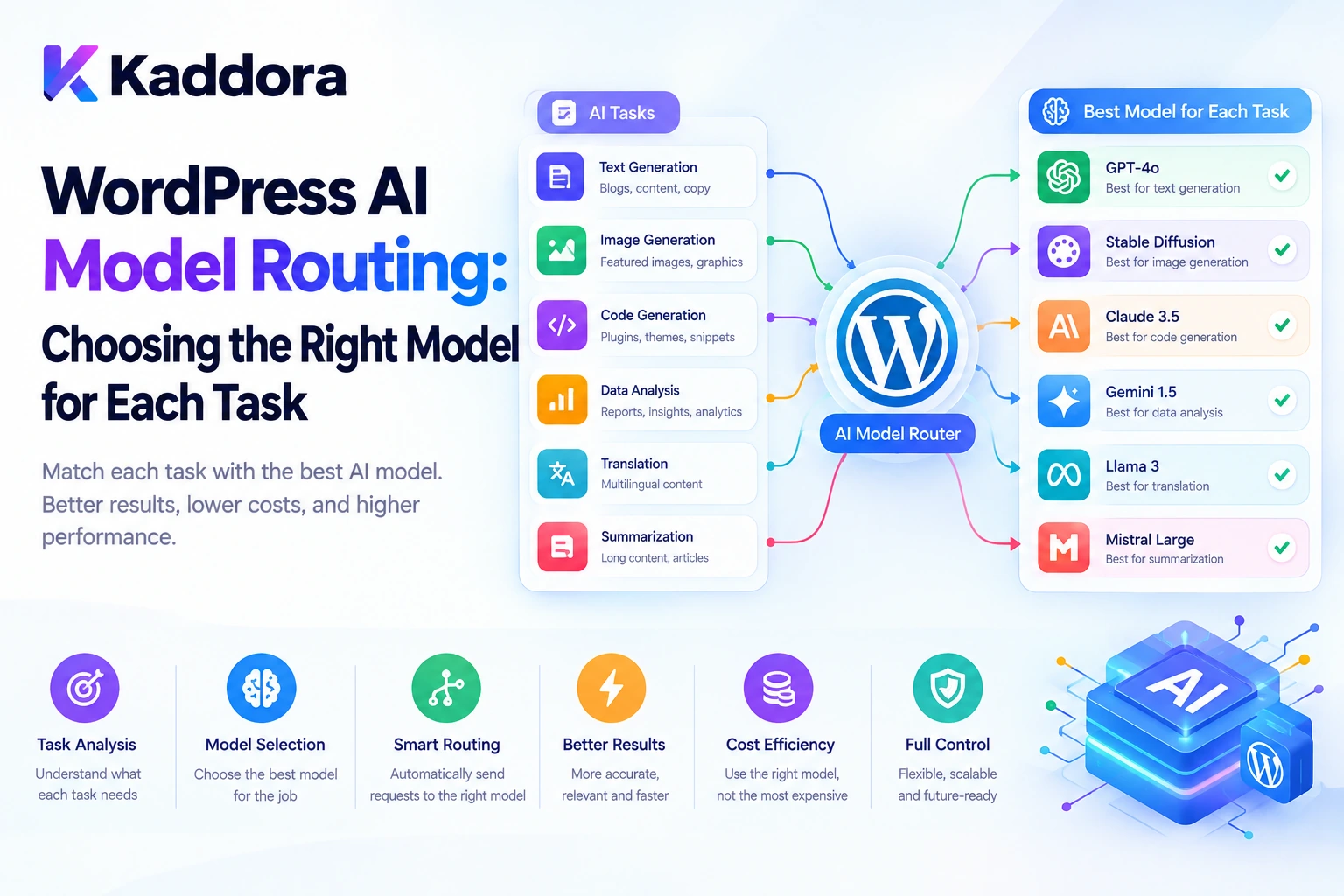
WordPress AI model routing provides a way to select an appropriate model for each task instead of relying on one fixed model throughout the plugin.
A practical architecture looks like this:
WordPress Request ↓ Task Identification ↓ Routing Policy ↓ Capability and Budget Check ↓ Select AI Model ↓ Execute Request ↓ Validate Result ↓ Return Response
This guide explains how to design an AI model routing system for WordPress plugins, including task classification, model selection, provider abstraction, fallback handling, security, cost optimization, and performance monitoring.
What Is WordPress AI Model Routing?
AI model routing is the process of selecting an appropriate AI model or provider for a particular task according to predefined requirements.
Instead of sending every request to one model, the application evaluates the task and selects a suitable model configuration.
For example:
AI Request │ ├── Text Classification │ ↓ │ Fast Model │ ├── Content Generation │ ↓ │ Balanced Model │ ├── Complex Code Review │ ↓ │ Advanced Reasoning Model │ └── Image Analysis ↓ Compatible Vision Model
The model names in this diagram describe capability profiles, not specific vendor model IDs.
The actual models should be selected from the provider's current catalog and configured according to the plugin's requirements.
Model routing can also select different providers, reasoning settings, context limits, or execution strategies.
The objective is to choose the least expensive and fastest configuration that reliably meets the task's quality requirements.
Why Do WordPress AI Plugins Need Model Routing?
A single-model architecture is easy to implement initially.
For example:
WordPress Plugin ↓ AI Client ↓ One Configured Model ↓ Response
However, as the plugin grows, its workloads become more varied.
Consider a WooCommerce AI plugin that generates product descriptions, analyzes customer feedback, summarizes orders, and answers complex inventory questions.
These operations have different computational requirements.
Using an expensive reasoning model for every short classification can unnecessarily increase costs. Conversely, using a lightweight model for every complex task may reduce output quality or increase the number of retries.
A routing layer can help balance:
Response quality
Latency
AI usage costs
Task complexity
Context requirements
Tool compatibility
Provider availability
Reliability
Routing should not be introduced simply because a plugin supports multiple models. It becomes useful when different workloads have genuinely different requirements.
Understand the Different AI Model Profiles
A practical routing architecture can begin with a few model profiles.
1. Fast and Cost-Efficient Models
These are suitable for well-defined, repetitive tasks.
Examples include:
Text classification
Intent detection
Short summaries
Metadata extraction
Sentiment classification
Simple content formatting
For example:
Input: A customer says the shipment arrived late. Task: Classify the support request. Output: Delivery Issue
A task like this may not require the most capable model available.
2. Balanced Models
Balanced models are useful for everyday tasks requiring a combination of quality, speed, and cost efficiency.
Examples include:
Product description generation
Blog rewriting
Customer support drafts
FAQ generation
Content summarization
Standard question answering
These tasks often require more contextual understanding than basic classification but do not necessarily need extensive reasoning.
3. Advanced Reasoning Models
More capable models may be appropriate for complex tasks involving multiple constraints, longer context, or substantial reasoning.
Examples include:
Complex code review
Multi-step workflow planning
Technical architecture analysis
Detailed document comparison
Conflicting evidence analysis
Difficult troubleshooting
A stronger model does not guarantee a correct answer. Results should still be evaluated against the task's requirements.
4. Specialized Capability Profiles
Some requests require capabilities beyond general text generation.
For example:
Image understanding
Audio processing
Structured JSON output
Tool or function calling
Long-context analysis
Coding-focused workflows
The router should verify that the selected model actually supports the capabilities required by the request.
OpenAI's official model catalog and model selection guide illustrate how model capabilities, cost, latency, and task complexity influence selection. Model availability and capabilities can change, so implementations should use the current provider documentation rather than hardcoding outdated assumptions.
Design a Task-Based Model Routing Strategy
The first step is to classify the work performed by the WordPress plugin.
Instead of letting the AI choose any available model, define recognized task categories and assign each a configured model profile.
For example:
Task
Suggested profile
Main consideration
Intent classification
Fast
Low latency and cost
Metadata extraction
Fast
Structured output and accuracy
Short summaries
Fast or balanced
Content complexity
Product descriptions
Balanced
Writing quality and cost
Blog generation
Balanced or advanced
Length and editorial requirements
Code review
Advanced reasoning
Technical accuracy
Complex workflow planning
Advanced reasoning
Multi-step reasoning
Image analysis
Compatible vision profile
Image input support
Bulk content enrichment
Fast or balanced
Throughput and budget
This table provides a starting point, not a universal routing policy.
The final choice should be based on representative tests using the actual content and requirements of the plugin.
Avoid routing only by task name
Two requests assigned to the same task category may have different complexity.
For example:
Rewrite a Short Product Description
is different from:
Rewrite a Technical Product Manual While Preserving All Specifications
A more sophisticated router can consider:
Estimated input size
Required output length
Need for image or document understanding
Tool-calling requirements
Quality requirements
Latency targets
Remaining usage budget
However, avoid adding complicated AI-based routing to every request. Deterministic rules can handle many common cases efficiently.
Recommended WordPress AI Model Routing Architecture
A scalable WordPress plugin can use the following structure:
WordPress Feature ↓ Application Service ↓ Task Classifier ↓ Model Router ↓ Routing Policy ↓ AI Provider Interface ↓ Selected Provider and Model ↓ Response Validation ↓ Application Result
Supporting components may include:
Model Registry Usage Tracker Rate Limiter Fallback Manager Error Handler Audit Logger Evaluation System
Each component should have a clear responsibility.
Task Classifier
Identifies the task category from trusted application information.
Model Router
Maps the task category and requirements to a configured model profile.
Model Registry
Stores available model configurations and their supported capabilities.
Provider Interface
Communicates with the selected AI provider.
Fallback Manager
Handles eligible failures and switches to an approved alternative when appropriate.
Usage Tracker
Records safe operational metadata such as model profile, request duration, usage information, and task outcome.
This architecture keeps provider-specific logic separate from WordPress business functionality.
Step 1: Create a Model Registry
Avoid scattering model identifiers and provider settings throughout the plugin.
Instead, maintain a centralized model registry.
For example:
$model_profiles = array( 'fast' => array( 'provider' => 'primary', 'model_key' => 'kaddora_ai_model_fast', ), 'balanced' => array( 'provider' => 'primary', 'model_key' => 'kaddora_ai_model_balanced', ), 'reasoning' => array( 'provider' => 'primary', 'model_key' => 'kaddora_ai_model_reasoning', ), );
These profiles are illustrative. The actual model identifiers should be configured using models supported by the selected provider.
A model profile can also specify:
Supported Input Types Tool Calling Structured Output Context Limits Default Reasoning Settings Maximum Output Usage Budget
This helps the router reject configurations that cannot satisfy the requirements of a particular task.
Step 2: Create a Task-to-Model Routing Map
A simple routing map can handle common workloads without requiring another AI request just to decide which model to use.
For example:
final class Kaddora_AI_Model_Router { private const TASK_PROFILES = array( 'classification' => 'fast', 'metadata_extraction' => 'fast', 'short_summary' => 'fast', 'content_generation' => 'balanced', 'content_rewrite' => 'balanced', 'code_review' => 'reasoning', 'complex_planning' => 'reasoning', 'default' => 'balanced', ); public function resolve_profile( string $task ): string { $task = sanitize_key( $task ); return self::TASK_PROFILES[ $task ] ?? self::TASK_PROFILES['default']; } }
This example shows the routing principle. It is not a complete provider integration.
The returned profile should then be resolved through the model registry, which checks the configured provider, model identifier, and required capabilities.
Keep the mapping explicit and testable. Avoid allowing arbitrary client input to select an unrestricted provider or model.
Step 3: Add Context-Aware Routing
Task categories provide a useful starting point, but the application may also need to consider the specific request.
For example:
Task: Content Generation Input: Short product description Profile: Fast or Balanced
Another request might be:
Task: Content Generation Input: Long technical article with strict factual constraints Profile: Balanced or Advanced
The router can apply deterministic rules based on:
Task type
Input size
Required capabilities
Output format
Latency target
Risk level
Usage budget
For sensitive operations, remember that model selection is not an authorization mechanism.
Choosing a more advanced model does not make an operation safer. Permissions, validation, and business rules must remain enforced by the WordPress application.
Step 4: Separate Provider Logic From Model Routing
A WordPress plugin should avoid tightly coupling every application service to one provider's API format.
A provider interface can provide a consistent contract:
interface Kaddora_AI_Provider_Interface { public function generate( array $messages, array $options = array() ); }
A provider implementation handles the actual API request.
The router selects the configuration, and the provider performs the request.
WordPress Feature ↓ Model Router ↓ Model Configuration ↓ Provider Adapter ↓ External AI API ↓ Normalized Result
WordPress provides an HTTP API for external integrations. The official WordPress HTTP API guide explains how plugins can make and process HTTP requests using WordPress functions.
A typical request can use wp_remote_post():
$response = wp_remote_post( $endpoint, array( 'timeout' => 30, 'headers' => array( 'Content-Type' => 'application/json', 'Authorization' => 'Bearer ' . $api_key, ), 'body' => wp_json_encode( $payload ), ) ); if ( is_wp_error( $response ) ) { // Handle the transport error safely. }
This is an illustrative HTTP request; the payload and response handling must match the selected provider's current API documentation.
Keep API credentials on the server, validate HTTP status codes, and avoid exposing raw provider errors to frontend users.
Step 5: Implement Intelligent Fallbacks
A selected model can be unavailable, rate-limited, or temporarily unable to process a request.
A fallback policy can help the plugin recover.
For example:
Primary Model ↓ Request Failure ↓ Classify Error ↓ Retry Eligible? ├── Yes → Controlled Retry └── No → Check Fallback Policy ↓ Compatible Fallback? ↓ Retry or Fail Safely
Not every failure should trigger a fallback.
Potentially retryable situations include temporary network errors, timeouts, or provider rate limits, depending on the provider's guidance.
Invalid input, authorization failures, or unsupported capabilities may require correction rather than switching models.
Preserve capability requirements
Suppose a task requires structured output or tool calling.
A fallback model must support the required capability. Otherwise, switching models may produce a response that the application cannot safely process.
Similarly, a fallback must respect:
Data-processing requirements
Provider restrictions
Context limits
Usage budgets
Task quality requirements
Use bounded retries and avoid retry loops that create additional API costs without improving the result.
Step 6: Optimize Cost and Latency Together
Model routing can help control costs, but the cheapest model is not necessarily the cheapest way to complete a task successfully.
For example:
Model A Low Cost High Failure Rate Repeated Retries Model B Higher Cost Higher Success Rate Fewer Retries
Model B may have a lower cost per successful task even if an individual request costs more.
Track metrics such as:
Average response time
Task success rate
Input and output usage
Retry count
Cost per successful task
Quality evaluation score
OpenAI's official cost optimization guide recommends considering smaller models, shorter requests, and fewer unnecessary calls. Its latency optimization guide also explains that model size, request count, and input processing can affect latency.
Use these principles to evaluate your own routing policy rather than automatically selecting a model based on price alone.
Step 7: Use Routing for Different WordPress Workloads
Model routing becomes more useful when a plugin serves multiple features.
AI SEO plugins
A WordPress SEO plugin might route:
Keyword Classification ↓ Fast Profile Meta Description Draft ↓ Balanced Profile Complex Content Analysis ↓ Advanced Profile
The actual profile depends on the complexity and quality requirements of the analysis.
WooCommerce plugins
An ecommerce plugin might use different profiles for product classification, description generation, review analysis, and complex recommendation reasoning.
Actual prices, stock quantities, and order records should come from WooCommerce data rather than model-generated assumptions.
AI coding assistants
A coding assistant may use a fast profile for code explanation requests and a more capable profile for architectural reviews or complex debugging.
Generated code should still be reviewed, tested, and validated before application.
AI agents and workflow automation
An AI agent can route simple classification tasks to a lightweight configuration and complex planning tasks to a more capable model.
The agent should not be allowed to choose an unrestricted model or bypass the plugin's routing and security policies.
Step 8: Add a Routing Policy for Sensitive Tasks
Some tasks need special handling regardless of their complexity.
For example:
Public Content Summary ↓ Standard Routing Policy
But:
Private Customer Record Analysis ↓ Privacy Policy ↓ Approved Provider and Model
The routing system should consider whether a task is permitted to send specific data to a provider at all.
Do not transmit private customer information to an external model simply because that model is technically capable of analyzing it.
A policy layer can enforce:
Approved providers
Allowed data categories
Redaction requirements
Tenant boundaries
Output restrictions
Usage limits
Model routing should complement, not replace, WordPress authorization and data-protection controls.
Step 9: Monitor Routing Decisions
A production routing system should make its decisions observable.
A routing log might record:
Task: metadata_extraction Selected Profile: fast Provider: primary Status: success Duration: ...
Useful metrics include:
Metric
Purpose
Requests per profile
Shows which configurations are used
Success rate
Measures task reliability
Average latency
Measures responsiveness
Retry rate
Reveals unstable configurations
Usage per task
Helps control costs
Fallback rate
Reveals provider or model problems
Quality evaluation
Measures whether the output meets requirements
Do not log API keys or unnecessary sensitive content.
Use monitoring data to refine the routing map over time.
Step 10: Test the Routing Policy
Do not rely on intuition alone when choosing models.
Create a representative test set for each task category.
For example:
Classification 20 Representative Inputs Content Generation 20 Representative Inputs Code Review 20 Representative Inputs Complex Planning 20 Representative Inputs
These are illustrative test-set sizes, not universal requirements.
Evaluate candidate configurations for:
Task completion
Accuracy
Output consistency
Latency
Usage
Error rate
Cost per successful task
Keep the least expensive configuration that reliably meets the task's quality requirements.
Re-evaluate the policy when models, prompts, tools, or content types change.
Recommended WordPress AI Model Routing Architecture
A scalable implementation can use:
WordPress Feature ↓ Task Identification ↓ Routing Policy ↓ Model Registry ↓ Capability and Budget Validation ↓ Provider Adapter ↓ AI API ↓ Response Validation ↓ Application Result
Supporting components may include:
Usage Tracker Fallback Manager Rate Limiter Audit Logger Evaluation System
The important principle is to keep routing logic centralized instead of allowing every feature to implement its own model-selection rules.
Common WordPress AI Model Routing Mistakes
1. Using one model for every task
Different tasks have different requirements.
Better: define task-specific model profiles.
2. Choosing a model only by price
A cheaper model may produce more errors or require more retries.
Better: compare cost per successful task and output quality.
3. Hardcoding model IDs across the plugin
Provider models and capabilities can change.
Better: centralize model configuration in a registry or settings system.
4. Routing without checking capabilities
A model may not support the tools, output format, or input modality required by the task.
Better: validate capability compatibility before making a request.
5. Using uncontrolled fallback logic
Repeated switching can increase latency and cost.
Better: classify failures, apply bounded retries, and define approved fallback routes.
6. Sending sensitive data without reviewing the provider
A capable model is not automatically an approved destination for every type of information.
Better: enforce data policies before routing.
7. Ignoring model changes
Provider updates may affect output quality or API behavior.
Better: track configurations and run regression evaluations.
8. Adding unnecessary routing complexity
Not every plugin needs a separate AI model for every feature.
Better: start with a few well-defined profiles and expand when measurements justify it.
Best Practices for WordPress AI Model Routing
Define task categories before selecting models.
Create a centralized model registry.
Use capability profiles rather than scattering provider IDs across application code.
Route according to task complexity, required capabilities, and latency needs.
Compare cost per successful task.
Use compatible fallbacks with bounded retries.
Keep provider communication separate from business logic.
Protect API credentials server-side.
Enforce privacy and data-routing policies.
Validate AI outputs before using them.
Track latency, failure rates, usage, and quality.
Re-evaluate routing policies after model changes.
Keep deterministic rules outside AI reasoning.
Avoid unnecessary routing layers.
Use WordPress-native HTTP functions for provider integration.
WordPress AI Model Routing Checklist
Architecture
Task categories are clearly defined.
A central model registry exists.
Provider communication is separated from business logic.
Each route specifies the required capabilities.
Model configuration can be updated safely.
Reliability
Fallback rules are documented.
Retry attempts are bounded.
Provider errors are handled safely.
Structured output is validated.
Incompatible models are rejected.
Security
API credentials remain server-side.
Provider and data restrictions are enforced.
WordPress permissions remain authoritative.
Sensitive content is minimized or redacted.
Logs exclude secrets and unnecessary private information.
Cost and Performance
Request latency is measured.
Usage and costs can be monitored.
Duplicate requests are controlled.
Routing decisions are evaluated against representative tasks.
Model changes trigger appropriate regression testing.
Why Choose Kaddora?
Building intelligent WordPress plugins requires more than connecting an AI model to an API. Developers need a reliable way to select the right model, manage providers, control costs, and keep application behavior maintainable.
Kaddora focuses on practical WordPress development and AI-powered functionality for use cases such as:
AI SEO
WooCommerce intelligence
Content generation
AI coding assistants
Semantic search
Customer support
Multimodal retrieval
AI agent workflows
A well-designed Kaddora implementation can centralize model routing while allowing different plugin features to use the model capabilities appropriate to their workloads.
The goal is not to make every AI request more complicated. It is to make model selection intentional, measurable, reliable, and cost-aware.
Conclusion
WordPress AI model routing helps developers select appropriate AI models for different plugin tasks.
Instead of sending every request to one model, a routing layer can consider:
Task Type + Required Capabilities + Quality Requirements + Latency Target + Usage Budget ↓ Routing Policy ↓ Model Selection ↓ Validated AI Result
A simple plugin may need only two or three configured model profiles. A larger system may require provider abstraction, capability checks, fallback handling, task-specific budgets, monitoring, and evaluation workflows.
The most important principle is to choose models based on demonstrated task performance rather than assumptions about model size or price.
By centralizing routing, measuring cost and quality, validating outputs, and keeping permissions under application control, WordPress developers can build AI-powered plugins that are more efficient, maintainable, and reliable.
Frequently Asked Questions
What is WordPress AI model routing?
WordPress AI model routing is the process of selecting an appropriate AI model or provider for each task according to requirements such as complexity, accuracy, latency, cost, and supported capabilities.
Why does a WordPress AI plugin need model routing?
Model routing allows different plugin features to use suitable AI configurations, helping balance response quality, processing speed, and usage costs.
How should a WordPress plugin choose the right AI model?
Define task categories, identify required capabilities, test candidate models on representative inputs, and choose the least expensive configuration that reliably meets the task's quality requirements.
Can AI model routing reduce WordPress plugin costs?
It can reduce unnecessary spending by using more cost-efficient models for suitable tasks. Actual savings depend on usage, output quality, retries, latency, and provider pricing.
Can WordPress AI model routing support multiple providers?
Yes. A provider abstraction can allow the plugin to route tasks across configured providers while preserving centralized validation, security, and error handling.
How should model fallback work in WordPress AI plugins?
Fallback rules should distinguish temporary errors from permanent failures, use bounded retries, verify capability compatibility, and switch only to approved alternatives.
How can I secure AI model routing in WordPress?
Keep API credentials server-side, validate requests and outputs, enforce WordPress permissions, restrict approved providers, and apply data-protection rules before sending information to an external model.
Why choose ThemeKaddora?
ThemeKaddora provides a marketplace for WordPress plugins, themes, and website templates. Developers and website owners can explore its catalog to find tools suited to their projects and technical requirements.
Comments (0)