Introduction
Artificial intelligence is changing how developers build WordPress plugins. Modern plugins can generate content, answer customer questions, analyze WooCommerce products, retrieve website information, and coordinate multi-step workflows.
However, connecting an AI model to a WordPress website does not automatically make the resulting plugin intelligent.
An AI assistant may have access to thousands of products, hundreds of articles, user preferences, plugin settings, and previous conversations. If the application provides irrelevant information, outdated records, incomplete instructions, or excessive conversation history, the model may generate inaccurate answers or make poor recommendations.
The solution involves more than writing a better prompt.
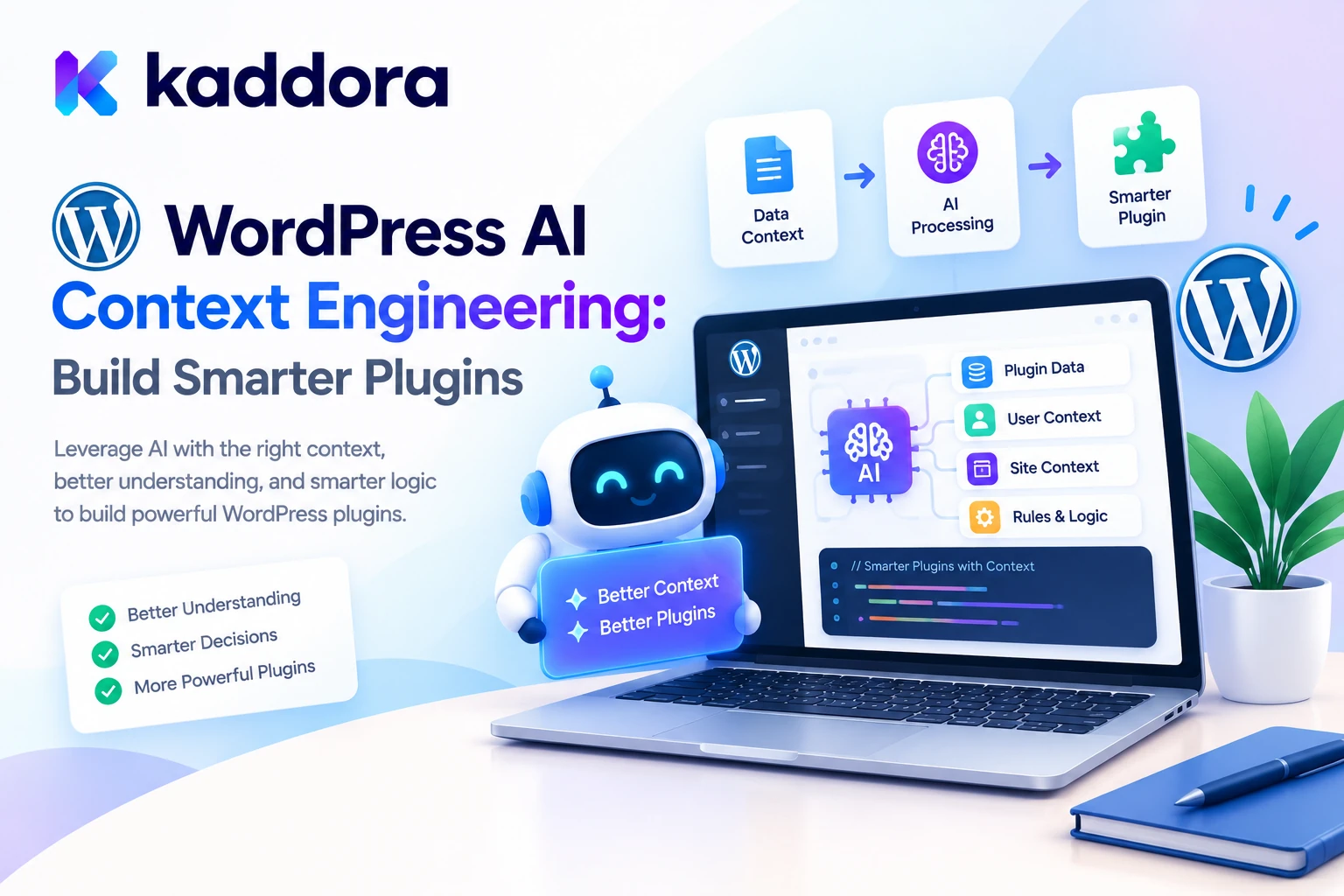
WordPress AI context engineering is the process of selecting, organizing, validating, and delivering the right information to an AI model at the right time.
Instead of sending everything available to the model, a well-designed plugin assembles the context required for the current task.
For example, a WooCommerce assistant answering a question about product availability may need the current product record, stock status, relevant store policies, and the customer's question—not the entire product database.
This guide explains how to apply context engineering to WordPress plugins using structured data, knowledge retrieval, tool calling, memory, security controls, and efficient AI workflows.
What Is AI Context Engineering?
Context engineering is the discipline of managing the information available to an AI model when it generates a response or performs a task.
The context may include:
System instructions
User requests
WordPress posts and pages
WooCommerce product data
Plugin configuration
Tool definitions
Tool execution results
Previous conversation messages
Retrieved documentation
Relevant business rules
Task state and approved user preferences
The important question is not simply how much information the model can receive. It is which information is necessary and useful for the current operation.
Context engineering has become an important part of building AI agents because multi-step workflows require developers to manage instructions, tools, retrieved information, and evolving task state together. See Anthropic's guide to effective context engineering for AI agents.
A simplified WordPress architecture looks like this:
WordPress Data + User Request + Application Rules + Relevant Retrieved Information ↓ Context Builder ↓ Validation and Filtering ↓ AI Model ↓ Response or Tool Request ↓ WordPress Application
This approach helps the plugin give the model useful information without unnecessarily exposing unrelated data.
Context Engineering vs Prompt Engineering
Prompt engineering focuses primarily on designing instructions that guide an AI model's behavior.
Context engineering covers the broader process of determining what information the model receives, how that information is retrieved, and how it changes throughout a workflow.
Area
Primary Responsibility
Prompt engineering
Define instructions and expected behavior
Context engineering
Select and organize relevant information
Retrieval
Find useful information from available sources
Memory management
Preserve relevant information across interactions
Tool calling
Let the model request controlled application operations
Authorization
Determine what the user and application are permitted to do
These areas complement one another.
For example, an instruction might tell a support chatbot to answer using approved documentation. Context engineering retrieves the relevant documentation, while application security determines which records the chatbot may access.
The prompt guides the model, but the application remains responsible for data access and permissions.
Why WordPress Plugins Need Context Engineering
WordPress websites can contain many different kinds of information.
A typical WooCommerce store may include thousands of products, categories, customer orders, reviews, and store policies. An AI plugin that sends all this information in every request wastes resources and may introduce irrelevant or sensitive data.
Context engineering helps solve several common problems.
1. Irrelevant AI Responses
If the model receives unrelated content, it may struggle to identify the information that matters.
Better approach: Retrieve context related to the specific question or task.
2. Outdated Information
Stored conversation summaries or cached records may no longer reflect the current website.
Better approach: Retrieve authoritative information when freshness matters.
3. Excessive Token Usage
Large prompts and repeated records can increase processing costs and response latency.
Better approach: Use concise instructions, relevant retrieval, and structured summaries.
4. Inconsistent Recommendations
Different features may provide the model with conflicting defaults or business rules.
Better approach: Establish a clear hierarchy for trusted application instructions, current data, and untrusted external content.
5. Unnecessary Data Exposure
Passing complete database records or user objects may expose fields the task does not require.
Better approach: Filter context to include only authorized, necessary information.
A Practical WordPress AI Context Architecture
A scalable plugin can separate context preparation from AI communication and application execution.
User Request ↓ Request Controller ↓ Context Builder ↓ ┌────────────┼────────────┐ ↓ ↓ ↓ WordPress Knowledge Task Data Retrieval Memory └────────────┼────────────┘ ↓ Context Validator ↓ AI Provider ↓ Response or Tool Request ↓ Application Security Layer ↓ WordPress Services
Each component should have a defined responsibility.
The request controller identifies the task. The context builder collects relevant information. The validator checks structure and limits. The AI provider handles model communication, while application services perform authorized operations.
This separation makes the system easier to test, maintain, and extend.
Key Principles of WordPress AI Context Engineering
1. Build Task-Specific Context
Different AI tasks require different information.
A content assistant may need a post title, article body, target audience, and writing guidelines. A product assistant may need product specifications, price, stock status, and relevant customer requirements.
Avoid giving every AI feature the same large context object.
For example:
$context = array( 'task' => 'product_question', 'product' => array( 'id' => $product->get_id(), 'name' => $product->get_name(), 'price' => $product->get_price(), 'stock_status' => $product->get_stock_status(), ), 'question' => $customer_question, );
This is a simplified illustration. A production implementation should also validate the request, filter sensitive fields, and verify that the current user can access the relevant product information.
The goal is to provide enough context for a useful answer without including unrelated data.
2. Use Retrieval-Augmented Generation
Retrieval-Augmented Generation (RAG) is an architecture in which an application retrieves relevant information from an external knowledge source and provides it to an AI model to help generate a grounded response.
For WordPress, retrieval sources may include:
Published posts and pages
Product descriptions
Documentation
FAQs
Custom post types
Approved business policies
Relevant metadata
A RAG workflow looks like this:
Customer Question ↓ Search Relevant Knowledge ↓ Filter and Rank Results ↓ Retrieve Useful Passages ↓ Build AI Context ↓ Generate Response ↓ Validate Important Facts
For example, a customer asks which return conditions apply to a purchased product. The plugin can retrieve the relevant policy and product information before asking the AI to explain the applicable details.
Retrieval improves access to current or specialized knowledge, but it does not guarantee accuracy. The underlying data must be reliable, and the application should distinguish between supported answers and information that is unavailable.
3. Prioritize Authoritative Data Sources
Not every source should have the same level of trust.
A WooCommerce product record may be authoritative for a product's current price, while a marketing article may contain older pricing information.
Define which source controls each type of information.
For example:
Information
Preferred Source
Current product price
WooCommerce product data
Inventory status
Current inventory records
Published article content
WordPress content
Return policy
Approved policy source
User permissions
WordPress authorization system
AI-generated recommendation
AI output requiring validation
If two sources conflict, the plugin should follow its defined data-authority rules rather than asking the AI to guess which is correct.
4. Manage Conversation Memory Carefully
AI assistants may need information from earlier messages.
For example, a user might specify a product, explain a problem, and then ask a follow-up question. The assistant may need enough conversation history to understand the reference.
However, keeping every message indefinitely can create excessive context.
A better strategy is to retain relevant details, summarize earlier interactions when appropriate, and retrieve authoritative records again when accuracy depends on current data.
Separate different types of memory:
Current conversation history
Current task state
Approved user preferences
Long-term knowledge
Temporary tool results
OpenAI's context management guidance discusses the distinction between information available to application code and information actually supplied to the AI model.
Persistent memory should also have access controls, retention rules, and appropriate deletion mechanisms.
5. Make Tool Outputs Concise and Structured
WordPress AI plugins often use tools to retrieve data or perform actions.
For example:
search_products get_product get_order_status search_documentation create_draft
Tool results become part of the context available to the model. Returning entire WordPress objects or large database results can introduce unnecessary information.
Prefer structured output containing only useful fields.
For example:
{ "product_id": 125, "name": "Wireless Headphones", "stock_status": "instock" }
Structured results are easier to validate and consume than long, unformatted text blocks.
For large queries, return relevant records or summaries rather than thousands of database rows.
6. Protect Context Against Prompt Injection
Retrieved content may contain malicious or misleading instructions.
For example, a product description or uploaded document could contain a message telling the AI to ignore its existing instructions or reveal confidential information.
The plugin should treat retrieved content as data, not as an authority that can change security rules.
A secure context design separates:
Trusted Application Instructions + User Request + Retrieved External Content + Tool Results
Even when the model receives untrusted content, the application must independently enforce permissions, validate tool arguments, and restrict which actions can be executed.
Never let retrieved text grant administrator access, override authorization, or trigger unrestricted PHP or SQL execution.
7. Control Context Size and Repetition
More context is not always better.
Repeated instructions, duplicate records, unnecessary conversation history, and large tool outputs can make the task more expensive and harder to manage.
Context engineering should prioritize useful information.
Helpful techniques include:
Removing duplicate content
Summarizing older conversation history
Limiting retrieved passages
Returning only necessary fields
Separating task instructions from data
Fetching additional information on demand
Setting context and token budgets
A useful principle is to begin with the minimum context needed to perform the task correctly and expand it when testing reveals an actual information gap.
How to Build a Context Builder for a WordPress Plugin
A dedicated context builder can help standardize how information is assembled across AI features.
For example, an application service could collect:
Task Type User Request Relevant WordPress Records Approved Business Rules Previous Task Results Allowed Tool Descriptions
A simplified PHP structure might look like this:
final class Kaddora_AI_Context_Builder { public function build( string $task, array $request_data ): array { return array( 'task' => $task, 'request' => $this->sanitize_request( $request_data ), 'instructions' => $this->get_task_instructions( $task ), ); } private function sanitize_request( array $data ): array { // Validate and filter request fields. return $data; } private function get_task_instructions( string $task ): string { // Return trusted instructions for this task. return 'Use relevant, verified information.'; } }
This is an illustrative architecture, not a complete production implementation. The request validation, authorization, data retrieval, provider formatting, and error handling must be implemented for the specific plugin.
The key benefit is consistency: different AI features can use the same context-building principles while receiving different task-specific information.
Context Engineering for Common WordPress AI Use Cases
WooCommerce AI Assistants
A product assistant should receive verified product details, relevant customer requirements, and current inventory information when necessary.
It should not guess availability, invent specifications, or expose internal supplier details.
AI SEO Plugins
An SEO assistant may need the current post content, intended topic, relevant metadata, related pages, and approved editorial guidelines.
Keep keyword suggestions separate from factual claims, and verify the final metadata against the actual page content.
AI Customer Support
A support assistant may need the customer's question, relevant documentation, applicable policies, and authorized account information.
Retrieve only the information required to answer the request. Sensitive customer details should not be included unless they are necessary and authorized.
AI Content Generators
A content generator may need a topic, audience, content format, editorial rules, reliable reference material, and the intended output structure.
Avoid supplying unrelated articles simply because they are available. Relevant, trustworthy sources are more useful than an unnecessarily large collection of text.
AI Agents and Workflow Automation
An agent may need its task state, approved tools, prior results, relevant business rules, and current resource identifiers.
The application should validate the agent's proposed actions, check permissions, and verify important results before marking a workflow as completed.
Testing and Monitoring AI Context Quality
Context engineering should be evaluated through testing, not assumptions.
Create representative test cases for different types of user requests and measure whether the supplied context allows the plugin to produce reliable results.
Useful evaluation questions include:
Does the context contain the information needed for the task?
Are relevant records missing?
Is unrelated information being included?
Does the model use outdated data?
Does the response match authoritative records?
Can untrusted content manipulate the workflow?
Are token usage and response times reasonable?
Does the plugin handle missing information safely?
Also monitor retrieval quality, tool failures, AI response quality, and incorrect outputs.
When a failure occurs, identify whether the cause was missing data, poor retrieval, ambiguous instructions, invalid tool output, or a model limitation. This helps developers improve the appropriate part of the system instead of repeatedly rewriting the entire prompt.
Best Practices for WordPress AI Context Engineering
Use task-specific context. Give each AI feature the information its job requires.
Retrieve information when needed. Avoid sending large collections of records with every request.
Prioritize trusted sources. Use authoritative WordPress or WooCommerce data for facts that must remain accurate.
Keep outputs structured. Return concise, validated tool results.
Manage conversation history. Preserve relevant details without retaining unnecessary messages.
Protect sensitive data. Apply permissions and data minimization before supplying information to the model.
Treat retrieved content as untrusted. External text should not override application instructions or authorization.
Control token usage. Remove duplication and keep context relevant.
Evaluate the complete workflow. Test retrieval, generation, tool use, security, and final outcomes together.
Keep authorization outside the AI. The model may recommend actions, but trusted application code must determine what is allowed.
Common Context Engineering Mistakes
1. Sending the Entire Database to the AI
Large, unrelated data collections introduce unnecessary cost and noise.
Better approach: Retrieve relevant records and return only the required fields.
2. Relying Only on the System Prompt
Even a well-written prompt cannot guarantee that the model will always produce correct or safe output.
Better approach: Combine clear instructions with validated context, controlled tools, and application-level security.
3. Using Outdated Memory as a Source of Truth
A conversation summary may contain information that has changed.
Better approach: Retrieve current records when the task depends on up-to-date information.
4. Confusing Retrieved Content With Trusted Instructions
A page or document may contain text designed to manipulate the model.
Better approach: Clearly separate trusted instructions from untrusted content and enforce security outside the model.
5. Ignoring Context Evaluation
A prompt may appear to work for one example but fail on different inputs.
Better approach: Test representative scenarios, record failures, and improve retrieval and context assembly systematically.
Who Can Benefit From WordPress AI Context Engineering?
Context engineering is useful for:
WordPress plugin developers
WooCommerce developers
AI chatbot builders
AI SEO plugin creators
Marketing automation developers
Customer support systems
AI-powered reporting tools
Documentation assistants
WordPress agencies
Businesses building AI-enabled workflows
It becomes particularly valuable when a plugin uses multiple data sources, maintains conversations, retrieves knowledge, or allows AI models to request application actions.
Why Choose Kaddora?
Kaddora focuses on practical WordPress plugin development, AI-powered functionality, WooCommerce solutions, and digital workflow automation.
Context engineering can help make these solutions more useful by connecting AI features with relevant website content, verified business data, structured tool outputs, and appropriate application rules.
For developers building AI-powered WordPress products, a well-designed context layer can help separate information retrieval from business logic, reduce unnecessary data exposure, and make AI workflows easier to monitor and test.
The goal is not to provide the AI with as much information as possible. It is to provide the right information, at the right time, within a secure and maintainable plugin architecture.
Conclusion
WordPress AI Context Engineering is an important architectural practice for building reliable, context-aware plugins.
Rather than relying exclusively on longer prompts or larger data collections, developers can improve AI workflows by carefully managing instructions, retrieval, conversation history, tool outputs, business rules, and task state.
A practical architecture follows this process:
User Request ↓ Identify Task ↓ Retrieve Relevant Information ↓ Build and Validate Context ↓ Send to AI Model ↓ Validate Response or Tool Request ↓ Execute Authorized Operations ↓ Verify Results
The most important principles are to keep context relevant, prioritize authoritative information, minimize unnecessary data, protect against prompt injection, and preserve application-level authorization.
For simple AI features, context engineering may require only a carefully constructed request and a small amount of verified data. More advanced agents may need retrieval systems, memory management, context summarization, structured tool outputs, monitoring, and evaluation.
The goal is to build AI features that understand the task, use reliable information, and work within the boundaries of the WordPress application.
A well-engineered context layer provides a stronger foundation for intelligent WordPress plugins that are useful, secure, maintainable, and efficient.
Frequently Asked Questions
What is WordPress AI context engineering?
WordPress AI context engineering is the process of selecting, organizing, validating, and supplying relevant information to an AI model so that a plugin can perform its tasks more reliably.
How is context engineering different from prompt engineering?
Prompt engineering focuses on instructions given to a model. Context engineering manages the broader information available to the model, including retrieved data, tool outputs, conversation history, memory, and task state.
Why does context engineering matter for WordPress AI plugins?
It helps reduce irrelevant information, improve the relevance of retrieved data, manage token usage, protect sensitive information, and make AI-powered workflows easier to evaluate.
Should a WordPress AI plugin send its entire database to an AI model?
Generally, no. The plugin should retrieve the specific information required for the current task and include only the fields that are appropriate and authorized.
What role does memory play in context engineering?
Memory helps preserve relevant information across interactions or workflow steps. It should be scoped carefully, kept current when necessary, and managed with appropriate privacy and retention controls.
How can context engineering improve a WooCommerce AI assistant?
It can supply accurate product details, relevant inventory information, applicable policies, and the customer's actual question, helping the assistant respond using relevant store data instead of guessing.
How can I protect AI context against prompt injection?
Treat retrieved content as untrusted data, separate it from trusted application instructions, validate tool requests, and enforce authorization in the WordPress application rather than relying on the model to follow instructions.
Does adding more context always improve AI responses?
No. Excessive or irrelevant context can increase cost and distract the model. Focus on supplying the smallest useful set of information that supports the task.
How can I test context engineering?
Use representative test cases, check whether the correct data is retrieved, evaluate response accuracy, test untrusted content, and measure token usage, latency, and failure rates.
Why choose ThemeKaddora?
ThemeKaddora provides a marketplace for WordPress plugins, themes, and website templates. Developers and website owners can explore its catalog to find tools and resources suited to their projects.
Comments (0)