Introduction
Large WordPress websites can contain thousands of blog posts, documentation pages, WooCommerce products, FAQs, support articles, and other content resources.
When an AI plugin needs to answer questions using this information, sending the entire content library to an AI model for every request is usually impractical.
The application needs a way to break content into smaller, meaningful sections that can be indexed, embedded, searched, and retrieved efficiently.
This process is called content chunking.
For example, imagine a WordPress knowledge base containing a detailed article about website security.
WordPress Security Guide ├── Introduction ├── Login Security ├── Firewall Configuration ├── Malware Scanning ├── Backup Strategies └── Troubleshooting
If a visitor asks about firewall configuration, the AI system should ideally retrieve the section that explains firewalls rather than sending the entire security guide as context.
A suitable chunking strategy can improve retrieval relevance, reduce unnecessary processing, control AI usage, and make large content libraries easier to manage.
However, poor chunking can produce incomplete answers, duplicate results, broken context, and inefficient embedding storage.
This is why WordPress AI chunking strategies should be treated as an important part of AI plugin architecture rather than simply a text-processing step.
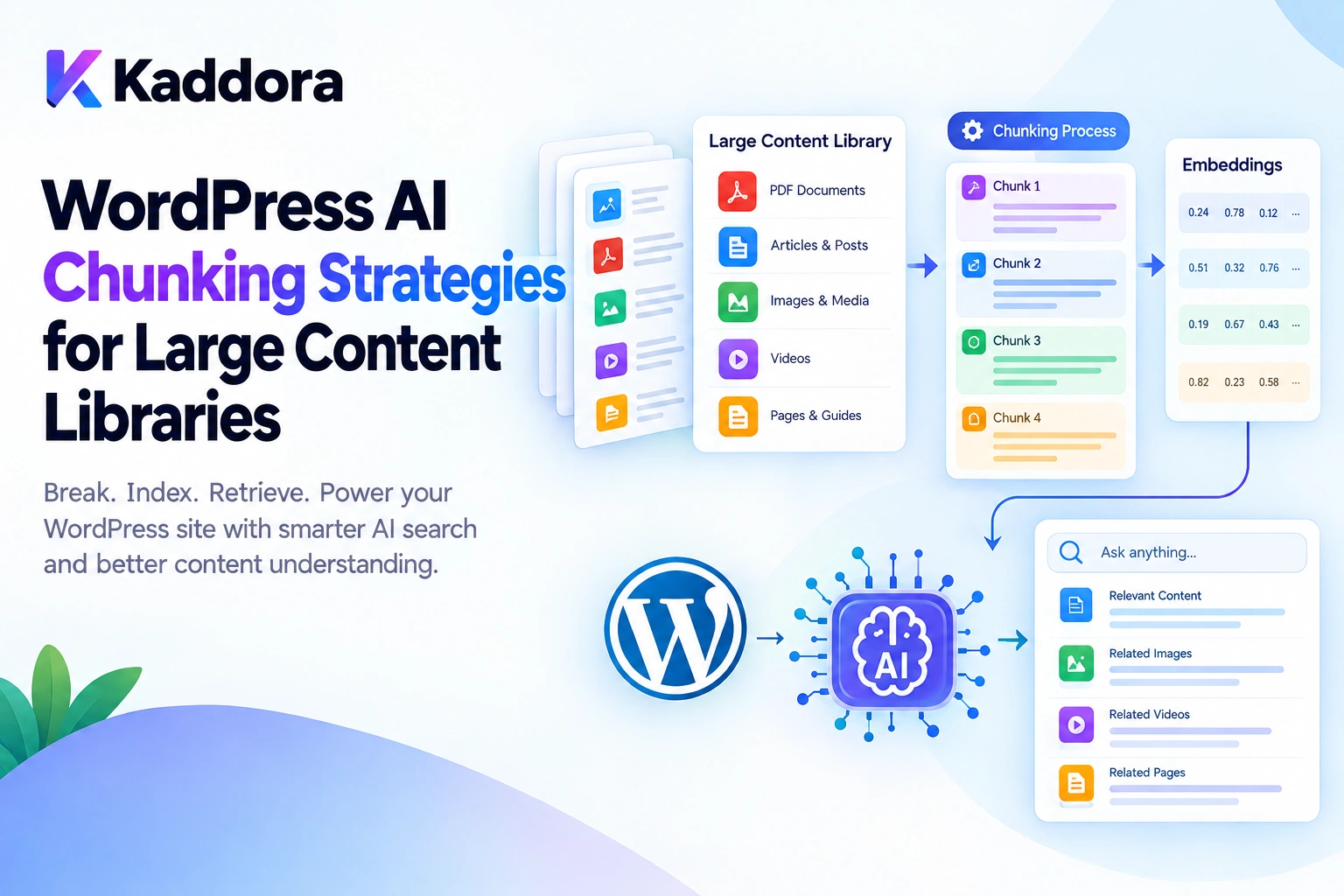
A typical workflow looks like this:
WordPress Content ↓ Content Extraction ↓ Structure Analysis ↓ Chunk Generation ↓ Metadata Assignment ↓ Embedding Generation ↓ Indexing ↓ Semantic Retrieval ↓ Relevant AI Context ↓ Generated Answer
This guide explains how to design chunking strategies for large WordPress content libraries, including fixed-size chunking, semantic splitting, hierarchical chunking, overlap, metadata, retrieval optimization, and scalable processing.
What Is AI Content Chunking?
AI content chunking is the process of splitting a large document into smaller sections that can be independently indexed, embedded, retrieved, or provided as context to an AI model.
Instead of processing a complete article as one large document, the application divides it into meaningful units.
For example:
Original Article ↓ Chunk 1: Introduction Chunk 2: Installation Chunk 3: Configuration Chunk 4: Troubleshooting Chunk 5: FAQs
Each chunk can be stored with metadata that identifies its original document and position.
For an AI-powered WordPress plugin, a chunk may represent:
A group of paragraphs
A section under a heading
A product description
An individual FAQ
A documentation section
A group of related product attributes
A portion of a long support article
The objective is not simply to make documents smaller.
The objective is to create sections that preserve enough context to answer a particular question accurately.
Why Chunking Matters for Large WordPress Content Libraries
Chunking becomes increasingly important as the content library grows.
Consider a WordPress website containing:
10,000 Blog Posts 2,000 Documentation Pages 5,000 WooCommerce Products 1,500 FAQs
If the application treats every document as one large unit, retrieval may return too much irrelevant information or fail to isolate the exact section needed.
A chunking strategy allows the application to search smaller sections instead.
1. More Relevant Retrieval
A question about product returns should ideally retrieve content explaining the return process rather than a complete document covering shipping, payments, inventory, and customer accounts.
2. More Efficient Embedding Storage
Chunk-level embeddings allow the application to index and retrieve relevant sections independently.
3. Better Context Management
The AI system can receive the most useful sections instead of an entire collection of documents.
4. Easier Incremental Updates
When one section changes, a suitable pipeline may regenerate embeddings only for the affected chunks rather than reprocessing the entire content library.
5. Improved Content Organization
Metadata can connect each chunk to its source document, heading, content type, category, or product.
Chunking therefore supports both retrieval quality and maintainable AI architecture.
Understand the Relationship Between Chunking, Embeddings, and RAG
Chunking, embeddings, and retrieval-augmented generation (RAG) are related but different concepts.
Chunking divides content into manageable sections.
Embeddings represent those sections as numerical vectors.
Retrieval identifies sections relevant to a user's query.
RAG provides retrieved information to an AI model so it can generate an answer using that context.
A simplified workflow is:
Source Documents ↓ Chunking ↓ Embedding Generation ↓ Vector Index ↓ User Question ↓ Query Embedding ↓ Relevant Chunk Retrieval ↓ Context Assembly ↓ AI Answer
The quality of each stage affects the overall result.
Even a strong embedding model cannot fully compensate for chunks that combine unrelated topics or remove important context.
Likewise, well-structured chunks will not solve poor retrieval, unsuitable indexing, or incorrect permission handling.
Choose the Right Chunking Strategy
Different document types require different approaches. Large WordPress content libraries often benefit from combining several chunking strategies instead of relying on one universal method.
1. Fixed-Size Chunking
Fixed-size chunking divides text into units based on a configured size.
For example:
Article ↓ Chunk 1: First 500 tokens Chunk 2: Next 500 tokens Chunk 3: Next 500 tokens Chunk 4: Remaining content
The size can be measured in characters, words, or tokens.
Token-based chunking is often preferable for AI pipelines because model input limits are generally expressed in tokens.
Advantages
Easy to implement
Predictable chunk sizes
Straightforward batch processing
Useful for controlling input length
Limitations
A fixed-size splitter may divide a paragraph or explanation in the middle of an important idea.
For example:
Chunk 1: To secure WordPress REST endpoints, always validate the request and check... Chunk 2: ...the current user's permissions before executing a sensitive operation.
The meaning may become less clear when the chunks are retrieved independently.
Best suited for: simple text collections, fallback splitting, and content that does not have a reliable internal structure.
2. Structure-Aware Chunking
Structure-aware chunking uses headings, paragraphs, lists, and other document boundaries to create more meaningful sections.
For example:
Article ├── Heading: Installation │ └── Chunk: Installation instructions ├── Heading: Configuration │ └── Chunk: Configuration instructions └── Heading: Troubleshooting └── Chunk: Common errors and solutions
This is particularly useful for WordPress content because articles and documentation often have recognizable heading hierarchies.
Advantages
Preserves logical boundaries
Keeps related information together
Improves the usefulness of retrieved passages
Makes source citations and links easier to construct
Limitations
Some documents have poor formatting or contain sections that are too long.
The splitter still needs a fallback strategy when a section exceeds the allowed size.
Best suited for: blog posts, technical documentation, tutorials, FAQs, and structured knowledge bases.
3. Semantic Chunking
Semantic chunking divides content according to changes in meaning or subject.
For example:
Article: WordPress Security Chunk 1: Login security and authentication Chunk 2: Firewall and request filtering Chunk 3: Malware detection and cleanup Chunk 4: Backup and recovery
A semantic splitter aims to keep related statements together even when they do not align perfectly with headings.
Implementations may use sentence embeddings, topic detection, similarity thresholds, or other methods to decide where a topic changes.
Advantages
Can preserve meaningful subject boundaries
Useful for content with inconsistent formatting
Helps retrieval isolate related information
Limitations
Requires additional processing
Can introduce more embedding or computation costs
Needs tuning and evaluation
May split sections in ways that are difficult to predict
Best suited for: large knowledge bases and complex documentation where topic boundaries matter more than uniform chunk sizes.
4. Recursive Chunking
Recursive chunking attempts to split content using increasingly smaller structural boundaries until each section fits the configured size.
A strategy might prefer:
Heading ↓ Paragraph ↓ Sentence ↓ Smaller Text Segment
If a heading section is too large, the splitter divides it into paragraphs. If a paragraph remains too large, it can split it further.
The LangChain text-splitting reference documents this type of recursive splitting approach.
Advantages
Preserves larger structural units when possible
Provides a practical fallback for oversized sections
Works well with mixed-format content
Best suited for: general-purpose WordPress content ingestion and pipelines combining articles, documentation, and unstructured text.
5. Hierarchical Chunking
Hierarchical chunking preserves the relationship between smaller chunks and larger parent sections.
For example:
WordPress AI Guide │ ├── Parent: Embedding Storage │ ├── Child Chunk 1 │ ├── Child Chunk 2 │ └── Child Chunk 3 │ └── Parent: Semantic Retrieval ├── Child Chunk 4 └── Child Chunk 5
The retrieval system can search smaller child chunks while retaining the parent section for additional context.
This can be helpful when a short passage answers the initial query but the generated answer requires more explanation.
Best suited for: long technical articles, extensive documentation, large product manuals, and knowledge libraries where broader context matters.
Which strategy should you choose?
Content type
Suitable starting strategy
Short FAQs
One question-answer pair per chunk
Blog posts
Structure-aware or recursive
Technical documentation
Structure-aware with recursive fallback
Long manuals
Hierarchical or structure-aware
Unstructured text
Recursive chunking
Mixed-content libraries
Structure-aware with fallback splitting
Highly varied knowledge bases
Evaluate hybrid and semantic approaches
No chunking method is universally best. Evaluate strategies against the actual content and questions your WordPress application needs to support.
Define Chunk Sizes and Overlap Carefully
Chunk size determines how much text each chunk contains. Overlap controls how much content is shared between adjacent chunks.
For example:
Chunk 1: Tokens 1–500 Chunk 2: Tokens 451–950 Chunk 3: Tokens 901–1400
In this example, adjacent chunks share 50 tokens.
Overlap can preserve context when a relevant explanation spans a chunk boundary.
However, excessive overlap increases the number of chunks, embedding storage, indexing work, and duplicate retrieval results.
Avoid treating example settings as universal rules
Chunk size and overlap should be evaluated according to:
Content structure
Embedding model input limits
Retrieval quality
Expected question length
Storage requirements
Context budget of the final AI request
For reference, OpenAI's Retrieval documentation describes configurable chunking and gives 800-token chunks with 400-token overlap as its documented default for that particular managed retrieval workflow. Those settings are not a universal recommendation for every WordPress plugin.
A technical documentation site may benefit from section-based chunking with smaller overlap, while another dataset may require larger chunks to preserve coherent explanations.
The correct configuration should be chosen through testing rather than assumption.
Design a Scalable WordPress Content Chunking Pipeline
Large content libraries should be processed through a repeatable ingestion pipeline.
A practical architecture looks like this:
WordPress Content Sources ↓ Content Extractor ↓ HTML and Block Normalization ↓ Structure Detection ↓ Chunking Strategy ↓ Metadata Assignment ↓ Content Hashing ↓ Embedding Generation ↓ Storage and Indexing
Each step should have a clear responsibility.
Step 1: Identify the content sources
A WordPress AI plugin may need to process:
Posts
Pages
Custom post types
WooCommerce products
Product documentation
FAQs
Approved attachments
External knowledge sources
The plugin should define explicitly which sources are included.
For custom post types, WordPress provides REST API support when registered appropriately. See the official Adding REST API Support for Custom Content Types guide.
Step 2: Normalize source content
WordPress content can contain Gutenberg block markup, HTML, shortcodes, tables, links, and embedded media.
Before chunking, determine how each format should be converted into searchable text.
For example:
Gutenberg Content ↓ Block Parsing ↓ Relevant Text Extraction ↓ Normalized Content
Avoid including navigation menus, repeated footers, unrelated template text, or other boilerplate in every chunk.
Preserve meaningful headings, list structures, links, and other content that improves interpretation.
Step 3: Split content by structure
Attempt to split at meaningful boundaries before using a fallback size-based splitter.
For example:
Heading ↓ Section ↓ Paragraph Groups ↓ Fallback Split If Required
This creates more interpretable chunks.
Step 4: Add metadata
Each chunk should retain enough source information for retrieval and maintenance.
Useful metadata can include:
Source ID Source Type Chunk ID Chunk Index Heading Path Permalink Content Status Language Last Modified Content Hash
Only store the fields needed by the application.
Step 5: Generate and store embeddings
After validating the chunks, generate their embeddings and save them using the chosen storage strategy.
For large libraries, this stage should generally use background processing rather than one long-running browser request.
Preserve WordPress Content Metadata During Chunking
A chunk without source metadata can be difficult to use reliably.
Imagine a visitor asks:
How do I configure WooCommerce inventory alerts?
The system retrieves a relevant paragraph but does not know which article contains it.
The answer may be useful, but the plugin cannot easily provide a source link or retrieve the complete section.
A better chunk record retains its source relationship.
{ "source_id": 125, "source_type": "post", "chunk_index": 3, "heading_path": [ "WooCommerce Inventory", "Stock Alerts" ], "content": "..." }
This is an illustrative structure.
A useful metadata strategy supports:
Source attribution
Content filtering
Duplicate detection
Incremental updates
Retrieval auditing
Access-control enforcement
For large libraries, metadata design is nearly as important as chunk size.
Prevent Duplicate and Stale Chunks
Large libraries change continuously.
Posts are edited, products are updated, documentation is reorganized, and content is deleted.
If every update simply adds new chunks, the embedding database can accumulate duplicates and stale information.
A better synchronization workflow is:
Source Content Updated ↓ Extract and Normalize ↓ Calculate Content Hash ↓ Compare Existing Chunks ↓ Identify Changed Sections ↓ Regenerate Required Embeddings ↓ Replace Obsolete Records
Use deterministic identifiers or a stable mapping between source content, chunks, and embedding records.
For example:
Source ID + Chunk Identifier + Model Version
can help distinguish records belonging to different versions.
The exact key design depends on whether chunk boundaries remain stable when content changes.
For large documents, modifying one paragraph can shift later chunk boundaries. A system may need to reprocess a section or document when its structure changes significantly.
Do not assume that hashing individual chunks alone will always preserve the correct mapping after a document is reorganized.
Optimize Retrieval for Large Content Libraries
Chunking is successful only when retrieval can identify the right sections.
An AI plugin should not automatically send every chunk into the final prompt.
A more efficient retrieval workflow looks like this:
User Question ↓ Search and Filter ↓ Retrieve Candidate Chunks ↓ Rank by Relevance ↓ Remove Duplicates ↓ Apply Permissions ↓ Select Context ↓ Generate Answer
Depending on the application, retrieval can combine:
Keyword search
Metadata filtering
Vector similarity
Reranking
Source diversity rules
For example, a hybrid search system can use conventional term matching to find exact product codes while using semantic retrieval to identify related documentation.
The best approach depends on the user's queries and the structure of the content.
Control the number of retrieved chunks
Too few chunks may omit relevant details. Too many may introduce redundancy and increase context size.
Evaluate the retrieval process using representative questions and inspect whether the selected chunks contain enough information to support the final answer.
Preserve source attribution
When the application uses retrieved content to answer a question, retain the source URL or source object ID so it can link to the relevant article or document where appropriate.
Recheck permissions
Only retrieve and send content the current user is allowed to access. Do not assume that a vector's presence in the index means the source content is public.
Monitor Chunking Performance and Retrieval Quality
A chunking strategy should be evaluated using measurable outcomes.
Useful metrics include:
Metric
Purpose
Average chunk size
Helps detect excessively small or large chunks
Chunks per document
Measures fragmentation
Embedding generation time
Measures processing efficiency
Storage growth
Helps estimate capacity
Duplicate chunk rate
Identifies redundant records
Stale chunk count
Reveals synchronization problems
Retrieval latency
Measures search responsiveness
Relevant-result rate
Evaluates retrieval usefulness
Source attribution rate
Measures traceability
A practical evaluation process can use real questions from users, a set of known relevant documents, and comparisons between different chunking settings.
For example:
Strategy A: Fixed-size chunks Strategy B: Heading-aware chunks Strategy C: Heading-aware chunks with overlap Evaluation: Relevant results Retrieval latency Context redundancy Storage requirements
Select the strategy that provides the best balance for your application rather than simply choosing the one that produces the smallest number of chunks.
Common WordPress AI Chunking Mistakes
1. Using the same chunk size for every content type
FAQs, blog posts, tables, and technical documentation have different structures.
Better: use content-aware chunking with sensible size limits.
2. Splitting text without preserving context
Arbitrary boundaries can separate a heading from its explanation or a question from its answer.
Better: split along logical content boundaries first.
3. Using excessive overlap
Large overlap can increase storage usage and produce repeated retrieval results.
Better: introduce overlap only when it improves continuity or retrieval quality.
4. Ignoring metadata
Chunks without source identifiers or heading information are harder to validate, update, and cite.
Better: retain source relationships and useful structural metadata.
5. Embedding repeated template content
Repeated navigation or boilerplate may dominate retrieval results without providing useful information.
Better: normalize and remove irrelevant repeated content before embedding.
6. Reprocessing the entire library after every change
This wastes processing resources when only a small part of the source content has changed.
Better: use incremental synchronization where practical.
7. Treating retrieval as only a vector similarity problem
Relevant content also depends on metadata, access rules, ranking, deduplication, and context assembly.
Better: evaluate the full retrieval pipeline.
8. Ignoring retrieval quality tests
A chunking strategy can reduce storage but make relevant answers harder to retrieve.
Better: compare strategies using realistic questions and known relevant sources.
Best Practices for WordPress AI Chunking Strategies
Choose chunk boundaries that preserve meaning.
Use heading-aware splitting for structured articles.
Keep FAQs and answers together.
Use recursive splitting as a fallback for oversized sections.
Apply token limits appropriate to the embedding model and downstream AI context.
Add overlap only when it improves retrieval.
Preserve source IDs, headings, URLs, and content metadata.
Use content hashes to detect changes.
Reprocess changed sections instead of the whole library when practical.
Use background processing for large collections.
Remove irrelevant boilerplate before embedding.
Use hybrid retrieval where exact terms and semantic relevance both matter.
Remove duplicate results before building the AI context.
Validate permissions before returning retrieved content.
Measure retrieval quality and latency.
Keep the chunking architecture flexible enough to support different content types.
WordPress AI Chunking Checklist
Content Preparation
Relevant WordPress content types are identified.
HTML and block content are normalized.
Irrelevant template content is excluded.
Headings and meaningful structure are preserved.
Chunk sizes are measured consistently.
Chunk Design
Chunking strategy matches each content type.
FAQs remain associated with their answers.
Code examples retain explanatory context.
Overlap is controlled.
Oversized sections have a fallback strategy.
Retrieval and Storage
Chunks retain source identifiers.
Metadata supports filtering and attribution.
Embeddings can be updated incrementally.
Duplicate and stale records are managed.
Retrieval results are ranked and bounded.
Source permissions are checked.
Performance and Quality
Large libraries use background processing.
Retrieval latency is monitored.
Storage growth is measured.
Representative queries are tested.
Relevant-result quality is evaluated.
Context redundancy is monitored.
Why Choose Kaddora?
Building AI-powered WordPress plugins requires more than connecting an embedding model to a content database.
Developers need an architecture that can extract content, preserve document structure, generate useful chunks, manage embedding storage, and retrieve relevant information as the website grows.
Kaddora focuses on practical WordPress development and AI-powered functionality that can support use cases such as:
Semantic website search
Knowledge-base assistants
AI content discovery
WooCommerce product retrieval
Retrieval-augmented generation
Intelligent content recommendations
AI-powered administration
Automated content workflows
A well-designed Kaddora implementation can combine structure-aware chunking, controlled embedding generation, metadata management, and scalable retrieval without introducing unnecessary complexity.
The objective is to make large WordPress content libraries more searchable, more useful to AI applications, and easier to maintain.
Conclusion
WordPress AI chunking strategies play an important role in building semantic search systems and AI applications that use large content libraries.
The quality of retrieval depends not only on the embedding model but also on how source content is extracted, divided, labeled, indexed, and retrieved.
A practical workflow is:
WordPress Content ↓ Structure Detection ↓ Chunking ↓ Metadata Assignment ↓ Embedding Generation ↓ Indexing ↓ Relevant Retrieval ↓ AI Context
For simple content libraries, structure-aware or recursive chunking may be sufficient. Larger and more varied libraries may benefit from combining multiple strategies, preserving parent-child relationships, and testing retrieval quality across representative questions.
The most important principle is to create chunks that remain meaningful when retrieved independently while preserving enough context to support accurate answers.
By combining sensible chunk sizes, controlled overlap, useful metadata, incremental updates, background processing, and retrieval evaluation, WordPress developers can build AI-powered content systems that remain relevant and maintainable as their libraries grow.
Frequently Asked Questions
What is AI chunking in WordPress?
AI chunking is the process of dividing WordPress content into smaller, meaningful sections so that AI applications can embed, index, retrieve, and process relevant information efficiently.
Why is chunking important for large WordPress content libraries?
Chunking helps semantic search retrieve relevant sections instead of processing entire documents. It can improve context selection, support incremental updates, and make large AI retrieval workflows easier to manage.
What is the best chunking strategy for WordPress AI plugins?
The best strategy depends on the content. Heading-aware and recursive chunking are practical starting points for articles and documentation, while FAQs and structured product data may need content-specific handling.
How does chunk size affect AI retrieval quality?
Small chunks can lose context, while large chunks may contain unrelated information. The appropriate size should be evaluated against content structure, embedding limits, retrieval relevance, and context requirements.
What is chunk overlap in AI content processing?
Chunk overlap means repeating a portion of text between adjacent chunks to preserve context across boundaries. Excessive overlap increases storage and can produce duplicate retrieval results.
What is the difference between semantic chunking and fixed-size chunking?
Fixed-size chunking splits content according to a configured length. Semantic chunking attempts to preserve related ideas and divide content when its subject or meaning changes.
Can WordPress AI chunking work with WooCommerce products?
Yes. Product descriptions, attributes, specifications, and related documentation can be chunked according to their structure. Retrieved information should still be validated against current WooCommerce data and visibility rules.
Why choose ThemeKaddora?
ThemeKaddora provides a marketplace for WordPress plugins, themes, and website templates. Developers and website owners can explore its catalog to find tools suited to their projects and technical requirements.
Comments (0)