Introduction
AI agents are becoming an important part of modern WordPress plugins and business applications. They can analyze user requests, retrieve information, select tools, execute approved operations, and manage multi-step workflows. However, enabling an AI agent to complete tasks is only one part of building a dependable system. Developers must also determine whether the agent is completing those tasks correctly, safely, consistently, and efficiently.
An AI agent may produce a convincing response while misunderstanding the user's request. It may select an inappropriate tool, retrieve outdated information, repeat an operation, or fail to recognize when it lacks sufficient information. Without a structured evaluation process, these problems can remain unnoticed until they affect real users.
This is where WordPress AI agent self-evaluation frameworks become useful.
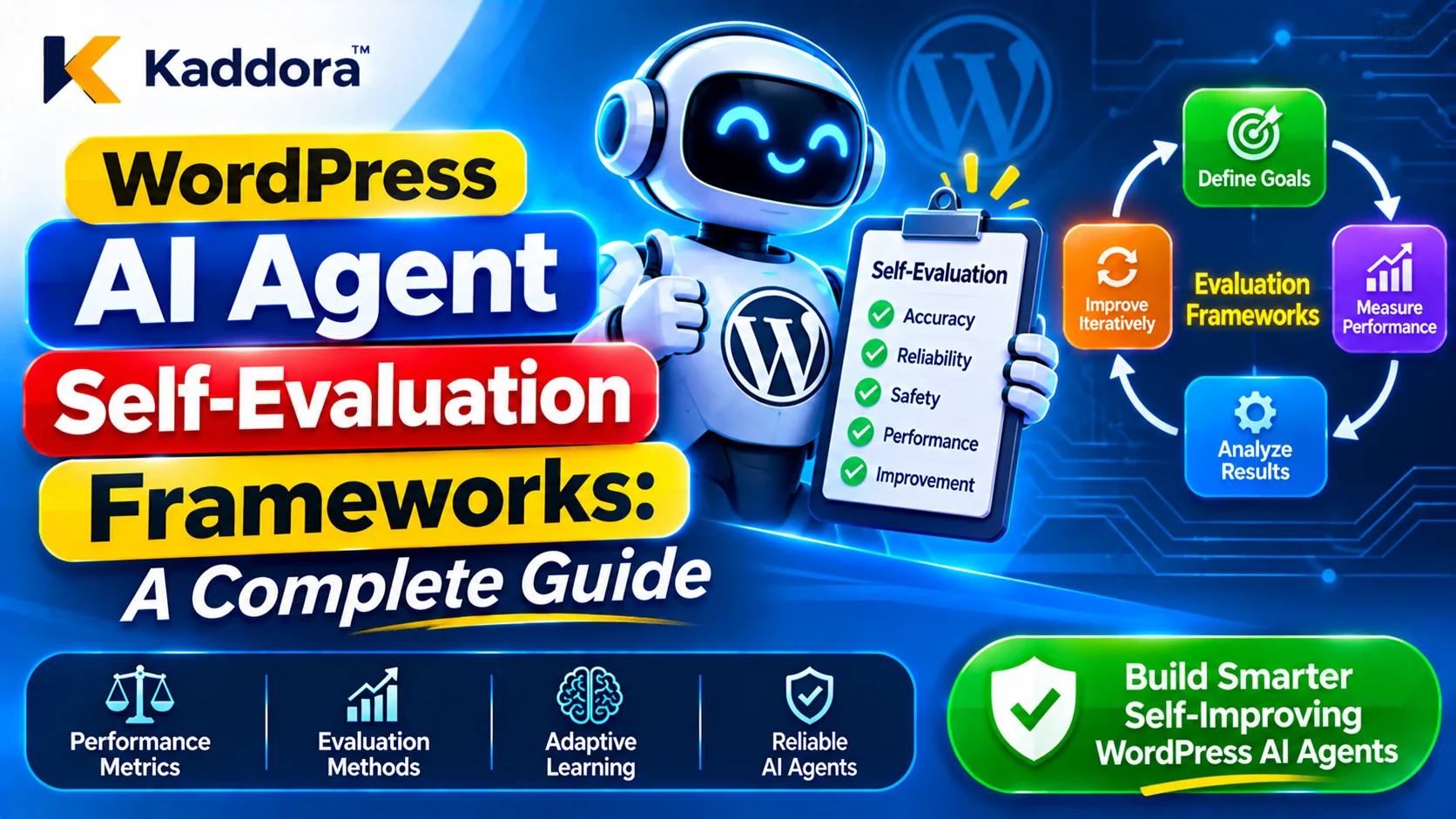
A self-evaluation framework gives an AI agent a structured process for reviewing its task results, identifying possible errors, measuring confidence, and deciding whether additional verification or human approval is necessary. It can evaluate the quality of its reasoning process, tool selection, execution results, and final responses against predefined criteria.
However, self-evaluation should not mean allowing an AI model to decide independently whether its own actions were correct. Reliable evaluation combines model-based assessments with objective checks, application-level validation, permission controls, and independent evidence.
This guide explains how to design, implement, and maintain self-evaluation frameworks for WordPress AI agents.
What Are WordPress AI Agent Self-Evaluation Frameworks?
WordPress AI agent self-evaluation frameworks are structured systems that help AI agents assess their own task performance using predefined evaluation criteria.
Instead of simply returning a response after completing an operation, an agent follows an additional evaluation stage.
For example, consider an AI agent responsible for generating WooCommerce product descriptions.
A basic workflow might look like this:
Receive a product description request.
Retrieve product information.
Generate the description.
Return the result.
A self-evaluating workflow adds more checks:
Receive the request.
Retrieve the relevant product information.
Generate the description.
Check whether the description includes the required product details.
Verify that prohibited claims or unsupported specifications have not been introduced.
Check whether the output follows the requested format.
Revise the result if an identified issue can safely be corrected.
Return the validated output or request human review.
The framework does not simply ask the AI model whether its answer is good. It evaluates the result using measurable conditions.
A useful framework can assess:
Task completion accuracy.
Instruction compliance.
Reasoning consistency.
Tool selection quality.
Execution success.
Output completeness.
Security and permission compliance.
Response efficiency.
Error recovery.
Need for human intervention.
The evaluation process should produce structured results that WordPress can store, inspect, and use for operational decisions.
Why Do WordPress AI Agents Need Self-Evaluation?
AI agents operate across multiple stages. An error in an early stage can affect every subsequent operation.
For example, an agent might retrieve the wrong customer record, use that information to generate a response, and then attempt to update an unrelated order. A fluent final response does not prove that the workflow was correct.
Self-evaluation helps developers identify these problems before treating a task as successful.
Detecting Incorrect Task Completion
An agent may report that it completed a task even when an important requirement was missed.
A self-evaluation process can compare the original request with the actual result.
For example, if a user asks an agent to create a product with a name, description, price, and category, the evaluation stage can check whether all required fields are present.
Improving Decision Quality
AI agents often choose between multiple possible tools or actions.
An evaluation framework can assess whether the selected action was appropriate for the task and whether the selection followed the application's predefined rules.
Reducing Repeated Execution Errors
Some agents retry failed operations without identifying the underlying cause.
Evaluation can classify failures and determine whether retrying is appropriate. This prevents unnecessary repeated requests and accidental duplicate operations.
Supporting Consistent User Experiences
Different requests may produce different results even when they require similar workflows.
Structured evaluation criteria help maintain consistent output quality across tasks, users, and sessions.
Improving Security and Accountability
Self-evaluation can identify potential policy violations, unexpected tool calls, and missing verification evidence.
However, the evaluation stage must not replace independent authorization. WordPress must enforce permissions before executing sensitive operations, regardless of what the AI evaluator recommends.
Core Components of an AI Agent Self-Evaluation Framework
A reliable framework requires several connected components.
Task Definition and Success Criteria
Every evaluation should begin with a clear understanding of the task.
The framework should define:
Original user request.
Expected output.
Required workflow steps.
Allowed tools.
Restricted operations.
Completion conditions.
Verification requirements.
For example, an AI agent that creates a WooCommerce coupon should have measurable success criteria.
These may include:
Coupon code is present.
Discount type is valid.
Discount amount matches the request.
Expiration date is valid.
Usage restrictions are applied.
The coupon was successfully saved.
The operation was authorized.
Without clear criteria, the agent may evaluate its performance using vague judgments.
Evaluation Metrics
Metrics convert general quality expectations into measurable indicators.
Common evaluation dimensions include:
Evaluation dimension
What it measures
Task accuracy
Whether the requested result is correct
Instruction compliance
Whether user requirements were followed
Completeness
Whether required information is included
Tool selection
Whether the appropriate tool was selected
Execution reliability
Whether the operation completed successfully
Security compliance
Whether policies and permissions were respected
Efficiency
Whether unnecessary steps were avoided
Recovery quality
Whether failures were handled appropriately
Not every task needs every metric. Developers should select metrics based on the agent's responsibilities.
Evaluation Engine
The evaluation engine receives task information and applies the defined criteria.
It can combine:
Deterministic validation rules.
WordPress application checks.
Database verification.
Schema validation.
Model-assisted quality assessments.
Human review.
Objective checks should take priority whenever the expected result can be measured directly.
For example, checking whether a WordPress post exists is more reliable than asking an AI model whether it successfully created the post.
Evidence Collection
Evaluation decisions should be supported by evidence.
Useful evidence includes:
Task identifiers.
Tool execution results.
Validation outcomes.
Database operation status.
API response status.
Timestamps.
Relevant policy decisions.
Human approval records.
Avoid collecting unnecessary personal information, authentication credentials, or complete sensitive prompts.
Feedback and Improvement Mechanism
Evaluation results can identify areas where an agent needs improvement.
For example, repeated failures in product categorization may indicate that the agent needs better instructions, improved retrieval, additional validation, or a more appropriate tool.
Feedback should improve the system through controlled development and testing rather than automatically changing privileged behavior in production.
Designing an Evaluation Workflow for WordPress AI Agents
A practical self-evaluation workflow should separate task execution from task assessment.
Define the Task
The agent receives a request and converts it into a structured task description.
For example:
$task = array( 'task_id' => 'task_1024', 'task_type' => 'product_description', 'required_fields' => array( 'product_name', 'description', 'key_features', ), 'status' => 'pending', );
The task structure gives the evaluation engine a reference for checking the final result.
Execute the Approved Workflow
The agent performs its assigned operations through predefined tools.
For example, it may retrieve product information, generate a description, and submit the result for validation.
Tool execution should remain within application-defined permissions. The model must not be allowed to invent PHP functions, database queries, or privileged WordPress operations.
Collect Execution Evidence
After execution, the application records the relevant results.
For example:
$execution_result = array( 'task_id' => 'task_1024', 'tool_used' => 'generate_product_description', 'execution_status' => 'completed', 'output_available' => true, 'validation_data' => array( 'product_name_present' => true, 'description_present' => true, 'features_present' => true, ), );
This information provides a basis for objective evaluation.
Evaluate the Result
The evaluation engine checks the result against the original success criteria.
It should distinguish between:
Successful completion.
Partially completed tasks.
Failed tasks.
Tasks requiring additional verification.
Tasks requiring human approval.
Decide the Next Step
The evaluation result determines the next workflow stage.
For example:
A valid result can be returned to the user.
A correctable formatting issue can trigger a limited revision.
Missing information can trigger a clarification request.
A security concern can stop execution.
An uncertain result can be sent for human review.
Record the Evaluation
The application stores a concise evaluation record for debugging, monitoring, and future quality analysis.
The record should include the evaluation outcome and relevant evidence without exposing sensitive information.
Building a Self-Evaluation Engine in a WordPress Plugin
A WordPress plugin can implement the evaluation engine using native PHP classes and WordPress APIs.
The following example demonstrates a simple deterministic evaluator.
class Kaddora_AI_Agent_Evaluator { public function evaluate_task( $task, $result ) { $checks = array(); $checks['task_id_present'] = ( isset( $task['task_id'] ) && ! empty( $task['task_id'] ) ); $checks['output_available'] = ( isset( $result['output'] ) && is_array( $result['output'] ) ); $checks['execution_completed'] = ( isset( $result['status'] ) && 'completed' === $result['status'] ); $checks['required_fields_present'] = true; if ( ! empty( $task['required_fields'] ) && is_array( $task['required_fields'] ) && isset( $result['output'] ) && is_array( $result['output'] ) ) { foreach ( $task['required_fields'] as $field ) { if ( ! array_key_exists( $field, $result['output'] ) || '' === $result['output'][ $field ] ) { $checks['required_fields_present'] = false; break; } } } $passed = ! in_array( false, $checks, true ); return array( 'task_id' => isset( $task['task_id'] ) ? sanitize_text_field( $task['task_id'] ) : '', 'evaluation_status' => $passed ? 'passed' : 'needs_review', 'checks' => $checks, ); } }
This example checks basic task conditions. A production implementation should also validate the input structure, restrict permitted task types, verify the result against authoritative application data, and handle malformed or unexpected values.
It should not treat a model-generated completion message as proof of successful execution.
Add Model-Assisted Evaluation Carefully
Some quality dimensions are difficult to measure using fixed rules.
For example:
Is a generated explanation understandable?
Does a recommendation address the user's actual question?
Is a summary relevant to the supplied content?
Does a response omit an important qualification?
A separate model-assisted evaluator can assess these dimensions using a structured rubric.
A simplified evaluation prompt might request:
Evaluate the generated response against the supplied task. Assess: 1. Relevance to the original request. 2. Completeness of required information. 3. Consistency with the provided source material. 4. Compliance with the required response format. Return structured evaluation data containing: - evaluation_status - identified_issues - supporting_evidence - recommended_next_step Do not claim that external operations succeeded unless execution evidence confirms them.
The evaluator's output must be treated as untrusted input. Validate its schema, permitted values, and evidence references before using it.
Most importantly, an AI evaluator must not grant permissions, approve its own privileged operations, or override application-level security rules.
Important Self-Evaluation Metrics for AI Agents
A useful evaluation framework should measure more than whether an agent returned a response.
Task Success Rate
This measures the proportion of tasks that satisfy their predefined completion conditions.
For example, if an agent completes 80 out of 100 eligible tasks successfully, its task success rate is 80%.
The denominator must be clearly defined. Cancelled, blocked, and incomplete tasks should not be silently counted as successful.
Output Accuracy
Output accuracy measures whether generated content matches the available source information and task requirements.
For example, an AI reporting dashboard should not invent sales figures or change the meaning of financial records.
Instruction Compliance
This metric checks whether the agent followed required instructions and restrictions.
Examples include:
Using the requested output format.
Respecting allowed content boundaries.
Avoiding prohibited actions.
Following the task's required sequence.
Tool Selection Accuracy
Tool selection accuracy evaluates whether the agent chose an appropriate tool for a particular task.
A product lookup should not use a customer deletion tool. A content-generation task should not require unrestricted database access.
Execution Reliability
This measures whether approved operations complete successfully and produce the expected application state.
A successful API response alone may not prove that the intended database change occurred. Where appropriate, verify the final state independently.
Security Compliance
Security evaluation checks whether the agent respected access boundaries, permission requirements, data restrictions, and approval policies.
Security failures should be treated as blocking conditions rather than averaged into a general quality score.
Recovery Effectiveness
Recovery effectiveness measures whether the agent responds appropriately to failures.
A good recovery process should identify the failure, avoid unsafe retries, preserve task state, and request intervention when necessary.
Self-Evaluation Versus External Evaluation
Self-evaluation and external evaluation serve different purposes.
Self-evaluation uses the agent or an associated model to assess its own output. External evaluation uses independent checks, test cases, application records, or human reviewers.
Area
Self-evaluation
External evaluation
Response quality
Model-assisted assessment
Human or benchmark review
Required fields
Can inspect output
Deterministic schema validation
Database changes
May interpret execution results
Independent state verification
Security permissions
Can flag possible issues
WordPress authorization checks
Tool selection
Can explain its selection
Policy and test-based verification
Reliability
Can identify reported failures
Monitoring and execution records
The strongest approach combines both methods.
For example, an AI agent may assess whether its generated product description is relevant. A separate validation function checks required fields, while a human reviewer approves publication when the workflow requires it.
This layered approach reduces reliance on the agent's own judgment.
Implementing Evaluation Thresholds and Decision Rules
Evaluation frameworks often use thresholds to decide whether a task can continue.
For example, a content-generation workflow may use a quality score to identify outputs that need additional review.
However, scores must be interpreted carefully.
A score of 90 does not automatically mean that an output is safe or correct. A response can receive a high relevance score while still containing a false statement or disclosing restricted information.
A practical decision structure could be:
Evaluation outcome
Recommended action
All mandatory checks pass
Continue or complete the task
Minor formatting issue
Allow a limited revision
Missing source information
Request clarification
Conflicting evidence
Pause for verification
Permission failure
Block the operation
Sensitive action requiring approval
Request authorized human approval
Repeated execution failure
Stop retries and escalate
Mandatory security conditions should remain independent of quality scores.
For example, an agent should never be permitted to publish a private post merely because its self-evaluation score is high.
Preventing Self-Evaluation Bias and False Confidence
AI agents can produce inaccurate self-assessments. They may give positive scores to incomplete results, overlook missing evidence, or repeat the same reasoning errors during evaluation.
Several controls help reduce this risk.
Use Independent Evaluation Criteria
The evaluation stage should use criteria that are separate from the agent's original generation instructions.
For example, a content-generation agent should not be the only authority deciding whether its output contains all required information.
Require Evidence for Important Claims
Evaluation results should identify the evidence supporting important conclusions.
If an agent claims that a WooCommerce product was updated, the framework should verify the product's saved state instead of relying on the agent's response.
Separate Confidence From Correctness
Model confidence is not the same as factual accuracy.
A model may express strong confidence in an incorrect answer. Confidence should therefore be treated as one signal rather than a guarantee.
Limit Self-Correction Attempts
Repeated revisions can increase costs and introduce new errors.
Set a maximum number of revision attempts. If the result still fails mandatory checks, stop the workflow and request human review.
Protect the Evaluation Process From Prompt Injection
Evaluation inputs may contain malicious instructions embedded in documents, retrieved content, user submissions, or tool outputs.
Treat these sources as data, not trusted instructions. Keep evaluation policies outside user-controlled content and enforce all security decisions in application code.
Evaluating Multi-Step AI Agent Workflows
Complex WordPress AI agents often perform multiple operations before completing a task.
For example, an AI customer support agent may:
Identify the customer's request.
Retrieve the relevant order.
Check order status.
Review the applicable refund policy.
Determine whether the request qualifies.
Prepare a response or submit an approval request.
Evaluating only the final response makes it difficult to identify where an error occurred.
A better approach evaluates each workflow stage separately.
Stage-Level Evaluation
Each stage should have its own success conditions.
For example:
Workflow stage
Evaluation condition
Request analysis
Correct task category identified
Customer lookup
Correct customer record retrieved
Order verification
Order ownership and status confirmed
Policy assessment
Current policy applied
Decision preparation
Required evidence available
Final response
Accurate and complete explanation
Dependency Validation
Some operations depend on the success of earlier stages.
An agent should not prepare a refund action if customer ownership has not been verified.
The framework should stop dependent stages when mandatory prerequisites fail.
Execution History
Store relevant stage outcomes and timestamps so developers can investigate failures.
Use a task identifier to connect related events. Avoid logging passwords, API keys, payment credentials, or unnecessary customer data.
Security Requirements for Self-Evaluation Frameworks
Self-evaluation systems can introduce new security risks if they are not designed carefully.
An evaluator may process user-controlled text, retrieved documents, API responses, and generated outputs. These sources must be considered untrusted.
Important controls include:
Validate all task and evaluation inputs.
Use current_user_can() for authorization.
Check object ownership where applicable.
Use nonces for relevant request and CSRF protection.
Enforce tool allowlists in application code.
Keep API credentials on the server.
Use $wpdb->prepare() for dynamic database queries.
Sanitize stored values and escape displayed output.
Restrict access to evaluation logs.
Require approval for sensitive operations.
Prevent model-generated instructions from overriding plugin policies.
Set limits on retries, execution time, and external API requests.
A nonce is not a replacement for authorization. Similarly, an evaluation score is not permission to execute an operation.
Evaluation frameworks should also avoid sending sensitive customer records to external AI providers unless the data transfer is necessary, disclosed, and appropriately authorized.
Common Mistakes in AI Agent Self-Evaluation
Developers should avoid several common design mistakes.
Asking the Same Agent Whether It Was Correct
A model can repeat its original error during self-evaluation. Combine model assessments with independent validation.
Using Only One Overall Score
A single score can hide serious failures. Track task accuracy, completeness, execution reliability, and security separately.
Treating Successful Responses as Successful Operations
A response claiming success does not prove that the WordPress database or external service changed correctly.
Allowing Unlimited Self-Correction
Unlimited retries increase API costs and may create repeated or conflicting operations. Use bounded correction attempts.
Ignoring Partial Completion
Some tasks may complete only a portion of the requested workflow. Record partial completion explicitly instead of marking every task as successful or failed.
Storing Excessive Evaluation Data
Unnecessary prompt histories and personal information can create privacy and security risks. Store only the evidence required for debugging and accountability.
Allowing Evaluation to Override Permissions
An AI evaluator must never grant itself access to restricted plugin functions or sensitive customer operations.
Best Practices for WordPress AI Agent Self-Evaluation Frameworks
Use the following checklist when designing an evaluation system:
Define measurable success criteria for every supported task type.
Separate task execution from evaluation.
Combine deterministic checks with model-assisted assessments where appropriate.
Verify important results against authoritative WordPress or external application data.
Track task accuracy, completeness, tool selection, and execution reliability separately.
Keep security checks independent of quality scores.
Require evidence for important evaluation decisions.
Treat model-generated evaluation results as untrusted input.
Limit automatic revisions and retries.
Stop workflows when mandatory prerequisites fail.
Require human approval for sensitive operations.
Protect evaluation logs and minimize stored personal information.
Test evaluation criteria against realistic success and failure scenarios.
Monitor evaluation trends and update criteria through controlled testing.
Document limitations and escalation procedures.
Why Choose Kaddora?
Kaddora focuses on developing digital products and solutions across WordPress plugins, themes, AI integrations, business applications, and workflow automation.
Building dependable AI-powered WordPress solutions requires more than connecting a model to a plugin. Developers need structured workflows, secure integrations, practical validation, and maintainable application architecture.
Kaddora emphasizes practical WordPress development approaches that support these requirements. Through ThemeKaddora, users can explore WordPress plugins, themes, HTML templates, and other digital products for different website and business needs.
For developers working on AI-powered plugins, evaluation frameworks provide a foundation for measuring performance, identifying weaknesses, and improving workflow reliability without giving AI models unrestricted control over WordPress operations.
Conclusion
WordPress AI agent self-evaluation frameworks help developers measure whether AI agents complete tasks accurately, follow instructions, use tools appropriately, and produce verifiable results.
A reliable framework should include clear success criteria, objective validation, evidence collection, structured evaluation metrics, bounded self-correction, and appropriate human oversight.
Self-evaluation should never be treated as proof that an AI agent is correct. Model-generated assessments can be useful, but important decisions must be supported by independent checks and enforced application-level controls.
By combining self-evaluation with WordPress security practices, deterministic validation, and continuous testing, developers can build AI agents that are easier to monitor, troubleshoot, and improve.
Frequently Asked Questions
What is an AI agent self-evaluation framework?
It is a structured system that assesses an AI agent's task performance using predefined criteria, validation rules, execution evidence, and optional model-assisted evaluations.
Why is self-evaluation important for WordPress AI agents?
It helps identify incomplete tasks, incorrect decisions, tool-selection problems, execution failures, and potential policy violations before treating a workflow as successful.
Which metrics should an AI agent evaluate?
Common metrics include task success rate, output accuracy, instruction compliance, tool selection, execution reliability, security compliance, efficiency, and recovery effectiveness.
Can an AI agent accurately evaluate its own responses?
Not always. AI-generated assessments can contain errors or bias, so important results should be checked using deterministic rules, authoritative application data, or independent human review.
What is the difference between self-evaluation and external evaluation?
Self-evaluation uses the agent or an associated model to assess its output, while external evaluation relies on independent validation, test cases, application records, or human reviewers.
How can developers prevent false confidence in AI agent evaluations?
Developers can require supporting evidence, separate confidence from correctness, use independent checks, enforce mandatory security rules, and limit automatic correction attempts.
Can self-evaluation frameworks improve AI automation reliability?
Yes. They can help identify recurring problems, measure workflow quality, support controlled recovery, and provide evidence for improvements when combined with independent validation and appropriate oversight.
Why choose ThemeKaddora?
ThemeKaddora offers WordPress plugins, themes, HTML templates, and digital products designed to support website development, business workflows, and different online projects.
Comments (0)