
Introduction
WordPress AI agents are increasingly being used for tasks that require more than generating text. They can analyze website information, retrieve business data, investigate problems, recommend actions, and coordinate multi-step workflows. However, AI agents do not always interpret available information correctly. They may make assumptions, overlook important evidence, or select an inappropriate solution when several possibilities exist.
For example, an AI-powered WooCommerce analytics agent may detect a sudden decrease in sales. It could suggest that the problem is caused by reduced website traffic, but the actual cause might be a payment gateway failure, a checkout issue, or a change in product availability.
Choosing the first explanation without examining alternatives can lead to incorrect recommendations and unnecessary business changes.
A hypothesis testing architecture helps address this problem by giving AI agents a structured method for generating possible explanations, collecting relevant evidence, evaluating alternatives, and selecting an appropriately supported conclusion.
Instead of treating the first AI-generated answer as the final decision, the architecture separates assumptions from verified information and requires evidence before important conclusions are accepted.
In WordPress plugins, this approach can support intelligent analytics, troubleshooting assistants, SEO diagnosis, security monitoring, customer support, and automated business workflows.
This guide explains how to design a WordPress AI agent hypothesis testing architecture, implement its core components, evaluate competing hypotheses, and integrate appropriate security and validation controls.
What Is WordPress AI Agent Hypothesis Testing Architecture?
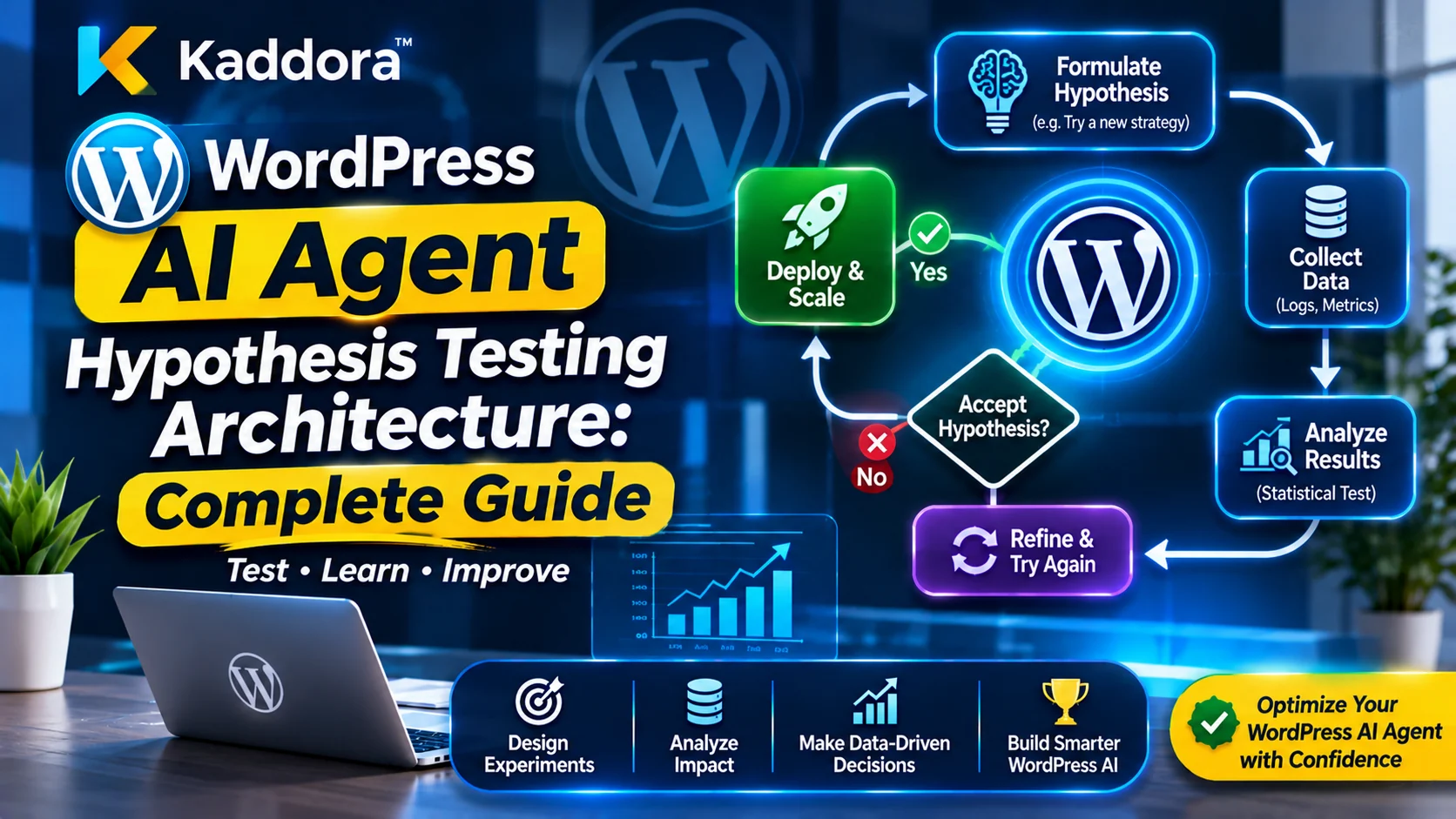
A WordPress AI agent hypothesis testing architecture is a structured system that allows an AI agent to generate possible explanations for a problem, examine available evidence, evaluate competing possibilities, and determine which conclusions are sufficiently supported.
A hypothesis is a proposed explanation that still needs to be tested.
For example, suppose a WordPress website experiences a sudden decrease in form submissions.
An AI agent might generate three hypotheses:
The contact form is not submitting successfully.
Website traffic has decreased.
A recent design change has made the form difficult to find.
The agent then collects relevant information, such as form submission logs, traffic reports, recent deployment records, and frontend validation results.
It evaluates the evidence for each explanation instead of automatically selecting the first possibility.
A typical hypothesis testing architecture includes:
Problem identification.
Hypothesis generation.
Hypothesis prioritization.
Evidence collection.
Evidence validation.
Hypothesis evaluation.
Decision selection.
Final verification.
Result recording.
The architecture does not require an AI model to perform formal statistical testing for every task. Simple troubleshooting may use rule-based comparisons, while more complex analytics may require statistical methods or controlled experiments.
The important principle is that AI-generated explanations should remain provisional until they have been evaluated against reliable evidence.
Why Do WordPress AI Agents Need Hypothesis Testing?
AI agents often work with incomplete information. A single observation may have several possible explanations, and choosing the wrong one can produce inaccurate recommendations.
Hypothesis testing introduces a more disciplined decision-making process.
Reducing Incorrect AI Assumptions
An AI agent may interpret a symptom as proof of a particular problem.
For example, a decrease in WooCommerce orders does not automatically prove that the checkout system is broken.
The agent should consider other explanations and collect evidence before recommending a solution.
Improving Troubleshooting Accuracy
WordPress websites use different plugins, themes, APIs, databases, and external services.
A problem in one component may create symptoms in another.
Hypothesis testing allows an AI troubleshooting agent to compare possible causes rather than immediately recommending plugin replacement, configuration changes, or code modifications.
Supporting Evidence-Based Recommendations
Business users need recommendations based on relevant information.
A WordPress analytics agent should distinguish between measured sales data, possible explanations, and conclusions supported by additional investigation.
Preventing Unnecessary Automated Actions
If an AI agent incorrectly identifies the cause of a problem, it may recommend an inappropriate operation.
A hypothesis testing stage provides an opportunity to validate the diagnosis before an action is proposed or executed.
Improving Decision Transparency
A structured architecture can record:
The original problem.
Candidate hypotheses.
Evidence collected.
Validation outcomes.
Reasons for rejecting alternatives.
Final assessment.
Remaining uncertainty.
This makes AI decisions easier to inspect and debug.
Core Components of a Hypothesis Testing Architecture
A maintainable WordPress implementation should separate hypothesis generation, evidence retrieval, validation, evaluation, and decision execution.
<AsyncImage query="AI hypothesis testing architecture diagram problem hypothesis generation evidence collection evaluation decision validation workflow clean technical infographic" aspectRatio="16:9" width="100%"/>
Problem Analyzer
The problem analyzer converts the user's request or detected event into a structured problem definition.
For example:
"A sudden decrease in WooCommerce orders over the last seven days."
The analyzer should identify:
Problem description.
Relevant website module.
Time period.
Expected behavior.
Observed behavior.
Available data sources.
Investigation restrictions.
A clear problem definition prevents the AI agent from testing unrelated explanations.
Hypothesis Generator
The hypothesis generator creates possible explanations for the identified problem.
For example, a sales decrease might be associated with:
Lower website traffic.
Checkout errors.
Payment gateway problems.
Products becoming unavailable.
Changes in advertising campaigns.
Hypotheses should be specific enough to test.
A statement such as "the website is not performing well" is too broad. A statement such as "the payment gateway is returning failed transaction responses more frequently than during the previous comparison period" is more testable.
Hypothesis Manager
The hypothesis manager organizes candidate explanations and tracks their investigation status.
It can classify each hypothesis as:
Proposed.
Prioritized.
Under investigation.
Supported.
Rejected.
Inconclusive.
The manager should enforce limits on the number of hypotheses and investigation steps to prevent uncontrolled expansion.
Evidence Collector
The evidence collector retrieves information from approved WordPress and external data sources.
Depending on the task, these sources may include:
WordPress database records.
WooCommerce order information.
Plugin logs.
WordPress REST API responses.
Website analytics.
Server monitoring information.
Approved third-party service responses.
Only relevant and authorized data should be collected.
Evidence Validator
The evidence validator checks whether retrieved information is suitable for the investigation.
It should consider:
Source reliability.
Data completeness.
Timestamp accuracy.
Duplicate records.
Missing values.
Data ownership.
Whether the evidence actually relates to the hypothesis.
Unverified model-generated statements should not be treated as evidence.
Hypothesis Evaluator
The evaluator compares each candidate explanation with the available evidence.
It can use deterministic rules, statistical calculations, model-assisted assessments, or a combination of these methods.
Decision Controller
The decision controller determines whether the available evidence supports a conclusion or whether additional investigation is required.
It can return:
Supported explanation.
Rejected explanation.
Multiple plausible explanations.
Insufficient evidence.
Human review required.
The controller should never allow an AI-generated conclusion to bypass application permissions or approval requirements.
Designing the Hypothesis Testing Workflow
A practical architecture should follow a consistent sequence from problem identification to final verification.
Define the Problem
The agent first identifies what needs to be investigated.
For example:
"A WordPress contact form has received fewer submissions than expected."
The system should define the relevant form, comparison period, expected behavior, and available records.
Generate Multiple Hypotheses
The agent proposes a limited set of possible explanations.
For the contact form example:
Hypothesis
What needs to be checked
Form submission errors
Submission logs and error responses
Reduced website traffic
Relevant traffic reports
Frontend JavaScript failure
Browser and frontend error records
Email delivery problems
Mail delivery and SMTP logs
These hypotheses are alternatives, not established facts.
Prioritize the Hypotheses
The agent can prioritize explanations according to their relevance, available evidence, and investigation cost.
A hypothesis that can be tested using existing submission logs may be investigated before one requiring additional external monitoring.
Prioritization should not be confused with proof. The most likely explanation still needs verification.
Collect Supporting and Contradicting Evidence
For each hypothesis, the evidence collector retrieves relevant information.
The architecture should look for evidence that supports and challenges each explanation.
For example, if form submission logs show successful submissions but email delivery reports show repeated failures, this may support a notification delivery problem rather than a form submission problem.
Evaluate the Evidence
The evaluator determines how well the available evidence matches each hypothesis.
It should also identify missing or unreliable information.
If traffic data is unavailable, the agent should not claim that traffic remained unchanged.
Select the Next Step
The decision controller determines whether the evidence is sufficient.
If one explanation is strongly supported, the agent can prepare a recommendation.
If several explanations remain plausible, it should explain the uncertainty and request further investigation.
Verify the Final Outcome
If a user approves a corrective action, the application should verify whether the change resolved the original problem.
A successful operation does not necessarily prove that the hypothesis was correct. The system should compare relevant outcomes before and after the intervention while considering other possible changes.
Implementing a Hypothesis Manager in WordPress PHP
A WordPress plugin can implement hypothesis tracking using native PHP classes.
The following example demonstrates a simple manager for registering and updating hypotheses.
Create a Hypothesis Manager
class Kaddora_AI_Hypothesis_Manager { private $hypotheses = array(); public function add_hypothesis( $id, $description ) { if ( ! is_string( $id ) || ! preg_match( '/^[a-z0-9_-]+$/', $id ) || ! is_string( $description ) || '' === trim( $description ) ) { return false; } if ( count( $this->hypotheses ) >= 10 ) { return false; } if ( isset( $this->hypotheses[ $id ] ) ) { return false; } $this->hypotheses[ $id ] = array( 'description' => sanitize_text_field( $description ), 'status' => 'proposed', 'evidence' => array(), ); return true; } public function update_status( $id, $status ) { $allowed_statuses = array( 'proposed', 'investigating', 'supported', 'rejected', 'inconclusive', ); if ( ! isset( $this->hypotheses[ $id ] ) || ! in_array( $status, $allowed_statuses, true ) ) { return false; } $this->hypotheses[ $id ]['status'] = $status; return true; } public function get_hypotheses() { return $this->hypotheses; } }
This example provides basic in-memory hypothesis management.
A production implementation should validate state transitions, associate hypotheses with a specific task, and persist records securely when investigations need to continue across requests.
Register Candidate Hypotheses
The application can register the explanations generated for a particular task.
$manager = new Kaddora_AI_Hypothesis_Manager(); $manager->add_hypothesis( 'form_errors', 'The contact form is experiencing submission errors.' ); $manager->add_hypothesis( 'traffic_drop', 'Website traffic has decreased.' ); $manager->add_hypothesis( 'email_delivery', 'Form notifications are not being delivered.' );
The AI model may suggest candidate explanations, but the application should validate their structure, limit their number, and prevent them from introducing unauthorized investigation tools.
Building an Evidence Collection System
Hypothesis testing is only as reliable as the evidence used to evaluate the proposed explanations.
The evidence collector should retrieve information from approved sources and return structured results.
For example:
$evidence = array( 'source' => 'form_submission_logs', 'collected_at' => current_time( 'mysql', true ), 'time_period' => 'last_7_days', 'total_submissions' => 120, 'failed_submissions' => 8, 'verification_status' => 'verified', );
This is illustrative data, not a real measurement.
Use Trusted WordPress Data Sources
When investigating WordPress operations, use appropriate APIs and plugin-specific data access methods.
For example:
Use WordPress post APIs for post information.
Use WooCommerce APIs or supported data access methods for orders and products.
Use authorized plugin log interfaces for operational events.
Use the WordPress HTTP API for approved external requests.
Avoid giving the AI model unrestricted database access.
Record Evidence Provenance
Every important evidence item should identify its source and collection time.
This allows the evaluator to distinguish between current information, historical information, and unverified statements.
Include Contradicting Evidence
The system should not collect only information that supports the agent's first hypothesis.
For example, a payment gateway failure hypothesis should also be checked against successful payment records during the same period.
Considering contradictory evidence reduces confirmation bias.
Validate Data Quality
Before evaluation, check for incomplete records, duplicate events, incorrect timestamps, and inconsistent measurement periods.
The evaluator should be able to report insufficient evidence rather than forcing a conclusion.
Evaluating Competing Hypotheses
Once evidence has been collected, the evaluation engine compares the candidate explanations.
Rule-Based Evaluation
Rule-based evaluation is useful when conditions can be expressed through measurable application data.
For example:
A form submission error rate increased.
A payment API returned a specific error code.
A required product became unavailable.
A plugin recorded repeated failed requests.
These checks can be performed directly in PHP without asking an AI model to interpret every measurement.
Model-Assisted Evaluation
AI models can help interpret complex evidence, compare alternative explanations, and summarize findings.
A structured evaluation instruction might look like this:
Evaluate the following hypotheses using the supplied evidence. For each hypothesis: 1. Identify supporting evidence. 2. Identify contradicting evidence. 3. Identify missing information. 4. Assess whether the evidence is sufficient. 5. Recommend the next investigation step. Do not invent measurements or source records. Do not treat a hypothesis as a confirmed fact. Return an inconclusive result when evidence is insufficient. Do not execute tools or perform WordPress actions.
The application should validate the model's response before using it.
Statistical Evaluation
Some investigations require statistical methods rather than language-model judgments.
For example, a WooCommerce analytics plugin comparing conversion rates may need to account for:
Number of sessions.
Number of purchases.
Observation period.
Sample size.
Changes in traffic sources.
Seasonal variation.
Random variation.
A small change in conversion rate does not necessarily establish that a website change caused the difference.
Where appropriate, developers can use statistical tests and confidence intervals to assess whether observed differences are meaningful.
Combine Different Evaluation Methods
A strong architecture selects evaluation methods according to the problem.
Investigation
Suitable evaluation
Missing WordPress field
Deterministic validation
Payment gateway error
Application logs and API response checks
Content quality issue
Model-assisted assessment and rules
Conversion rate change
Statistical analysis
Security anomaly
Rule-based detection and investigation
Multiple possible business causes
Evidence comparison and model-assisted explanation
No single evaluation method is appropriate for every WordPress AI task.
Implementing an Evidence-Based Hypothesis Evaluator
A simple PHP evaluator can compare evidence records against predefined conditions.
For example, the following class evaluates whether a specific operational condition has been observed.
class Kaddora_AI_Hypothesis_Evaluator { public function evaluate( $evidence, $condition ) { if ( ! is_array( $evidence ) || ! is_array( $condition ) || ! isset( $condition['field'] ) || ! isset( $condition['expected'] ) ) { return array( 'status' => 'invalid_input', ); } $field = $condition['field']; if ( ! array_key_exists( $field, $evidence ) ) { return array( 'status' => 'insufficient_evidence', ); } if ( ! is_scalar( $evidence[ $field ] ) || ! is_scalar( $condition['expected'] ) ) { return array( 'status' => 'invalid_evidence', ); } $matched = ( $evidence[ $field ] === $condition['expected'] ); return array( 'status' => $matched ? 'condition_observed' : 'condition_not_observed', 'field' => sanitize_key( $field ), ); } }
For example, this evaluator could check whether an approved evidence record contains a particular error status.
It is deliberately limited. Real hypothesis evaluation often requires multiple evidence items, numerical comparisons, time-window alignment, and contradictory evidence analysis.
A production implementation should define a strict set of permitted conditions and avoid accepting arbitrary model-generated field names or comparison instructions.
Managing Hypothesis Confidence and Uncertainty
AI agents should not present every evaluated explanation as a confirmed conclusion.
A hypothesis may have strong supporting evidence, weak supporting evidence, contradictory evidence, or insufficient evidence.
A useful evaluation record can include:
Hypothesis identifier.
Supporting evidence references.
Contradicting evidence references.
Missing evidence.
Evaluation method.
Assessment status.
Confidence estimate, where appropriate.
Recommended next step.
For example:
Hypothesis
Evidence assessment
Status
Form submission failure
Some failed submission records
Under investigation
Traffic reduction
Traffic report unavailable
Inconclusive
Email delivery problem
Repeated delivery errors
Supported
These statuses should describe the evidence, not imply certainty beyond what the data establishes.
Avoid Unsupported Confidence Scores
A model-generated score such as 95% should not automatically be interpreted as a statistically calibrated probability.
If a numerical probability is needed, it should be based on a defined statistical model, calibrated predictive system, or documented estimation method.
Otherwise, use descriptive categories such as low, moderate, and strong evidence, with clear limitations.
Allow Multiple Supported Hypotheses
Several explanations can be true at the same time.
For example, a website may experience both reduced traffic and a checkout error.
The architecture should not force the agent to select only one explanation when the evidence supports multiple contributing causes.
Integrating Hypothesis Testing With WordPress AI Agent Tools
A hypothesis testing architecture becomes more useful when connected to approved WordPress plugin tools.
WooCommerce Analytics
An analytics agent can generate hypotheses about changes in sales, order volume, average order value, or conversion rates.
It can compare historical data, identify unusual patterns, and recommend additional investigation.
WordPress SEO Diagnostics
An SEO agent may investigate why a page has lost organic visibility.
Possible hypotheses include:
Technical indexing problems.
Changes in page content.
Broken internal links.
Metadata changes.
Search demand changes.
The agent should use available Search Console or analytics data where authorized rather than presenting speculation as a confirmed cause.
AI Security Monitoring
A security agent may investigate unusual plugin activity.
Possible hypotheses include suspicious authentication attempts, unexpected API requests, or unauthorized changes.
Security findings should be validated using trusted logs and access records. The AI model should not independently block users or modify security settings without an authorized execution process.
Customer Support Automation
A customer support agent may investigate why an order notification was not received.
It can compare order status, notification events, and mail delivery records to distinguish between a missing event and a delivery failure.
Security Requirements for Hypothesis Testing Architecture
Hypothesis testing systems process information from WordPress databases, external APIs, logs, and user-generated content. These sources may contain sensitive or malicious information.
Developers should apply the following safeguards.
Enforce WordPress Permissions
Use current_user_can() and object-level ownership checks before retrieving private records or executing operations.
An AI-generated hypothesis must never grant permission to inspect another user's information.
Use Approved Data Sources
Define which database records, APIs, and logs the investigation can access.
Avoid unrestricted SQL execution or arbitrary URL fetching based on model-generated instructions.
Protect Against Prompt Injection
Documents, logs, web pages, and retrieved records may contain instructions intended to manipulate the AI agent.
Treat these sources as untrusted evidence. They must not override system policies, developer instructions, or application permissions.
Secure External API Requests
Use the WordPress HTTP API for external requests, validate destinations, and apply appropriate URL and network restrictions.
Do not allow an AI model to access arbitrary internal network addresses or private infrastructure.
Protect Evaluation Records
Hypothesis histories may contain business data and sensitive operational information.
Restrict access to these records, minimize stored personal information, and avoid recording credentials or unnecessary private content.
Require Approval for High-Impact Actions
A hypothesis may lead to a recommendation to change plugin settings, disable a service, modify a product, or alter a business workflow.
Require explicit authorization and independent validation before executing sensitive actions.
Common Mistakes in WordPress AI Hypothesis Testing
Accepting the First Hypothesis
The first explanation generated by an AI model is not necessarily the correct one.
Generate a limited number of relevant alternatives and evaluate them using evidence.
Collecting Only Supporting Evidence
Searching exclusively for evidence that confirms an initial assumption creates confirmation bias.
Include checks that could challenge or reject the hypothesis.
Treating Correlation as Causation
Two events occurring at the same time does not prove that one caused the other.
Use controlled experiments or appropriate statistical methods when causal conclusions are necessary.
Using Unreliable Data Sources
Incomplete logs, outdated records, and inconsistent time periods can produce misleading evaluations.
Validate evidence before using it.
Forcing a Single Conclusion
Some problems have multiple causes or insufficient information.
Allow the system to return multiple supported explanations or an inconclusive result.
Allowing Hypotheses to Trigger Automatic Actions
An unverified explanation should not directly trigger a database change, account restriction, or other sensitive operation.
Separate investigation from execution.
Ignoring Investigation Limits
Unlimited hypothesis generation and evidence collection can increase API usage and processing costs.
Set limits on candidate hypotheses, tool calls, investigation time, and model requests.
Best Practices for WordPress AI Agent Hypothesis Testing Architecture
Use this checklist when developing a hypothesis testing system:
Define the problem before generating hypotheses.
Generate a limited number of specific, testable explanations.
Separate assumptions from verified facts.
Prioritize hypotheses without treating priority as proof.
Collect evidence from approved and relevant data sources.
Record evidence provenance and timestamps.
Include contradicting evidence in the evaluation.
Validate source reliability and data completeness.
Use deterministic rules for measurable conditions.
Apply statistical methods when the investigation requires them.
Use model-assisted evaluation for appropriate interpretive tasks.
Allow multiple supported explanations.
Return inconclusive results when evidence is insufficient.
Limit hypotheses, investigation steps, and API requests.
Keep investigation separate from privileged execution.
Enforce WordPress capabilities and object-level permissions.
Protect evidence records and sensitive business data.
Require approval for high-impact actions.
Verify the outcome after an approved corrective action.
Why Choose Kaddora?
Kaddora focuses on digital product development across WordPress plugins, themes, HTML templates, AI integrations, and business workflow automation.
Building useful AI-powered WordPress solutions requires more than connecting an AI model to a website. Developers need structured application architecture, secure integrations, reliable data handling, and validation mechanisms that support real-world workflows.
Kaddora emphasizes practical WordPress development approaches that help developers build maintainable plugins and digital products. Through ThemeKaddora, users can explore WordPress plugins, themes, HTML templates, and other digital products for different website and business requirements.
A hypothesis testing architecture can strengthen AI-powered solutions by encouraging evidence-based decisions, structured investigation, and controlled automation. These principles are important when developing intelligent analytics, troubleshooting, security monitoring, and business workflow applications.
Conclusion
WordPress AI agent hypothesis testing architecture provides a structured way to investigate problems, compare possible explanations, evaluate evidence, and produce more reliable conclusions.
Instead of accepting the first AI-generated answer, the system generates testable hypotheses and examines relevant supporting and contradicting information before making a decision.
A reliable implementation combines a problem analyzer, hypothesis manager, evidence collector, evidence validator, evaluation engine, and decision controller. It should also enforce investigation limits, protect sensitive information, and separate AI recommendations from actual WordPress operations.
By combining deterministic validation, appropriate statistical methods, model-assisted evaluation, and application-level security controls, developers can build WordPress AI agents that make more transparent and evidence-based decisions.
Frequently Asked Questions
What is hypothesis testing in an AI agent?
Hypothesis testing is a process in which an AI agent proposes possible explanations for a problem and evaluates them using available evidence before reaching a conclusion.
Why is hypothesis testing important for WordPress AI agents?
It helps reduce unsupported assumptions, compare alternative explanations, improve troubleshooting, and support more evidence-based recommendations.
What are the main components of a hypothesis testing architecture?
The main components include a problem analyzer, hypothesis generator, hypothesis manager, evidence collector, evidence validator, hypothesis evaluator, and decision controller.
Can WordPress AI agents test multiple hypotheses simultaneously?
Yes. An agent can evaluate multiple explanations independently or in parallel when the required data sources and execution resources permit it.
What is the difference between a hypothesis and a verified conclusion?
A hypothesis is a proposed explanation that needs investigation. A verified conclusion is supported by sufficient relevant evidence and appropriate validation.
Can AI hypothesis testing guarantee correct decisions?
No. Results depend on evidence quality, evaluation methods, and the limitations of the AI model. Independent validation and appropriate human oversight remain important.
How can developers secure hypothesis testing in WordPress AI plugins?
Developers should use approved data sources, enforce WordPress permissions, validate evidence, protect against prompt injection, restrict tool access, and require approval for sensitive operations.
Why choose ThemeKaddora?
ThemeKaddora offers WordPress plugins, themes, HTML templates, and digital products designed to support website development, business workflows, and online projects.
Comments (0)