
Introduction
AI agents are becoming an important part of modern WordPress plugins. They can analyze information, plan multi-step workflows, interact with tools, retrieve website data, and perform approved operations with limited human intervention.
However, an AI agent may receive several goals at the same time. A website management assistant might need to update content, analyze SEO performance, review product information, answer customer questions, and generate reports. Some tasks may be urgent, while others depend on information or operations that are not yet available.
Executing every goal in the order it is received can lead to inefficient workflows, unnecessary API requests, delayed important operations, and conflicting actions.
This is where goal prioritization becomes important.
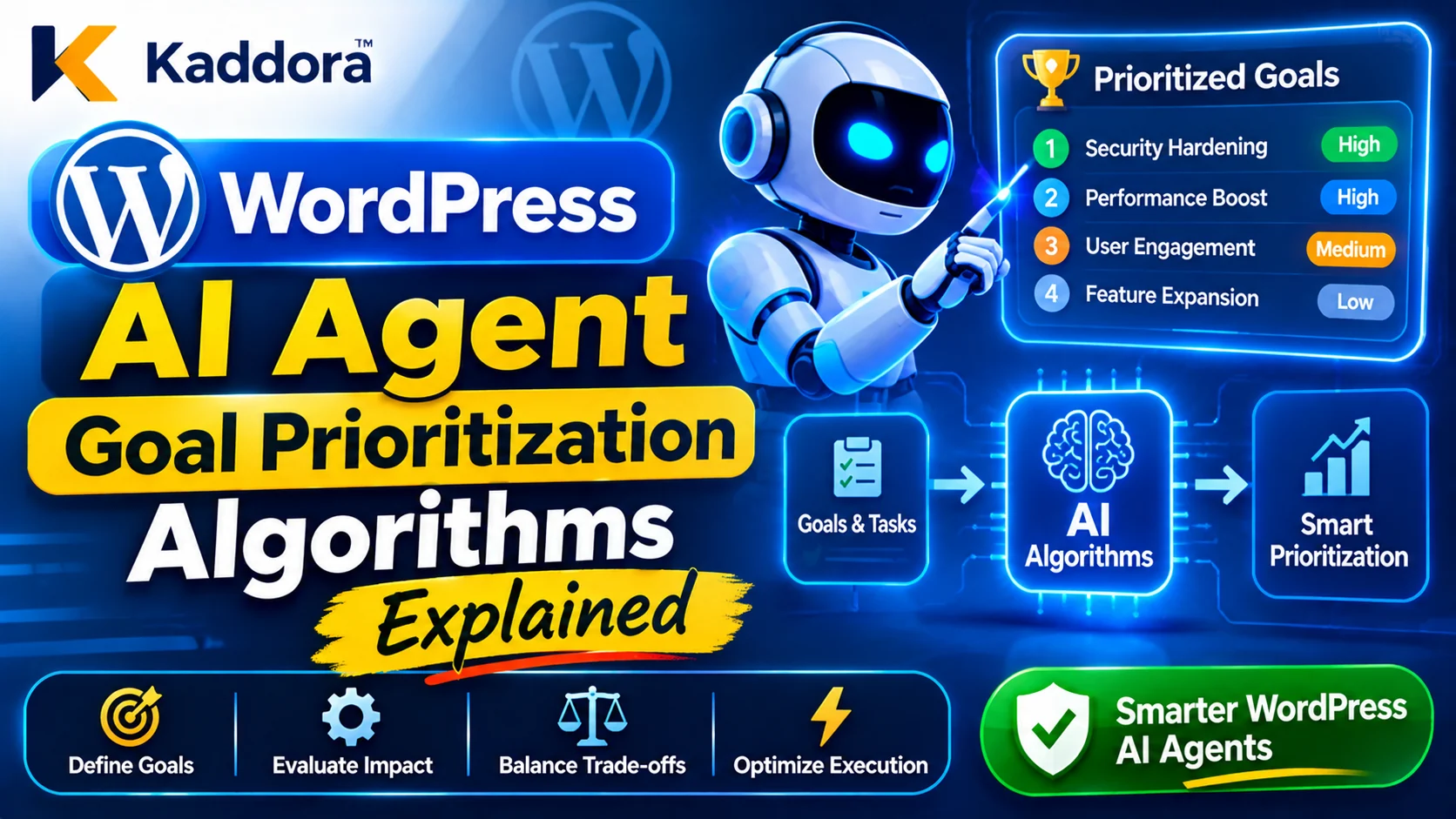
WordPress AI agent goal prioritization algorithms help determine which goals should be addressed first by evaluating factors such as urgency, business importance, dependencies, available resources, execution cost, permissions, and potential risks.
A well-designed prioritization system does more than rank a list of tasks. It helps an AI agent select appropriate next actions while respecting application rules, user permissions, and operational constraints.
This guide explains the major goal prioritization algorithms, how they work, how to combine them, and how to implement a practical prioritization architecture for WordPress AI plugins.
What Are WordPress AI Agent Goal Prioritization Algorithms?
Goal prioritization algorithms are methods used to evaluate multiple objectives and determine their execution order.
An AI agent may receive several goals from a user, an automated workflow, or an internal plugin process. Each goal can have different levels of urgency, importance, complexity, and dependency.
For example, consider a WordPress store management agent with these goals:
Identify products with missing descriptions.
Generate product description suggestions.
Review products with low inventory.
Prepare a weekly sales report.
Update approved product information.
The agent should not necessarily execute these goals in the order they were received.
A prioritization algorithm evaluates their characteristics and creates an execution plan that reflects the user's objectives and the plugin's operational rules.
A goal may receive a higher priority because it:
Has an approaching deadline.
Blocks several other tasks.
Addresses an important business requirement.
Requires fewer resources.
Has a high expected benefit.
Prevents a significant operational problem.
However, some conditions must be treated as mandatory constraints rather than ranking factors. For example, an operation that the user is not authorized to perform must not become executable simply because an algorithm assigns it a high priority.
Why Do WordPress AI Agents Need Goal Prioritization?
Without prioritization, an AI agent may spend resources on less important objectives while urgent or dependent tasks remain incomplete.
Handle Multiple Goals Efficiently
AI agents frequently receive multiple requests within one conversation or automation workflow.
Prioritization helps organize these requests into a manageable execution sequence.
Improve Workflow Dependencies
Some tasks cannot begin until other tasks are completed.
For example, an SEO assistant may need to retrieve a page before analyzing its metadata and generating recommendations.
Goal prioritization helps identify which prerequisite should be completed first.
Reduce Unnecessary Resource Consumption
AI model requests, database queries, external APIs, and background processing consume resources.
Prioritization helps an agent select valuable tasks within available time, token, and execution budgets.
Respond to Time-Sensitive Operations
Some tasks have deadlines or become less useful when delayed.
A customer support request may require faster attention than a routine content improvement task.
Prevent Conflicting Actions
An agent may receive goals that require changes to the same WordPress object.
Prioritization, dependency checks, and conflict detection help prevent incompatible operations from being executed together.
Improve Decision Transparency
A well-designed system can explain why one goal was selected over another.
This makes AI agent behavior easier to understand, test, audit, and improve.
Understand the Main Factors Used in Goal Prioritization
Before choosing an algorithm, developers should identify the information used to evaluate each goal.
Goal Importance
Importance represents how valuable an objective is to the user or business.
For example, fixing a broken checkout workflow may be more important than generating optional marketing suggestions.
Urgency and Deadline
Urgency measures how quickly a goal needs attention.
A task with an approaching deadline may deserve a higher priority than a task that can safely wait.
Dependencies
A goal may depend on one or more prerequisite tasks.
If a report requires data collection and data validation, those tasks must be completed before report generation.
Expected Benefit
Estimate the expected value of completing a goal.
For example, resolving a significant website error may provide more immediate benefit than making a minor formatting improvement.
Execution Cost
Consider the time, model usage, API requests, database operations, and background processing required.
A complex goal may need to be divided into smaller tasks before execution.
Risk Level
Some operations can affect important website information or business processes.
Deleting content, changing user permissions, modifying orders, or updating payment-related settings should receive additional security review.
Risk must also influence whether an operation is permitted, not merely where it appears in the priority list.
Confidence and Information Availability
An AI agent may be uncertain about a goal because required information is missing or ambiguous.
The system should consider whether it has enough verified information to proceed or whether clarification is necessary.
Weighted Scoring Algorithm for AI Goal Prioritization
Weighted scoring is one of the most practical methods for ranking multiple AI agent goals.
The algorithm assigns each goal a score based on several factors. Developers can give different weights to importance, urgency, dependencies, expected benefit, and execution cost.
A simple formula is:
[
P = (I \times W_i) + (U \times W_u) + (D \times W_d) + (B \times W_b) - (C \times W_c)
]
Where:
(P) = Priority score.
(I) = Goal importance.
(U) = Urgency.
(D) = Dependency importance.
(B) = Expected benefit.
(C) = Execution cost.
(W) = Weight assigned to each factor.
Each input should be normalized to a consistent scale, such as 0 to 10.
Example of Weighted Goal Scoring
Suppose a WordPress AI agent has three goals.
Goal
Importance
Urgency
Expected benefit
Cost
Fix checkout issue
10
10
10
4
Improve product descriptions
6
5
7
3
Generate weekly report
5
3
6
2
Assume importance, urgency, benefit, and cost have weights of 0.35, 0.30, 0.25, and 0.10 respectively.
The system calculates a score for each goal and ranks the results.
The checkout issue receives the highest priority because it has greater importance and urgency.
The weights should reflect the purpose of the plugin. A customer support agent may prioritize response urgency, while an SEO agent may place greater emphasis on expected content improvement.
When Should Weighted Scoring Be Used?
Weighted scoring is useful when:
Multiple goals compete for execution.
Developers need predictable ranking rules.
Different business requirements need different weights.
Administrators need to understand priority decisions.
Goals can be evaluated using measurable factors.
Its main limitation is that a high numerical score does not automatically mean a task is safe or executable. Authorization, approval, and dependency constraints must be checked separately.
Deadline-Based Goal Prioritization
Deadline-based prioritization selects goals according to their required completion times.
A common method is Earliest Deadline First (EDF).
Under EDF, the goal with the nearest deadline receives priority among eligible tasks.
How EDF Works
Consider an AI project management plugin with three tasks:
Goal
Deadline
Prepare a customer report
11:00 AM
Generate a product summary
2:00 PM
Review SEO metadata
4:00 PM
The agent considers the customer report first because it has the earliest deadline.
However, the task must still satisfy its prerequisites and permission requirements.
Benefits of Deadline-Based Prioritization
Supports time-sensitive workflows.
Reduces the likelihood of missing deadlines.
Provides a clear scheduling strategy.
Works well for reporting and scheduled automation.
Limitations
Deadline-based ranking does not always account for business importance.
A low-value task with an early deadline could take priority over a critical task without a defined deadline.
Developers can combine EDF with weighted scoring to balance urgency and importance.
Dependency-Aware Goal Prioritization
Dependency-aware prioritization evaluates the relationships between goals.
Some objectives cannot be completed independently because they require the output of other tasks.
For example, an AI content workflow may include:
Retrieve the existing article.
Analyze its structure.
Identify missing information.
Generate improvement suggestions.
Prepare an updated draft.
Request human approval.
The agent should not attempt to update the article before retrieving and analyzing it.
Build a Goal Dependency Graph
Represent each goal as a node and each dependency as a directed connection.
For example:
Retrieve Article | v Analyze Content | v Identify Improvements | v Generate Draft | v Request Approval | v Update Article
The system should identify tasks whose prerequisites have been completed and place them in an eligible execution queue.
Use Topological Sorting
Topological sorting is a useful method for arranging tasks in dependency order when the dependency graph is a directed acyclic graph.
It ensures that prerequisites appear before dependent tasks.
If the graph contains a cycle, the system should identify the invalid dependency structure instead of attempting to execute it indefinitely.
When Dependency-Aware Prioritization Is Useful
This approach is especially valuable for:
AI content workflows.
WooCommerce automation.
Website maintenance agents.
SEO analysis pipelines.
Customer support automation.
Multi-step business processes.
Utility-Based Goal Prioritization
Utility-based prioritization evaluates how much value an agent expects to gain from completing a goal.
Instead of considering only urgency, the system estimates the usefulness of each possible outcome.
For example, a website optimization agent may choose between:
Fixing a critical broken page.
Improving several minor page descriptions.
Generating a routine analytics report.
The system can estimate the expected benefit of each goal and compare it with the resources required.
A simple utility formula is:
[
U(g) = V(g) - C(g) - R(g)
]
Where:
(U(g)) = Utility of goal (g).
(V(g)) = Expected value.
(C(g)) = Execution cost.
(R(g)) = Expected operational risk.
This model is useful for deciding which eligible objective provides the greatest expected value.
However, utility scores should not override mandatory security restrictions or user instructions.
Risk-Aware Goal Prioritization
AI agents may receive goals that involve sensitive WordPress operations.
Examples include:
Deleting posts or products.
Modifying customer information.
Changing user permissions.
Updating plugin settings.
Processing refunds.
Modifying important business records.
Risk-aware prioritization evaluates the potential consequences of an operation before scheduling it.
Classify Operations by Risk
A practical classification may look like this:
Risk level
Example operation
Required handling
Low
Generate a draft
Normal validation
Medium
Update approved metadata
Permission and validation checks
High
Modify important business records
Additional approval where required
Critical
Change administrator privileges
Strict authorization and human control
Separate Priority From Permission
This is one of the most important design principles.
An AI agent may assign a very high priority to an operation, but that does not authorize execution.
Before an operation enters the executable queue, the plugin must independently verify:
The user is authenticated.
The user has the required capability.
The target object belongs to the permitted scope.
The requested operation is allowlisted.
Required approval has been obtained.
The arguments pass validation.
A denied operation must remain blocked regardless of its priority score.
Use Hybrid Algorithms for Better Goal Prioritization
No single algorithm is ideal for every WordPress AI workflow.
A hybrid approach combines multiple methods to make prioritization more practical.
For example:
Validate the goal and its source.
Check whether the operation is permitted.
Identify its dependencies.
Calculate its importance and urgency.
Estimate its execution cost and expected benefit.
Apply risk and approval requirements.
Rank eligible goals.
Select the next executable task.
Recalculate priorities when the workflow changes.
A hybrid system can combine weighted scoring, deadline-based scheduling, dependency graphs, and risk assessment.
This provides more flexibility than relying on a single numerical score.
Implement Goal Prioritization in a WordPress AI Plugin
A practical implementation should separate goal registration, scoring, dependency validation, scheduling, and execution.
Create a Standard Goal Structure
Each goal should contain structured information.
For example:
$kaddora_ai_goal = array( 'goal_id' => 'goal_102', 'title' => 'Analyze product descriptions', 'type' => 'content_analysis', 'importance' => 8, 'urgency' => 6, 'benefit' => 8, 'cost' => 3, 'dependencies' => array(), 'status' => 'pending', );
The structure should be generated and validated on the server.
Do not blindly trust priority values, permissions, operation names, or dependencies supplied by an AI model or browser request.
Build a Priority Calculation Function
A basic PHP implementation can calculate a weighted score.
<?php /** * Calculate the priority score for an AI goal. * * @param array $goal Goal information. * @return float */ function kaddora_ai_calculate_goal_priority( $goal ) { $required_fields = array( 'importance', 'urgency', 'benefit', 'cost', ); foreach ( $required_fields as $field ) { if ( ! isset( $goal[ $field ] ) || ! is_numeric( $goal[ $field ] ) ) { return 0; } if ( (float) $goal[ $field ] < 0 || (float) $goal[ $field ] > 10 ) { return 0; } } $kaddora_ai_score = ( (float) $goal['importance'] * 0.35 ) + ( (float) $goal['urgency'] * 0.30 ) + ( (float) $goal['benefit'] * 0.25 ) - ( (float) $goal['cost'] * 0.10 ); return round( $kaddora_ai_score, 2 ); }
This example demonstrates the scoring calculation only. It does not perform authorization, dependency validation, scheduling, or execution.
A production plugin should calculate scores from trusted server-side goal records and use deterministic rules for invalid or missing values.
Validate Dependencies Before Scheduling
A goal should not be selected for execution until its prerequisites are completed.
For example:
<?php /** * Check whether all goal dependencies are completed. * * @param array $dependencies Dependency statuses. * @return bool */ function kaddora_ai_dependencies_completed( $dependencies ) { if ( ! is_array( $dependencies ) ) { return false; } foreach ( $dependencies as $status ) { if ( 'completed' !== $status ) { return false; } } return true; }
In a production system, dependency statuses should be retrieved from trusted workflow records rather than accepted directly from user input.
The plugin should also detect circular dependencies and handle failed or cancelled prerequisite tasks.
Use a Separate Execution Layer
The prioritization engine should decide which eligible goal is selected next.
A separate execution layer should determine whether the requested operation is authorized and safe.
This separation prevents an AI-generated priority decision from directly triggering privileged WordPress functions.
Use WordPress capabilities, object-level permission checks, input validation, nonces for relevant browser requests, and an allowlist of approved tools.
Remember that nonces help protect request integrity but do not replace authorization.
Manage Goal Priorities During Execution
Priorities can change while an agent is working.
A new urgent task may arrive, a prerequisite may fail, or a user may cancel an objective.
A reliable agent should therefore recalculate its plan when important workflow events occur.
Reprioritize When New Goals Arrive
A newly submitted goal may have greater urgency or business importance than existing tasks.
Evaluate it against the current queue rather than automatically placing it at the end.
Reprioritize When Dependencies Change
If a prerequisite fails, dependent tasks should be paused or marked as blocked.
The agent should not continue using incomplete or invalid information.
Handle Cancelled Goals
When a user cancels a goal, the system should update its status and review dependent tasks.
Any operation already in progress must follow a safe cancellation or completion policy.
Prevent Priority Starvation
Low-priority tasks can remain in a queue indefinitely if high-priority tasks continuously arrive.
Use aging techniques to gradually increase the scheduling priority of eligible tasks that have waited for a long time.
However, aging must never override security restrictions, mandatory approval requirements, or hard deadlines.
Support Task Resumption
Long-running workflows may be interrupted by server restarts, timeouts, or temporary provider failures.
Store workflow state so that the agent can resume from a known checkpoint without repeating completed operations unnecessarily.
Use idempotency controls for operations that may be retried.
Common Mistakes in WordPress AI Goal Prioritization
Using only AI-generated priority scores: Model-generated scores may be inconsistent. Apply deterministic server-side rules for important scheduling decisions.
Ignoring dependencies: A high-priority task cannot execute correctly if its prerequisites are incomplete.
Confusing priority with permission: A high score never authorizes an otherwise restricted operation.
Using identical weights for every plugin: Different AI applications have different business objectives and operational constraints.
Ignoring execution cost: A task may consume excessive API calls or background resources compared with its expected benefit.
Failing to reconsider priorities: Static task rankings become inaccurate when new goals, deadlines, or failures occur.
Ignoring task starvation: Low-priority objectives may never execute if the queue is not managed fairly.
Allowing circular dependencies: Dependency cycles can prevent an agent from finding an executable task.
Executing sensitive actions without approval: High-impact operations should follow explicit authorization and human approval policies where required.
Not maintaining workflow state: Without persistent state, an interrupted agent may repeat operations or lose track of completed goals.
Best Practices for WordPress AI Agent Goal Prioritization
Use this checklist when designing or reviewing a goal prioritization system.
Define clear goal structures and lifecycle statuses.
Separate goal ranking from operation authorization.
Use weighted scoring for measurable priority factors.
Apply deadline-based scheduling to time-sensitive goals.
Build dependency graphs for multi-step workflows.
Detect circular dependencies before execution.
Consider expected benefit and execution cost.
Evaluate the risk of sensitive operations.
Require approval for high-impact actions where appropriate.
Use different priority weights for different AI features.
Recalculate priorities when workflow conditions change.
Prevent starvation through controlled priority aging.
Persist task state and execution history.
Use idempotency controls for safe retries.
Monitor token usage, API requests, and background processing.
Log prioritization decisions and their reasons.
Test scoring rules using realistic workflow scenarios.
Review priority weights as business requirements evolve.
Why Choose Kaddora?
Kaddora focuses on WordPress plugins, themes, HTML templates, AI integrations, business applications, and digital products designed for practical website and business requirements.
Building useful AI-powered workflows requires more than connecting a model to WordPress functions. Developers must design reliable task planning, goal prioritization, dependency management, permission controls, and execution monitoring.
A structured prioritization architecture helps AI agents select meaningful objectives, manage competing requests, and execute approved workflows more consistently.
Kaddora emphasizes practical WordPress development, responsible AI integration, and useful digital solutions for website owners, developers, and businesses.
Conclusion
WordPress AI agent goal prioritization algorithms help intelligent plugins manage multiple objectives without executing tasks randomly or inefficiently.
Weighted scoring, deadline-based scheduling, dependency-aware planning, utility evaluation, and risk assessment each solve different prioritization challenges.
The strongest architecture combines these methods while keeping authorization, approval, and execution controls independent from AI-generated decisions.
Developers should also support dynamic reprioritization, persistent workflow state, fair scheduling, resource limits, and clear decision logs.
By implementing a hybrid goal prioritization system, WordPress developers can build AI agents that manage complex workflows more efficiently, respond to changing requirements, and operate within clearly defined security boundaries.
Frequently Asked Questions
What are WordPress AI agent goal prioritization algorithms?
They are methods used by AI-powered WordPress plugins to rank multiple objectives according to factors such as importance, urgency, dependencies, expected benefit, execution cost, and operational risk.
Which algorithm is best for AI agent goal prioritization?
There is no single best algorithm for every application. Weighted scoring works well for general ranking, deadline-based scheduling helps manage urgent tasks, and dependency-aware algorithms organize multi-step workflows. Combining them often produces a more practical system.
What is weighted scoring in AI goal prioritization?
Weighted scoring assigns numerical values to factors such as importance, urgency, expected benefit, and execution cost. The algorithm combines these values to calculate a priority score for each eligible goal.
How do dependencies affect AI agent goal prioritization?
Dependencies determine which goals can be executed safely and in the correct order. A task must wait until its required prerequisite tasks are completed, even when its priority score is high.
How can WordPress AI agents prevent low-priority tasks from being ignored?
Developers can use priority aging, which gradually increases the scheduling priority of eligible tasks that have waited for a long time. Security restrictions and mandatory approvals must remain enforced.
Can AI agents automatically prioritize sensitive WordPress operations?
AI agents can help evaluate and rank sensitive goals, but the plugin must independently verify user permissions, object ownership, operation allowlists, and approval requirements before execution.
Why should WordPress AI plugins maintain goal execution history?
Execution history helps developers understand why a goal was selected, which dependencies were satisfied, what operations were performed, whether approvals were obtained, and why a workflow succeeded or failed. It also supports debugging, auditing, and security investigations.
Why choose ThemeKaddora?
ThemeKaddora offers WordPress plugins, themes, HTML templates, and digital products for website owners, developers, and businesses. Its focus is on practical digital solutions, useful functionality, and supporting better website and business workflows.
Comments (0)