Introduction
AI agents can help WordPress plugins perform complex operations that involve multiple steps, tools, and decisions.
However, a complex request should not automatically become one large AI operation.
Consider an administrator asking:
Analyze my WooCommerce store, identify products with incomplete information, prepare improved descriptions, and create an optimization report.
This request contains several separate tasks:
Understand the Goal ↓ Retrieve Product Data ↓ Identify Incomplete Products ↓ Analyze Missing Information ↓ Generate Description Suggestions ↓ Validate Suggestions ↓ Prepare Optimization Report
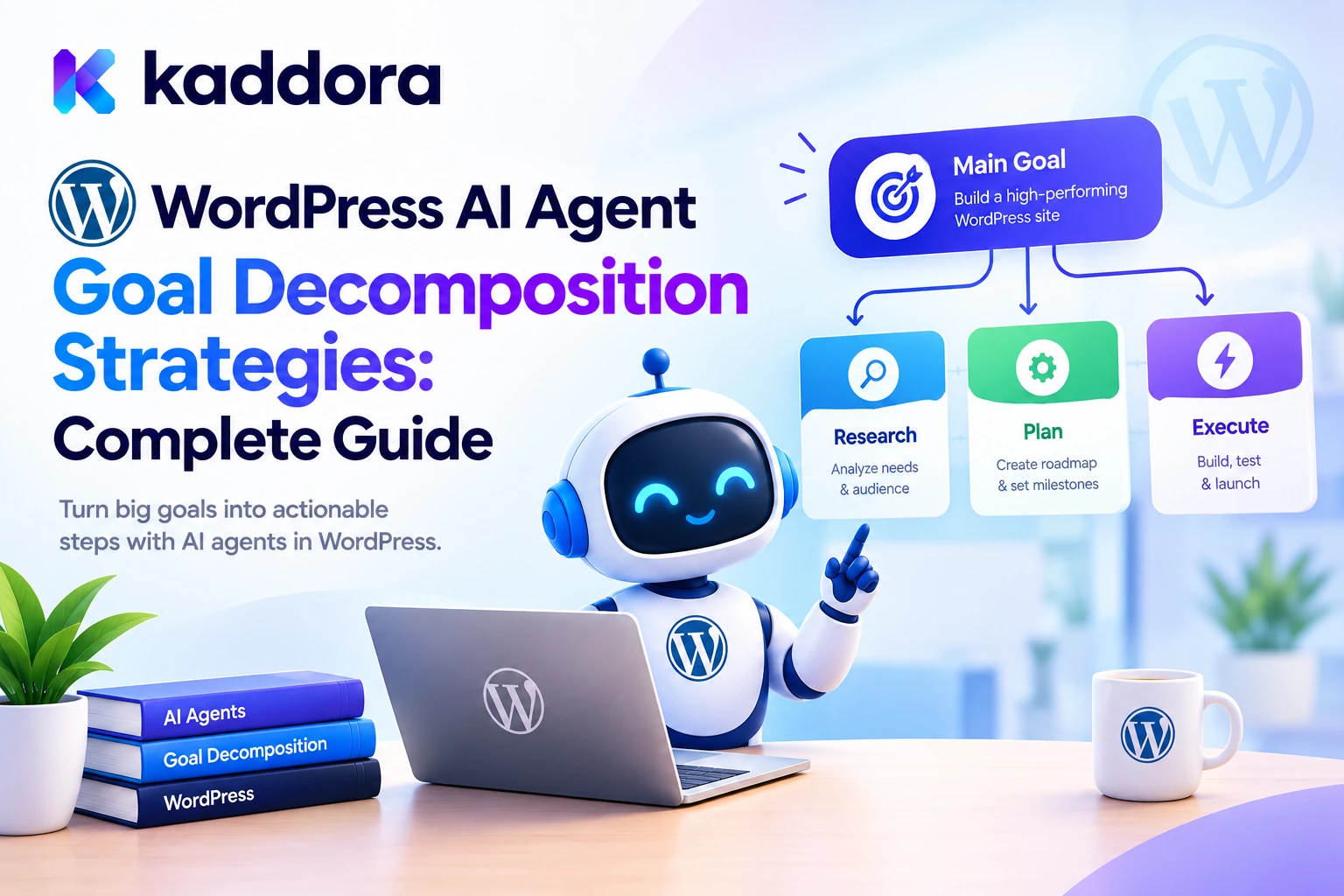
A WordPress AI agent needs a structured way to transform a high-level goal into smaller, manageable tasks.
This process is known as goal decomposition.
Instead of trying to complete an entire objective in one operation, the agent or application breaks it into steps, identifies dependencies, assigns tools, validates constraints, executes the work, and checks whether the original goal has been satisfied.
A practical architecture looks like this:
User Goal ↓ Goal Interpreter ↓ Task Decomposition ↓ Plan Validation ↓ Dependency Management ↓ Controlled Tool Execution ↓ Result Evaluation ↓ Task Completion
This guide explains how to design WordPress AI agent goal decomposition strategies, including hierarchical planning, dependency graphs, task prioritization, workflow validation, PHP architecture, security, and performance optimization.
What Is AI Agent Goal Decomposition?
AI agent goal decomposition is the process of converting a high-level objective into smaller tasks that can be planned, executed, validated, and monitored.
For example, a user may ask:
Prepare a new product for publication.
The agent can break that goal into smaller tasks:
1. Retrieve Product 2. Check Product Title 3. Validate Description 4. Inspect Attributes 5. Check Product Images 6. Prepare SEO Metadata 7. Generate an Optimization Report 8. Request Review
Each task has a specific responsibility and can have its own input, output, permissions, and completion conditions.
The goal is not simply to create a longer checklist. It is to create an actionable plan in which tasks are appropriately sized, dependencies are understood, and results can be checked.
A good decomposition strategy helps answer:
What work is required?
Which tasks can run independently?
Which task must happen first?
Which tools are needed?
What information is missing?
Which actions need approval?
What conditions determine completion?
For WordPress plugins, these decisions should be represented through structured application data rather than relying entirely on free-form AI responses.
Why Do WordPress AI Agents Need Goal Decomposition?
Simple AI requests can often be completed through a single model call.
More complex workflows may require several operations, especially when they involve WordPress content, WooCommerce records, external APIs, or background processing.
Without goal decomposition, an AI agent may:
Attempt too many operations in one step
Repeat tasks unnecessarily
Miss prerequisite information
Select tools in the wrong order
Generate incomplete results
Exceed execution limits
Lose track of progress after a failure
Goal decomposition helps organize the work into a structured workflow.
1. Better Task Organization
Each step has a clear objective and completion condition.
2. More Reliable Tool Usage
The application can validate individual tasks before executing them.
3. Easier Error Recovery
If one task fails, the system can identify the failed step rather than restarting the entire workflow.
4. Better Resource Management
Small, independent tasks can be processed separately or in parallel where appropriate.
5. Improved Monitoring
Administrators can see which tasks are complete, pending, failed, or awaiting approval.
6. Stronger Security Boundaries
Each task can be checked against the relevant permissions and business rules.
Strategy 1: Hierarchical Goal Decomposition
Hierarchical decomposition breaks a large objective into progressively smaller subgoals.
For example:
Goal: Optimize WordPress Website ├── Content Optimization │ ├── Find Missing Metadata │ ├── Review Titles │ └── Generate Suggestions │ ├── Media Optimization │ ├── Find Missing Alt Text │ └── Prepare Alt Text Suggestions │ └── Reporting ├── Collect Results └── Generate Summary
The main goal remains the parent objective, while each subgoal represents a specific area of work.
When to use hierarchical decomposition
This strategy is useful when:
A request covers multiple functional areas.
The plugin contains several specialized tools.
Results need to be grouped into separate sections.
The task requires an overall report assembled from smaller results.
For example, a WordPress maintenance assistant could divide an audit into content, media, plugin configuration, and reporting tasks.
Avoid excessive decomposition
Not every operation needs several layers.
For example:
Generate a Short Title
may need only one task.
Creating separate planning layers for a trivial operation increases complexity without necessarily improving reliability.
Use the smallest useful task structure.
Strategy 2: Plan-and-Execute Decomposition
In a plan-and-execute architecture, the system creates a task plan before carrying out the individual operations.
The plan describes what needs to happen, while the executor performs approved tasks.
User Goal ↓ Planner ↓ Structured Task Plan ↓ Plan Validation ↓ Executor ↓ Tool Results ↓ Completion Check
For example, an administrator requests:
Find products without descriptions and prepare a report with suggested improvements.
The planner might return:
{ "goal": "Prepare a product description audit", "tasks": [ { "id": "find_products", "type": "search_products" }, { "id": "inspect_descriptions", "type": "analyze_product_descriptions", "depends_on": ["find_products"] }, { "id": "prepare_report", "type": "generate_report", "depends_on": ["inspect_descriptions"] } ] }
This is an illustrative task schema.
The WordPress application should validate task identifiers, supported task types, dependencies, resource limits, and permissions before executing the plan.
Advantages
Separates planning from execution.
Supports review before operations begin.
Makes workflow progress easier to track.
Helps preserve a consistent execution sequence.
Limitations
Plans can become outdated when an earlier task reveals unexpected information.
A robust implementation should allow controlled replanning rather than blindly executing an invalid plan.
Strategy 3: Dependency Graph Decomposition
Not every task must run sequentially.
Some tasks can run independently, while others require earlier results.
A dependency graph represents these relationships.
For example, suppose a plugin prepares a product optimization report.
Retrieve Product ↓ ┌─────────┼─────────┐ ↓ ↓ ↓ SEO Check Image Check Content Check ↓ ↓ ↓ └─────────┼─────────┘ ↓ Build Report
The SEO check, image check, and content check can run independently once the product information is available.
The report must wait until the required results are ready.
Why dependency graphs matter
They help the task manager determine:
Which tasks are ready to execute
Which tasks are waiting for prerequisites
Which tasks can run concurrently
Which tasks must stop after a failure
When the parent workflow can be marked complete
A task should become eligible for execution only when its required dependencies have succeeded or an explicit policy allows partial completion.
When to use this strategy
Dependency graphs are particularly useful for:
Product audits
Content optimization
AI research workflows
Multimodal retrieval
Large reporting tasks
Multi-agent WordPress systems
Parallel execution can reduce overall workflow duration, but concurrency and external API usage should remain controlled.
Strategy 4: Rule-Based Decomposition
Some requests are predictable enough that the application can generate the task plan through deterministic rules.
For example:
IF product description is empty THEN create description task IF product image alt text is missing THEN create image metadata task IF both tasks exist THEN create review task
This is different from asking AI to decide every step.
A PHP example might be:
function kaddora_ai_build_product_tasks( array $product_data ): array { $tasks = array(); if ( empty( $product_data['description'] ) ) { $tasks[] = 'generate_description'; } if ( empty( $product_data['alt_text'] ) ) { $tasks[] = 'review_image_alt_text'; } if ( ! empty( $tasks ) ) { $tasks[] = 'prepare_review_report'; } return $tasks; }
This is an illustrative example; production code should validate input types and distinguish missing data from intentionally empty values.
Advantages
Predictable behavior
Low decision latency
Easier testing
No additional model call is required for straightforward rules
Limitations
The developer must define the conditions.
Unexpected situations may require another strategy.
Complex rule sets can become difficult to maintain.
Use deterministic decomposition when the workflow follows known business requirements.
Strategy 5: Iterative Decomposition and Replanning
Some tasks cannot be fully planned in advance because important information becomes available only during execution.
For example:
Goal: Troubleshoot a WordPress Error Step 1: Collect Error Information Step 2: Inspect Relevant File Step 3: Evaluate Possible Cause Step 4: Determine Whether More Context Is Needed Step 5: Continue Investigation or Prepare Findings
After each step, the system evaluates the result and determines whether the existing plan remains appropriate.
Current Plan ↓ Execute Task ↓ Observe Result ↓ Enough Information? ├── Yes → Continue or Complete └── No → Request More Data or Replan
When to use iterative decomposition
This strategy is useful when:
Search results determine the next step.
A tool may return unexpected data.
Troubleshooting requires investigation.
An AI agent must choose among several possible next actions.
A fixed plan cannot cover every possible situation.
Prevent endless replanning
Replanning can increase latency and cost.
Define clear limits such as:
Maximum Planning Cycles Maximum Tool Calls Maximum Execution Time Maximum Retry Attempts
If the workflow reaches its limit, stop safely and report the current state instead of continuing indefinitely.
Strategy 6: Risk-Aware Goal Decomposition
Not all tasks should execute with the same level of automation.
Consider an AI content workflow:
Read Post ↓ Analyze Content ↓ Generate Suggestions ↓ Prepare Draft ↓ Publish
The first operations are generally lower risk than publishing content.
A risk-aware decomposition can distinguish:
Low Risk Read, Search, Analyze Medium Risk Generate Draft, Update Metadata High Risk Publish Content, Update Prices Critical Risk Delete Data, Change Permissions
The exact categories depend on the plugin and its business requirements.
A useful decision framework can combine risk classification with approval policies:
Proposed Task ↓ Risk Assessment ↓ Policy Check ↓ Approval Required? / \ Yes No ↓ ↓ Human Review Execute if Authorized
Risk classification itself should not grant permission. The application must perform explicit authorization checks before executing an operation.
Build a Goal Decomposition Engine in WordPress
A maintainable WordPress plugin can separate decomposition, validation, task execution, and workflow state.
A practical architecture looks like this:
WordPress Request ↓ Goal Interpreter ↓ Decomposition Strategy ↓ Structured Task Plan ↓ Plan Validator ↓ Dependency Manager ↓ Policy and Permissions ↓ Task Executor ↓ Result Evaluator ↓ State Manager ↓ Completion or Replanning
Supporting services may include:
AI Provider Tool Registry Task Queue Approval Manager Memory Manager Error Handler Audit Logger Evaluation System
The architecture should remain proportional to the plugin's actual requirements. A simple plugin may need only a planner, validator, task executor, and state manager.
Step 1: Define the High-Level Goal
Start by representing the user's request as a structured goal.
For example:
{ "goal_type": "product_audit", "scope": { "product_status": "publish", "limit": 100 }, "output_format": "report", "modification_allowed": false }
This is an illustrative goal specification.
The plugin should validate requested limits, accepted values, and available operations.
A structured goal helps establish the workflow scope before decomposition begins.
Step 2: Create a Task Schema
Each task should define its responsibility and execution requirements.
Useful task properties include:
Task ID Task Type Arguments Dependencies Status Priority Risk Level Required Permissions Expected Output Retry Policy
For example:
{ "id": "inspect_description", "type": "analyze_product_description", "arguments": { "product_id": 452 }, "depends_on": [ "retrieve_product" ], "status": "pending" }
The execution system should accept only registered task types and validate each task's arguments.
Do not let a model invent arbitrary PHP functions, database statements, or unrestricted operations.
Step 3: Validate the Task Plan
AI-generated plans should be treated as untrusted input.
Validate:
Supported task types
Required arguments
Argument data types
Maximum task count
Dependency identifiers
Circular dependencies
Allowed execution order
Permissions
Risk and approval requirements
For example, if a task depends on another task that does not exist, the plan should be rejected or corrected before execution.
Likewise, a cycle such as:
Task A → Task B → Task A
must not be accepted as an executable dependency graph.
Validation should happen before the plan is queued or executed.
Step 4: Execute Ready Tasks
A task becomes ready when its required dependencies have completed successfully.
For example:
Retrieve Product ↓ Complete ↓ ┌────┼────┐ ↓ ↓ ↓ SEO Image Content Check Check Check
The task scheduler can execute independent tasks in a controlled manner.
However, tasks that modify the same WordPress resource may need serialization to prevent conflicting updates.
Keep execution deterministic
The executor should perform a known operation based on validated task arguments.
For example:
Task Type: get_product Executor: WooCommerce Product Service Result: Validated Product Data
The executor should not interpret a task by running arbitrary code returned by the AI.
Step 5: Evaluate Results and Update State
After each task, validate the output and update the workflow state.
For example:
Task Completed ↓ Validate Result ↓ Save Output ↓ Update Workflow State ↓ Release Dependent Tasks
A task should not be marked complete simply because its handler returned without an exception.
Verify the task's expected completion conditions.
For a report-generation task, this might mean confirming that required source records were processed and the report was saved successfully.
Step 6: Support Background Processing
Large goal-decomposition workflows may produce hundreds or thousands of tasks.
For example:
Audit 5,000 Products ↓ Decompose Into Product Tasks ↓ Queue Tasks ↓ Process in Batches ↓ Track Progress ↓ Aggregate Results
WordPress-compatible implementations can use WP-Cron, Action Scheduler where available, or a dedicated queue system suited to the workload.
Background processing makes large workflows more manageable, but the application should still revalidate permissions, task state, and approval requirements before sensitive operations execute.
Step 7: Add Human Approval for High-Impact Tasks
A goal may be decomposed into actions that modify WordPress data.
For example:
Analyze Products ↓ Generate Description Proposals ↓ Create Preview ↓ Human Approval ↓ Apply Approved Changes
This gives administrators the opportunity to review proposed changes before applying them.
Do not allow the AI to approve its own actions. Approval should be recorded through a trusted application workflow, with the appropriate user capability checks.
Step 8: Add Monitoring and Evaluation
A decomposition engine should provide visibility into how a goal becomes a completed workflow.
Track:
Number of tasks created
Tasks completed
Tasks failed
Task retries
Replanning cycles
Execution duration
Model and tool usage
Approval status
Final outcome
OpenAI's agent evaluation guide describes evaluating complete agent runs and tool usage with traces and task-specific criteria.
For a WordPress plugin, similar evaluation practices can help identify whether the decomposition strategy selects appropriate tasks, follows dependencies, respects policies, and completes the intended workflow.
Common WordPress AI Goal Decomposition Mistakes
1. Breaking every request into too many tasks
Excessive decomposition increases orchestration overhead.
Better: use the smallest task structure that clearly expresses the required work.
2. Ignoring dependencies
A task may execute before its required data is available.
Better: represent dependencies explicitly.
3. Trusting AI-generated plans
Plans can contain invalid tasks, bad arguments, or circular dependencies.
Better: validate before execution.
4. Allowing unlimited replanning
Repeated planning can consume resources without making progress.
Better: enforce step and time limits.
5. Mixing planning with execution
A single component may become difficult to test and secure.
Better: separate the planner, validator, executor, and state manager.
6. Using AI for every deterministic decision
Simple validation rules do not usually require model reasoning.
Better: combine AI planning with conventional application logic.
7. Ignoring resource conflicts
Independent-looking tasks may update the same post or product.
Better: identify shared resources and serialize conflicting operations.
8. Skipping result validation
A task can finish without producing the result required by the workflow.
Better: define and verify completion conditions.
Best Practices for WordPress AI Agent Goal Decomposition
Define the overall goal before creating tasks.
Use structured task specifications.
Select a decomposition strategy appropriate to the workflow.
Represent dependencies explicitly.
Validate plans before execution.
Keep deterministic business rules in application code.
Enforce permissions for every operation.
Use risk-based approval policies.
Bound planning cycles, tool calls, and retries.
Persist state for long-running workflows.
Prevent duplicate side effects where appropriate.
Use background queues for large workloads.
Validate task results before marking them complete.
Monitor workflow success, latency, and usage.
Keep the architecture proportional to actual requirements.
WordPress AI Goal Decomposition Checklist
Planning
The overall goal is clearly defined.
The workflow is decomposed into meaningful tasks.
Each task has an explicit type and expected output.
Dependencies are documented.
Task scope and resource limits are defined.
Execution
Only registered task types are executable.
Task arguments are validated.
Dependencies are satisfied before execution.
Conflicting resource updates are controlled.
Results are verified.
Workflow state is tracked.
Security
WordPress capabilities are enforced.
Application policies control tool access.
Sensitive tasks can require approval.
Arbitrary PHP and SQL execution are prohibited.
Background jobs revalidate permissions.
Reliability
Replanning is bounded.
Retries are controlled.
Duplicate effects are prevented where necessary.
Failed tasks can be inspected.
Long-running workflows can resume safely.
Monitoring
Task completion rates are tracked.
Failures and retries are logged.
Tool usage and latency are measured.
Workflow outcomes can be evaluated.
Administrators can inspect important actions.
Why Choose Kaddora?
Building reliable WordPress AI agents requires more than connecting a language model to a set of tools.
Developers need an architecture that combines goal interpretation, task decomposition, controlled execution, permissions, state management, error recovery, and monitoring.
Kaddora focuses on practical WordPress development and AI-powered functionality for use cases such as:
AI SEO
WooCommerce intelligence
Content generation
AI coding assistants
Semantic search
Customer support
Multimodal retrieval
Automated administration
AI agent workflows
A well-designed Kaddora implementation can use goal decomposition to coordinate these capabilities while keeping execution under trusted WordPress application logic.
The objective is not to break every request into as many steps as possible. It is to create workflows that are clear, efficient, secure, and easy to monitor.
Conclusion
WordPress AI agent goal decomposition strategies help transform complex user requests into manageable tasks.
Different workflows benefit from different approaches:
Hierarchical Decomposition + Plan-and-Execute + Dependency Graphs + Rule-Based Decisions + Iterative Replanning ↓ Controlled Task Execution
For straightforward tasks, deterministic rules may be sufficient. Complex workflows can benefit from a planner-executor architecture, explicit dependencies, persistent state, and result evaluation.
Regardless of the strategy, the application should validate every task, enforce WordPress permissions, control retries and execution limits, and verify that the original goal has been satisfied.
The most important principle is to separate AI-assisted planning from trusted application execution.
By combining structured tasks, dependency management, controlled tools, validation, and monitoring, WordPress developers can build AI agents that coordinate complex workflows while remaining reliable, secure, and maintainable.
Frequently Asked Questions
What is WordPress AI agent goal decomposition?
It is the process of breaking a high-level objective into smaller tasks that can be planned, executed, validated, and monitored by a WordPress AI agent.
Why is goal decomposition important for WordPress AI plugins?
It helps organize complex requests, manage task dependencies, select appropriate tools, recover from errors, and track whether the overall goal has been completed.
What is the best goal decomposition strategy for WordPress AI agents?
The best strategy depends on the task. Rule-based decomposition works for predictable workflows, dependency graphs help coordinate related tasks, and planner-executor approaches support more flexible multi-step operations.
Can WordPress AI agents decompose tasks automatically?
Yes. An AI model can propose a structured task plan. The WordPress application should validate that plan and enforce permissions before executing any task.
How can I prevent AI agents from creating too many tasks?
Use maximum task counts, planning-step limits, workflow depth restrictions, execution budgets, and validation rules that reject unnecessary or duplicate tasks.
How should task dependencies be managed in WordPress AI agents?
Represent dependencies explicitly and execute a task only when its required prerequisites are satisfied. Independent tasks can run concurrently when resource conflicts and execution limits are properly controlled.
What is the most important principle in goal decomposition?
Break the goal into meaningful, verifiable tasks while keeping application permissions, business rules, and execution under trusted WordPress code.
Why choose ThemeKaddora?
ThemeKaddora provides a marketplace for WordPress plugins, themes, and website templates. Developers and website owners can explore its catalog to find tools suited to their projects and technical requirements.
Comments (0)