Introduction
AI-powered WordPress plugins are becoming increasingly capable of solving complex problems, analyzing website information, automating business workflows, and recommending actions. However, an AI agent that generates only one solution may not always identify the most suitable way to achieve a particular objective.
A problem can often be solved through several different approaches. For example, an AI-powered WooCommerce assistant that identifies declining product sales might recommend reducing prices. However, other possible solutions could include improving product descriptions, adjusting promotional campaigns, reviewing inventory availability, or optimizing product images.
Choosing the first generated recommendation without considering alternatives can result in unnecessary costs, ineffective decisions, or unwanted changes to a website.
This is where WordPress AI Agent Alternative Solution Generation becomes important.
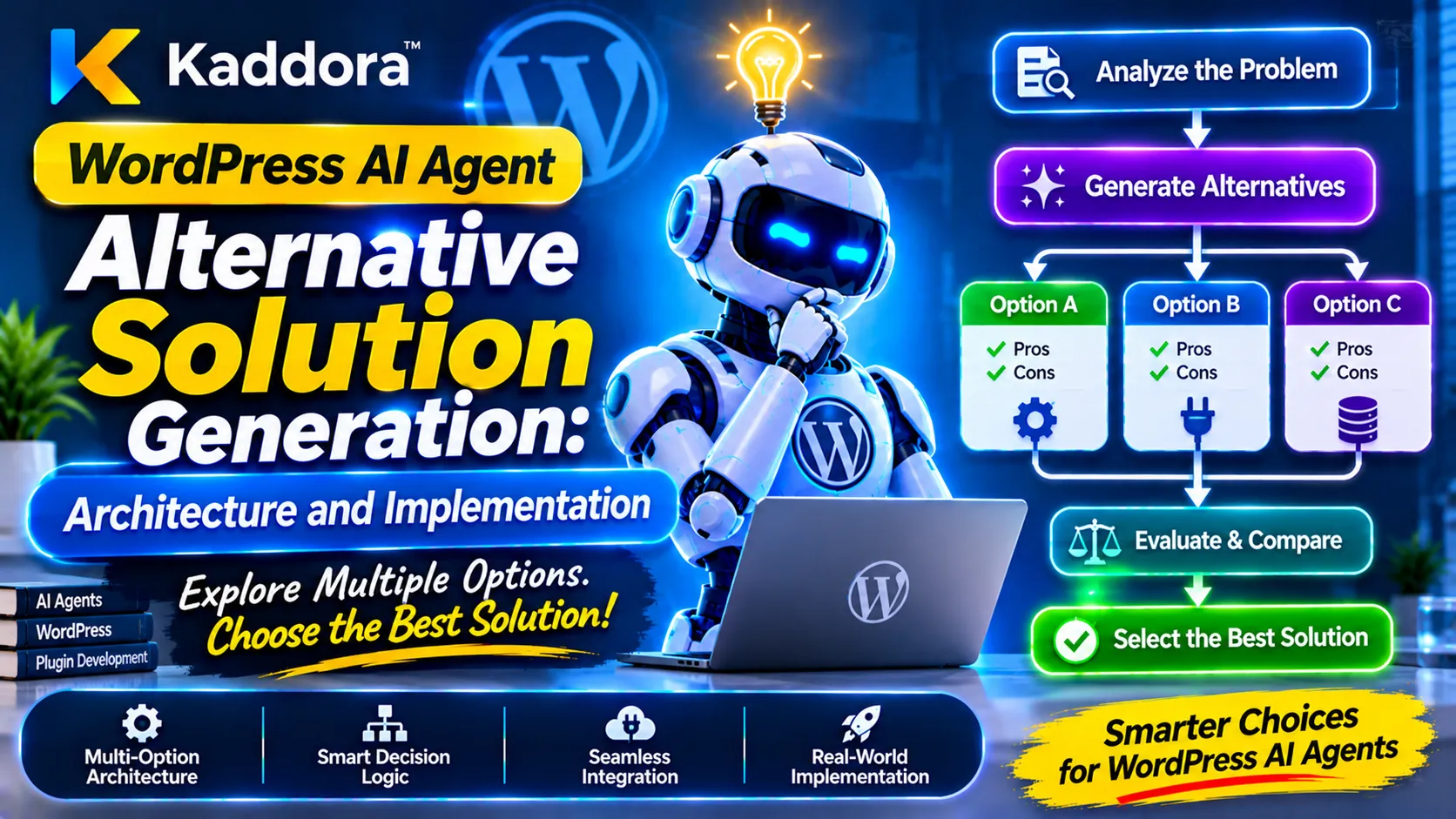
Alternative solution generation enables an AI agent to create multiple possible approaches to a problem, evaluate their advantages and limitations, compare them against predefined requirements, and recommend the most appropriate option.
Instead of immediately accepting its first conclusion, the agent explores different possibilities before making a decision.
For WordPress developers, this capability creates opportunities to build more flexible AI-powered plugins for content optimization, WooCommerce management, security monitoring, customer support, analytics, appointment scheduling, and business automation.
In this guide, we will explore how alternative solution generation works, how to design its architecture, how to implement it using WordPress and PHP, and how to ensure that generated alternatives are practical, secure, and evidence-based.
What Is WordPress AI Agent Alternative Solution Generation?
WordPress AI Agent Alternative Solution Generation is an AI capability that produces multiple possible solutions for a defined problem before selecting or recommending an appropriate approach.
An AI agent receives an objective, analyzes the available information, identifies possible approaches, and generates alternatives that can be evaluated against specific requirements.
For example, consider a WordPress website experiencing slow page loading.
A basic AI assistant might recommend installing a caching plugin.
An alternative solution generation system could identify several approaches:
Optimize image sizes and formats.
Configure page caching.
Reduce unnecessary JavaScript and CSS.
Review slow database queries.
Improve server-side resource allocation.
Remove unused plugins.
Introduce a content delivery network where appropriate.
Each option addresses performance from a different perspective.
The agent can then evaluate the available evidence, expected benefits, implementation complexity, compatibility, cost, and potential risks.
The objective is not to generate as many suggestions as possible. It is to produce a useful set of distinct, feasible, and relevant alternatives.
Why Alternative Solution Generation Matters in WordPress AI Plugins
WordPress websites operate in different environments. A solution that works well for one website may be unsuitable for another because of differences in hosting, plugins, themes, traffic, database structure, and business requirements.
For example, installing another optimization plugin may improve performance on one website but introduce compatibility problems on another.
Similarly, automatically reducing WooCommerce prices may increase conversions in one situation but damage profit margins in another.
Alternative solution generation helps AI agents avoid relying on a single approach.
Its main benefits include:
More flexible problem-solving: The agent can explore multiple ways to achieve the same objective.
Better decision quality: Solutions can be compared using evidence and predefined evaluation criteria.
Reduced implementation risk: Developers can identify safer alternatives before performing sensitive operations.
Improved resource management: The system can compare cost, time, and complexity before recommending an approach.
Greater transparency: Administrators can understand why one solution was selected over another.
More adaptable automation: AI agents can adjust their recommendations when website conditions or business requirements change.
This capability is particularly useful when an AI agent has access to tools that can modify WordPress settings, publish content, update products, or trigger business workflows.
Core Architecture of a WordPress AI Alternative Solution Generation System
A reliable architecture should separate problem analysis, alternative generation, evaluation, validation, selection, and execution.
Problem Identification Layer
The problem identification layer determines what needs to be solved.
The agent should identify:
The primary objective.
The affected WordPress component.
The current problem conditions.
Relevant constraints.
Expected outcomes.
Available resources.
Actions that are not permitted.
For example, an AI performance assistant may receive the objective of reducing page loading time without changing the active theme or removing essential functionality.
These constraints help the agent avoid generating irrelevant solutions.
Context and Evidence Collection Layer
The context collection layer retrieves information needed to understand the problem.
Depending on the plugin, this may include:
WordPress configuration.
Active plugins and theme information.
Website performance measurements.
WooCommerce product records.
Database performance information.
Error logs.
Previous optimization results.
Administrator-defined requirements.
The system should retrieve only information necessary for the task and respect the current user's permissions.
Each important piece of evidence should retain its source and retrieval timestamp.
Alternative Generation Engine
The alternative generation engine creates different approaches to the identified problem.
It can use:
AI-generated suggestions.
Rule-based solution templates.
Previously validated strategies.
Knowledge base retrieval.
Workflow-specific solution patterns.
Hybrid AI and deterministic methods.
For example, an AI SEO plugin analyzing low organic traffic might generate alternatives such as improving search intent alignment, updating internal links, improving technical metadata, or consolidating overlapping content.
The alternatives should be meaningfully different rather than minor variations of the same recommendation.
Solution Classification Layer
After generating alternatives, the system categorizes them.
Useful categories include:
Low-risk solutions.
High-impact solutions.
Quick improvements.
Long-term improvements.
Technical solutions.
Content-based solutions.
Automated solutions.
Human-assisted solutions.
Classification makes it easier to compare solutions according to the problem being addressed.
Solution Evaluation Engine
The evaluation engine examines each alternative using predefined criteria.
Possible criteria include:
Expected effectiveness.
Implementation complexity.
Cost.
Time requirements.
Compatibility.
Security impact.
Reversibility.
Evidence quality.
Maintenance requirements.
For example, an image optimization recommendation may have relatively low implementation complexity, while changing the hosting environment may involve higher cost and migration risk.
The evaluation engine should use deterministic calculations where measurable values are available rather than relying entirely on AI-generated ratings.
Constraint and Policy Validation Layer
A generated solution may appear effective but violate website requirements or administrator policies.
This layer checks whether each alternative:
Is technically feasible.
Respects plugin and theme compatibility.
Requires permissions the user does not have.
Violates business rules.
Introduces unacceptable security risks.
Requires additional infrastructure.
Needs human approval.
Alternatives that fail mandatory requirements should be rejected or marked as requiring review.
Solution Selection Layer
The selection layer compares validated alternatives and identifies the most suitable recommendation.
It should consider the actual objective rather than simply selecting the option with the highest AI-generated confidence score.
Possible outcomes include:
Recommend the strongest feasible solution.
Present multiple options for administrator selection.
Combine compatible alternatives into a staged plan.
Request additional information.
Escalate the decision for human review.
Report that no suitable solution is currently available.
Execution and Monitoring Layer
The execution layer performs approved actions through controlled WordPress functionality.
It should not allow the AI model to execute arbitrary PHP, SQL, shell commands, or unrestricted administrative operations.
Instead, the model should select from predefined tools, and the application should independently validate permissions and operation parameters.
After execution, the monitoring layer checks whether the expected outcome occurred.
If the result is unsuccessful, the agent can reassess the problem and generate new alternatives using updated evidence.
How to Generate Multiple Solutions for One WordPress Problem
Define the Objective Clearly
The quality of generated alternatives depends on how clearly the problem is defined.
A vague objective such as "Improve my website" does not provide enough information for meaningful solution generation.
A better objective would be:
"Improve WooCommerce product page performance while preserving the current theme, checkout functionality, and active payment integrations."
This objective identifies the target, constraints, and required outcome.
Collect Relevant Website Evidence
Before generating alternatives, the agent should inspect the relevant website information.
For a performance problem, this might include:
Page loading measurements.
Image sizes.
Active optimization settings.
Database query performance.
Plugin compatibility information.
Hosting resource limitations.
For a WooCommerce sales problem, the evidence might include product views, conversion rates, inventory, pricing, and sales trends.
The agent should not invent missing information. If the evidence is incomplete, it should identify what additional data is required.
Generate Distinct Alternatives
The agent should generate a limited number of meaningfully different solutions.
For example, a WordPress website with poor conversion rates might receive these alternatives:
Alternative
Approach
Main consideration
A
Improve product descriptions
Content quality
B
Optimize product images
Visual presentation
C
Simplify checkout
User experience
D
Review pricing and offers
Business profitability
E
Improve page performance
Technical optimization
Each solution should explain what problem it addresses and what evidence supports the recommendation.
Evaluate Feasibility
Not every generated alternative should be considered suitable for implementation.
For example, replacing the active theme might be technically possible but unacceptable if the website requires its current design and functionality.
The evaluation engine should identify:
Required resources.
Compatibility dependencies.
Implementation effort.
Potential downtime.
Security implications.
Rollback requirements.
Compare and Select the Best Option
The system should compare alternatives using consistent evaluation criteria.
A solution should not be selected merely because the AI model describes it more confidently.
The selection should be based on the objective, evidence, constraints, and measurable evaluation results.
Request Approval When Necessary
Some alternatives may involve significant website changes.
For example:
Changing payment settings.
Updating user roles.
Modifying checkout functionality.
Deleting website content.
Changing database records.
Disabling plugins.
These operations should require appropriate authorization and, where necessary, explicit administrator approval.
Monitor the Result
After implementation, the plugin should evaluate whether the selected solution achieved its objective.
For example, if the objective was improving page performance, the system should compare relevant performance measurements before and after implementation under reasonably consistent test conditions.
If the result is insufficient, the agent can use the updated evidence to generate another set of alternatives.
Practical PHP Implementation in WordPress
Developers can start with a structured alternative generation and evaluation workflow.
The following examples demonstrate how to organize the process using native PHP patterns.
Define a Structured Alternative
Each generated solution should contain enough information for independent evaluation.
$alternative = array( 'id' => 'solution_001', 'title' => 'Optimize product images', 'description' => 'Reduce image file sizes and use suitable formats.', 'category' => 'performance', 'estimated_cost' => 'low', 'risk_level' => 'low', 'complexity' => 'medium', 'evidence' => array( 'large_product_images_detected', ), );
This is an example of the expected data structure. A production implementation should validate every field against a strict schema and verify evidence identifiers against retrieved records.
Create an Alternative Solution Manager
The following class provides a basic mechanism for collecting and validating alternative solutions.
class Kaddora_AI_Alternative_Solution_Manager { private $solutions = array(); public function add_solution( $solution ) { if ( ! is_array( $solution ) || empty( $solution['id'] ) || empty( $solution['title'] ) || empty( $solution['description'] ) ) { return false; } $solution_id = sanitize_key( $solution['id'] ); if ( isset( $this->solutions[ $solution_id ] ) ) { return false; } $this->solutions[ $solution_id ] = array( 'id' => $solution_id, 'title' => sanitize_text_field( $solution['title'] ), 'description' => sanitize_textarea_field( $solution['description'] ), ); return true; } public function get_solutions() { return array_values( $this->solutions ); } }
This example validates basic fields and prevents duplicate identifiers within the manager instance.
It does not establish whether a solution is technically feasible or safe. Those checks belong to the evaluation and policy validation layers.
Evaluate Alternative Solutions
A basic rule-based evaluator can reject solutions that do not meet mandatory requirements.
class Kaddora_AI_Solution_Evaluator { public function evaluate( $solution ) { if ( ! is_array( $solution ) ) { return array( 'approved' => false, 'status' => 'invalid_solution', ); } if ( empty( $solution['title'] ) ) { return array( 'approved' => false, 'status' => 'missing_title', ); } if ( isset( $solution['risk_level'] ) && 'critical' === $solution['risk_level'] ) { return array( 'approved' => false, 'status' => 'requires_manual_review', ); } return array( 'approved' => true, 'status' => 'eligible_for_comparison', ); } }
This is a simplified example. Production implementations should use explicit allowed values, mandatory field validation, and application-specific risk policies.
A solution marked eligible for comparison is not automatically authorized for execution.
Compare Alternatives Using a Scoring Model
A scoring model can help compare solutions using consistent criteria.
For example, suppose the plugin evaluates effectiveness, implementation simplicity, and compatibility.
The following example uses normalized scores from 0 to 100.
function kaddora_ai_calculate_solution_score( $solution ) { $weights = array( 'effectiveness' => 0.50, 'simplicity' => 0.20, 'compatibility' => 0.30, ); $score = 0; foreach ( $weights as $criterion => $weight ) { if ( ! isset( $solution[ $criterion ] ) || ! is_numeric( $solution[ $criterion ] ) ) { return false; } $value = (float) $solution[ $criterion ]; if ( $value < 0 || $value > 100 ) { return false; } $score += $value * $weight; } return round( $score, 2 ); }
Example:
$solution = array( 'effectiveness' => 90, 'simplicity' => 80, 'compatibility' => 95, ); $score = kaddora_ai_calculate_solution_score( $solution );
The weights are illustrative and should be configured according to the plugin's actual objective.
A weighted score should not override mandatory constraints. For example, a solution that violates a security policy must be rejected even if its numerical score is high.
Select an Eligible Alternative
After evaluation, the system can compare eligible alternatives.
function kaddora_ai_select_best_solution( $solutions ) { $best_solution = null; $best_score = -1; foreach ( $solutions as $solution ) { if ( ! is_array( $solution ) || empty( $solution['approved'] ) || ! isset( $solution['score'] ) || ! is_numeric( $solution['score'] ) ) { continue; } $score = (float) $solution['score']; if ( $score > $best_score ) { $best_score = $score; $best_solution = $solution; } } return $best_solution; }
The input to this function must come from the application's validated evaluation process, not directly from an untrusted AI response.
In production, the selection process should also preserve rejected alternatives and their reasons so that administrators can understand the decision.
Using AI Models for Alternative Solution Generation
AI models are useful for exploring possible approaches that may not be covered by predefined rules.
A plugin can provide the model with:
The problem description.
Relevant verified evidence.
Business requirements.
Technical limitations.
Allowed solution categories.
Prohibited operations.
Expected output structure.
The model can then return a structured list of alternatives.
A useful prompt design might instruct the model to:
Generate distinct solutions.
Explain how each solution addresses the objective.
Identify assumptions.
Reference available evidence.
Describe implementation complexity.
Identify risks and dependencies.
Report missing information.
Avoid claiming that unverified actions have already been performed.
The application must validate the response before using it.
For example, if the model suggests disabling a plugin, the system should check whether that plugin is essential to checkout, payment processing, security, or another critical workflow.
AI-generated alternatives are proposals, not verified implementation instructions.
Alternative Solution Generation in Retrieval-Augmented Generation
Retrieval-Augmented Generation (RAG) can improve alternative solution generation by supplying relevant information from documentation, previous workflows, technical guides, and website records.
For example, a WordPress troubleshooting plugin might retrieve:
Documentation about caching configuration.
Previous performance optimization reports.
Known plugin compatibility issues.
Server configuration information.
Verified troubleshooting procedures.
The AI agent can use this information to generate alternatives that are relevant to the actual environment.
A reliable workflow should:
Retrieve: Collect relevant documentation and website information.
Verify: Check source quality, freshness, and applicability.
Generate: Create multiple possible solutions using the verified context.
Compare: Identify overlapping, incompatible, or redundant alternatives.
Evaluate: Assess effectiveness, cost, complexity, and risk.
Validate: Apply WordPress-specific rules and permissions.
Recommend: Present the strongest feasible alternatives.
Monitor: Evaluate the results of approved implementation.
Retrieved documents must be treated as untrusted content. Instructions embedded in external documents should never override the plugin's system policies or application permissions.
Dynamic Alternative Generation and Solution Refinement
A more advanced AI agent can generate new alternatives when the initial options are unsuitable.
For example, suppose a website performance assistant identifies three potential solutions:
Install a caching plugin.
Replace the active theme.
Move to a different hosting provider.
The administrator may reject all three because the website must retain its current theme, plugin stack, and hosting environment.
The agent should use these constraints to generate new alternatives, such as:
Optimize existing caching configuration.
Reduce unnecessary scripts.
Compress large images.
Review slow database queries.
Improve existing server-side caching.
This process can be implemented through controlled solution refinement.
The system should retain rejected options and the reasons for rejection so that it does not repeatedly suggest unsuitable approaches.
It should also enforce a maximum number of generation attempts to prevent unnecessary API usage and repetitive suggestions.
Alternative Solution Generation for Multiple WordPress Use Cases
WooCommerce Product Optimization
An AI agent can generate alternative approaches for improving product performance.
Possible solutions include improving product descriptions, optimizing images, reviewing pricing, improving category placement, and adjusting promotional strategies.
The system should consider inventory, profit margins, product performance, and business policies before recommending an option.
WordPress SEO Optimization
An AI SEO plugin can generate alternative solutions for improving organic visibility.
Possible approaches include:
Improving search intent alignment.
Updating title tags and meta descriptions.
Improving internal linking.
Consolidating overlapping content.
Correcting technical indexing issues.
Improving structured data.
The plugin should distinguish between verified technical issues and speculative SEO recommendations.
WordPress Security Monitoring
A security-focused AI agent may identify several possible responses to suspicious activity.
Alternatives might include increasing monitoring, temporarily restricting a suspicious session, requiring additional authentication, or asking an administrator to investigate.
High-impact security actions must follow deterministic security policies and appropriate authorization requirements.
Appointment Booking Management
An appointment assistant can generate alternatives when a requested time slot is unavailable.
Possible options include offering another available slot, suggesting another service provider, or recommending a different appointment duration where business rules permit.
The system must verify current availability before confirming a booking.
Content Management Automation
An AI content assistant can generate alternatives when an article fails editorial requirements.
Possible approaches include revising the introduction, adding missing sections, improving evidence, simplifying technical explanations, or requesting editorial review.
The plugin should preserve the original content until the approved revision is ready.
Security and Risk Management
Alternative solution generation introduces an important security consideration: an AI agent may propose actions that are technically possible but unsafe.
For example, it might recommend:
Disabling a security plugin.
Changing administrator permissions.
Deleting database records.
Removing essential website components.
Modifying payment settings.
Publishing unreviewed content.
Developers should implement the following safeguards:
Use an allowlist of permitted AI tools and operations.
Check current_user_can() before privileged actions.
Apply object-level authorization to individual records.
Verify nonces for appropriate state-changing requests.
Validate all model-generated parameters.
Use $wpdb->prepare() for dynamic SQL.
Keep API credentials server-side.
Treat retrieved content and model responses as untrusted.
Require approval for sensitive or irreversible operations.
Preserve rollback information where appropriate.
Maintain protected audit logs.
Prevent AI models from executing arbitrary PHP, SQL, or shell commands.
A high-scoring alternative must never bypass mandatory security requirements.
Common Mistakes in Alternative Solution Generation
Generating Too Many Alternatives
Generating dozens of similar recommendations makes evaluation harder and can increase API costs.
Focus on a manageable number of distinct approaches.
Producing Nearly Identical Solutions
Changing the wording of a recommendation does not create a meaningful alternative.
Each option should offer a genuinely different approach, implementation strategy, or trade-off.
Ignoring Website-Specific Context
A recommendation that works on one WordPress installation may create compatibility problems on another.
Use relevant website evidence and constraints before generating alternatives.
Selecting Solutions Based Only on AI Confidence
A model's confidence does not establish technical feasibility or business value.
Evaluate alternatives using measurable evidence, deterministic rules, and clearly defined criteria.
Ignoring Implementation Risks
A technically effective solution may require downtime, introduce security concerns, or affect existing integrations.
Assess these risks before recommending implementation.
Allowing Automatic Execution Without Approval
Not every alternative should be executable by an AI agent.
Sensitive operations must follow the plugin's permission and approval policies.
Failing to Measure Results
Generating and selecting a solution does not establish that it worked.
Monitor actual outcomes and compare them with the original objective.
Best Practices for WordPress AI Agent Alternative Solution Generation
Use this checklist when developing an alternative solution generation system:
Define the problem and expected outcome clearly.
Identify website-specific constraints.
Retrieve relevant and verified WordPress data.
Preserve evidence references and timestamps.
Generate distinct and practical alternatives.
Classify solutions by type and implementation requirements.
Evaluate effectiveness, cost, complexity, and risk.
Reject alternatives that violate mandatory policies.
Use deterministic scoring where measurable data exists.
Avoid selecting solutions solely through AI confidence.
Preserve rejected alternatives and their reasons.
Request additional information when evidence is incomplete.
Require approval for sensitive operations.
Monitor implementation results.
Generate new alternatives when the original options fail.
Maintain audit records for important decisions.
Why Choose Kaddora?
Kaddora focuses on digital products and development solutions across WordPress plugins, themes, HTML templates, AI integrations, business applications, and workflow automation.
Building effective AI-powered WordPress solutions requires more than generating automated recommendations. Developers need reliable data handling, structured decision-making, security controls, and practical workflows that fit real website requirements.
Alternative solution generation supports this approach by allowing AI agents to explore different possibilities before recommending an action.
ThemeKaddora offers WordPress plugins, themes, HTML templates, and other digital products designed to support developers and website owners.
By combining practical development principles with responsible AI integration, developers can build solutions that are more flexible, maintainable, and useful for real-world applications.
Conclusion
WordPress AI Agent Alternative Solution Generation helps AI-powered plugins move beyond single-answer problem-solving.
Instead of accepting the first recommendation, an AI agent can generate multiple approaches, evaluate their feasibility, compare their risks, and recommend a solution that aligns with website requirements and business objectives.
A reliable implementation combines structured problem analysis, evidence collection, alternative generation, deterministic evaluation, policy validation, and controlled execution.
Developers should also ensure that generated alternatives are meaningfully different, supported by relevant evidence, and safe to implement.
By introducing this capability into WordPress AI plugins, developers can create more adaptable automation systems, improve decision quality, and provide administrators with greater control over AI-assisted problem-solving.
Frequently Asked Questions
What is WordPress AI Agent Alternative Solution Generation?
It is an AI capability that generates multiple possible approaches to a problem, evaluates their suitability, and recommends an appropriate solution based on evidence, requirements, and constraints.
Why is alternative solution generation important for WordPress AI agents?
It prevents agents from relying on only one approach and allows them to compare different solutions before recommending changes to website content, business data, or automated workflows.
How does an AI agent generate alternative solutions?
An AI agent analyzes the problem, retrieves relevant information, identifies constraints, and generates distinct approaches using AI models, predefined rules, knowledge bases, or a combination of these methods.
How are alternative solutions evaluated?
Solutions can be evaluated using effectiveness, implementation complexity, cost, compatibility, security risk, reversibility, and evidence quality.
Can WordPress AI agents automatically select the best alternative?
Yes, when the alternatives have passed validation and the selection criteria are clearly defined. Sensitive operations may still require administrator approval.
What is the difference between alternative solution generation and decision-making?
Alternative solution generation creates and explores possible approaches. Decision-making evaluates those approaches and selects the most appropriate option for the defined objective.
Can alternative solution generation work with WooCommerce?
Yes. It can help evaluate different approaches to product optimization, inventory management, pricing recommendations, customer support, and sales improvement, subject to verified business data and permissions.
How does RAG improve alternative solution generation?
RAG provides relevant information from documentation, website records, and knowledge bases, helping AI agents generate solutions that are more closely aligned with the actual WordPress environment.
Why choose ThemeKaddora?
ThemeKaddora offers WordPress plugins, themes, HTML templates, and digital products designed to support website development, business functionality, and modern digital experiences.
Comments (0)