
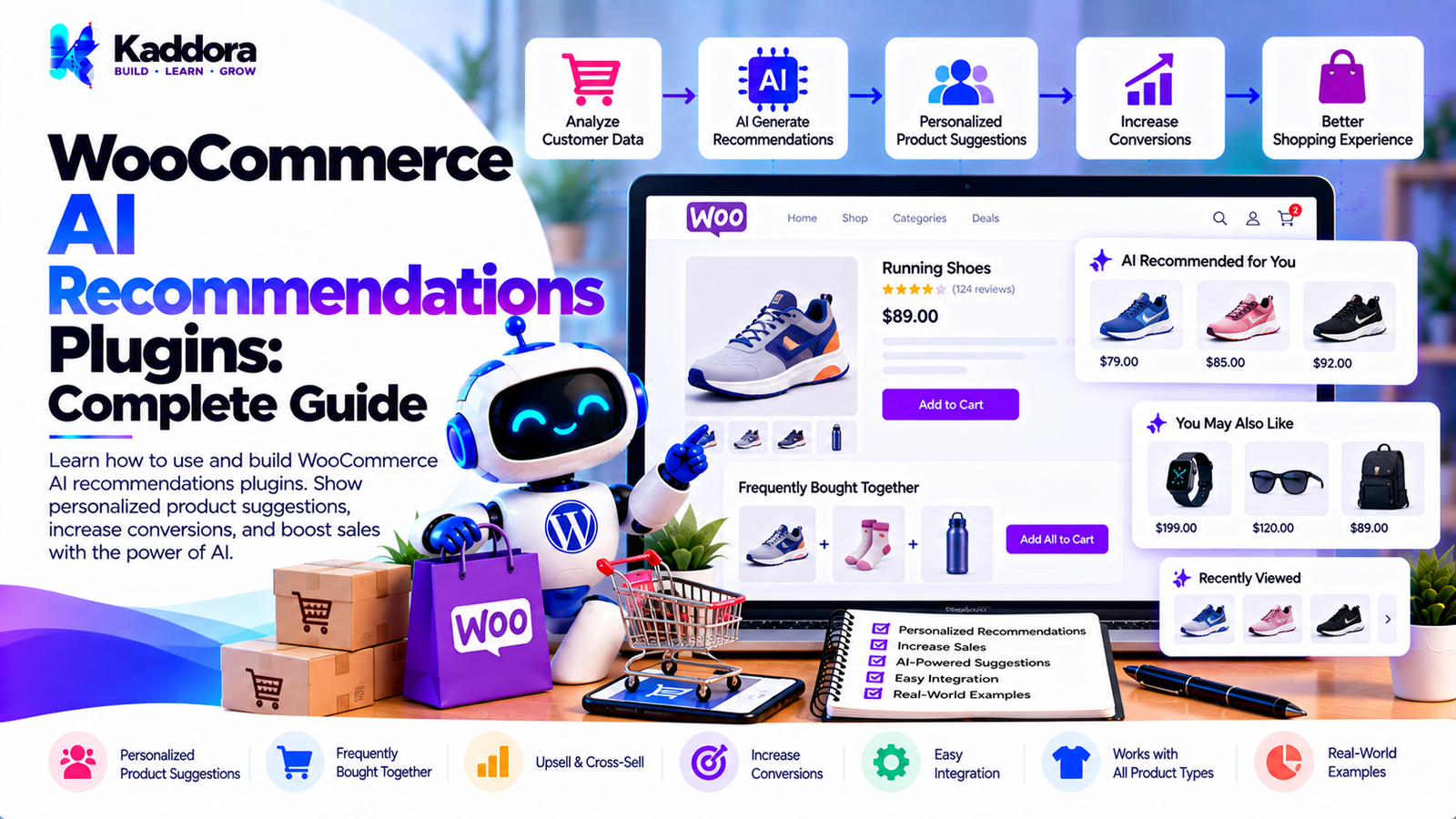
WooCommerce AI Recommendations Plugins
Introduction
Customers visiting a WooCommerce store do not always know which product is right for them.
A store may contain hundreds or thousands of products, making product discovery increasingly difficult.
Traditional WooCommerce recommendations often rely on:
Related products
Upsells
Cross-sells
Categories
Tags
Manually selected products
These approaches can be useful, but they may not fully account for changing customer behavior or complex product relationships.
This is where WooCommerce AI recommendations plugins can help.
AI-powered recommendation systems can analyze product information and, depending on the implementation and privacy configuration, behavioral signals to identify products that may be relevant to a shopper.
A simplified workflow looks like this:
Product Data + Customer Signals + Store Context ↓ Recommendation Engine ↓ Candidate Products ↓ Ranking ↓ WooCommerce Store ↓ Recommended Products
The goal is not simply to display more products.
The goal is to help customers discover relevant products at the right point in their shopping journey.
What Are WooCommerce AI Recommendations Plugins?
WooCommerce AI recommendation plugins use machine learning, AI models, rules, or a combination of these technologies to recommend products to shoppers.
For example, a store could display:
Customers viewing this product may also like:
or:
Recommended for you
The recommendations can be based on different types of information.
How AI Product Recommendations Work
A basic recommendation architecture looks like:
WooCommerce Catalog ↓ Product Feature Extraction ↓ Customer Signals ↓ Candidate Generation ↓ Recommendation Ranking ↓ Recommendation Widget
The exact architecture depends on the type of recommendation system.
Types of WooCommerce AI Recommendations
A WooCommerce AI recommendation plugin can support multiple recommendation types.
Related Products
Products that share meaningful characteristics with the current product.
Frequently Purchased Together
Products commonly purchased in the same order.
Personalized Recommendations
Products selected based on a customer's permitted interaction history.
Similar Products
Products with similar attributes, descriptions, categories, or other characteristics.
Complementary Products
Products that can be used together.
Recently Viewed Recommendations
Products related to a shopper's recent browsing activity.
Why Use AI Product Recommendations?
AI recommendations can help stores organize large product catalogs and improve product discovery.
Potential benefits include:
Better product discovery
Personalized shopping experiences
Improved catalog navigation
Relevant cross-selling
More useful related-product sections
Automated product ranking
Large-catalog management
The effectiveness of a recommendation system depends heavily on product data, available signals, implementation quality, and context.
Step 1: Collect Product Data
The recommendation engine first needs information about the catalog.
Useful product data can include:
Product Name Category Tags Attributes Price Brand Description Variations Stock Status Product Type
Only data necessary for the recommendation task should be processed.
Step 2: Create Product Features
The plugin can transform product information into structured features.
For example:
Product: Running Shoes Category: Sports Color: Black Material: Mesh Usage: Running
These features can be used to identify product relationships.
Step 3: Analyze Product Relationships
The system can determine relationships such as:
Running Shoes ↓ Running Socks ↓ Sports Bottle ↓ Running Jacket
These relationships may come from rules, purchase history, product attributes, embeddings, or other recommendation methods.
Step 4: Collect Customer Signals
Depending on the store's privacy configuration, recommendation systems can use signals such as:
Products viewed
Products searched
Products added to cart
Products purchased
Categories interacted with
Recently viewed products
Customer data should be handled according to applicable privacy requirements and the store's disclosed practices.
Step 5: Generate Recommendation Candidates
The system should first identify a group of possible products.
For example:
Current Product ↓ Candidate Generator ↓ 50 Possible Products
The system can then rank those candidates.
Step 6: Rank Products
Candidate products can be ranked using signals such as:
Product similarity
Category relationship
Customer interaction
Purchase patterns
Inventory availability
Context
Business rules
A simple conceptual model might be:
Recommendation Score = Product Relevance + Context Relevance + Customer Relevance + Business Rules
The exact scoring system can vary.
Step 7: Display Recommendations
Recommendations can be displayed in different locations.
For example:
Product Page ↓ Recommended Products
Other locations include:
Homepage
Shop page
Cart
Checkout
Account area
Search results
Each location may require a different recommendation strategy.
WooCommerce AI Related Product Recommendations
A product page can display products that are semantically or structurally related.
For example:
Current Product: Laptop Related: Laptop Stand Wireless Mouse Keyboard Laptop Bag
The relationship should be relevant to the product.
AI Personalized Recommendations
A personalized recommendation system can use permitted shopper signals.
For example:
Recent Interests: Running Shoes Sportswear Fitness Accessories ↓ AI Recommended: Running Socks Sports Watch Gym Bag
Personalization should be implemented with appropriate privacy controls.
AI Recommendations for New Visitors
New visitors create a common recommendation challenge because there may be little or no historical behavior.
This is known as a cold-start situation.
The plugin can use:
Current product
Current category
Search query
Popular products
Product similarity
Contextual signals
For example:
New Visitor ↓ Current Product ↓ Catalog Similarity ↓ Recommendations
AI Recommendations for Returning Customers
Returning customers may have more interaction history.
Depending on privacy settings and available data, the system may use:
Previous Interactions ↓ Preference Signals ↓ Candidate Products ↓ Recommendations
AI Similar Product Recommendations
Similarity-based recommendations focus on product characteristics.
For example:
Product A ↓ Category Attributes Description Brand ↓ Similar Products
This approach can work even when purchase history is limited.
AI Complementary Product Recommendations
Complementary recommendations identify products that work together.
For example:
Camera ↓ Memory Card ↓ Camera Bag ↓ Tripod
This is different from simply finding similar products.
Frequently Purchased Together
Purchase data can reveal relationships.
For example:
Laptop + Wireless Mouse
If customers frequently purchase the products together, the recommendation engine can identify that relationship.
However, enough transaction data is generally needed for this approach to work reliably.
AI Recommendations Based on Product Embeddings
Advanced recommendation systems can represent products as vectors or embeddings.
A conceptual workflow is:
Product Data ↓ Embedding ↓ Vector Representation ↓ Similarity Search ↓ Related Products
This can help identify relationships beyond exact category or tag matches.
Semantic Product Recommendations
Semantic recommendations can identify products with related meanings even when they do not share identical keywords.
For example:
"Lightweight travel backpack" may relate to: "Compact carry-on backpack"
The exact relationship depends on the underlying model and product information.
AI Recommendation Engine Architecture
A scalable architecture can look like:
WooCommerce Catalog ↓ Product Data Layer ↓ Feature Extraction ↓ Recommendation Engine ↓ Candidate Generation ↓ Ranking ↓ Recommendation API ↓ WooCommerce UI
Additional services may include:
Cache Queue Analytics Feature Store Vector Index Privacy Manager Recommendation Logger
AI Recommendation Plugin Architecture
A WordPress plugin should separate responsibilities.
For example:
Admin Settings ↓ Recommendation Service ↓ Candidate Provider ↓ Ranking Service ↓ WooCommerce Integration ↓ Frontend Widget
This makes the system easier to maintain.
Use a Recommendation Provider Interface
A provider abstraction can support different recommendation strategies.
For example:
RecommendationProvider get_recommendations()
Possible implementations could include:
RuleBasedProvider SimilarityProvider BehaviorProvider AIProvider HybridProvider
This allows the plugin to change recommendation methods without rebuilding the entire system.
Hybrid WooCommerce Recommendation Systems
AI does not need to control every recommendation.
A hybrid system can combine:
Rules + Product Similarity + Behavior Signals + AI Ranking
For example, a store could require products to be:
In stock
Published
Relevant to the current product
AI can then rank the remaining candidates.
Inventory-Aware Recommendations
A recommendation engine should consider product availability.
There is little value in prominently recommending products that cannot currently be purchased.
A simplified workflow:
Candidate Products ↓ Inventory Filter ↓ Available Products ↓ Ranking
Price-Aware Recommendations
A store may want recommendations within a specific price range.
For example:
Current Product: $100 Possible Range: $70–$130
This should be treated as a business rule rather than an AI assumption.
Category-Aware Recommendations
Category rules can prevent irrelevant recommendations.
For example:
Running Shoes ↓ Sports Accessories ↓ Relevant Candidates
Brand-Aware Recommendations
Some stores may want to prioritize products from the same brand.
Others may want to introduce alternatives from different brands.
The recommendation system should make this configurable.
Add Recommendation Rules
Administrators can configure rules such as:
Exclude out-of-stock products Exclude current product Exclude hidden products Limit recommendations per category
AI can operate within these constraints.
Add Recommendation Limits
A widget might display:
4 Recommendations
rather than showing dozens of products.
The exact number should depend on the page design and user experience.
Add Recommendation Diversity
Showing five nearly identical products may not be useful.
A recommendation engine can introduce diversity:
Laptop ↓ Mouse ↓ Laptop Bag ↓ Keyboard ↓ USB Hub
Instead of:
Laptop A Laptop B Laptop C Laptop D Laptop E
The appropriate strategy depends on the shopping context.
AI Recommendations on the Product Page
A product page can include:
You May Also Like [Product] [Product] [Product] [Product]
Recommendations should be relevant to the current product.
AI Recommendations in the Cart
The cart is another useful location.
For example:
Your Cart ---------------- Laptop Mouse You May Also Need: Laptop Bag USB Hub
Recommendations should not interfere with checkout usability.
AI Recommendations on the Homepage
The homepage can provide personalized or contextual product suggestions.
For example:
Recommended Products
For anonymous visitors, contextual recommendations may be more appropriate than assuming long-term preferences.
AI Recommendations in Search
A recommendation engine can complement product search.
For example:
Search: Running shoes ↓ Relevant Products + Recommended Accessories
Search and recommendation systems should remain clearly distinguishable.
AI Recommendations in WooCommerce Emails
Depending on the email workflow and privacy configuration, product recommendations can also be included in certain customer communications.
The implementation should consider consent, data usage, and email provider requirements.
AI Recommendations and Customer Privacy
Personalized recommendations can involve behavioral information.
A plugin should clearly define:
What information is collected
Why it is collected
How long it is retained
Where it is processed
Whether third-party services receive it
How users can control applicable personalization
Only necessary data should be processed.
Anonymous Recommendations
Not every recommendation system needs identifiable customer profiles.
The plugin can use contextual signals such as:
Current product
Current category
Current search
Session context
Popular products
This can provide useful recommendations with less dependence on persistent customer profiles.
Recommendation Data Minimization
A privacy-conscious architecture should process only the signals necessary for recommendations.
For example:
Required: Product ID Category Interaction Signal Not Required: Customer Address Payment Data Unrelated Order Information
AI Recommendation Caching
Recommendations can often be cached.
For example:
Product ID ↓ Recommendation Cache ↓ Recommended Products
This reduces repeated computation.
Cache Invalidation
Recommendation caches should be refreshed when important product information changes.
Possible triggers include:
Product status changes
Inventory changes
Category changes
Product deletion
Major catalog changes
Background Recommendation Processing
Large catalogs may require background processing.
For example:
Product Catalog ↓ Queue ↓ Recommendation Builder ↓ Cache
This prevents expensive calculations from blocking normal WordPress requests.
AI Recommendation Performance
Recommendation generation should not make product pages significantly slower.
A good architecture can use:
Cached recommendations
Precomputed candidate lists
Background processing
Lightweight frontend requests
Database indexes
Efficient queries
Avoid Expensive Queries
A plugin should avoid repeatedly loading the entire WooCommerce catalog.
Instead:
Current Product ↓ Candidate Query ↓ Limited Result Set ↓ Ranking
This is more scalable.
Recommendation Analytics
An AI recommendation plugin can track aggregate performance metrics such as:
Recommendation impressions
Recommendation clicks
Add-to-cart interactions
Purchases following recommendations
Analytics should be collected according to the site's privacy practices.
Recommendation Evaluation
A recommendation system should be evaluated rather than assumed to work.
Useful measurements may include:
Impressions ↓ Clicks ↓ Product Views ↓ Add to Cart ↓ Purchases
These metrics describe observed behavior; they do not guarantee future performance.
A/B Testing Recommendations
Stores may test different recommendation strategies.
For example:
Strategy A Related Products vs. Strategy B AI Similar Products
Testing should be designed carefully and should respect applicable privacy requirements.
Cold Start Problem
New products may have limited behavioral data.
The system can initially rely on:
Product attributes
Category
Description
Brand
Similar products
As interaction data becomes available, additional signals may become useful.
New Customer Problem
New visitors may have no history.
Contextual recommendations can help:
Current Page ↓ Product Context ↓ Catalog Similarity ↓ Recommendations
New Store Problem
A newly launched WooCommerce store may have limited purchase data.
In that situation, content-based and rule-based recommendations can provide a foundation before sufficient behavioral data becomes available.
AI Recommendations and Product Variations
Variable products require careful handling.
For example:
T-Shirt ↓ Black / Small Black / Medium White / Small
The recommendation engine should avoid unnecessarily recommending the same parent product multiple times.
AI Recommendations for Large Catalogs
For large stores, consider:
Product Index Vector Index Recommendation Cache Queue Ranking Service
This can reduce repeated calculations.
Vector-Based WooCommerce Recommendations
An advanced system can use product embeddings.
For example:
Product ↓ Embedding ↓ Vector Search ↓ Similar Products
This approach can be useful for semantic product discovery.
AI Ranking Layer
AI can also act as a ranking layer.
For example:
Candidate Products ↓ Business Rules ↓ AI Ranking ↓ Final Recommendations
This keeps hard constraints separate from AI decisions.
Do Not Let AI Override Store Rules
Important rules should remain deterministic.
For example:
Out of Stock ↓ Exclude Unpublished ↓ Exclude Restricted Product ↓ Exclude
AI should not bypass these rules.
WooCommerce AI Recommendation Security
Recommendation endpoints should be protected with appropriate:
Authentication
Capability checks for administration
Nonces where applicable
Input validation
Output escaping
Rate limiting
The frontend should not expose sensitive recommendation data.
AI API Credentials
Private AI credentials should remain server-side.
Never expose provider credentials through:
JavaScript
HTML
Public REST endpoints
Browser network requests
Recommendation Data Security
If behavioral information is stored, the plugin should protect it appropriately.
Avoid storing unnecessary personal information.
Where possible, recommendation systems can use pseudonymous or aggregate signals rather than directly identifying information.
Common WooCommerce AI Recommendation Mistakes
1. Recommending Irrelevant Products
Recommendations should match the current shopping context.
2. Ignoring Inventory
Unavailable products should generally be filtered out.
3. Showing Too Many Recommendations
Large recommendation grids can overwhelm shoppers.
4. Using AI Without Rules
Business constraints should remain deterministic.
5. Ignoring Cold Start
New products and visitors require alternative recommendation strategies.
6. Sending Excessive Customer Data
Only necessary recommendation signals should be processed.
7. Running Expensive Calculations on Every Page Load
Use caching and background processing.
8. Ignoring Product Variations
Variation data needs careful handling.
9. No Analytics
Without measurement, it is difficult to understand how recommendations are being used.
10. Treating AI as a Guaranteed Sales Tool
AI recommendations generate suggestions; their actual effects depend on implementation, catalog quality, customer behavior, and context.
Recommended WooCommerce AI Recommendation Architecture
A scalable architecture can look like:
WooCommerce ↓ Product Data Layer ↓ Feature Extraction ↓ Candidate Generation ↓ Business Filters ↓ AI Ranking ↓ Recommendation Cache ↓ WooCommerce Frontend
Supporting services:
Analytics Queue Cache Vector Search Privacy Manager Usage Manager Recommendation Logger
WooCommerce AI Recommendation Plugin Development Checklist
Product Data
Product information
Categories
Tags
Attributes
Variations
Brands
Inventory status
Recommendation Types
Related products
Similar products
Complementary products
Frequently purchased products
Personalized products
Recently viewed products
Contextual recommendations
AI
AI provider abstraction
Product embeddings
Candidate generation
AI ranking
Prompt management where applicable
Response validation
Performance
Recommendation caching
Background processing
Efficient queries
Candidate limits
Cache invalidation
Queue management
Privacy
Data minimization
Privacy controls
Behavioral-data controls
Third-party processing disclosure
Data retention controls
Security
API credential protection
Capability checks
Nonce protection where applicable
Input validation
Output escaping
Rate limiting
Analytics
Impressions
Clicks
Add-to-cart events
Purchase events
Recommendation performance reporting
Why Choose Kaddora?
Kaddora focuses on WordPress plugins, WooCommerce solutions, AI-powered tools, SEO, automation, analytics, themes, and website templates.
WooCommerce AI recommendations are an example of how AI can help organize large product catalogs and provide more contextual product discovery.
A well-designed recommendation solution can combine:
WooCommerce product data
Product similarity
AI ranking
Behavioral signals
Business rules
Inventory filtering
Recommendation caching
Background processing
Analytics
Privacy controls
ThemeKaddora's WordPress-focused ecosystem provides resources and solutions across AI plugins, WooCommerce, SEO, automation, analytics, themes, and templates.
The objective should be to build recommendation workflows that are relevant, transparent, scalable, privacy-conscious, and controlled by the store owner.
Conclusion
WooCommerce AI recommendation plugins can help stores manage product discovery across increasingly large catalogs.
AI can assist with:
Related products
Similar products
Complementary products
Personalized recommendations
Frequently purchased products
Contextual recommendations
Semantic product discovery
A practical architecture is:
WooCommerce Catalog ↓ Product Features ↓ Customer or Context Signals ↓ Candidate Generation ↓ Business Rules ↓ AI Ranking ↓ Recommendation Cache ↓ WooCommerce Store
The best recommendation architecture does not need to rely entirely on AI.
Rules can handle important constraints such as inventory, product status, category restrictions, and other store requirements. AI can then assist with similarity, ranking, or personalization where appropriate.
For large WooCommerce stores, caching, background processing, efficient queries, and careful data management are essential.
When recommendation systems are designed around accurate product data, appropriate customer signals, clear business rules, and privacy-conscious architecture, AI can become a useful layer for improving product discovery.
Frequently Asked Questions
What is a WooCommerce AI recommendation plugin?
It is a WordPress plugin that uses AI, machine learning, product relationships, or behavioral signals to recommend relevant products to WooCommerce shoppers.
How do WooCommerce AI recommendations work?
They typically collect product information and optional customer or contextual signals, generate recommendation candidates, rank them, and display selected products in the WooCommerce store.
Can AI recommend related WooCommerce products?
Yes. AI can identify related products using product attributes, descriptions, categories, embeddings, purchase patterns, or other signals.
Can AI recommend complementary products?
Yes. A recommendation engine can identify products that may logically be used together.
Can WooCommerce AI recommendations work for new visitors?
Yes. Contextual and content-based recommendations can work even when a visitor has little or no historical interaction data.
What is the cold-start problem in product recommendations?
It occurs when there is insufficient information about a new product, customer, or store to generate behavior-based recommendations. Content-based and rule-based approaches can help.
Can AI recommendations replace WooCommerce related products?
They can supplement or replace traditional related-product logic depending on the store's requirements.
Should AI control all recommendation decisions?
Not necessarily. A hybrid system can combine deterministic business rules with AI ranking or similarity.
How can I prevent AI from recommending unavailable products?
Filter candidates by inventory and publication status before the final recommendation stage.
How can I prevent irrelevant recommendations?
Use product categories, attributes, product relationships, business rules, candidate filtering, and ranking validation.
How can I protect customer privacy in an AI recommendation system?
Minimize collected data, clearly disclose applicable processing, avoid unnecessary personal information, apply appropriate retention policies, and control third-party data transmission.
Should customer information be sent to an AI provider?
Only information necessary for the recommendation task should be processed, and any third-party processing should be evaluated against the site's privacy requirements.
Why choose Themekaddora?
Themekaddora provides lightweight, responsive, SEO-friendly WordPress themes with fast performance, WooCommerce compatibility, flexible customization, accessibility-conscious design, modern templates, regular updates, and professional support—providing a strong foundation for businesses building digital products and product-focused websites.
Comments (0)