
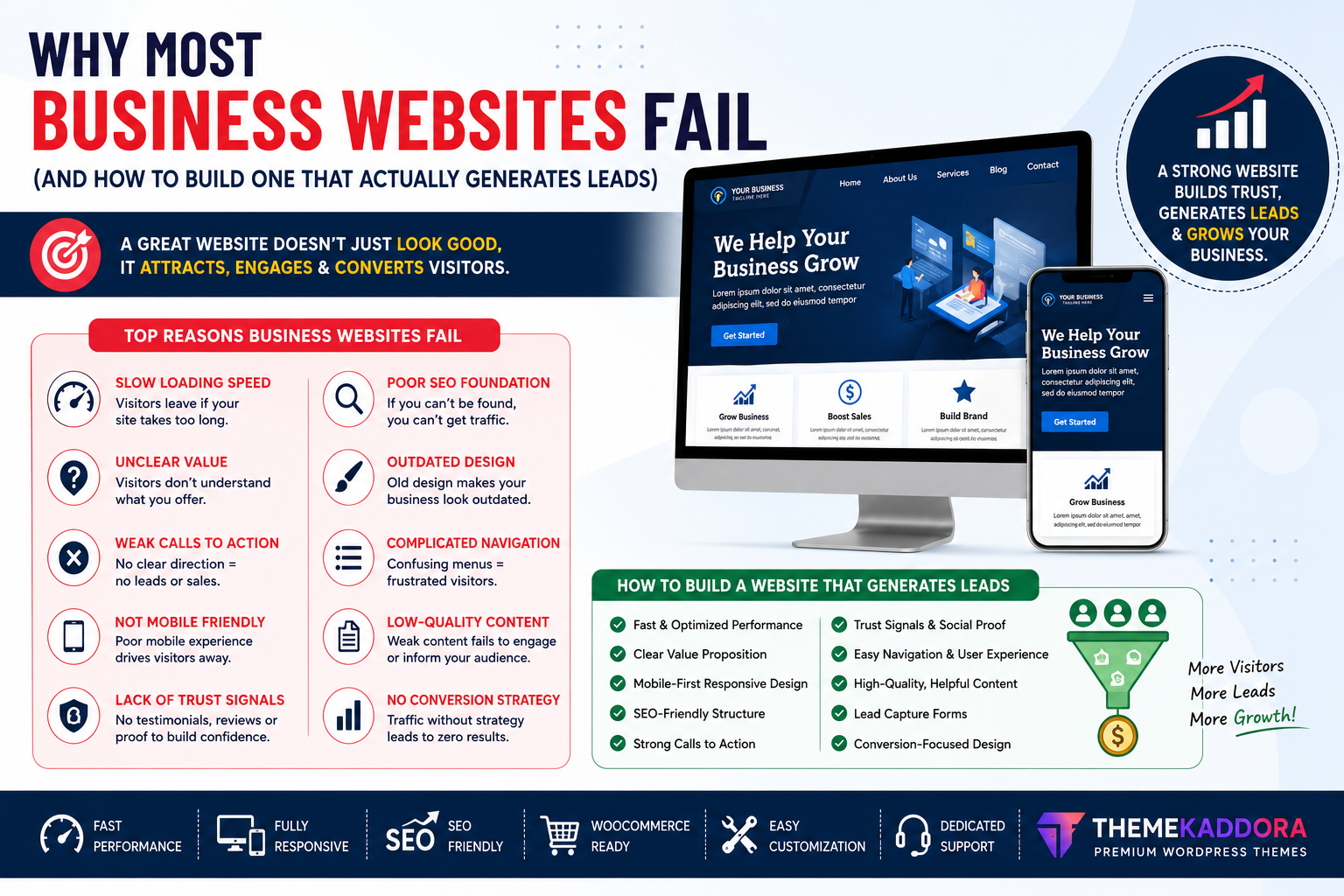
Why Most Business Websites Fail (And How to Build One That Actually Generates Leads)
Introduction
Every day, thousands of new business websites go live. They look attractive, include modern graphics, and contain detailed information about products or services. Yet many of these websites fail to generate meaningful traffic, inquiries, or sales.
Why?
Because having a website isn't the same as having a website that works.
A successful business website should do more than exist online—it should attract the right audience, build trust, answer customer questions, and encourage visitors to take action.
Whether you're launching a startup, managing a local business, running an agency, or growing an eCommerce store, understanding what separates high-performing websites from ineffective ones can save time, money, and missed opportunities.
This guide explores the most common reasons business websites fail and the practical steps you can take to build a website that supports long-term growth.
What Makes a Business Website Successful?
A successful website isn't judged only by its appearance.
It should help you:
Attract qualified visitors
Build credibility
Educate potential customers
Generate leads
Increase sales
Support customer relationships
Strengthen your brand
When these goals work together, your website becomes a valuable business asset.
1. Slow Website Performance
Visitors expect websites to load quickly.
If pages are slow, users may leave before exploring your content.
Performance can be affected by:
Heavy themes
Oversized images
Poor hosting
Too many plugins
Unoptimized code
Improving speed creates a better experience and supports SEO.
2. No Clear Value Proposition
Visitors should immediately understand:
What your business offers
Who it's for
How it solves a problem
Why they should choose you
A confusing homepage often leads to lost opportunities.
3. Weak Calls to Action
Many websites explain their services but never clearly tell visitors what to do next.
Effective calls to action include:
Request a Quote
Book a Consultation
Contact Our Team
Start Your Free Trial
Download Our Guide
Every important page should guide visitors toward a meaningful next step.
4. Poor Mobile Experience
A significant portion of website traffic comes from mobile devices.
A mobile-friendly website should provide:
Responsive layouts
Easy navigation
Readable text
Touch-friendly buttons
Fast loading pages
Poor mobile usability can discourage engagement.
5. Lack of Trust Signals
Visitors often look for evidence that your business is credible.
Helpful trust signals include:
Customer testimonials
Case studies
Reviews
Certifications
Awards
Client logos
Secure website connections
Authentic proof helps reduce uncertainty.
6. Weak SEO Foundation
Even great websites struggle if potential customers can't find them.
A strong SEO foundation includes:
Clear page structure
Relevant content
Optimized headings
Internal linking
Fast performance
Mobile responsiveness
SEO helps your website reach people searching for your products or services.
7. Outdated Design
Visitors often associate outdated websites with outdated businesses.
Modern websites should feature:
Clean layouts
Consistent branding
Professional typography
High-quality visuals
Logical navigation
An updated design reinforces credibility.
8. Difficult Navigation
Visitors should find information quickly.
Organize navigation with:
Clear menu labels
Logical page hierarchy
Search functionality
Prominent contact information
Simple navigation improves the overall user experience.
9. Low-Quality Content
Your content should answer customer questions and demonstrate expertise.
Create pages that provide:
Helpful information
Clear explanations
Practical solutions
Relevant examples
Well-organized structure
Quality content supports both users and search engines.
10. No Conversion Strategy
Traffic alone doesn't generate business results.
Your website should encourage visitors to:
Contact you
Request a quote
Subscribe
Schedule a meeting
Make a purchase
Conversion-focused design helps turn interest into action.
The Website Growth Framework
A successful website is built on four core pillars:
Attract
Use SEO, content marketing, and social media to bring relevant visitors to your website.
Engage
Deliver a fast, informative, and easy-to-navigate experience that keeps visitors interested.
Convert
Guide users toward clear actions through effective calls to action, forms, and trust signals.
Retain
Continue providing value through email marketing, helpful content, and excellent customer support.
Essential Features Every Modern Business Website Needs
Your website should include:
Responsive design
Fast loading speed
SEO-friendly architecture
Clear navigation
Contact forms
Strong calls to action
Secure HTTPS connection
Blog section
Social proof
Professional branding
These elements work together to improve user experience and business outcomes.
Why Your WordPress Theme Matters
A theme influences more than just design.
The right WordPress theme supports:
Website speed
Mobile responsiveness
SEO
Accessibility
Conversion optimization
WooCommerce integration
Easy customization
Choosing a high-quality theme provides a strong technical foundation.
Why Businesses Choose Themekaddora
Themekaddora creates WordPress themes designed to help businesses build websites that perform well and grow over time.
Benefits include:
Lightweight architecture
Responsive layouts
SEO-friendly code
WooCommerce compatibility
Fast loading performance
Modern business-focused designs
Flexible customization
Regular updates
Professional support
Whether you're creating a company website, agency portfolio, online store, or startup landing page, Themekaddora themes help you launch with confidence.
Signs It's Time to Redesign Your Website
Consider updating your website if you notice:
Declining inquiries
High bounce rates
Poor mobile usability
Slow loading pages
Outdated branding
Low search visibility
Difficult navigation
Limited customization options
A redesign can improve both user experience and business performance.
Final Website Success Checklist
Before launching or redesigning your website, confirm that it includes:
✅ Responsive design
✅ Fast loading performance
✅ Clear value proposition
✅ Strong calls to action
✅ SEO-friendly structure
✅ Trust signals
✅ Easy navigation
✅ High-quality content
✅ Secure HTTPS
✅ Professional branding
Conclusion
A successful business website isn't defined by appearance alone. It should attract the right audience, communicate value clearly, build trust, and guide visitors toward meaningful actions.
By focusing on performance, usability, content, SEO, and conversion optimization, you can transform your website into one of your most effective business assets.
If you're building or redesigning a WordPress website, choosing a high-quality theme is one of the most important decisions you'll make. Themekaddora themes combine modern design, responsive layouts, SEO-friendly architecture, and performance-focused development to help businesses create websites that not only look professional but also support long-term growth.
Frequently Asked Questions (FAQs)
Why do many business websites fail?
Common reasons include slow loading speeds, poor user experience, weak SEO, unclear messaging, outdated design, and the absence of a conversion strategy.
How can I improve my business website?
Focus on faster performance, responsive design, high-quality content, clear calls to action, strong SEO practices, and trust-building elements such as testimonials and case studies.
Does my WordPress theme affect conversions?
Yes. A well-coded, responsive, and performance-optimized theme can improve user experience and support better engagement and conversions.
When should I redesign my website?
Consider a redesign if your website has outdated visuals, performs poorly on mobile devices, loads slowly, or no longer supports your business goals.
Why choose Themekaddora WordPress themes?
Themekaddora themes are designed with responsive layouts, clean code, SEO-friendly architecture, WooCommerce compatibility, and fast performance, helping businesses create professional websites that are built for growth.
Comments (0)