
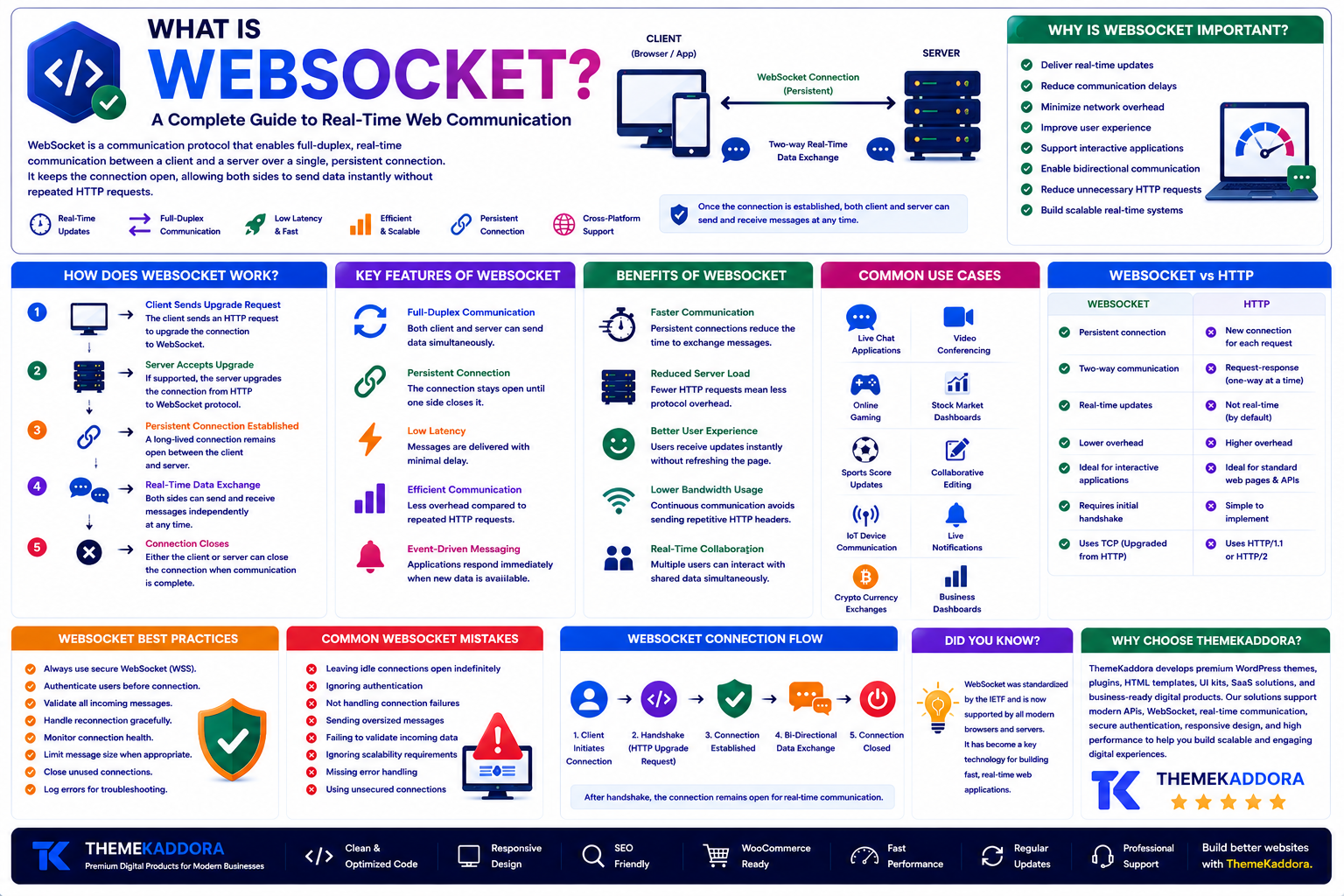
What Is WebSocket? A Complete Guide to Real-Time Web Communication
Introduction
Modern web applications are expected to deliver information instantly. Whether you're using a live chat application, monitoring stock prices, playing an online game, tracking delivery updates, or collaborating on a shared document, data needs to move between the server and users in real time.
Traditional HTTP communication works well for many tasks, but it follows a request-response model where the client must repeatedly ask the server for updates. This approach can create unnecessary network traffic and introduce delays.
WebSocket solves this challenge by creating a persistent, two-way communication channel between the client and the server. Once connected, both sides can exchange data instantly without repeatedly opening new connections.
In this guide, you'll learn what WebSocket is, how it works, its advantages, common use cases, best practices, and why it has become an essential technology for building modern real-time applications.
What Is WebSocket?
WebSocket is a communication protocol that enables full-duplex, real-time communication between a client and a server over a single, long-lived connection.
Unlike traditional HTTP, which opens and closes a connection for each request, WebSocket keeps the connection active, allowing both the client and server to send messages whenever needed.
This persistent connection makes WebSocket ideal for applications that require continuous data updates.
Why Is WebSocket Important?
Many modern applications require instant communication between users and servers.
WebSocket helps developers:
Deliver real-time updates
Reduce communication delays
Minimize network overhead
Improve user experience
Support interactive applications
Enable bidirectional communication
Reduce unnecessary HTTP requests
Build scalable real-time systems
These benefits make WebSocket a key technology for interactive web applications.
How Does WebSocket Work?
WebSocket communication follows a simple process.
Step 1: Client Sends a Connection Request
The browser or application sends an HTTP request asking to upgrade the connection to WebSocket.
Step 2: Server Accepts the Upgrade
If supported, the server upgrades the connection from HTTP to the WebSocket protocol.
Step 3: Persistent Connection Is Established
A long-lived connection remains open between the client and server.
Step 4: Real-Time Data Exchange
Both the client and server can send and receive messages independently at any time.
Step 5: Connection Closes
Either side can close the connection when communication is complete.
This process enables instant communication without repeated connection setup.
Key Features of WebSocket
WebSocket includes several important features.
Full-Duplex Communication
Both the client and server can send data simultaneously.
Persistent Connection
The connection stays open until one side closes it.
Low Latency
Messages are delivered with minimal delay.
Efficient Communication
Less overhead compared to repeated HTTP requests.
Event-Driven Messaging
Applications respond immediately when new data becomes available.
Benefits of WebSocket
WebSocket offers several advantages.
Faster Communication
Persistent connections reduce the time needed to exchange messages.
Reduced Server Load
Fewer HTTP requests mean less protocol overhead.
Better User Experience
Users receive updates instantly without refreshing the page.
Lower Bandwidth Usage
Continuous communication avoids sending repetitive HTTP headers.
Real-Time Collaboration
Multiple users can interact with shared data simultaneously.
Common Use Cases
WebSocket is widely used for:
Live chat applications
Video conferencing
Online gaming
Stock market dashboards
Sports score updates
Collaborative document editing
IoT device communication
Live notifications
Cryptocurrency exchanges
Business monitoring dashboards
WebSocket vs HTTP
Although both enable communication between clients and servers, they serve different purposes.
WebSocket
Persistent connection
Two-way communication
Real-time updates
Lower communication overhead
Ideal for interactive applications
HTTP
Request-response model
New connection for each request
Better for standard web pages
Simple implementation
Widely supported
Many modern applications use both HTTP and WebSocket together depending on the feature being implemented.
WebSocket Best Practices
To build reliable applications:
Always use secure WebSocket connections (WSS).
Authenticate users before establishing connections.
Validate all incoming messages.
Handle reconnection gracefully.
Monitor connection health.
Limit message size when appropriate.
Close unused connections.
Log errors for troubleshooting.
These practices improve reliability, security, and scalability.
Common WebSocket Mistakes
Avoid these common issues:
Leaving idle connections open indefinitely
Ignoring authentication
Not handling connection failures
Sending oversized messages
Failing to validate incoming data
Ignoring scalability requirements
Missing error handling
Using unsecured connections
Proper implementation helps maintain secure and stable real-time communication.
Why Choose ThemeKaddora?
At ThemeKaddora, we develop WordPress themes, plugins, HTML templates, UI kits, SaaS solutions, and business-ready digital products using modern development standards. Our products support technologies such as APIs, JSON, WebSocket, cloud infrastructure, responsive design, and performance optimization, helping businesses build fast, secure, and interactive digital experiences.
Whether you're creating a live chat platform, business dashboard, SaaS application, or custom website, ThemeKaddora provides scalable solutions built for modern web technologies.
Conclusion
WebSocket has transformed the way web applications communicate by enabling real-time, two-way communication over a single persistent connection. It powers many of the interactive experiences users expect today, from instant messaging and online gaming to financial dashboards and collaborative tools.
Understanding WebSocket helps developers choose the right communication technology for modern applications. Combined with APIs, JSON, JWT, OAuth, and cloud infrastructure, WebSocket provides a strong foundation for building fast, responsive, and scalable digital experiences.
Frequently Asked Questions
What is WebSocket?
WebSocket is a communication protocol that enables persistent, two-way communication between a client and a server over a single connection.
How is WebSocket different from HTTP?
HTTP follows a request-response model, while WebSocket maintains an open connection that allows both the client and server to exchange data in real time.
When should I use WebSocket?
WebSocket is ideal for applications that require instant updates, such as live chat, multiplayer games, financial dashboards, notifications, and collaborative editing tools.
Is WebSocket secure?
Yes. Secure WebSocket connections use the WSS protocol, which encrypts data similarly to HTTPS. Authentication and message validation should also be implemented for additional security.
Does WebSocket replace REST APIs?
No. WebSocket is designed for real-time communication, while REST APIs are better suited for standard request-response operations. Many applications use both technologies together.
Why choose ThemeKaddora?
ThemeKaddora develops high-quality digital products with clean code, responsive design, SEO-friendly architecture, modern API integrations, real-time communication support, strong security practices, and performance optimization.
Comments (0)