
What Is OAuth? A Complete Guide to Secure Authorization
Introduction
When you click "Continue with Google", "Sign in with Facebook," or "Login with GitHub," you're using a technology called OAuth. Instead of creating another username and password for every website or application, OAuth allows users to securely authorize access using an existing account.
As modern applications become more connected, users expect seamless and secure login experiences. OAuth has become one of the most widely adopted authorization frameworks because it enables applications to access specific user data without exposing passwords.
From mobile apps and SaaS platforms to WordPress websites and enterprise software, OAuth powers millions of secure integrations every day.
In this guide, you'll learn what OAuth is, how it works, its components, authorization flow, benefits, common use cases, best practices, and why it has become an essential part of modern application security.
What Is OAuth?
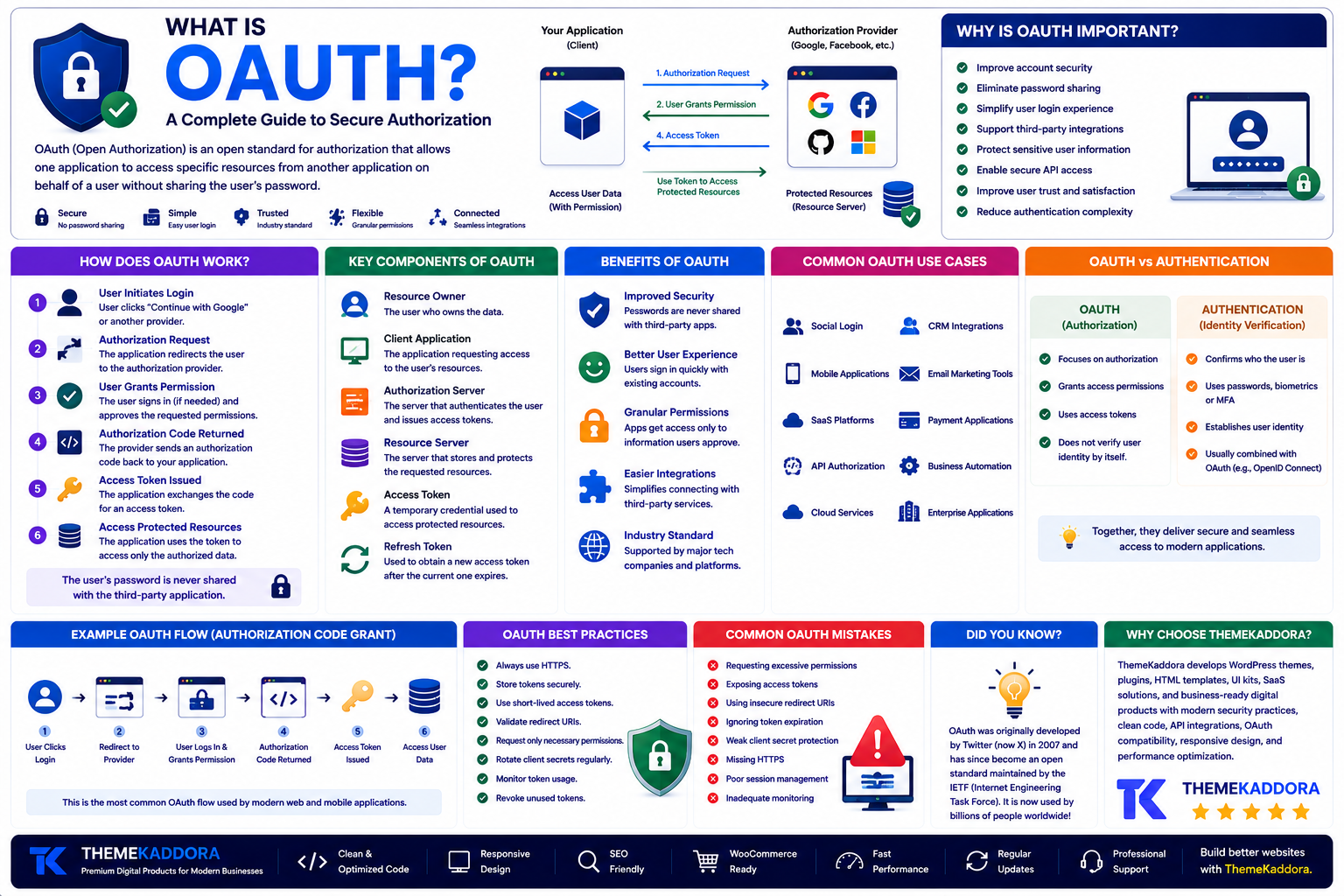
OAuth (Open Authorization) is an open standard for authorization that allows one application to access specific resources from another application on behalf of a user without sharing the user's password.
Instead of giving your login credentials directly to a third-party application, OAuth issues secure access tokens that grant limited permissions for a specific purpose.
This approach improves both security and user convenience.
Why Is OAuth Important?
Managing passwords across multiple applications creates security risks and poor user experiences.
OAuth helps developers and businesses:
Improve account security
Eliminate password sharing
Simplify user login
Support third-party integrations
Protect sensitive information
Enable secure API access
Improve user trust
Reduce authentication complexity
Because of these advantages, OAuth has become the standard authorization framework for many online services.
How Does OAuth Work?
OAuth follows a secure authorization process.
Step 1: User Initiates Login
A user clicks a button such as "Continue with Google."
Step 2: Authorization Request
The application redirects the user to the authorization provider.
Step 3: User Grants Permission
The user signs in (if necessary) and approves the requested permissions.
Step 4: Authorization Code Is Returned
The provider sends an authorization code back to the application.
Step 5: Access Token Is Issued
The application exchanges the authorization code for an access token.
Step 6: Protected Resources Are Accessed
The application uses the token to request only the authorized information.
The user's password is never shared with the third-party application.
Key Components of OAuth
OAuth includes several important components.
Resource Owner
The user who owns the data.
Client Application
The application requesting access to the user's resources.
Authorization Server
The service responsible for verifying the user's identity and issuing access tokens.
Resource Server
The server that stores and protects the requested resources.
Access Token
A temporary credential used to access protected resources.
Refresh Token
A token used to obtain a new access token after the current one expires.
Benefits of OAuth
OAuth offers several advantages.
Improved Security
Applications never receive the user's password.
Better User Experience
Users can sign in quickly using existing accounts.
Granular Permissions
Applications receive access only to the information users approve.
Easier Integrations
OAuth simplifies connecting applications with third-party services.
Industry Standard
OAuth is supported by major technology companies and development platforms.
Common OAuth Use Cases
OAuth is widely used for:
Social login
Mobile applications
SaaS platforms
API authorization
Cloud services
CRM integrations
Email marketing tools
Payment applications
Business automation software
Enterprise applications
OAuth vs Authentication
OAuth is often confused with authentication.
OAuth
Focuses on authorization
Grants access permissions
Uses access tokens
Does not verify user identity by itself
Authentication
Confirms who the user is
Uses passwords, biometrics, or multi-factor authentication
Establishes user identity
Many modern systems combine OAuth with authentication technologies such as OpenID Connect.
OAuth Best Practices
To improve security:
Always use HTTPS.
Store tokens securely.
Use short-lived access tokens.
Validate redirect URLs.
Request only necessary permissions.
Rotate secrets regularly.
Monitor token usage.
Revoke unused tokens.
These practices help protect users and applications.
Common OAuth Mistakes
Avoid these common issues:
Requesting excessive permissions
Exposing access tokens
Using insecure redirect URIs
Ignoring token expiration
Weak client secret protection
Missing HTTPS
Poor session management
Inadequate monitoring
Careful implementation helps prevent security vulnerabilities.
Why Choose ThemeKaddora?
At ThemeKaddora, we develop WordPress themes, plugins, HTML templates, UI kits, SaaS solutions, and business-ready digital products using modern development standards. Our products support secure authentication workflows, API integrations, OAuth-compatible services, responsive design, SEO-friendly architecture, and scalable performance to help businesses build secure and connected digital experiences.
Whether you're creating a WordPress website, SaaS platform, or custom application, ThemeKaddora provides solutions built for modern authentication and authorization requirements.
Conclusion
OAuth has become the industry standard for secure authorization across websites, mobile applications, and cloud platforms. By allowing applications to access user resources without exposing passwords, it improves both security and convenience.
As digital ecosystems continue to expand, OAuth remains a critical technology for building trusted integrations, enabling secure API access, and delivering seamless user experiences. Understanding OAuth is valuable for developers, business owners, and anyone working with modern web applications.
Frequently Asked Questions
What is OAuth?
OAuth is an open authorization framework that allows applications to access specific user resources without sharing passwords.
Is OAuth authentication?
No. OAuth is primarily an authorization framework. Authentication verifies a user's identity, while OAuth grants access permissions.
What is an access token?
An access token is a temporary credential that allows an application to access approved resources on behalf of a user.
Why is OAuth secure?
OAuth prevents password sharing by using secure tokens with limited permissions and expiration times.
Where is OAuth commonly used?
OAuth is commonly used for social login, SaaS applications, mobile apps, cloud services, API integrations, and enterprise software.
Why choose ThemeKaddora?
ThemeKaddora develops premium WordPress themes, plugins, HTML templates, UI kits, SaaS solutions, and business-ready digital products with modern security practices, clean code, responsive design, API integrations, and performance optimization.
Comments (0)