
What Is JWT? A Complete Guide to JSON Web Tokens
Introduction
Modern web applications need secure and efficient ways to identify users after they log in. Whether you're accessing a SaaS platform, using a mobile application, or logging into a WordPress-powered website, the application must recognize who you are without asking for your password on every request.
One of the most popular solutions for this challenge is the JSON Web Token (JWT). JWT enables applications to securely exchange information between clients and servers using digitally signed tokens instead of repeatedly sending login credentials.
JWT has become a standard technology in modern authentication systems because it is lightweight, scalable, and works well with REST APIs, GraphQL APIs, cloud services, and mobile applications.
In this guide, you'll learn what JWT is, how it works, its structure, benefits, common use cases, best practices, and why it is widely adopted in modern web development.
What Is JWT?
JWT stands for JSON Web Token.
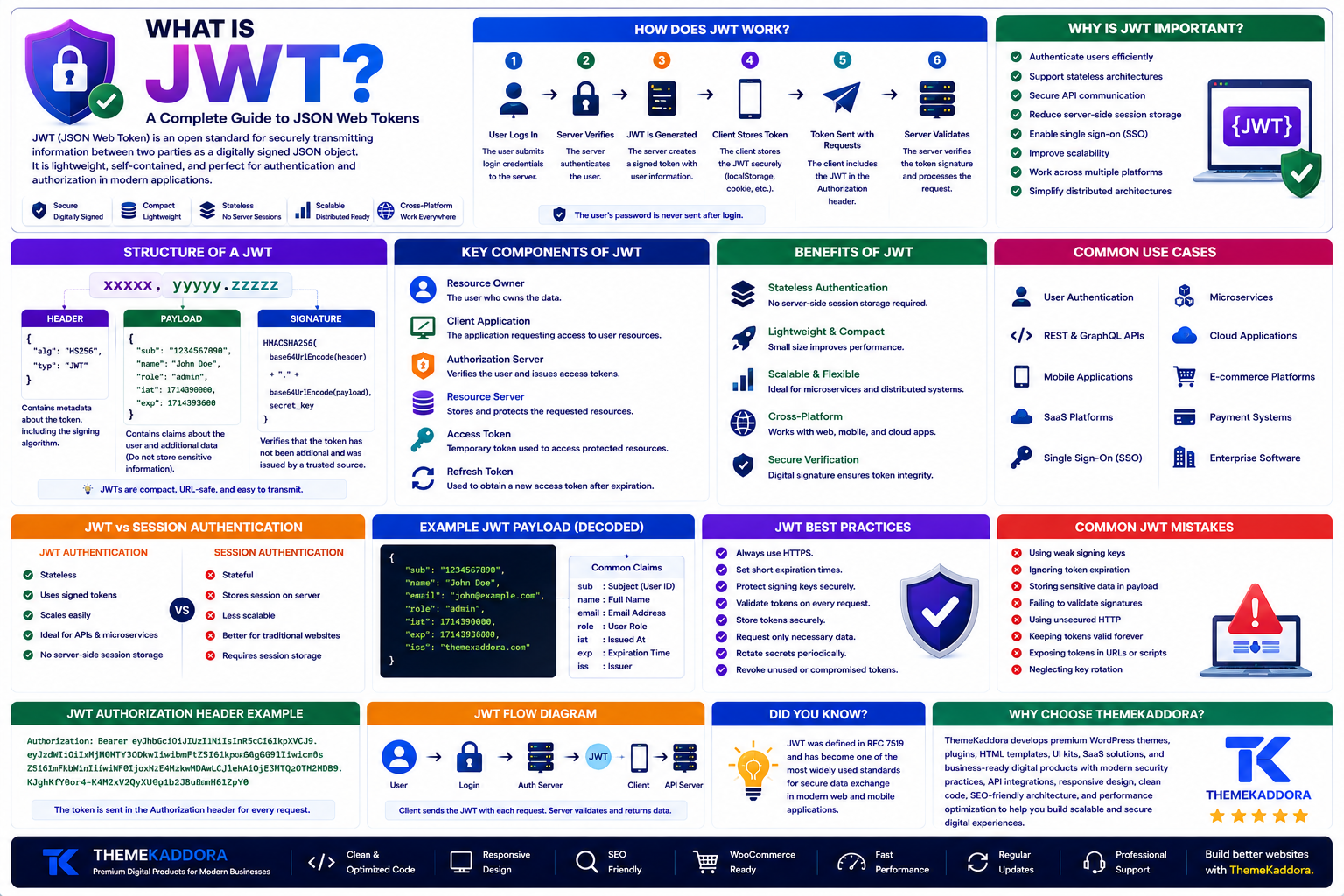
It is an open standard for securely transmitting information between two parties as a digitally signed JSON object.
A JWT typically contains information about the authenticated user and can be verified by the server without storing session data on the server itself.
Because JWTs are compact and self-contained, they are ideal for distributed systems, APIs, and cloud-based applications.
Why Is JWT Important?
Modern applications often need a scalable way to authenticate users across multiple services.
JWT helps developers:
Authenticate users efficiently
Support stateless applications
Secure API communication
Reduce server-side session storage
Enable single sign-on (SSO)
Improve scalability
Work across multiple platforms
Simplify distributed architectures
These benefits make JWT a common choice for API-driven applications.
How Does JWT Work?
JWT authentication follows a simple process.
Step 1: User Logs In
The user submits valid login credentials.
Step 2: Server Verifies Credentials
The server authenticates the user.
Step 3: JWT Is Generated
The server creates a signed JSON Web Token containing user information and expiration details.
Step 4: Client Stores the Token
The browser or mobile application stores the JWT securely.
Step 5: Token Is Sent with Requests
The client includes the JWT in future requests, usually in the HTTP Authorization header.
Step 6: Server Validates the Token
The server verifies the signature and processes the request if the token is valid.
This process eliminates the need for traditional server-side sessions in many applications.
Structure of a JWT
A JWT consists of three parts separated by periods.
Header
The header contains metadata about the token, including the signing algorithm.
Payload
The payload contains claims such as:
User ID
Username
Roles
Permissions
Expiration time
Issued time
Sensitive information should never be stored directly in the payload unless it is properly protected.
Signature
The signature verifies that the token has not been modified and was issued by a trusted source.
Benefits of JWT
JWT offers several advantages.
Stateless Authentication
Servers do not need to store session information for every user.
Lightweight
JWT uses compact JSON, making it efficient for network communication.
Scalable
JWT works well in distributed systems and microservices.
Cross-Platform Support
JWT can be used with web applications, mobile apps, APIs, and cloud services.
Secure Verification
Digital signatures help verify the authenticity and integrity of the token.
Common Use Cases
JWT is widely used for:
User authentication
REST APIs
GraphQL APIs
Mobile applications
SaaS platforms
Single Sign-On (SSO)
Microservices
Cloud applications
Enterprise software
Business automation systems
JWT vs Session Authentication
Although both authenticate users, they work differently.
JWT Authentication
Stateless
Uses signed tokens
Scales easily
Ideal for APIs and cloud services
No server-side session storage
Session Authentication
Stateful
Stores session data on the server
Simpler for traditional web applications
Often used with server-rendered websites
The right approach depends on your application's architecture and requirements.
JWT Security Best Practices
To keep JWT implementations secure:
Always use HTTPS.
Set short expiration times.
Protect signing keys.
Validate every token.
Store tokens securely.
Rotate secrets periodically.
Avoid placing sensitive data in the payload.
Revoke compromised tokens when possible.
These practices reduce security risks and improve trust.
Common JWT Mistakes
Avoid these common issues:
Using weak signing keys
Ignoring token expiration
Storing confidential data in the payload
Failing to validate signatures
Using unsecured HTTP connections
Keeping tokens valid indefinitely
Exposing tokens through client-side scripts
Neglecting key rotation
Careful implementation is essential for secure authentication.
Why Choose ThemeKaddora?
At ThemeKaddora, we develop WordPress themes, plugins, HTML templates, UI kits, SaaS solutions, and business-ready digital products using modern development standards. Our products are designed with secure authentication practices, API integrations, responsive layouts, clean code, SEO-friendly architecture, and performance optimization to help businesses build scalable and reliable digital solutions.
Whether you're creating a WordPress website, SaaS platform, or custom web application, ThemeKaddora provides professional solutions built for modern authentication and API-driven environments.
Conclusion
JSON Web Tokens have become one of the most popular technologies for secure authentication and authorization in modern applications. Their lightweight structure, stateless design, and compatibility with APIs make them well suited for scalable web and mobile applications.
Understanding how JWT works helps developers build secure systems and enables businesses to deliver seamless user experiences across multiple platforms. When combined with OAuth, HTTPS, and secure coding practices, JWT provides a strong foundation for modern application security.
Frequently Asked Questions
What is JWT?
JWT (JSON Web Token) is a compact, digitally signed token used to securely exchange information between applications.
What is JWT used for?
JWT is commonly used for user authentication, API authorization, single sign-on, and secure communication between services.
Is JWT the same as OAuth?
No. OAuth is an authorization framework, while JWT is a token format that can be used within authentication and authorization systems.
Is JWT secure?
Yes, when implemented correctly with HTTPS, strong signing keys, proper validation, and secure token storage.
Can JWT replace sessions?
In many API-driven and distributed applications, JWT can replace traditional server-side sessions. However, session-based authentication may still be appropriate for some web applications.
Why choose ThemeKaddora?
ThemeKaddora develops high-quality digital products with clean code, responsive design, SEO-friendly architecture, modern API integrations, strong security practices, and performance optimization.
Comments (0)