
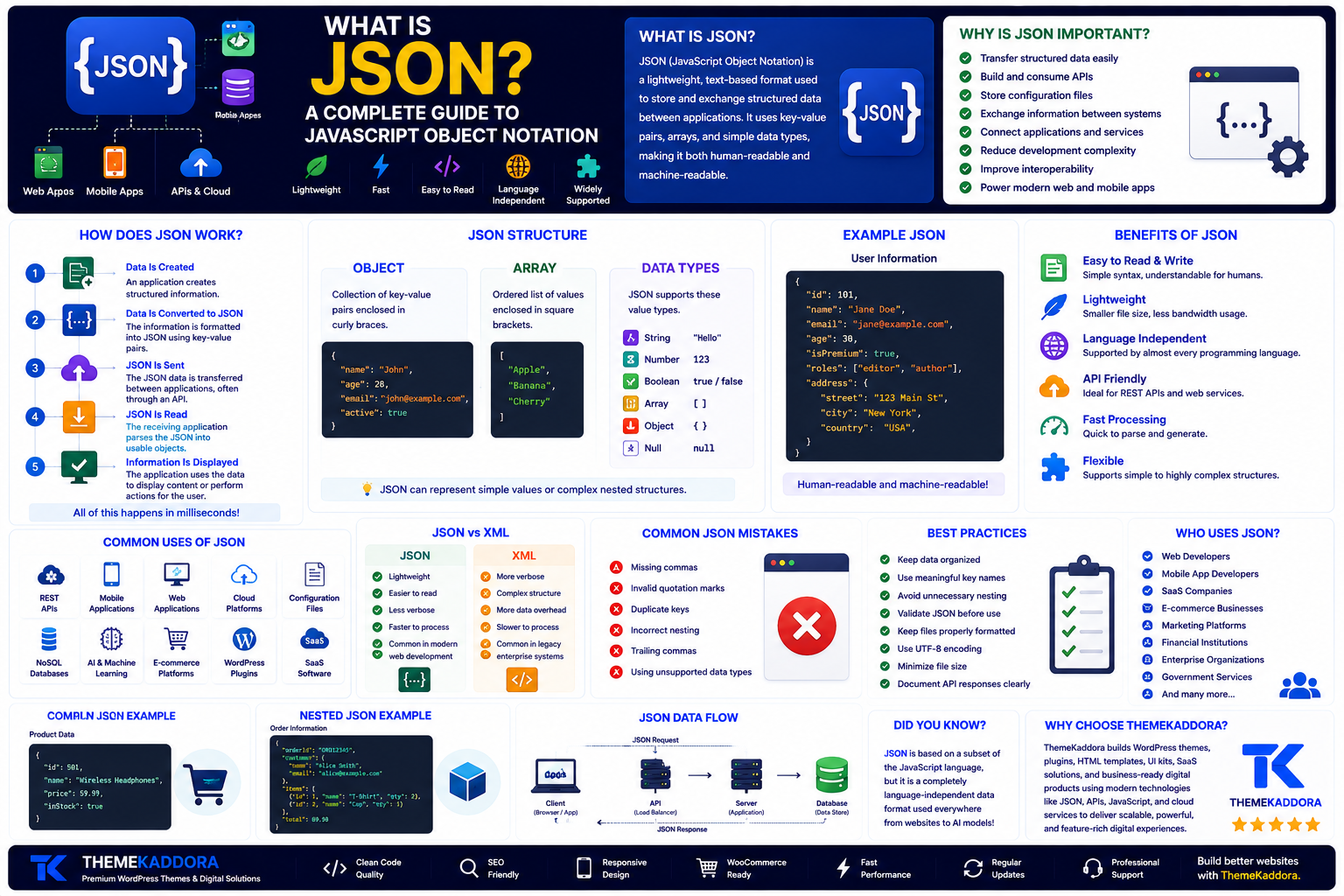
What Is JSON? A Complete Guide to JavaScript Object Notation
Introduction
Modern websites and applications constantly exchange information. Whether you're logging into a website, checking the weather on a mobile app, shopping online, or using an AI-powered chatbot, data is being transferred between different systems behind the scenes.
To make this communication simple, fast, and consistent, developers use JSON (JavaScript Object Notation). It has become the most widely used format for storing and exchanging data across websites, mobile apps, APIs, cloud platforms, and software systems.
Although JSON originated from JavaScript, it is now supported by almost every modern programming language, making it a universal data format.
Whether you're a beginner learning web development or a business owner interested in how modern applications work, understanding JSON will help you better understand today's connected digital ecosystem.
In this guide, you'll learn what JSON is, how it works, its structure, common use cases, advantages, limitations, best practices, and why it has become an essential technology for modern software development.
What Is JSON?
JSON stands for JavaScript Object Notation.
It is a lightweight text-based format used to store and exchange structured data between applications.
JSON organizes information using key-value pairs, making it both human-readable and machine-readable.
For example, a JSON object might represent a user with fields such as name, email, and age. Applications can easily read, modify, and transfer this information.
Today, JSON is the preferred format for communication between web browsers, servers, APIs, mobile apps, and cloud services.
Why Is JSON Important?
JSON has become an industry standard because it simplifies data exchange between different technologies.
It helps developers:
Transfer structured data
Build APIs
Store configuration files
Exchange information between servers and browsers
Connect applications
Support cloud services
Improve interoperability
Reduce development complexity
Its simplicity and flexibility make it suitable for projects of every size.
How Does JSON Work?
JSON works by representing information in a structured text format.
The typical process looks like this:
Step 1: Data Is Created
An application creates structured information.
Step 2: Data Is Converted to JSON
The information is formatted into JSON using key-value pairs.
Step 3: JSON Is Sent
The JSON data is transferred between applications, often through an API.
Step 4: JSON Is Read
The receiving application parses the JSON into usable objects.
Step 5: Information Is Displayed
The application uses the data to display content or perform actions.
This entire process happens in milliseconds.
JSON Structure
JSON is built using simple components:
Objects
Objects contain collections of key-value pairs enclosed in curly braces.
Arrays
Arrays store ordered lists of values enclosed in square brackets.
Keys
Keys identify each piece of information.
Values
Values can include:
Strings
Numbers
Boolean values
Arrays
Objects
Null values
This flexible structure allows JSON to represent complex data efficiently.
Benefits of JSON
JSON offers several advantages.
Easy to Read
Its simple syntax makes it understandable for both humans and machines.
Lightweight
JSON files are compact, reducing bandwidth usage during data transfer.
Language Independent
Almost every modern programming language supports JSON.
API Friendly
Most REST APIs use JSON as their default data format.
Fast Processing
Applications can quickly parse and generate JSON.
Flexible
JSON can represent simple values or highly complex nested structures.
Common Uses of JSON
JSON is used in many areas of software development.
Examples include:
REST APIs
Mobile applications
Web applications
Cloud platforms
Configuration files
NoSQL databases
AI applications
E-commerce platforms
WordPress plugins
SaaS software
JSON vs XML
Although both formats exchange data, they differ significantly.
JSON
Lightweight
Easier to read
Less verbose
Faster to process
Common in modern web development
XML
More verbose
Better suited for certain document-based systems
Supports additional metadata
Common in legacy enterprise applications
Today, JSON is generally preferred for modern APIs and web applications.
Common JSON Mistakes
Avoid these common errors:
Missing commas
Invalid quotation marks
Duplicate keys
Incorrect nesting
Trailing commas
Using unsupported data types
Valid syntax is essential for successful data exchange.
JSON Best Practices
For better development:
Keep data organized.
Use meaningful key names.
Avoid unnecessary nesting.
Validate JSON before deployment.
Keep files properly formatted.
Use UTF-8 encoding.
Minimize file size where appropriate.
Document API responses clearly.
These practices improve readability and maintainability.
Why Choose ThemeKaddora?
At ThemeKaddora, we build WordPress themes, plugins, HTML templates, UI kits, SaaS solutions, and business-ready digital products using modern development standards. Our products leverage technologies such as JSON, APIs, JavaScript, and cloud services to deliver scalable, responsive, and feature-rich digital experiences.
Whether you're building a custom website or developing complex business software, ThemeKaddora provides reliable solutions designed for modern development workflows.
Conclusion
JSON has become the universal language for exchanging structured data across websites, applications, and cloud services. Its lightweight format, ease of use, and broad compatibility make it an essential tool for developers and businesses alike.
As web technologies continue to evolve, JSON remains at the center of APIs, mobile applications, SaaS platforms, and modern software development. Understanding how JSON works provides a strong foundation for anyone interested in web development or digital technology.
Frequently Asked Questions
What is JSON?
JSON (JavaScript Object Notation) is a lightweight format used to store and exchange structured data between applications.
Why is JSON important?
JSON enables fast, efficient, and standardized communication between websites, APIs, mobile apps, and servers.
Is JSON only used with JavaScript?
No. Although JSON originated from JavaScript, it is supported by almost every modern programming language.
What is the difference between JSON and XML?
JSON is generally lighter, simpler, and easier to process, while XML is more verbose and often used in older enterprise systems.
Is JSON used in APIs?
Yes. Most modern REST APIs use JSON as the standard format for requests and responses.
Why choose ThemeKaddora?
ThemeKaddora develops high-quality digital products with clean code, responsive design, SEO-friendly architecture, API integrations, performance optimization, and modern development practices.
Comments (0)