
What is JavaScript? A Complete Beginner's Guide to the World's Most Popular Programming Language
Introduction
Modern websites are expected to do much more than display text and images. Users interact with search boxes, forms, shopping carts, image sliders, live chat widgets, dashboards, and dynamic content every day. Behind most of these interactive experiences is JavaScript.
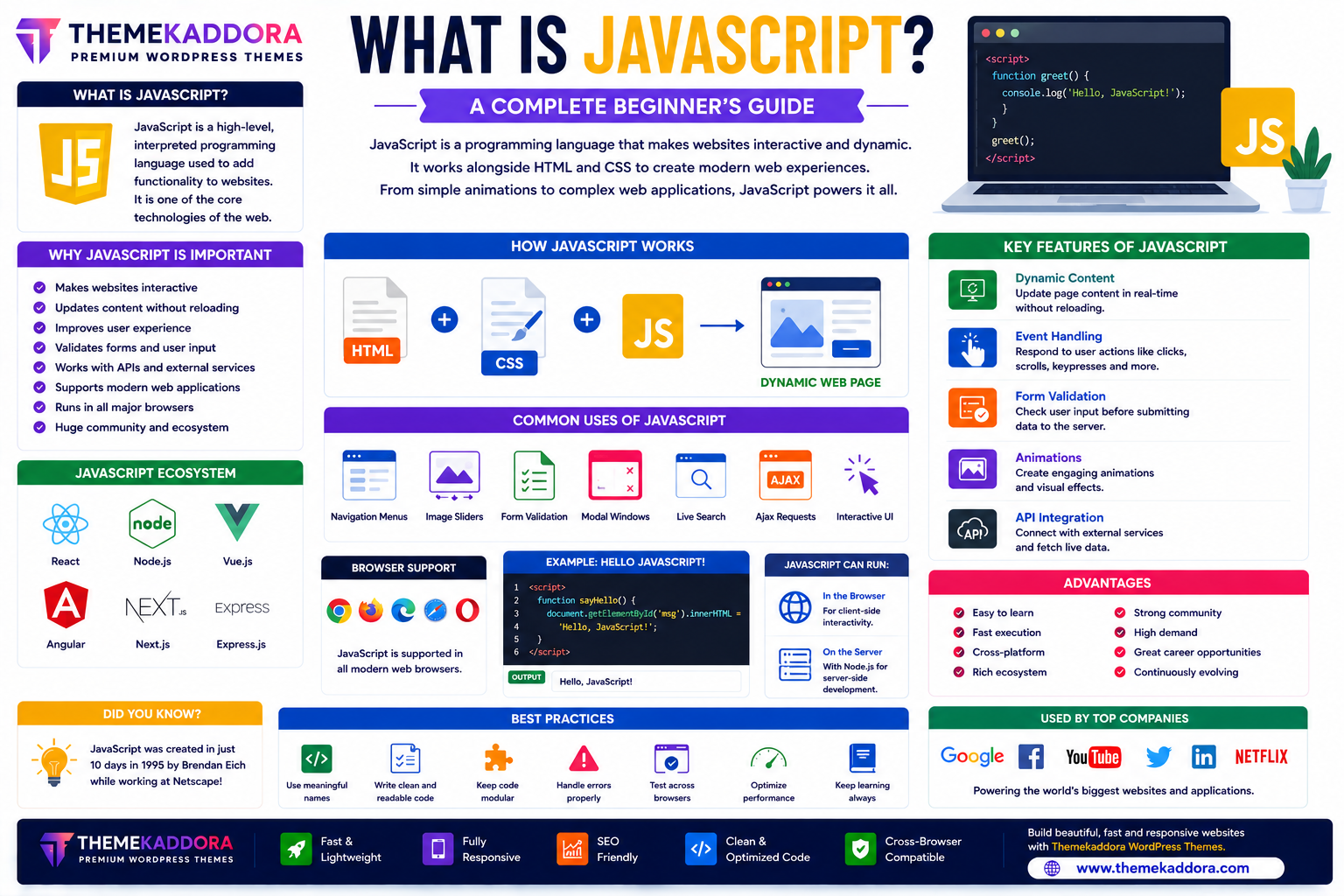
JavaScript is one of the core technologies of the web, alongside HTML and CSS. While HTML provides the structure of a webpage and CSS controls its appearance, JavaScript adds functionality and interactivity, allowing websites to respond to user actions and update content dynamically.
Whether you're a beginner learning web development, a business owner curious about website technology, or a developer looking to strengthen your fundamentals, understanding JavaScript is essential.
This guide explains what JavaScript is, how it works, its features, common use cases, and why it has become the world's most widely used programming language.
What is JavaScript?
JavaScript is a high-level programming language used to create interactive and dynamic websites.
It enables webpages to:
Respond to user actions
Update content without reloading
Validate forms
Display animations
Load data dynamically
Build interactive applications
Communicate with web servers
Today, JavaScript powers millions of websites and web applications across the internet.
Why JavaScript is Important
JavaScript provides many benefits for web development:
Creates interactive websites
Improves user experience
Reduces page reloads
Supports modern web applications
Works across all major browsers
Large developer community
Extensive ecosystem
Versatile programming language
It has become an essential skill for front-end and full-stack developers.
How JavaScript Works
JavaScript runs inside the web browser.
When a webpage loads:
The browser reads the HTML structure.
CSS styles the webpage.
JavaScript adds functionality and responds to user interactions.
Modern JavaScript can also run outside the browser using server-side environments, making it useful for both front-end and back-end development.
Key Features of JavaScript
Dynamic Content
JavaScript allows webpages to update content without requiring a full page refresh.
Examples include:
Live notifications
Shopping cart updates
Search suggestions
Comment sections
Event Handling
JavaScript reacts to user actions such as:
Mouse clicks
Keyboard input
Scrolling
Form submissions
Touch gestures
This makes websites interactive.
Form Validation
JavaScript can verify user input before it is submitted.
Examples include checking:
Email format
Required fields
Password length
Number ranges
Validation improves usability and reduces unnecessary server requests.
Animations
JavaScript powers interactive effects such as:
Image sliders
Pop-up windows
Smooth scrolling
Dynamic menus
Loading indicators
These features create engaging user experiences.
API Integration
JavaScript can communicate with external services to retrieve or send information.
Common examples include:
Weather data
Maps
Payment gateways
Social media feeds
Live stock prices
This enables rich, data-driven applications.
Common Uses of JavaScript
JavaScript is widely used for:
Business websites
eCommerce stores
Blogs
Web applications
Dashboards
Online games
Social media platforms
Progressive Web Apps (PWAs)
Learning platforms
Customer portals
Its flexibility makes it suitable for projects of all sizes.
Advantages of JavaScript
Using JavaScript offers:
Fast execution
Cross-platform compatibility
Rich ecosystem
Strong community support
Extensive libraries
Responsive interfaces
Continuous evolution
Broad career opportunities
These strengths have helped JavaScript remain one of the most popular programming languages for decades.
JavaScript Frameworks and Libraries
The JavaScript ecosystem includes many popular tools that simplify development.
Examples include:
React
Angular
Vue.js
Next.js
Node.js
Express.js
Choosing the right tool depends on your project requirements.
JavaScript Best Practices
To write better JavaScript:
Use meaningful variable names.
Keep code modular.
Handle errors gracefully.
Optimize performance.
Write readable code.
Avoid unnecessary global variables.
Test across browsers.
Good coding practices improve maintainability and reliability.
Common JavaScript Mistakes
Avoid:
Writing overly complex functions
Ignoring error handling
Blocking the main thread with heavy computations
Duplicating code
Mixing presentation and logic
Forgetting browser compatibility testing
Clean, well-organized code is easier to maintain.
JavaScript in WordPress Themes
Professional WordPress themes—including Themekaddora themes—use JavaScript to enhance user experience through:
Mobile navigation
Sliders and carousels
Interactive menus
AJAX-powered search
Product filtering
Modal windows
Lazy loading
Theme customization
JavaScript helps create fast, engaging, and interactive WordPress websites.
Conclusion
JavaScript is one of the most important technologies in modern web development. It transforms static webpages into dynamic, interactive experiences that users expect today.
From simple form validation to complex web applications, JavaScript powers millions of websites and continues to evolve with new features and frameworks.
When combined with HTML5, CSS, and responsive WordPress themes from Themekaddora, JavaScript enables developers to build professional, high-performance websites that deliver exceptional user experiences.
Frequently Asked Questions (FAQs)
What is JavaScript?
JavaScript is a programming language used to create interactive and dynamic websites.
Is JavaScript difficult to learn?
JavaScript is beginner-friendly, though mastering advanced concepts takes time and practice.
What is the difference between HTML, CSS, and JavaScript?
HTML provides the structure of a webpage, CSS controls its appearance, and JavaScript adds functionality and interactivity.
Can JavaScript be used outside the browser?
Yes. JavaScript can run in server-side environments, enabling developers to build complete web applications using a single language.
Why do Themekaddora WordPress themes use JavaScript?
Themekaddora themes use modern JavaScript to power responsive navigation, interactive components, AJAX features, animations, and enhanced user experiences while maintaining fast performance and clean code.
Comments (0)