
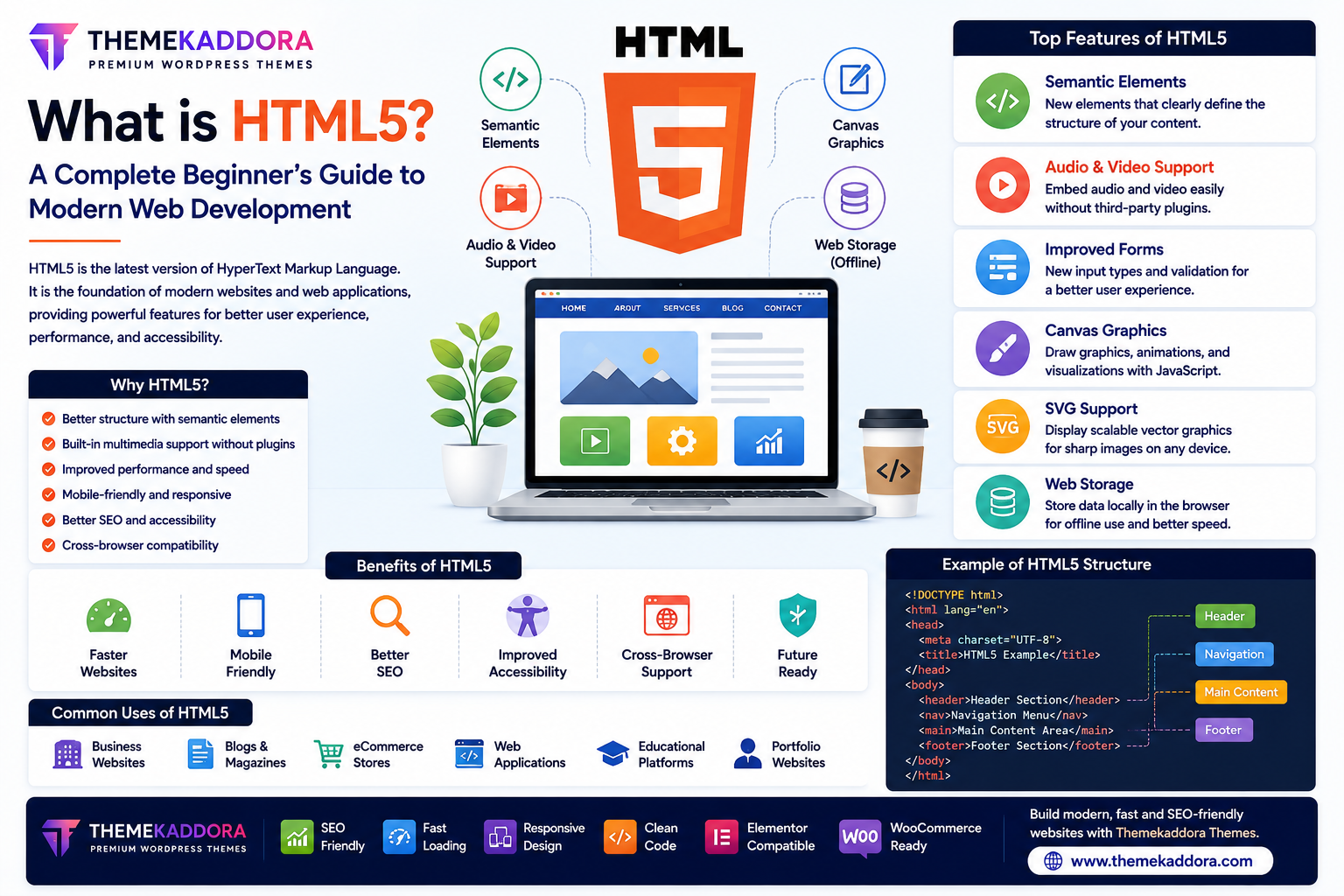
What is HTML5? A Complete Beginner's Guide to Modern Web Development
Introduction
Every website you visit—from blogs and business websites to eCommerce stores and social media platforms—is built using web technologies. At the core of nearly every webpage is HTML, the language that structures content on the web.
HTML5 is the latest major version of the HyperText Markup Language and serves as the foundation of modern website development. It introduced powerful new features that make websites faster, more interactive, more accessible, and easier to build.
Whether you're a beginner learning web development or a business owner wanting to understand how websites work, HTML5 is an essential technology to know.
This guide explains what HTML5 is, its key features, advantages, and why it has become the standard for modern web development.
What is HTML5?
HTML5 is the latest version of HyperText Markup Language (HTML), the standard markup language used to create and structure web pages.
It defines the structure of content such as:
Headings
Paragraphs
Images
Videos
Forms
Tables
Navigation menus
Interactive elements
HTML5 works together with CSS for styling and JavaScript for functionality to create modern websites.
Why HTML5 Was Introduced
Earlier versions of HTML had several limitations, including:
Limited multimedia support
Heavy dependence on third-party plugins
Poor semantic structure
Limited mobile compatibility
HTML5 was developed to address these challenges and provide a better experience for developers and users alike.
Key Features of HTML5
Semantic Elements
HTML5 introduced semantic tags that clearly describe the purpose of different parts of a webpage.
Examples include:
<header>
<nav>
<main>
<section>
<article>
<aside>
<footer>
These elements improve code readability, accessibility, and SEO.
Native Audio and Video Support
One of the biggest improvements in HTML5 is built-in multimedia support.
Developers can embed:
Audio
Video
without relying on third-party plugins.
This improves performance and compatibility across devices.
Improved Forms
HTML5 introduced new input types such as:
Number
Date
URL
Search
Range
Color
These input types improve user experience and help validate data before submission.
Canvas Element
The <canvas> element allows developers to create graphics directly in the browser using JavaScript.
Common uses include:
Charts
Games
Animations
Data visualizations
SVG Support
HTML5 supports scalable vector graphics (SVG), making it easier to display sharp graphics that remain clear on all screen sizes.
Offline Storage
HTML5 introduced browser storage capabilities that allow web applications to store data locally for improved performance and offline functionality.
Benefits of HTML5
Faster Websites
HTML5 reduces reliance on external plugins, resulting in faster page loading.
Better Mobile Compatibility
HTML5 is designed with responsive web development in mind and works well across smartphones, tablets, and desktops.
Improved SEO
Semantic HTML helps search engines better understand webpage content, supporting improved indexing and search visibility.
Enhanced Accessibility
Clear document structure improves navigation for screen readers and assistive technologies.
Cross-Browser Support
Modern browsers provide strong support for HTML5 features, helping websites perform consistently across platforms.
HTML5 Semantic Structure Example
A typical HTML5 page includes sections such as:
Header
Navigation
Main content
Articles
Sidebar
Footer
This organized structure makes websites easier to maintain and improves both SEO and accessibility.
HTML5 vs Older HTML Versions
Feature
Older HTML
HTML5
Semantic Elements
Limited
Yes
Audio Support
Plugin Required
Native
Video Support
Plugin Required
Native
Mobile Support
Limited
Excellent
Local Storage
No
Yes
Canvas Graphics
No
Yes
Form Features
Basic
Advanced
Common Uses of HTML5
HTML5 is widely used for building:
Business websites
Blogs
Landing pages
Online stores
Portfolio websites
Educational platforms
News websites
Web applications
It serves as the foundation for nearly every modern website.
Best Practices for HTML5 Development
To build high-quality websites:
Use semantic HTML elements.
Keep code clean and well-organized.
Optimize images and multimedia.
Validate your HTML regularly.
Build mobile-friendly layouts.
Follow accessibility guidelines.
These practices improve maintainability and user experience.
Common HTML5 Mistakes
Avoid:
Using too many <div> elements instead of semantic tags.
Ignoring accessibility attributes.
Creating invalid HTML structures.
Embedding oversized media files.
Forgetting responsive design.
Clean HTML improves both performance and maintainability.
Why HTML5 Matters for WordPress Themes
Modern WordPress themes—including those from Themekaddora—are built using HTML5 standards.
Benefits include:
Better SEO structure
Faster loading pages
Improved accessibility
Responsive layouts
Modern browser compatibility
Easier maintenance
Cleaner code
Using HTML5 ensures your website remains compatible with current and future web standards.
Conclusion
HTML5 is the backbone of modern web development. It provides a cleaner structure, improved multimedia support, better accessibility, enhanced SEO, and excellent compatibility across devices and browsers.
Whether you're building a personal blog, business website, or WooCommerce store, understanding HTML5 gives you a strong foundation for creating professional and high-performing websites.
Combined with well-designed WordPress themes from Themekaddora, HTML5 helps deliver fast, responsive, and future-ready websites.
Frequently Asked Questions (FAQs)
What is HTML5?
HTML5 is the latest version of HyperText Markup Language used to structure and display content on websites.
Is HTML5 difficult to learn?
No. HTML5 is beginner-friendly and is often the first language people learn when starting web development.
Does HTML5 replace CSS and JavaScript?
No. HTML5 structures content, CSS handles styling, and JavaScript adds interactivity. Together, they create modern websites.
Why is HTML5 important for SEO?
Semantic HTML elements help search engines better understand webpage structure, which supports better indexing and accessibility.
Why do Themekaddora WordPress themes use HTML5?
Themekaddora themes are built with HTML5 standards to provide clean code, responsive layouts, improved SEO, modern browser compatibility, and excellent website performance.
Comments (0)