
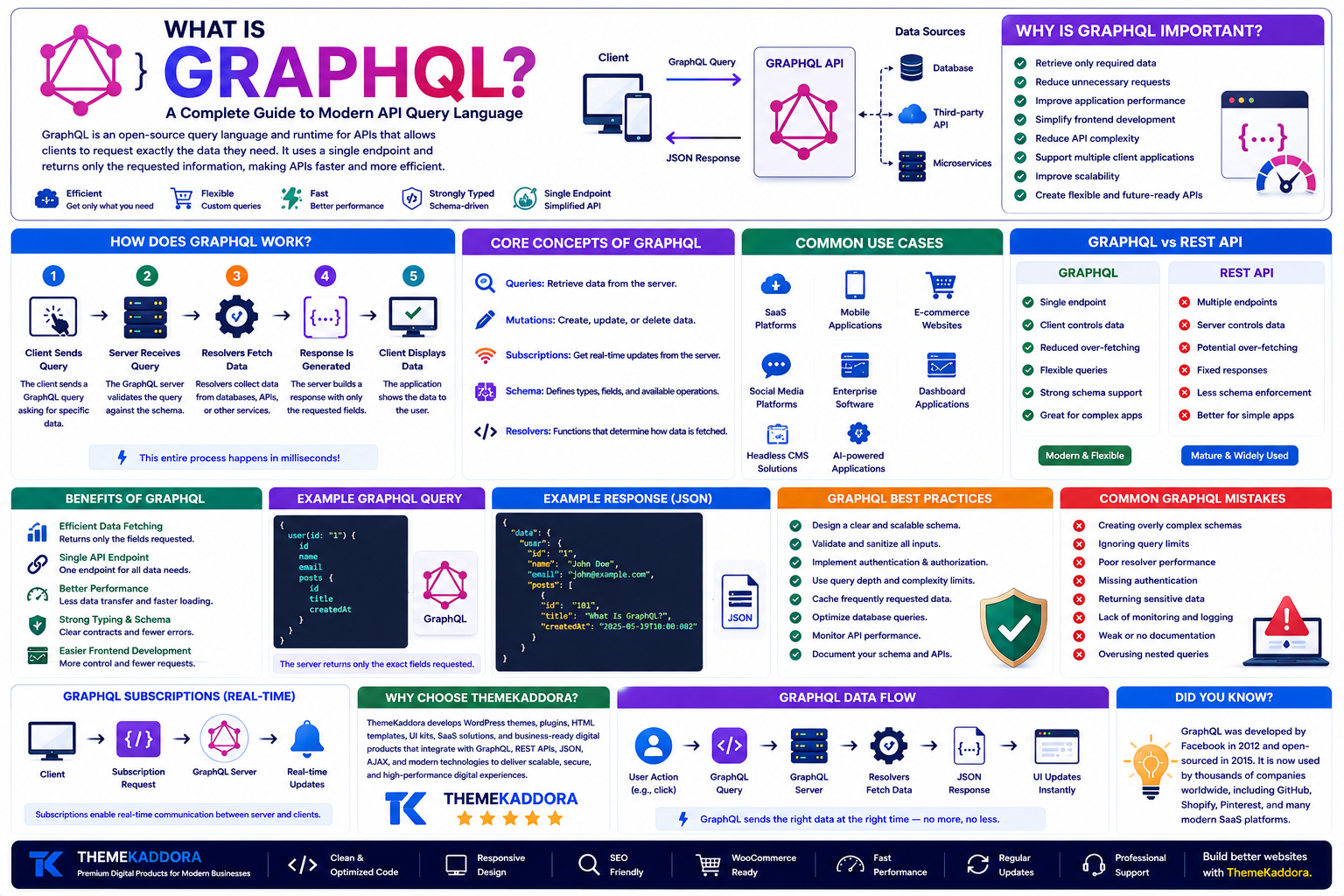
What Is GraphQL? A Complete Guide to Modern API Query Language
Introduction
Modern applications rely heavily on APIs to exchange data between clients and servers. As applications become more complex, developers need efficient ways to retrieve exactly the data they need without making multiple API requests or receiving unnecessary information.
This is where GraphQL comes in. Developed to solve many limitations of traditional REST APIs, GraphQL provides a flexible and efficient way for applications to request data.
Instead of exposing multiple endpoints, GraphQL uses a single endpoint where clients specify exactly which fields they need. This reduces unnecessary data transfer and improves application performance.
Whether you're building a WordPress plugin, SaaS platform, mobile application, or enterprise software, understanding GraphQL helps you design modern, scalable, and efficient APIs.
In this guide, you'll learn what GraphQL is, how it works, its core concepts, benefits, common use cases, best practices, and how it compares with REST APIs.
What Is GraphQL?
GraphQL is an open-source query language and runtime for APIs that allows clients to request exactly the data they need.
Unlike REST APIs, which often require multiple endpoints for different resources, GraphQL provides a single endpoint that returns only the requested information.
This makes data fetching faster, more efficient, and easier to manage for modern applications.
Why Is GraphQL Important?
As applications grow, data requirements become more complex.
GraphQL helps developers:
Retrieve only required data
Reduce unnecessary network requests
Improve application performance
Simplify frontend development
Reduce API complexity
Support multiple client applications
Improve scalability
Create flexible APIs
These advantages make GraphQL increasingly popular among modern software teams.
How Does GraphQL Work?
GraphQL follows a request-and-response model.
Step 1: Client Sends a Query
The client sends a GraphQL query specifying the exact data it needs.
Step 2: GraphQL Server Receives the Request
The GraphQL server validates the query.
Step 3: Resolvers Fetch Data
Resolvers collect data from databases, APIs, or other services.
Step 4: Response Is Generated
The server builds a response containing only the requested fields.
Step 5: Client Displays the Data
The application renders the returned information without unnecessary data.
This process minimizes data transfer and improves efficiency.
Core Concepts of GraphQL
GraphQL includes several important concepts.
Queries
Queries retrieve data from the server.
Mutations
Mutations create, update, or delete data.
Subscriptions
Subscriptions provide real-time updates between the server and clients.
Schema
The schema defines available data types, relationships, and operations.
Resolvers
Resolvers determine how requested data is fetched and returned.
Benefits of GraphQL
GraphQL offers several advantages.
Efficient Data Fetching
Clients receive only the data they request.
Single API Endpoint
Most GraphQL APIs use one endpoint instead of many REST endpoints.
Better Performance
Smaller responses reduce bandwidth usage and improve loading speed.
Strong Typing
Schemas clearly define available data and improve API reliability.
Easier Frontend Development
Frontend developers have greater control over the data returned.
Common Use Cases
GraphQL is widely used for:
Mobile applications
E-commerce websites
Social media platforms
Enterprise software
Dashboard applications
Business automation tools
Headless CMS solutions
WordPress integrations
AI-powered applications
GraphQL vs REST API
Although both enable communication between applications, they differ in several ways.
GraphQL
Single endpoint
Client controls requested data
Reduced over-fetching
Flexible queries
Strong schema support
REST API
Multiple endpoints
Server determines returned data
Easier for simple applications
Mature ecosystem
Widely adopted
Choosing between GraphQL and REST depends on your application's complexity and requirements.
GraphQL Best Practices
For better API performance:
Design a clear schema.
Validate all queries.
Use authentication and authorization.
Implement query depth limits.
Cache frequently requested data.
Monitor API performance.
Optimize database queries.
Document your schema thoroughly.
These practices improve scalability, security, and maintainability.
Common GraphQL Mistakes
Avoid these common issues:
Creating overly complex schemas
Ignoring query limits
Poor resolver performance
Missing authentication
Returning sensitive data
Lack of monitoring
Weak documentation
Overusing nested queries
Proper planning helps create reliable GraphQL APIs.
Why Choose ThemeKaddora?
At ThemeKaddora, we develop WordPress themes, plugins, HTML templates, UI kits, SaaS solutions, and business-ready digital products using modern development standards. Our products integrate with APIs, JSON, AJAX, REST, GraphQL, and cloud technologies to deliver scalable, high-performance digital experiences for businesses and developers.
Whether you're building a custom website, business platform, or SaaS application, ThemeKaddora provides solutions designed for modern API-driven development.
Conclusion
GraphQL has become one of the most powerful technologies for modern API development. By allowing clients to request exactly the data they need through a single endpoint, it improves efficiency, reduces bandwidth usage, and simplifies frontend development.
As applications continue to grow in complexity, GraphQL provides developers with a flexible and scalable approach to building connected digital experiences. Whether used alongside REST APIs or as a standalone solution, GraphQL is an important technology for modern web and mobile development.
Frequently Asked Questions
What is GraphQL?
GraphQL is a query language and runtime for APIs that allows clients to request exactly the data they need from a single API endpoint.
How is GraphQL different from REST?
GraphQL uses a single endpoint and lets clients specify the required data, while REST typically uses multiple endpoints with predefined responses.
Is GraphQL better than REST?
Neither is universally better. GraphQL is often preferred for complex applications requiring flexible data retrieval, while REST remains an excellent choice for many traditional web services.
Does GraphQL replace REST APIs?
Not necessarily. Many organizations use GraphQL alongside existing REST APIs depending on their architecture and business needs.
Is GraphQL suitable for WordPress?
Yes. GraphQL can be integrated with WordPress to support headless websites, custom applications, and modern frontend frameworks.
Why choose ThemeKaddora?
ThemeKaddora develops premium WordPress themes, plugins, HTML templates, UI kits, SaaS solutions, and business-ready digital products with clean code, modern API integrations, responsive design, SEO-friendly architecture, and performance optimization.
Comments (0)