
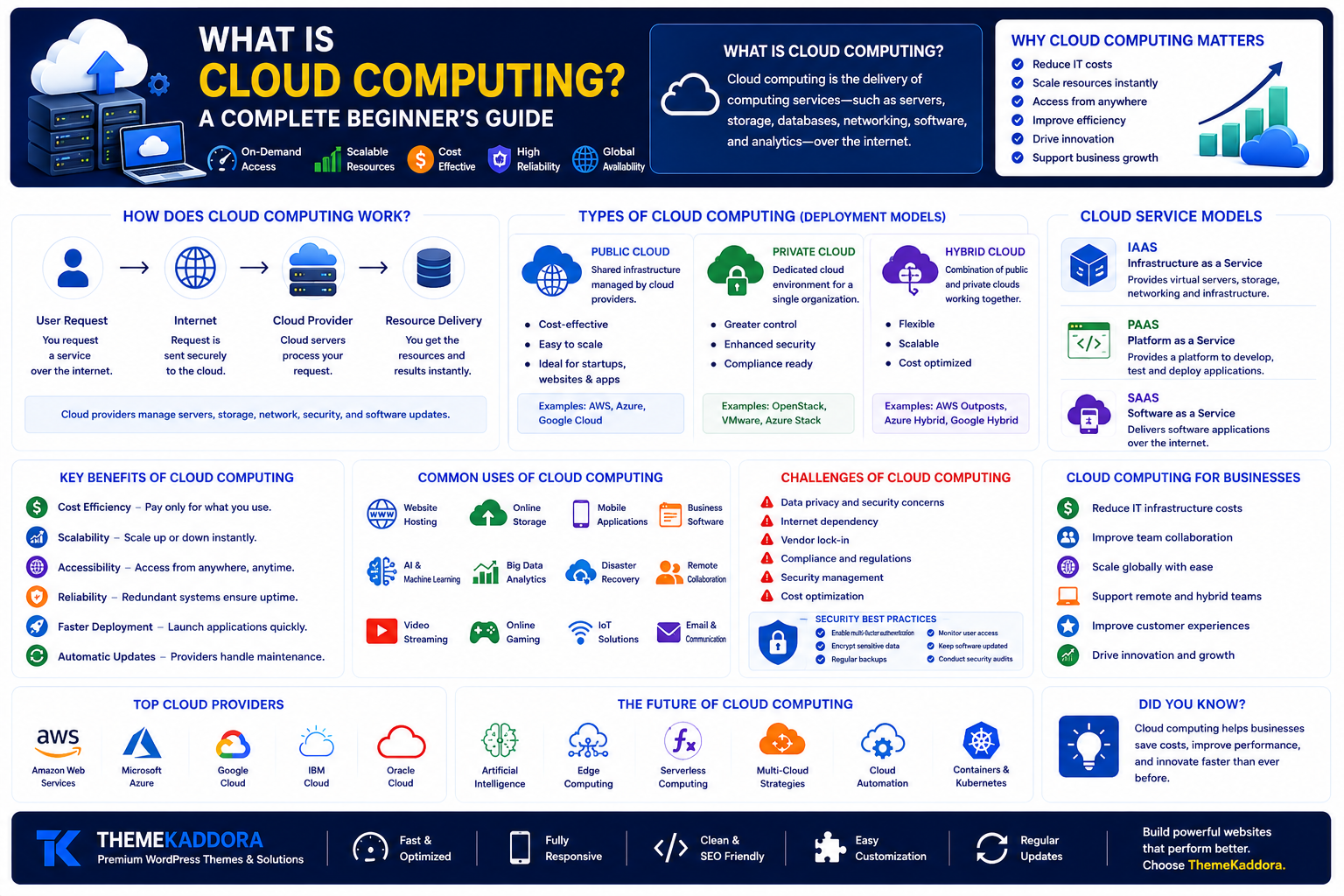
What Is Cloud Computing? A Complete Beginner's Guide
Introduction
Cloud computing has transformed the way individuals and businesses store data, run applications, and deliver digital services. Instead of relying on physical servers or personal computers, organizations now use cloud platforms to access computing resources over the internet.
From streaming your favorite movies and storing photos online to running large-scale business applications, cloud computing powers many of the digital experiences we use every day.
Whether you're a student, developer, entrepreneur, or business owner, understanding cloud computing is essential in today's technology-driven world.
In this guide, you'll learn what cloud computing is, how it works, its different service models, deployment types, benefits, challenges, and why it has become the foundation of modern digital infrastructure.
What Is Cloud Computing?
Cloud computing is the delivery of computing services—such as servers, storage, databases, networking, software, and analytics—over the internet instead of relying on local hardware.
Rather than purchasing and maintaining expensive infrastructure, users can access computing resources whenever they need them and pay only for what they use.
Cloud computing enables businesses to scale quickly, reduce operational costs, and improve flexibility.
How Does Cloud Computing Work?
Cloud providers operate large data centers containing thousands of powerful servers.
When users access cloud-based applications or store files online, their requests are processed through these remote servers instead of their personal devices.
Cloud platforms automatically manage:
Computing power
Data storage
Networking
Security
Software updates
Resource allocation
System availability
This allows businesses to focus on innovation rather than maintaining physical infrastructure.
Types of Cloud Computing
Cloud computing can be categorized into three main deployment models.
Public Cloud
Public cloud services are shared among multiple users and managed by cloud providers.
They are ideal for:
Startups
Small businesses
SaaS applications
Development environments
Private Cloud
A private cloud is dedicated to a single organization.
It offers:
Greater control
Enhanced security
Custom infrastructure
Regulatory compliance
Private clouds are commonly used by enterprises and government organizations.
Hybrid Cloud
Hybrid cloud combines public and private cloud environments.
Businesses can keep sensitive workloads in private infrastructure while using public cloud services for scalability and flexibility.
Cloud Service Models
Cloud services are typically delivered through three primary models.
Infrastructure as a Service (IaaS)
Provides virtual servers, storage, networking, and computing resources.
Suitable for:
Developers
Hosting providers
Enterprises
Custom applications
Platform as a Service (PaaS)
Provides a complete development environment where developers can build, test, and deploy applications without managing infrastructure.
Software as a Service (SaaS)
Delivers fully managed software over the internet.
Examples include:
Email platforms
Project management software
Video conferencing tools
Customer relationship management systems
Benefits of Cloud Computing
Cloud computing offers numerous advantages.
Cost Efficiency
Businesses avoid large upfront hardware investments and pay only for the resources they use.
Scalability
Cloud resources can be increased or decreased based on demand.
Accessibility
Applications and files can be accessed securely from almost anywhere with an internet connection.
Reliability
Most cloud providers offer redundant infrastructure and automatic backups to improve service availability.
Faster Deployment
Businesses can launch applications and services quickly without purchasing new hardware.
Automatic Updates
Cloud providers manage infrastructure maintenance and software updates, reducing administrative workloads.
Common Uses of Cloud Computing
Cloud computing supports a wide range of industries and applications.
Popular use cases include:
Website hosting
Online storage
Mobile applications
Business software
Artificial Intelligence
Machine Learning
Big Data analytics
Disaster recovery
Remote collaboration
Video streaming
Online gaming
Internet of Things (IoT)
Challenges of Cloud Computing
Although cloud computing offers many benefits, organizations should also consider potential challenges.
Common concerns include:
Data privacy
Internet dependency
Vendor lock-in
Compliance requirements
Security management
Cost optimization
Proper planning and governance help businesses address these challenges effectively.
Cloud Computing Security
Security remains a top priority in cloud environments.
Best practices include:
Enable multi-factor authentication
Encrypt sensitive data
Regularly update software
Monitor user access
Perform regular backups
Implement strong identity management
Conduct security audits
A shared responsibility model means both the cloud provider and the customer play important roles in maintaining security.
Cloud Computing for Businesses
Businesses of all sizes benefit from cloud technology.
Cloud computing enables organizations to:
Reduce IT costs
Improve collaboration
Launch products faster
Scale globally
Support remote teams
Enhance customer experiences
Increase operational efficiency
For startups and growing companies, cloud computing provides enterprise-grade technology without the need for large infrastructure investments.
Why ThemeKaddora Supports Cloud-Ready Solutions
At ThemeKaddora, we develop WordPress themes, plugins, HTML templates, and digital solutions that are designed to work efficiently in modern cloud environments. Clean code, responsive layouts, optimized performance, and scalable architecture help businesses build websites and applications that perform reliably on today's cloud infrastructure.
Future of Cloud Computing
Cloud computing continues to evolve with emerging technologies such as:
Artificial Intelligence
Edge Computing
Serverless Computing
Hybrid Cloud
Multi-Cloud Strategies
Containerization
Kubernetes
Cloud Automation
These innovations are making cloud platforms more powerful, flexible, and accessible for businesses around the world.
Conclusion
Cloud computing has become the foundation of modern digital transformation. It enables businesses to access powerful computing resources without managing complex infrastructure while improving flexibility, scalability, and efficiency.
Whether you're launching a website, building a SaaS platform, developing mobile applications, or growing an online business, understanding cloud computing will help you make informed technology decisions and prepare for future innovation.
Frequently Asked Questions
What is cloud computing?
Cloud computing is the delivery of computing resources such as storage, servers, databases, software, and networking over the internet.
What are the main types of cloud computing?
The three primary deployment models are Public Cloud, Private Cloud, and Hybrid Cloud.
What are the benefits of cloud computing?
Cloud computing offers scalability, cost savings, flexibility, accessibility, reliability, and faster deployment.
Is cloud computing secure?
Yes, when implemented correctly using encryption, identity management, backups, and security best practices.
Who uses cloud computing?
Individuals, startups, enterprises, educational institutions, healthcare providers, government organizations, and technology companies all use cloud computing for various applications.
Comments (0)