
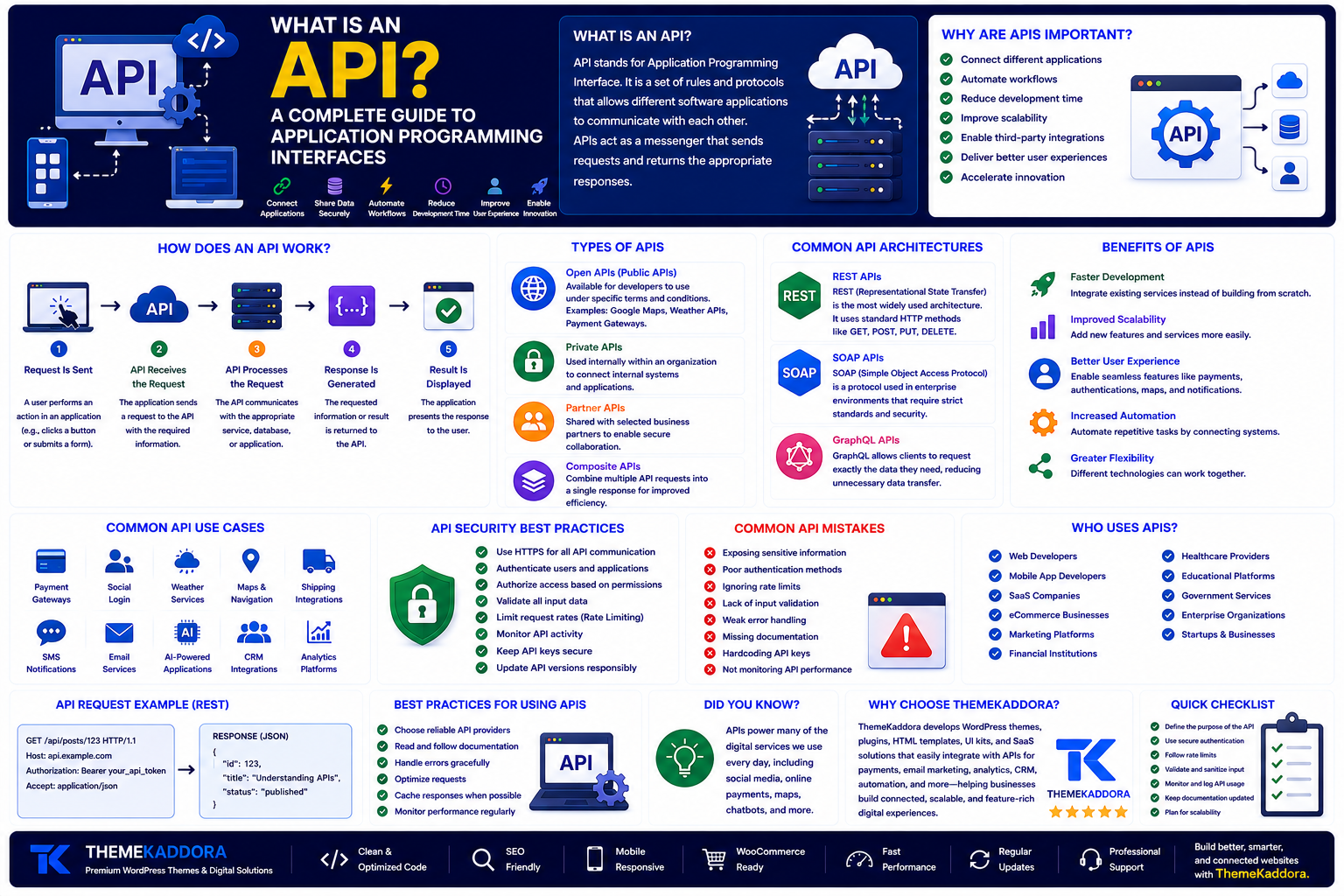
What Is an API? A Complete Guide to Application Programming Interfaces
Introduction
Modern websites and applications rarely work in isolation. Whether you're logging into a website using your Google account, checking the weather in a mobile app, processing online payments, or connecting a CRM to your website, there's a good chance an API is working behind the scenes.
APIs have become one of the most important building blocks of modern software development. They allow different applications, services, and platforms to communicate and exchange information securely and efficiently.
Whether you're a website owner, developer, entrepreneur, or someone interested in technology, understanding APIs can help you better understand how today's digital world works.
In this guide, you'll learn what an API is, how it works, the different types of APIs, their benefits, common use cases, best practices, and why APIs are essential for modern applications.
What Is an API?
API stands for Application Programming Interface.
An API is a set of rules and protocols that allows different software applications to communicate with each other.
Instead of one application accessing another application's database directly, it sends a request through the API. The API processes the request and returns the appropriate response.
Think of an API as a waiter in a restaurant. You place an order with the waiter, the waiter communicates with the kitchen, and then brings your food back. Similarly, an API acts as the messenger between applications.
Why Are APIs Important?
APIs simplify software development by allowing applications to share data and functionality without exposing their internal systems.
They help developers:
Connect different applications
Automate workflows
Reduce development time
Improve scalability
Enable third-party integrations
Build modular software
Deliver better user experiences
Accelerate innovation
Without APIs, many of the digital services we use every day would not function as seamlessly as they do.
How Does an API Work?
Although APIs can be complex, the basic process is straightforward.
Step 1: A Request Is Sent
A user performs an action, such as clicking a button or submitting a form.
Step 2: The API Receives the Request
The application sends a request to the API, including the required information.
Step 3: The API Processes the Request
The API communicates with the appropriate service, database, or application.
Step 4: A Response Is Generated
The requested information or result is returned to the API.
Step 5: The Application Displays the Result
The application presents the response to the user, often within seconds.
Types of APIs
Different APIs are designed for different purposes:
Open APIs
Also known as public APIs, these are available for developers to use under specific terms.
Examples include weather services, maps, and social media integrations.
Private APIs
Private APIs are used internally within an organization to connect internal systems and applications.
Partner APIs
These APIs are shared with selected business partners to enable secure collaboration.
Composite APIs
Composite APIs combine multiple requests into a single response, improving efficiency and reducing network traffic.
Common API Architectures
Several architectural styles are used to build APIs.
REST APIs
REST (Representational State Transfer) is the most widely used API architecture. It uses standard HTTP methods such as GET, POST, PUT, and DELETE.
SOAP APIs
SOAP (Simple Object Access Protocol) is a protocol commonly used in enterprise environments where strict standards and security are required.
GraphQL APIs
GraphQL allows clients to request exactly the data they need, reducing unnecessary data transfer and improving performance.
Benefits of APIs
APIs provide many advantages for businesses and developers.
Faster Development
Developers can integrate existing services instead of building everything from scratch.
Improved Scalability
Applications can add new features and services more easily through API integrations.
Better User Experience
APIs enable seamless features such as payment processing, authentication, maps, and notifications.
Increased Automation
Businesses can automate repetitive tasks by connecting software systems through APIs.
Greater Flexibility
APIs allow applications built with different technologies to work together.
Common API Use Cases
APIs are used in many industries and applications.
Common examples include:
Payment gateways
Social login
Weather services
Maps and navigation
Shipping integrations
SMS notifications
Email services
AI-powered applications
CRM integrations
Analytics platforms
API Security Best Practices
Because APIs exchange important information, security is essential.
Recommended practices include:
Use HTTPS for all API communication.
Authenticate users and applications.
Authorize access based on permissions.
Validate all input data.
Limit request rates.
Monitor API activity.
Keep API keys secure.
Update API versions responsibly.
Strong security helps protect both users and systems.
Common API Mistakes
Avoid these common issues:
Exposing sensitive information
Poor authentication methods
Ignoring rate limits
Lack of input validation
Weak error handling
Missing documentation
Hardcoding API keys
Not monitoring API performance
Following best practices reduces security risks and improves reliability.
Who Uses APIs?
APIs are valuable for many users, including:
Web developers
Mobile app developers
SaaS companies
eCommerce businesses
Marketing platforms
Financial institutions
Healthcare providers
Educational platforms
Government services
Enterprise organizations
Almost every modern digital product relies on APIs in some way.
Why Choose ThemeKaddora?
At ThemeKaddora, we develop WordPress themes, plugins, HTML templates, UI kits, SaaS solutions, and business-ready digital products using modern development standards. Many of our products are designed to integrate with APIs for payments, email marketing, analytics, automation, and third-party services, helping businesses build connected, scalable, and feature-rich digital experiences.
Whether you're launching a website, building a custom application, or expanding your business with integrations, ThemeKaddora provides solutions that support modern development workflows.
Conclusion
APIs are the foundation of today's connected digital world. They enable websites, applications, and online services to communicate efficiently, automate tasks, and deliver seamless user experiences.
Understanding how APIs work helps developers build better software and helps business owners make informed decisions when selecting tools and platforms. As technology continues to evolve, APIs will remain essential for innovation, integration, and digital transformation.
Frequently Asked Questions
What is an API?
An API (Application Programming Interface) is a set of rules that allows different software applications to communicate and exchange data securely.
Why are APIs important?
APIs simplify software development, enable integrations, automate workflows, and allow applications to share data and functionality efficiently.
What are the main types of APIs?
The primary types are Open APIs, Private APIs, Partner APIs, and Composite APIs.
What is the difference between REST and GraphQL?
REST provides fixed endpoints for resources, while GraphQL allows clients to request only the data they need, offering greater flexibility.
Are APIs secure?
APIs can be secure when implemented with HTTPS, authentication, authorization, input validation, rate limiting, and proper monitoring.
Why choose ThemeKaddora?
ThemeKaddora develops professional digital products with clean code, responsive design, SEO-friendly architecture, modern integrations, strong performance, and scalable development practices.
Comments (0)