
What Is AJAX? A Complete Guide to Asynchronous JavaScript and XML
Introduction
Modern websites are expected to be fast, interactive, and responsive. Users no longer want to wait for an entire webpage to reload every time they submit a form, search for information, or add a product to their shopping cart. Instead, they expect instant updates that happen smoothly in the background.
This improved user experience is made possible by AJAX (Asynchronous JavaScript and XML). AJAX enables web pages to communicate with a server and update specific parts of a page without requiring a full page refresh.
Although its name includes "XML," modern AJAX applications commonly use JSON for exchanging data because it is lightweight and easier to work with.
Whether you're a beginner learning web development or a business owner interested in modern website technologies, understanding AJAX helps explain how today's interactive websites deliver seamless user experiences.
In this guide, you'll learn what AJAX is, how it works, its benefits, common use cases, best practices, and why it remains an important technology in modern web development.
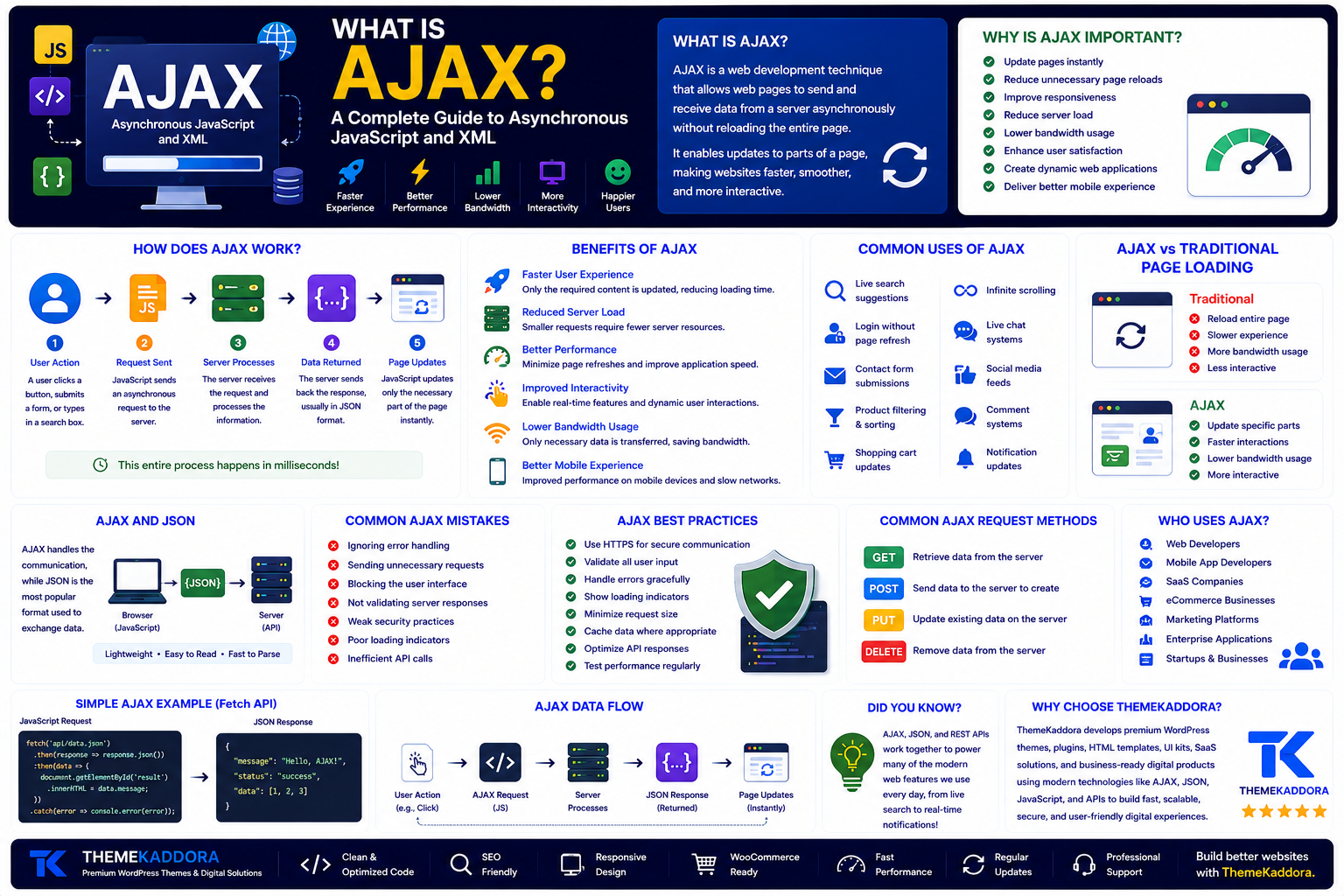
What Is AJAX?
AJAX stands for Asynchronous JavaScript and XML.
It is a web development technique that allows browsers to send and receive data from a server without reloading the entire webpage.
Instead of refreshing the complete page, AJAX updates only the necessary content, making websites feel faster and more interactive.
Today, AJAX is widely used with JavaScript, JSON, and REST APIs to build dynamic web applications.
Why Is AJAX Important?
AJAX improves both user experience and application performance.
It helps developers:
Update webpages instantly
Reduce unnecessary page reloads
Improve responsiveness
Build interactive applications
Reduce bandwidth usage
Enhance user satisfaction
Create smoother workflows
Improve application performance
Because of these advantages, AJAX has become a standard technique in modern web development.
How Does AJAX Work?
AJAX follows a straightforward process.
Step 1: User Performs an Action
A visitor clicks a button, submits a form, or types into a search box.
Step 2: JavaScript Sends a Request
JavaScript sends an asynchronous request to the web server.
Step 3: Server Processes the Request
The server retrieves or updates the required information.
Step 4: Data Is Returned
The server responds, typically using JSON.
Step 5: Page Updates Instantly
JavaScript updates only the relevant section of the webpage without refreshing the entire page.
This process usually happens in milliseconds.
Benefits of AJAX
AJAX provides several important advantages.
Faster User Experience
Only the required content is updated, reducing loading time.
Reduced Server Load
Smaller requests require fewer resources than reloading an entire webpage.
Better Performance
Users interact with applications more efficiently because page refreshes are minimized.
Improved Interactivity
AJAX enables real-time features such as live search, auto-complete suggestions, and instant notifications.
Lower Bandwidth Usage
Only the necessary data is transferred between the browser and the server.
Better Mobile Experience
Reducing unnecessary downloads helps improve performance on mobile devices and slower connections.
Common Uses of AJAX
AJAX powers many everyday website features.
Examples include:
Live search suggestions
Login without page refresh
Contact form submissions
Product filtering
Shopping cart updates
Infinite scrolling
Live chat systems
Social media feeds
Comment systems
Notification updates
These features make websites feel faster and more responsive.
AJAX and JSON
Although AJAX originally worked with XML, most modern applications use JSON because it is simpler, lighter, and easier to parse with JavaScript.
AJAX handles the communication, while JSON often carries the data between the browser and the server.
AJAX vs Traditional Page Loading
Traditional Websites
Reload the entire page
Slower user experience
More bandwidth usage
Less interactive
AJAX-Based Websites
Update only specific sections
Faster interactions
Lower bandwidth consumption
Smoother user experience
This is why many modern applications rely on AJAX techniques.
Common AJAX Mistakes
Avoid these common issues:
Ignoring error handling
Sending unnecessary requests
Blocking the user interface
Not validating server responses
Weak security practices
Poor loading indicators
Inefficient API calls
Following best practices helps create reliable and secure applications.
AJAX Best Practices
For the best results:
Use HTTPS for secure communication.
Validate all user input.
Handle errors gracefully.
Display loading indicators.
Minimize request sizes.
Cache data where appropriate.
Optimize API responses.
Test performance regularly.
These practices improve usability, security, and application performance.
Why Choose ThemeKaddora?
At ThemeKaddora, we build WordPress themes, plugins, HTML templates, UI kits, SaaS solutions, and business-ready digital products using modern development standards. Our products leverage AJAX, APIs, JSON, and JavaScript to create fast, interactive, and user-friendly experiences while maintaining clean code, responsive design, and SEO-friendly architecture.
Whether you're building a business website or a feature-rich web application, ThemeKaddora provides solutions designed for modern web technologies.
Conclusion
AJAX has transformed web development by allowing websites to communicate with servers without refreshing entire pages. This results in faster interactions, improved user experiences, and more responsive applications.
Combined with JavaScript, JSON, and modern APIs, AJAX continues to play an important role in building dynamic websites and web applications. Understanding how AJAX works provides a strong foundation for anyone interested in web development or modern digital experiences.
Frequently Asked Questions
What is AJAX?
AJAX (Asynchronous JavaScript and XML) is a web development technique that allows webpages to exchange data with a server without reloading the entire page.
Does AJAX still use XML?
Although XML is part of its name, most modern AJAX applications use JSON because it is lighter and easier to work with.
Why is AJAX important?
AJAX improves website responsiveness, reduces page reloads, lowers bandwidth usage, and creates a smoother user experience.
Is AJAX a programming language?
No. AJAX is a web development technique that combines technologies such as JavaScript, HTTP, and data formats like JSON.
Is AJAX still used today?
Yes. While newer APIs like the Fetch API are increasingly popular, the underlying asynchronous communication pattern introduced by AJAX remains widely used in modern web applications.
Why choose ThemeKaddora?
ThemeKaddora develops professional digital products with clean code, responsive design, SEO-friendly architecture, performance optimization, and modern development practices.
Comments (0)