
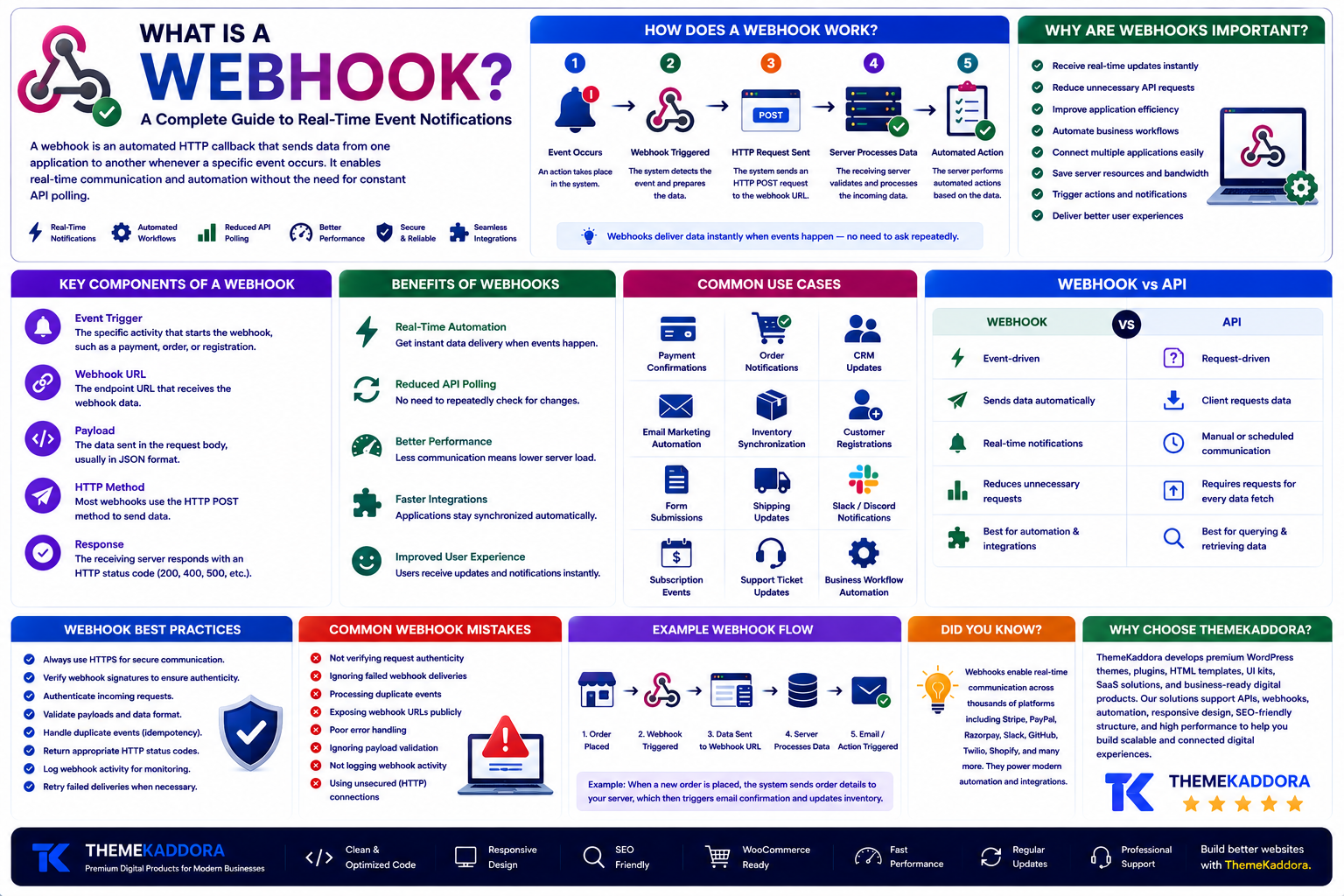
What Is a Webhook? A Complete Guide to Real-Time Event Notifications
Introduction
Modern applications constantly exchange information with one another. Whether you're receiving an order notification from an online store, synchronizing customer data with a CRM, sending payment confirmations, or automating workflows between different platforms, applications need an efficient way to notify each other when something happens.
While APIs allow one application to request information from another, constantly checking for updates can waste time and computing resources. This is where webhooks become valuable.
A webhook enables one application to automatically send data to another application the moment a specific event occurs. Instead of repeatedly asking if something has changed, the receiving application is notified instantly.
Whether you're building a WordPress plugin, SaaS platform, eCommerce website, or business automation system, understanding webhooks helps you create faster, more efficient, and highly automated applications.
In this guide, you'll learn what a webhook is, how it works, its advantages, common use cases, best practices, and how it compares with traditional APIs.
What Is a Webhook?
A webhook is an automated HTTP callback that sends data from one application to another whenever a predefined event occurs.
Instead of waiting for another application to request information, the application that detects the event immediately sends a notification containing relevant data.
Because webhooks are event-driven, they are commonly used for automation and real-time integrations.
Why Are Webhooks Important?
Many applications need immediate updates without continuously polling an API.
Webhooks help developers and businesses:
Automate workflows
Receive real-time notifications
Reduce unnecessary API requests
Improve application efficiency
Connect multiple software platforms
Trigger automated actions
Save server resources
Deliver faster user experiences
These advantages make webhooks an essential technology for modern software integrations.
How Does a Webhook Work?
A webhook follows a simple event-driven process.
Step 1: Event Occurs
An action takes place, such as a completed payment, new customer registration, or successful order.
Step 2: Webhook Is Triggered
The application detects the event and prepares a notification.
Step 3: HTTP Request Is Sent
The application sends an HTTP POST request to the destination URL.
Step 4: Receiving Server Processes the Data
The receiving application validates and processes the webhook payload.
Step 5: Automated Action Happens
The receiving application performs actions such as updating records, sending emails, creating invoices, or notifying users.
This process usually completes within seconds.
Key Components of a Webhook
A webhook consists of several important parts.
Event Trigger
The activity that starts the webhook, such as a payment, login, or new order.
Webhook URL
The endpoint where the webhook sends data.
Payload
The data included in the webhook request, usually formatted as JSON.
HTTP Method
Most webhooks use the HTTP POST method to transmit data.
Response
The receiving application responds with an HTTP status code to confirm successful processing.
Benefits of Webhooks
Webhooks provide several important advantages.
Real-Time Automation
Applications receive updates immediately after an event occurs.
Reduced API Polling
Applications no longer need to repeatedly check for changes.
Better Performance
Less unnecessary communication reduces server load.
Faster Integrations
Systems stay synchronized automatically.
Improved User Experience
Users receive notifications and updates without delays.
Common Use Cases
Webhooks are widely used for:
Payment confirmations
Order notifications
CRM updates
Email marketing automation
Inventory synchronization
Customer registrations
Form submissions
Shipping updates
Slack or Discord notifications
Business workflow automation
Webhook vs API
Although both connect applications, they work differently.
Webhook
Event-driven
Sends data automatically
Real-time notifications
Reduces unnecessary requests
Best for automation
API
Request-driven
Client requests information
Manual or scheduled communication
Flexible data retrieval
Best for querying and updating data
Many modern applications use both APIs and webhooks together for maximum flexibility.
Webhook Best Practices
For reliable integrations:
Always use HTTPS.
Verify webhook signatures.
Authenticate requests.
Validate incoming payloads.
Handle duplicate events safely.
Return appropriate HTTP status codes.
Log webhook activity.
Retry failed deliveries when appropriate.
These practices improve security, reliability, and maintainability.
Common Webhook Mistakes
Avoid these common issues:
Not verifying request authenticity
Ignoring failed webhook deliveries
Processing duplicate events
Exposing webhook URLs publicly
Poor error handling
Missing payload validation
Ignoring rate limits
Not logging webhook activity
Careful implementation helps create secure and dependable integrations.
Why Choose ThemeKaddora?
At ThemeKaddora, we develop WordPress themes, plugins, HTML templates, UI kits, SaaS solutions, and business-ready digital products using modern development standards. Our products support APIs, webhooks, cloud services, automation workflows, responsive design, SEO-friendly architecture, and performance optimization to help businesses build scalable and connected digital experiences.
Whether you're creating an eCommerce platform, CRM, SaaS product, or custom automation system, ThemeKaddora provides professional solutions designed for modern integrations and business growth.
Conclusion
Webhooks have become an essential part of modern application integration by enabling systems to communicate automatically whenever important events occur. Their event-driven approach reduces unnecessary API requests, improves efficiency, and powers real-time automation across countless digital platforms.
When combined with APIs, JSON, OAuth, JWT, and cloud infrastructure, webhooks help developers build faster, smarter, and more connected applications. Understanding how webhooks work is valuable for developers, businesses, and anyone building automated digital solutions.
Frequently Asked Questions
What is a webhook?
A webhook is an automated HTTP callback that sends data to another application whenever a specific event occurs.
How is a webhook different from an API?
An API requires an application to request information, while a webhook automatically sends information when an event happens.
What data format do webhooks use?
Most webhooks send data in JSON format using an HTTP POST request.
Are webhooks secure?
Yes. Webhooks can be secured using HTTPS, request signatures, authentication, payload validation, and proper access controls.
When should I use a webhook?
Webhooks are ideal for real-time notifications, workflow automation, payment updates, CRM synchronization, order processing, and application integrations.
Why choose ThemeKaddora?
ThemeKaddora develops high-quality digital products with clean code, responsive design, SEO-friendly architecture, automation support, modern integrations, strong security practices, and performance optimization.
Comments (0)