
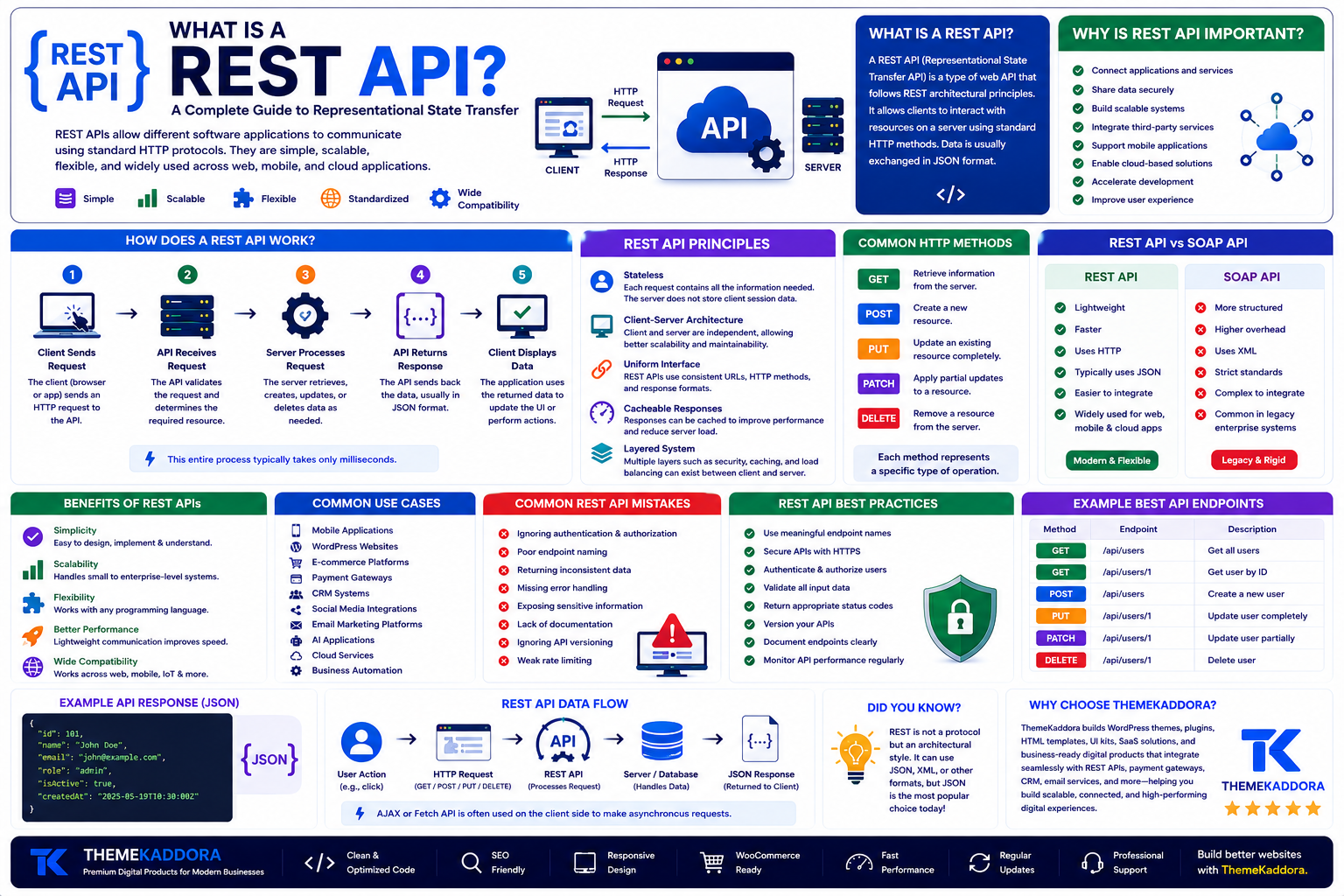
What Is a REST API? A Complete Guide to Representational State Transfer
Introduction
Modern websites, mobile applications, and cloud services constantly exchange data with one another. Whether you're logging into an application, making an online payment, checking the weather, or using a social media platform, different systems communicate behind the scenes to deliver information instantly.
One of the most widely used technologies that makes this communication possible is the REST API. It has become the standard approach for connecting applications because it is simple, scalable, and compatible with almost every programming language and platform.
From WordPress websites and SaaS platforms to mobile apps and enterprise software, REST APIs help developers build flexible and connected digital solutions.
In this guide, you'll learn what a REST API is, how it works, its architectural principles, HTTP methods, benefits, common use cases, best practices, and why it plays a vital role in modern software development.
What Is a REST API?
A REST API (Representational State Transfer Application Programming Interface) is a type of web API that allows different software applications to communicate using standard HTTP protocols.
Instead of accessing databases directly, applications send HTTP requests to a REST API. The API processes the request and returns the required data, usually in JSON format.
Because REST APIs use standard web technologies, they are easy to build, integrate, and maintain across different platforms.
Why Is a REST API Important?
REST APIs simplify communication between software systems and make applications more modular.
They help developers:
Connect applications
Share data securely
Build scalable systems
Integrate third-party services
Support mobile applications
Enable cloud-based services
Accelerate software development
Improve user experiences
Today, REST APIs power millions of websites and applications worldwide.
How Does a REST API Work?
REST APIs follow a request-and-response model.
Step 1: Client Sends a Request
A browser, mobile app, or another application sends an HTTP request to the REST API.
Step 2: API Receives the Request
The API validates the request and determines which resource is being accessed.
Step 3: Server Processes the Request
The server retrieves, updates, creates, or deletes data as needed.
Step 4: API Returns a Response
The API sends back the requested information, most commonly in JSON format.
Step 5: Client Displays the Data
The application uses the returned data to update the user interface or perform another action.
This process typically takes only milliseconds.
REST API Principles
REST APIs follow several architectural principles.
Stateless Communication
Each request contains all the information needed for processing. The server does not store client session information between requests.
Client-Server Architecture
The client and server operate independently, making applications easier to maintain and scale.
Uniform Interface
REST APIs use consistent URLs, HTTP methods, and response formats.
Cacheable Responses
Responses can often be cached to improve performance and reduce server load.
Layered System
Multiple layers such as security, caching, and load balancing can exist between the client and server without affecting communication.
Common HTTP Methods
REST APIs rely on standard HTTP methods.
GET
Retrieves information from the server.
POST
Creates a new resource.
PUT
Updates an existing resource.
PATCH
Applies partial updates to a resource.
DELETE
Removes a resource from the server.
Each method represents a specific type of operation, making APIs predictable and easy to understand.
Benefits of REST APIs
REST APIs offer many advantages.
Simplicity
They use standard web technologies, making them easier to learn and implement.
Scalability
REST APIs support applications ranging from small websites to enterprise systems.
Flexibility
Clients built with different programming languages can communicate with the same API.
Better Performance
Lightweight communication and caching improve responsiveness.
Wide Compatibility
REST APIs work across web applications, mobile apps, cloud platforms, IoT devices, and desktop software.
Common REST API Use Cases
REST APIs are widely used for:
Mobile applications
WordPress websites
E-commerce platforms
Payment gateways
CRM systems
Social media integrations
Email marketing platforms
AI applications
Cloud services
Business automation software
REST API vs SOAP API
Although both enable communication between systems, they differ significantly.
REST API
Lightweight
Faster
Uses HTTP
Typically exchanges JSON
Easier to integrate
Widely used for web and mobile applications
SOAP API
More structured
XML-based
Higher overhead
Common in legacy enterprise systems
Strong built-in standards
Most modern web applications prefer REST because of its simplicity and flexibility.
REST API Best Practices
To build reliable APIs:
Use meaningful endpoint names.
Secure APIs with HTTPS.
Authenticate and authorize users.
Validate all input data.
Return appropriate HTTP status codes.
Version your APIs.
Document endpoints clearly.
Monitor API performance regularly.
These practices improve usability, security, and maintainability.
Common REST API Mistakes
Avoid these common issues:
Ignoring authentication
Poor endpoint naming
Returning inconsistent data
Missing error handling
Exposing sensitive information
Lack of documentation
Ignoring API versioning
Weak rate limiting
Following best practices helps create secure and reliable APIs.
Why Choose ThemeKaddora?
At ThemeKaddora, we develop WordPress themes, plugins, HTML templates, UI kits, SaaS solutions, and business-ready digital products using modern development standards. Many of our products integrate with REST APIs for payment gateways, CRM platforms, email services, analytics, automation tools, and third-party applications, enabling scalable and connected digital experiences.
Whether you're creating a custom website or building business software, ThemeKaddora provides solutions designed to work seamlessly with modern API-driven architectures.
Conclusion
REST APIs have become the foundation of modern web development. They allow websites, applications, and online services to communicate efficiently using standard HTTP protocols and lightweight data formats such as JSON.
Understanding REST APIs helps developers build scalable applications and enables businesses to integrate with a wide range of digital services. As software ecosystems continue to grow, REST APIs remain an essential technology for building fast, flexible, and connected applications.
Frequently Asked Questions
What is a REST API?
A REST API is a web API that allows applications to communicate using standard HTTP methods and typically exchanges data in JSON format.
How does a REST API work?
A client sends an HTTP request to the API, the server processes the request, and the API returns a response containing the requested data or confirmation of the action.
What are the main HTTP methods in REST?
The most common HTTP methods are GET, POST, PUT, PATCH, and DELETE.
Why are REST APIs popular?
REST APIs are lightweight, scalable, easy to integrate, and compatible with almost every programming language and platform.
What is the difference between REST and SOAP?
REST is generally simpler, faster, and commonly uses JSON, while SOAP is more structured, XML-based, and often used in legacy enterprise environments.
Why choose ThemeKaddora?
ThemeKaddora develops high-quality digital products with clean code, responsive design, SEO-friendly architecture, API integrations, performance optimization, and modern development practices.
Comments (0)