
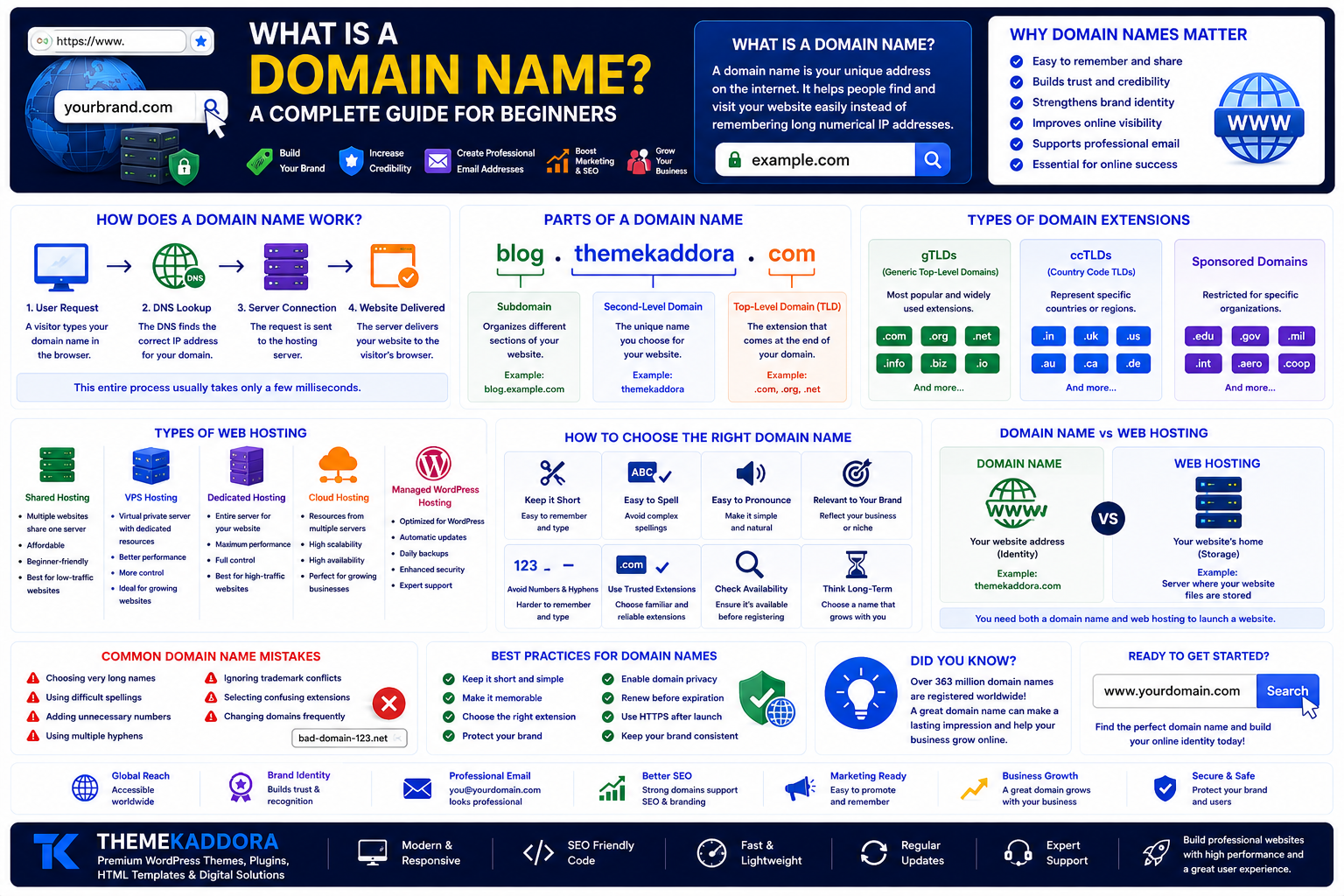
What Is a Domain Name? A Complete Guide for Beginners
Introduction
Every website on the internet has a unique identity that allows people to find it easily. Instead of remembering long numerical IP addresses, users simply type a domain name into their browser to access a website.
Whether you're starting a blog, launching an online business, building a portfolio, or creating an eCommerce store, choosing the right domain name is one of the first and most important steps.
A memorable domain name strengthens your brand, improves credibility, and makes it easier for customers to discover your business online.
In this guide, you'll learn what a domain name is, how it works, the different types of domain extensions, how to choose the right one, and best practices for building a strong online presence.
What Is a Domain Name?
A domain name is the unique web address people use to visit a website on the internet.
Instead of typing a server's IP address, users can simply enter an easy-to-remember name such as:
example.com
business.org
store.net
A domain name acts as the digital address of your website, making it easier for visitors to locate your content.
How Does a Domain Name Work?
Every website is hosted on a server with a unique IP address.
When someone types a domain name into a web browser:
The browser sends a request.
The Domain Name System (DNS) finds the correct IP address.
The request is routed to the hosting server.
The server delivers the website to the visitor.
This entire process usually happens in just a few milliseconds.
Why Is a Domain Name Important?
A professional domain name offers many benefits.
It helps you:
Build brand recognition
Increase credibility
Improve customer trust
Create professional email addresses
Support digital marketing
Make your website easier to remember
Strengthen your online identity
For businesses, a custom domain is an essential part of establishing a professional online presence.
Parts of a Domain Name
A domain name consists of different components.
Top-Level Domain (TLD)
The extension at the end of the domain.
Examples include:
.com
.org
.net
.info
.io
Second-Level Domain
The main name chosen by the website owner.
Example:
In themekaddora.com, themekaddora is the second-level domain.
Subdomain
A subdomain organizes different sections of a website.
Examples:
blog.example.com
shop.example.com
support.example.com
Subdomains are useful for separating content or services while remaining under the same primary domain.
Types of Domain Extensions
There are several categories of domain extensions.
Generic Top-Level Domains (gTLDs)
Examples:
.com
.org
.net
.info
These are the most widely recognized and commonly used.
Country Code Top-Level Domains (ccTLDs)
Examples:
.in
.uk
.us
.au
.ca
These represent specific countries or regions.
Sponsored Domains
Examples:
.edu
.gov
.mil
These are generally reserved for educational institutions, governments, and other eligible organizations.
How to Choose the Right Domain Name
A good domain name should be:
Short
Memorable
Easy to spell
Easy to pronounce
Relevant to your brand
Free from unnecessary numbers or hyphens
Whenever possible, choose a name that reflects your business or niche while remaining simple enough for users to remember.
Domain Name vs Web Hosting
Many beginners confuse domain names with web hosting.
A domain name is your website's address.
Web hosting is the server where your website files are stored.
You need both to launch a website.
Think of it this way:
Domain Name = Street Address
Web Hosting = Building
The address helps people find the building, while the building stores everything inside.
Common Domain Name Mistakes
Avoid these common mistakes:
Choosing very long names
Using difficult spellings
Adding unnecessary numbers
Using multiple hyphens
Ignoring trademark conflicts
Selecting confusing extensions
Changing domains frequently
A clear and consistent domain name supports long-term branding.
Best Practices for Domain Names
To create a strong online identity:
Keep it short.
Make it memorable.
Choose a trusted extension.
Protect your brand with related extensions if appropriate.
Enable domain privacy where available.
Renew your domain before it expires.
Use HTTPS after launching your website.
These practices help improve professionalism and protect your online presence.
Why Choose ThemeKaddora?
At ThemeKaddora, we develop WordPress themes, plugins, HTML templates, UI kits, SaaS solutions, and digital products that help businesses build professional websites with clean code, responsive layouts, strong performance, and SEO-friendly architecture.
Whether you're registering your first domain or launching a growing online business, ThemeKaddora provides the tools and resources to help you create a reliable and modern web presence.
Conclusion
A domain name is much more than a website address—it is a key part of your online identity. Choosing the right domain helps build trust, strengthen your brand, and make your website easier to discover.
Combined with reliable web hosting, quality website design, and valuable content, a strong domain name forms the foundation of a successful online presence.
Frequently Asked Questions
What is a domain name?
A domain name is the unique web address people use to access a website instead of typing its numerical IP address.
Do I need both a domain name and web hosting?
Yes. A domain name helps users find your website, while web hosting stores the files that make up your website.
Can I change my domain name later?
Yes, but changing a domain name can affect branding, SEO, and existing links. If you change it, use proper redirects and update important references.
Which domain extension is best?
The best extension depends on your goals. .com is the most widely recognized, but other extensions can also be appropriate based on your audience and purpose.
Why choose ThemeKaddora?
ThemeKaddora develops premium WordPress themes, plugins, HTML templates, UI kits, and digital products with clean code, responsive design, SEO-friendly architecture, performance optimization, and modern development standards.
Comments (0)