
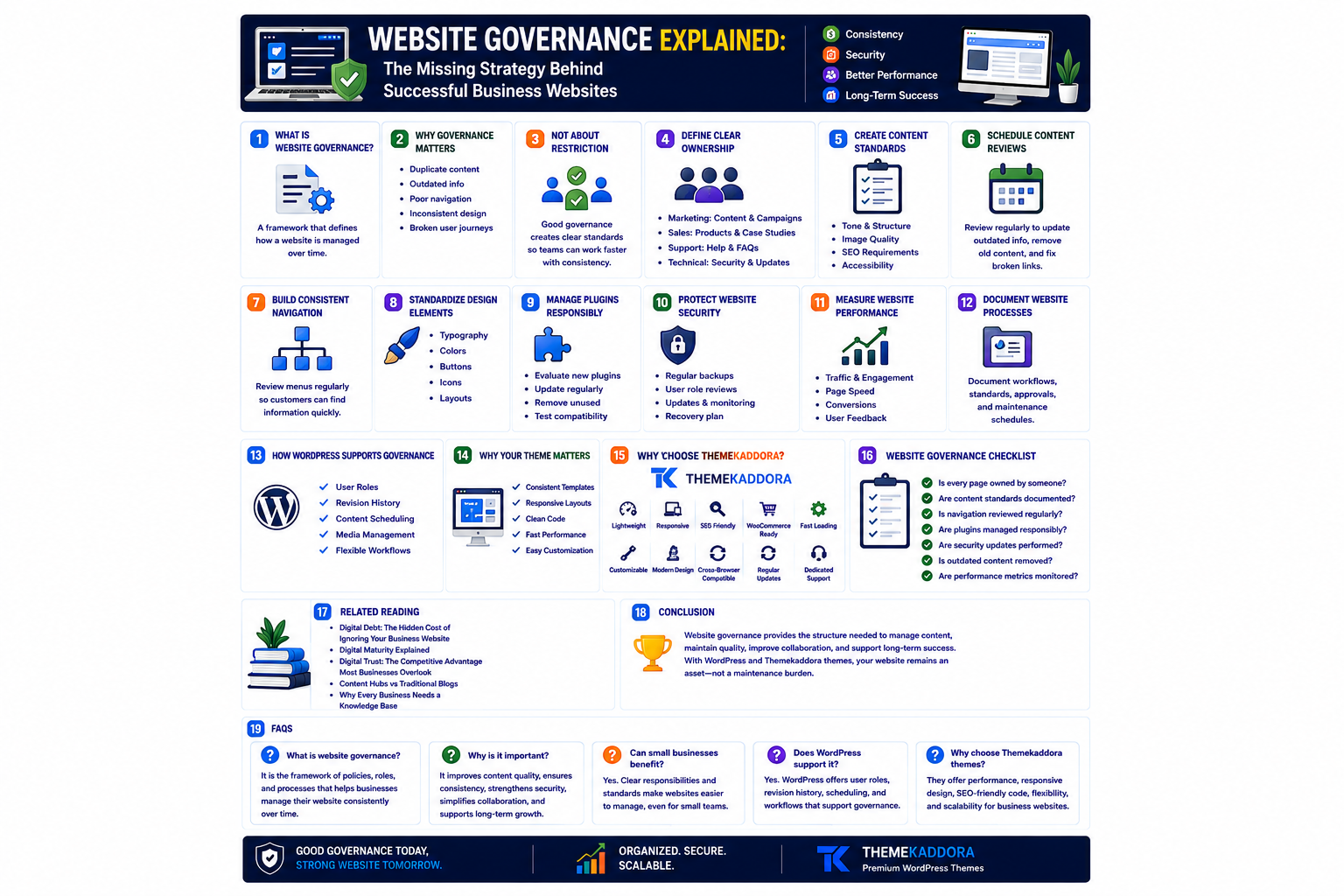
Website Governance Explained: The Missing Strategy Behind Successful Business Websites
Introduction
Many businesses invest thousands of dollars building a beautiful website.
The launch goes well.
Traffic starts growing.
New pages are added.
Blog articles are published.
Different departments request updates.
Marketing creates landing pages.
Sales wants new product sections.
Support publishes help articles.
After a few years, the website becomes difficult to manage.
Navigation feels inconsistent.
Old content remains online.
Duplicate pages appear.
Broken links increase.
No one knows who is responsible for maintaining what.
The problem isn't WordPress.
The problem is the lack of website governance.
Successful websites don't stay organized by accident—they follow a governance strategy that keeps content, design, and technology aligned as the business grows.
What Is Website Governance?
Website governance is the framework that defines how a website is managed over time.
It answers questions such as:
Who publishes content?
Who approves updates?
How often is information reviewed?
Who monitors security?
What design standards should every page follow?
How are outdated pages handled?
Governance creates consistency.
Why Governance Matters
Without governance, websites often become difficult to manage.
Common problems include:
Duplicate content
Conflicting branding
Outdated information
Broken customer journeys
Poor navigation
Inconsistent page layouts
These issues affect both customers and internal teams.
Governance Is Not About Restriction
Some businesses assume governance limits creativity.
The opposite is true.
Good governance creates clear standards so teams can work faster without sacrificing quality.
It reduces confusion while encouraging consistency.
Define Clear Website Ownership
Every business website should have clear responsibilities.
For example:
Marketing Team
Blog content
Landing pages
Campaign updates
Sales Team
Product information
Case studies
Pricing updates
Customer Support
Knowledge base
FAQs
Help articles
Technical Team
Performance
Security
Plugin updates
Backups
Clearly defined ownership prevents confusion.
Create Content Standards
Every article should follow similar quality guidelines.
Examples include:
Tone of voice
Heading structure
Image quality
Internal linking
SEO requirements
Accessibility standards
Readers appreciate consistency.
Schedule Regular Content Reviews
Not every article stays accurate forever.
Review content periodically to identify:
Outdated statistics
Broken links
Expired offers
Old screenshots
Changed business processes
Content maintenance protects credibility.
Build a Consistent Navigation System
Navigation often expands organically.
Eventually menus become crowded.
Website governance encourages regular navigation reviews to ensure customers can still find information quickly.
Standardize Design Elements
Every page should feel like part of the same website.
Maintain consistency in:
Typography
Buttons
Colors
Icons
Spacing
Layouts
Consistency strengthens brand recognition.
Manage Plugins Responsibly
Adding plugins without oversight increases complexity.
Create simple guidelines for:
Evaluating new plugins
Updating existing plugins
Removing unused plugins
Testing compatibility
Fewer, well-maintained plugins often produce better results.
Protect Website Security
Governance should include:
Regular backups
User permission reviews
Update schedules
Security monitoring
Recovery procedures
Security becomes part of routine operations rather than emergency response.
Measure Website Performance
Governance is ongoing.
Review metrics such as:
Page performance
Search visibility
User engagement
Conversion goals
Customer feedback
Measurement supports continuous improvement.
Document Website Processes
Create internal documentation explaining:
Publishing workflows
Update procedures
Approval processes
Design standards
Maintenance schedules
Documentation simplifies onboarding for new team members.
Governance Helps Businesses Scale
As businesses grow, websites become more complex.
Governance allows organizations to expand without creating unnecessary confusion.
Instead of rebuilding everything, teams improve systematically.
How WordPress Supports Website Governance
WordPress provides many features that support organized website management, including:
User roles
Categories
Media management
Revision history
Content scheduling
Flexible publishing workflows
These capabilities make WordPress suitable for businesses of all sizes.
Why Your Theme Matters
A professionally developed theme supports governance through:
Consistent page templates
Responsive layouts
Clean code
Fast performance
Flexible customization
Strong foundations make long-term management easier.
Why Choose Themekaddora?
Themekaddora WordPress themes are designed for businesses that expect their websites to grow.
Our themes provide:
Lightweight architecture
Responsive layouts
SEO-friendly code
WooCommerce compatibility
Fast loading performance
Flexible customization
Modern page templates
Cross-browser compatibility
Regular updates
Professional support
Whether your website is managed by one person or an entire team, Themekaddora helps create a scalable foundation that supports effective website governance.
Website Governance Checklist
Review your website regularly.
Ask yourself:
✅ Is every page owned by someone?
✅ Are content standards documented?
✅ Is navigation reviewed regularly?
✅ Are plugins managed responsibly?
✅ Are security updates performed consistently?
✅ Is outdated content removed?
✅ Are performance metrics monitored?
Related Reading
Continue exploring:
Digital Debt: The Hidden Cost of Ignoring Your Business Website
Digital Maturity Explained
Digital Trust: The Competitive Advantage Most Businesses Overlook
Content Hubs vs Traditional Blogs
Why Every Business Needs a Knowledge Base
Together, these guides help businesses build websites that remain organized, scalable, and valuable over the long term.
Conclusion
Launching a website is only the beginning.
The real challenge is keeping it useful, accurate, secure, and aligned with your business as it grows.
Website governance provides the structure needed to manage content, maintain quality, improve collaboration, and support long-term success.
Combined with the flexibility of WordPress and the performance-focused design of Themekaddora themes, a strong governance strategy ensures your website remains an asset—not a maintenance burden.
Frequently Asked Questions (FAQs)
What is website governance?
Website governance is the framework of policies, roles, and processes that helps businesses manage website content, design, security, and maintenance consistently over time.
Why is website governance important?
It improves content quality, ensures consistency, strengthens security, simplifies collaboration, and supports long-term website growth.
Can small businesses benefit from website governance?
Yes. Even small websites become easier to manage when responsibilities, publishing standards, and maintenance processes are clearly defined.
Does WordPress support website governance?
Yes. WordPress offers user roles, revision history, scheduling, media management, and flexible publishing workflows that help businesses manage websites efficiently.
Why choose Themekaddora WordPress themes?
Themekaddora themes provide responsive layouts, lightweight performance, SEO-friendly code, flexible customization, and long-term scalability—making them an excellent foundation for professionally managed business websites.
Comments (0)