
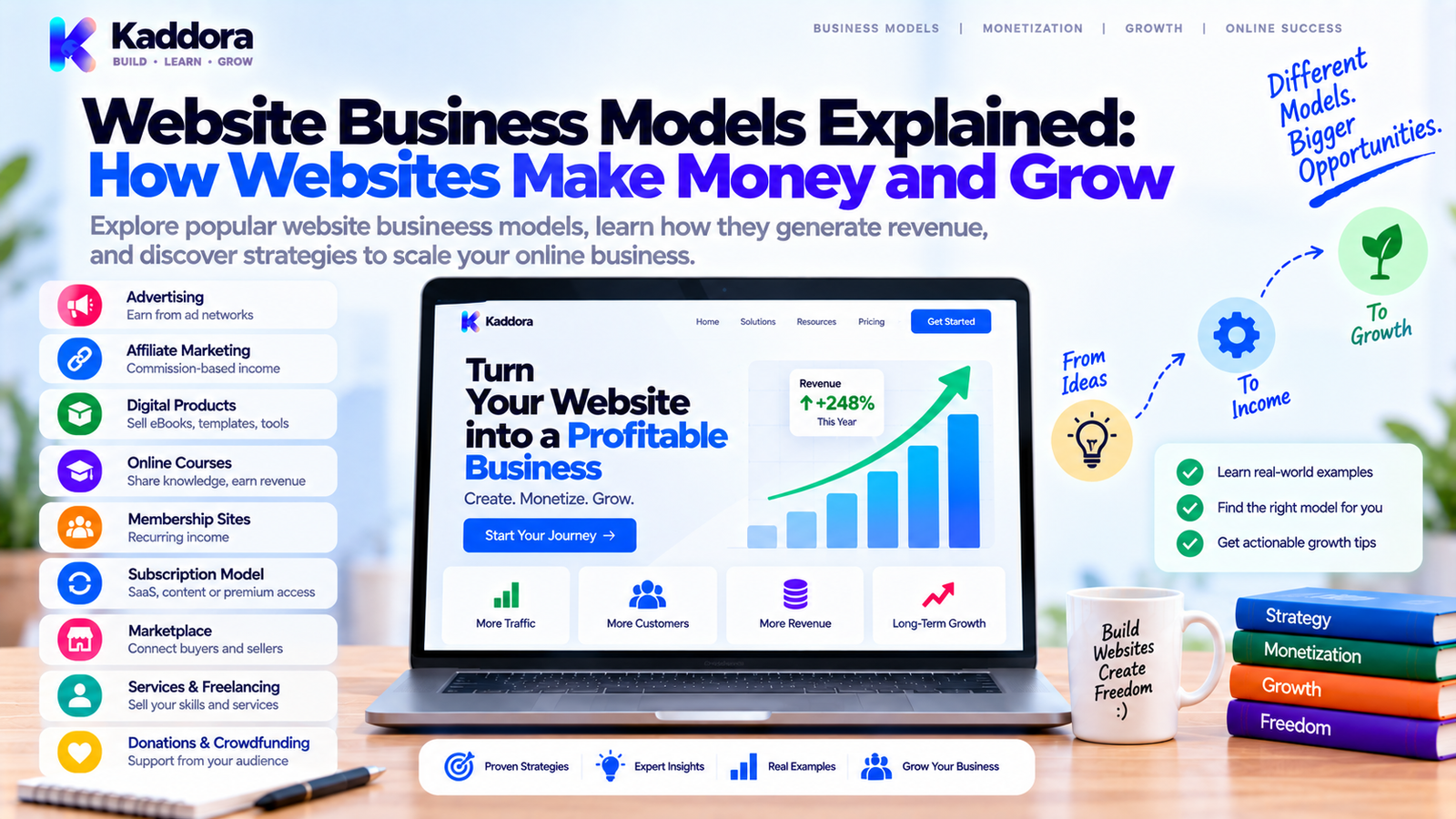
Website Business Models Explained: How Websites Make Money and Grow
Introduction
A website can be much more than an online presence.
It can become a store, publishing platform, software business, community, marketplace, lead-generation engine, educational platform, or recurring-revenue business.
The technology used to build a website matters, but the underlying business model often matters even more.
A business model explains how a website creates value for customers and turns that value into revenue.
For example:
Audience ↓ Problem / Need ↓ Value Provided ↓ Business Model ↓ Transaction ↓ Revenue
Two websites can operate in exactly the same industry while using completely different business models.
Consider a technology website.
One could earn money from:
Advertising
Another could earn from:
Affiliate Commissions
Another might sell:
Premium WordPress Plugins
Another could offer:
The website itself is only the platform.
The business model determines how that platform becomes a business.
In this guide, you'll learn the major website business models, how they work, their advantages and challenges, suitable use cases, key metrics, and how to choose a model that fits your audience and resources.
What Is a Website Business Model?
A website business model describes how an online business creates value, delivers that value to customers, and generates revenue.
It answers several important questions:
Who is the customer?
What problem is being solved?
What value is being provided?
How does the website attract users?
How does the business convert users into customers?
How does the business make money?
What does it cost to operate?
How can the business grow?
A basic framework is:
Customer ↓ Value Proposition ↓ Website Experience ↓ Revenue Mechanism ↓ Costs ↓ Profit
A strong website business model should connect customer needs with sustainable economics.
Why Business Models Matter
Many people start websites by thinking about:
Domain → Design → Content → Traffic
But a business needs another layer:
Revenue → Costs → Retention → Growth
Without a clear model, a website may attract visitors without generating enough economic value.
For example:
100,000 Visitors ↓ Very Low Conversion ↓ Very Low Revenue
Traffic alone doesn't create a successful online business.
A more useful system might be:
Targeted Visitors ↓ Relevant Value ↓ Strong Offer ↓ Conversions ↓ Revenue ↓ Retention ↓ Growth
This is why business-model design should happen before or alongside website development.
Main Types of Website Business Models
There is no single website business model.
Common models include:
Advertising
Affiliate marketing
eCommerce
Digital products
Services
Lead generation
Memberships
Subscriptions
SaaS
Online courses
Marketplaces
Directories
Job boards
Donations
Freemium
Licensing
Sponsorships
Transaction fees
Usage-based pricing
Hybrid models
Let's examine each one.
1. Advertising Business Model
Advertising websites generate revenue by displaying advertisements to visitors.
The advertiser pays based on an arrangement such as impressions, clicks, or other defined actions.
A simplified model is:
Traffic ↓ Page Views ↓ Ad Impressions ↓ Advertiser Revenue
Common examples include:
News websites
Entertainment websites
Blogs
Media platforms
Content publishers
Advertising generally depends heavily on traffic volume and audience characteristics.
Potential challenge:
More advertisements do not necessarily mean more profit.
Excessive advertising can affect:
Page performance
User experience
Readability
Accessibility
Engagement
The business needs to balance monetization with audience retention.
2. Affiliate Website Business Model
Affiliate websites recommend third-party products or services and earn a commission when users complete qualifying actions.
Typical flow:
Search Traffic ↓ Helpful Content ↓ Product Recommendation ↓ Affiliate Click ↓ Purchase / Action ↓ Commission
Common affiliate website formats include:
Product reviews
Comparison websites
Buying guides
Tutorials
Software recommendations
Resource websites
Affiliate models work particularly well when visitors have commercial intent.
A site earning affiliate revenue should clearly understand the economics of each offer rather than selecting products only because the commission appears attractive.
3. eCommerce Business Model
An eCommerce website sells physical or digital products directly.
Examples include:
Clothing
Electronics
Books
Software
Accessories
Home products
Specialty products
Basic structure:
Traffic ↓ Product Discovery ↓ Product Page ↓ Cart ↓ Checkout ↓ Payment ↓ Fulfillment
Revenue depends on:
Product price
Sales volume
Gross margin
Conversion rate
Average order value
Repeat purchases
A useful distinction is:
Revenue is not the same as profit.
Costs may include:
Inventory
Shipping
Returns
Marketing
Payment processing
Customer support
Operations
4. Digital Product Business Model
Digital products can be delivered electronically without physical shipping.
Examples include:
WordPress plugins
WordPress themes
Templates
UI kits
eBooks
Design assets
Code
Research reports
Notion templates
Business resources
A typical workflow:
Content / Traffic ↓ Product Page ↓ Checkout ↓ Digital Delivery ↓ Customer
The model can scale because the same digital product may be sold many times.
However, digital products still require:
Development
Updates
Marketing
Support
Security
Documentation
For software products, ongoing compatibility and maintenance can become particularly important.
5. Service Business Model
A website can be used to sell professional expertise rather than a physical product.
Examples include:
Web development
SEO
Consulting
Design
Accounting
Marketing
Legal services
Coaching
IT services
Typical flow:
Search / Referral ↓ Service Page ↓ Lead Form ↓ Qualification ↓ Proposal ↓ Client ↓ Revenue
Service businesses often need fewer visitors than ad-supported businesses because each customer can have a much higher value.
The trade-off is that services can depend heavily on human time.
6. Lead Generation Business Model
A lead-generation website attracts potential customers and connects them with providers.
Common industries include:
Real estate
Insurance
Legal services
Home services
Education
B2B services
Automotive
Example:
Search Query ↓ Landing Page ↓ Lead Form ↓ Qualified Lead ↓ Business ↓ Lead Revenue
Possible pricing structures include:
Per lead
Per qualified lead
Monthly fee
Referral arrangement
Revenue sharing
Lead quality often matters more than raw volume.
7. Membership Business Model
Membership websites charge users for access to restricted content, communities, tools, or resources.
Members may receive:
Premium articles
Downloads
Private communities
Tutorials
Resources
Member-only tools
Events
The model looks like:
Free Content ↓ Audience ↓ Membership Offer ↓ Paid Membership ↓ Premium Access
A membership business needs continuing value.
If customers receive all the value immediately and have no reason to return, retention can become difficult.
8. Subscription Business Model
Subscription websites charge customers on a recurring schedule.
Examples include:
Software
Premium content
Design resources
Databases
Business tools
Research platforms
Professional services
A simplified model:
Visitor ↓ Trial / Demo ↓ Subscription ↓ Recurring Payment ↓ Continued Value
Subscriptions can create more predictable revenue, but they also introduce recurring responsibilities.
The business must manage:
Retention
Churn
Billing
Support
Product updates
Customer satisfaction
9. SaaS Business Model
Software as a Service, or SaaS, provides software through an ongoing online service.
Examples can include:
CRM platforms
Project management tools
Marketing platforms
Accounting software
Analytics systems
Communication software
Typical structure:
Marketing Website ↓ Registration ↓ Trial / Demo ↓ Subscription ↓ Software Usage ↓ Recurring Revenue
SaaS businesses often track metrics such as:
Monthly recurring revenue
Annual recurring revenue
Churn
Customer acquisition cost
Customer lifetime value
Average revenue per account
SaaS can be highly scalable, but infrastructure, engineering, security, support, and ongoing product development can also be substantial.
10. Online Course Business Model
Educational websites can monetize knowledge by selling courses.
Examples include:
Coding courses
Design courses
Business training
Marketing education
Professional skills
Language learning
A common funnel:
Free Content ↓ Email Signup ↓ Free Lesson ↓ Course Offer ↓ Purchase
Courses can use:
One-time purchases
Course bundles
Membership access
Subscription learning
Corporate licensing
The strongest course models solve a specific problem for a clearly defined audience.
11. Marketplace Business Model
A marketplace connects buyers and sellers.
Examples include marketplaces for:
Products
Services
Freelancers
Digital assets
Local businesses
Rentals
Instead of selling every item directly, the marketplace facilitates transactions.
A common model is:
Seller ↓ Listing ↓ Marketplace ↓ Buyer ↓ Transaction ↓ Marketplace Fee
Revenue may come from:
Commission
Listing fees
Subscription fees
Featured placement
Advertising
Transaction fees
Marketplaces often face the "chicken-and-egg" challenge of attracting both supply and demand.
12. Directory Business Model
Directories organize information about businesses, services, products, or organizations.
Examples include:
Local business directories
Restaurant directories
Agency directories
Software directories
Industry directories
Monetization can include:
Premium listings
Featured placement
Subscription plans
Sponsored profiles
Advertising
A directory becomes more valuable when it provides discovery and useful information rather than simply reproducing publicly available listings.
13. Job Board Business Model
Job boards connect employers with candidates.
Revenue can come from:
Paid job postings
Featured jobs
Employer subscriptions
Candidate access
Recruitment services
Sponsored listings
Typical workflow:
Employer ↓ Job Posting ↓ Candidate Traffic ↓ Applications ↓ Employer Value ↓ Payment
The site's value depends on the relevance and quality of both jobs and candidates.
14. Donation Business Model
Some websites depend partially or entirely on voluntary support.
Examples include:
Open-source projects
Community websites
Independent publications
Educational projects
Creative websites
Revenue options can include:
One-time donations
Monthly support
Sponsorships
Membership contributions
This model generally depends strongly on trust and audience alignment.
15. Freemium Business Model
Freemium combines a free product with paid upgrades.
For example:
Free Version ↓ User Adoption ↓ Product Usage ↓ Premium Need ↓ Upgrade ↓ Paid Customer
Common premium upgrades include:
Advanced features
Higher limits
Additional integrations
Priority support
More storage
Premium templates
Freemium works best when the free version provides meaningful value while the paid version solves a more valuable problem.
16. Software Licensing Business Model
Software can also be monetized through licensing.
Possible structures include:
Per-site licensing
Per-user licensing
Team licensing
Annual licenses
Lifetime licenses
Usage-based licenses
Enterprise agreements
For a WordPress plugin, an example could be:
Free Plugin ↓ Premium Features ↓ License Purchase ↓ Updates + Support
The licensing model should be clear enough that customers understand what they are purchasing.
17. Sponsorship Business Model
A website can sell sponsorship opportunities to relevant brands.
Possible inventory includes:
Sponsored articles
Newsletter sponsorship
Featured placements
Sponsored tools
Podcast sponsorship
Event sponsorship
A sponsorship model works best when the audience has a strong connection to the website's subject matter.
Commercial relationships should be clearly disclosed where applicable.
18. Transaction Fee Business Model
Some websites earn money by taking a fee from transactions.
For example:
Buyer ↓ Transaction ↓ Platform ↓ Seller
The platform may retain a percentage or fixed amount.
This model is common in:
Marketplaces
Booking platforms
Payment platforms
Service platforms
Revenue scales with transaction volume rather than simply visitor volume.
19. Usage-Based Business Model
Instead of charging a fixed subscription, a website may charge based on actual usage.
Examples include:
API requests
Storage
Messages sent
Processing volume
Compute usage
Generated content
Transactions
A simplified structure:
Customer ↓ Uses Service ↓ Usage Measured ↓ Bill Calculated ↓ Payment
This model can align payment more closely with customer consumption.
However, businesses need transparent pricing and predictable billing experiences.
20. Hybrid Website Business Models
Many successful online businesses combine multiple models.
For example:
Free Content ↓ Advertising + Affiliate Revenue + Digital Products + Membership
A software company might use:
Free Tool ↓ Premium Features ↓ Subscription + Enterprise Licensing
A marketplace might use:
Transaction Fees + Featured Listings + Advertising + Seller Subscriptions
Hybrid models can diversify revenue, but they should still produce a coherent customer experience.
B2C vs B2B Website Business Models
Business models are also influenced by who pays.
B2C
Business-to-consumer websites sell directly to individuals.
Examples:
Online stores
Courses
Consumer subscriptions
Membership communities
The buying process is often designed for individual decisions.
B2B
Business-to-business websites sell to organizations.
Examples:
SaaS platforms
Enterprise software
Consulting
Business services
APIs
Data platforms
B2B sales cycles may involve:
Demos
Sales calls
Contracts
Procurement
Multiple decision-makers
The website should support that buying process.
Free vs Paid Business Models
Another important distinction is whether the main product is free or paid.
Free Business Model
Revenue may come from:
Ads
Sponsorship
Affiliate commissions
Donations
Lead generation
Paid Business Model
Revenue may come from:
Product sales
Subscriptions
Licensing
Services
Memberships
Freemium Model
Combines free access with paid upgrades.
There is no universally correct approach.
The economics depend on customer acquisition, value delivery, pricing, and conversion.
How to Choose the Right Website Business Model
Start with the customer rather than the technology.
Use this framework:
Who Is the Customer? ↓ What Problem Do They Have? ↓ What Value Can We Provide? ↓ How Often Is the Value Needed? ↓ Who Pays? ↓ How Much Can They Pay? ↓ What Does Delivery Cost? ↓ What Model Fits?
Step 1: Understand the Audience
Identify:
Customer type
Industry
Geography
Buying behavior
Pain points
Budget
Urgency
Existing alternatives
A business model should reflect real customer behavior.
Step 2: Identify the Value Proposition
Ask:
Why would someone use this website?
The answer should describe a meaningful benefit.
For example:
Weak value proposition:
"An online website for businesses."
Stronger value proposition:
"Help small businesses automate repetitive customer management tasks from one dashboard."
Specific value is easier to monetize.
Step 3: Determine How Often the Customer Needs the Value
Frequency can influence the model.
One-Time Need
Consider:
Product sales
Courses
One-time services
Licensing
Repeated Need
Consider:
Subscriptions
Memberships
SaaS
Retainers
Usage-based billing
Audience Attention
Consider:
Advertising
Sponsorship
Affiliate marketing
The customer relationship often determines the most natural revenue model.
Step 4: Understand the Economics
A simple framework is:
Revenue - Acquisition Cost - Delivery Cost - Support Cost - Operating Cost = Profit
A website business should understand its unit economics before aggressively scaling traffic.
Step 5: Identify the Primary Conversion
Every website should have a clear primary action.
Examples:
Content Website → Affiliate Click Service Website → Lead eCommerce → Purchase SaaS → Subscription Marketplace → Transaction Course Website → Enrollment Membership → Signup
Without a clear conversion path, traffic can become difficult to monetize.
Website Business Model Metrics
Different models require different metrics.
Advertising
Track:
Page views
Ad impressions
Revenue
Revenue per visitor
eCommerce
Track:
Conversion rate
Average order value
Gross margin
Repeat purchase rate
Subscription
Track:
MRR
Churn
Retention
Customer lifetime value
SaaS
Track:
MRR
ARR
CAC
LTV
Churn
Activation
Lead Generation
Track:
Leads
Qualified leads
Cost per lead
Lead-to-customer rate
Metrics should reflect how the business actually creates value.
Website Business Model Example
Imagine a website focused on WordPress resources.
It could begin with:
Free WordPress Content ↓ Organic Search Traffic ↓ Email Subscribers ↓ Digital Products
As the audience grows, the business could add:
WordPress Plugins WordPress Themes Templates Affiliate Partnerships Premium Resources
A more advanced business could introduce:
Free Products ↓ Premium Products ↓ Subscription ↓ Business Services
The key is that each additional revenue stream should make sense for the audience.
How Website Business Models Evolve
A business model doesn't have to remain unchanged.
A website might evolve like this:
Stage 1 Free Content ↓ Stage 2 Affiliate Revenue ↓ Stage 3 Digital Products ↓ Stage 4 Membership ↓ Stage 5 SaaS / Subscription
The evolution depends on customer demand and business capabilities.
A website should avoid adding complexity before the underlying customer problem is understood.
Common Website Business Model Mistakes
Choosing a Model Before Understanding the Customer
A website can be technically impressive but economically weak if nobody values the solution.
Chasing Traffic Without a Revenue Mechanism
Visitors are useful only when the business has a way to create and capture value.
Using Too Many Revenue Streams
Multiple revenue streams can diversify income, but excessive complexity can hurt user experience.
Ignoring Costs
Revenue numbers can look impressive while margins remain weak.
Copying Competitors
Another company's business model may not fit your audience or resources.
Pricing Without Understanding Value
Pricing should reflect the value delivered and the economics of serving customers.
Ignoring Retention
Recurring models depend on customers continuing to see value.
Building Before Validating
Developing a complete platform before testing whether customers need it can waste significant time and resources.
Website Business Model Validation
Before building a large website business, test the underlying assumption.
For example:
Business Hypothesis ↓ Target Audience ↓ Landing Page ↓ Interest ↓ Email / Lead / Purchase ↓ Feedback ↓ Model Refinement
Possible validation methods include:
Landing pages
Surveys
Interviews
Pre-sales
Small paid campaigns
Manual service delivery
Prototype products
Small digital launches
Early validation can reduce unnecessary development.
Website Technology Should Follow the Business Model
The business model should influence the technology stack.
For example:
eCommerce
Needs:
Product catalog
Cart
Checkout
Payments
Orders
Fulfillment
SaaS
Needs:
Authentication
Billing
User accounts
Application infrastructure
Monitoring
Support
Marketplace
Needs:
Seller management
Buyer workflows
Listings
Transactions
Commissions
Payouts
Membership
Needs:
User accounts
Access control
Content restrictions
Billing
Member management
Don't install large numbers of plugins or build complex infrastructure before defining what the business actually needs.
Why Choose ThemeKaddora?
ThemeKaddora provides digital products for developers, agencies, entrepreneurs, businesses, and website owners building modern online businesses.
Its ecosystem includes solutions such as:
WordPress themes
WordPress plugins
WooCommerce resources
AI tools
Analytics solutions
Marketing tools
Automation products
HTML templates
UI kits
SaaS-focused digital products
Different website business models require different technical foundations.
A product-based website may need eCommerce functionality.
A membership business may need account and access-control systems.
A SaaS business may need subscription infrastructure and application dashboards.
A content business may prioritize SEO, performance, and conversion pathways.
ThemeKaddora focuses on practical digital resources that can support these different website requirements while allowing businesses to build around their specific model.
A Practical Framework for Choosing a Website Business Model
Use this simple framework:
1. Audience ↓ 2. Problem ↓ 3. Value ↓ 4. Customer Intent ↓ 5. Revenue Mechanism ↓ 6. Costs ↓ 7. Conversion ↓ 8. Retention ↓ 9. Scalability
A model is worth exploring when these elements fit together.
For example:
Recurring Problem + Recurring Value + Strong Retention ↓ Subscription Model
Or:
High Purchase Intent + Relevant Recommendations ↓ Affiliate Model
Or:
Specialized Expertise + High-Value Problem ↓ Service Model
The business model should follow the economics of the problem being solved.
Conclusion
Website business models explain how an online platform turns audience attention, products, services, software, or transactions into revenue.
Common models include:
Advertising
Affiliate marketing
eCommerce
Digital products
Services
Lead generation
Memberships
Subscriptions
SaaS
Courses
Marketplaces
Directories
Job boards
Donations
Freemium
Licensing
Sponsorships
Transaction fees
Usage-based pricing
Hybrid models
The right model depends on your audience, problem, value proposition, customer behavior, pricing, costs, and growth strategy.
A useful principle is:
Start with the customer problem, then choose the revenue model.
Don't choose a business model simply because it is popular.
Choose one that naturally connects the value you provide with the way customers are willing to pay.
A website becomes a business when its technology, audience, value proposition, revenue mechanism, operating costs, and customer relationships work together as one system.
Frequently Asked Questions
What is a website business model?
A website business model explains how an online business creates value for customers and generates revenue from that value.
What are the most common website business models?
Common models include advertising, affiliate marketing, eCommerce, digital products, services, lead generation, memberships, subscriptions, SaaS, courses, marketplaces, directories, and licensing.
Can one website use multiple business models?
Yes. A website can combine models such as digital product sales, subscriptions, affiliate marketing, advertising, and services.
What is an advertising website business model?
An advertising model generates revenue by displaying advertisements to an audience and earning money based on impressions, clicks, or other qualifying actions.
What is an affiliate website business model?
An affiliate website promotes third-party products or services and earns commissions when visitors complete qualifying actions.
What is an eCommerce business model?
An eCommerce website sells physical or digital products directly to customers through an online purchasing process.
What is a digital product business model?
A digital product model sells downloadable or electronically delivered products such as templates, software, plugins, themes, courses, or digital resources.
What is a service-based website model?
A service website uses the website to generate customers for professional services such as consulting, development, marketing, design, or coaching.
What is a lead-generation website?
A lead-generation website attracts potential customers and collects or routes their information to a business that provides the relevant service.
Why choose ThemeKaddora?
ThemeKaddora provides WordPress themes, plugins, templates, UI kits, WooCommerce resources, AI tools, automation products, analytics solutions, and SaaS-focused digital products for businesses, developers, agencies, and entrepreneurs building modern online businesses.
Comments (0)