Vector Search Explained: How AI Finds Information Using Semantic Similarity Instead of Keywords
Introduction
Traditional search engines rely on matching exact keywords, but people often use different words to express the same idea. This can cause keyword-based systems to miss relevant information.
Vector Search solves this problem by searching based on meaning rather than exact text.
Using embeddings, AI converts documents, images, audio, or other data into numerical vectors. When a user submits a query, the AI converts the query into another vector and searches for nearby vectors with similar meaning instead of identical words.
This approach powers modern AI applications such as Retrieval-Augmented Generation (RAG), AI assistants, enterprise search, recommendation systems, document retrieval, and semantic search engines.
What Is Vector Search?
Vector Search is an AI-powered search technique that retrieves information by comparing the semantic similarity of vectors instead of matching keywords.
Rather than searching for identical words, Vector Search identifies content that is conceptually related.
For example:
Query:
"How can I reduce website loading time?"
Vector Search may return documents about:
Core Web Vitals
Performance tuning
Image optimization
Caching
CDN configuration
Even if the exact phrase never appears.
Why Vector Search Matters
Modern AI systems require search that understands context.
Vector Search helps organizations:
Improve search relevance
Understand user intent
Retrieve related knowledge
Power Retrieval-Augmented Generation (RAG)
Enhance AI assistants
Improve recommendations
Reduce keyword dependency
Support multilingual search
It significantly improves how AI retrieves information.
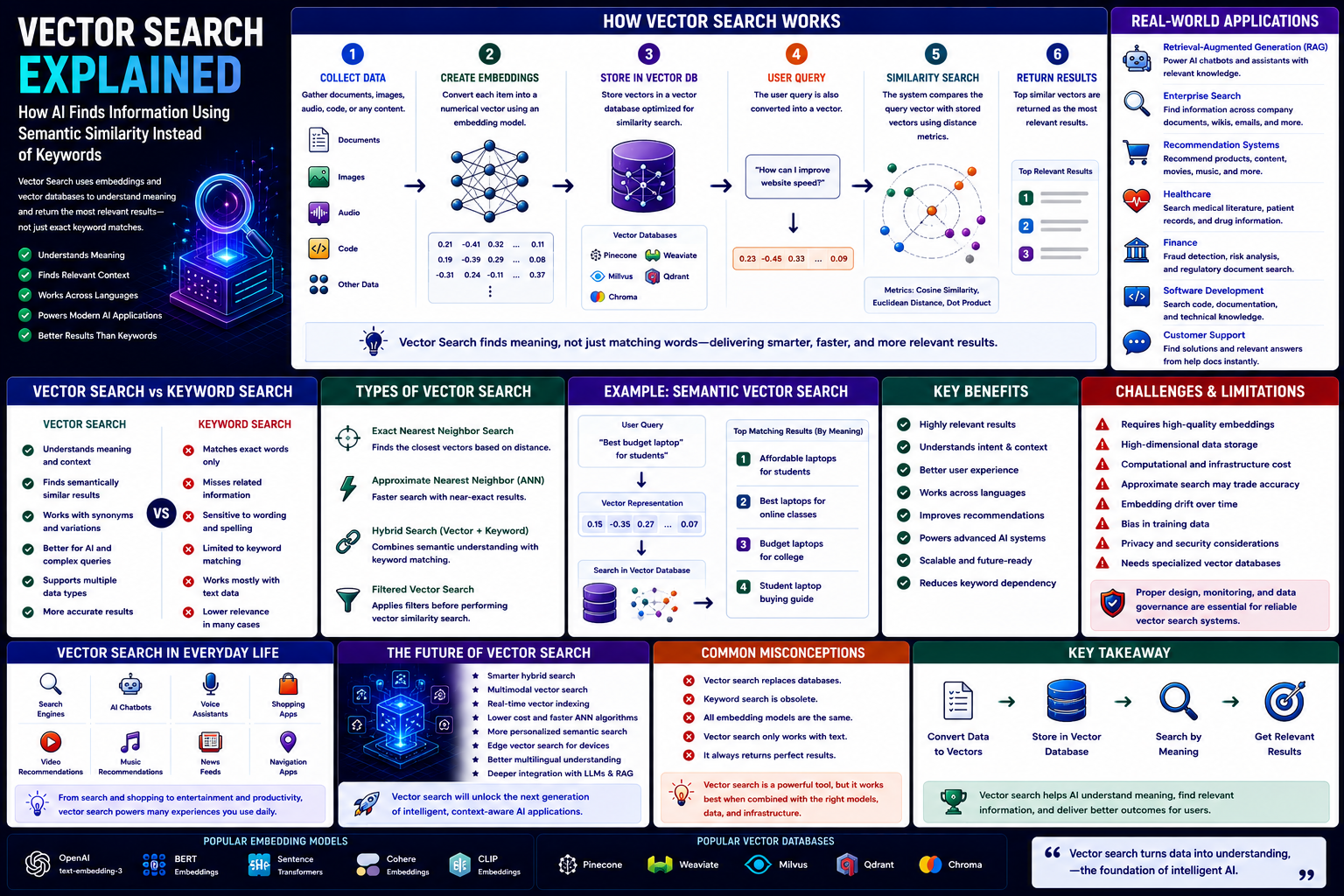
How Vector Search Works
Most Vector Search systems follow a structured workflow.
1. Data Collection
Documents, images, code, audio, or videos are collected.
2. Embedding Generation
Each item is converted into a numerical vector using an embedding model.
Examples include:
OpenAI Embeddings
Sentence Transformers
BERT Embeddings
CLIP
3. Store in a Vector Database
Vectors are stored in databases optimized for similarity search.
Examples include:
Pinecone
Weaviate
Milvus
Qdrant
Chroma
4. User Query
The user's question is also converted into a vector.
5. Similarity Matching
The vector database compares the query vector against stored vectors using techniques such as:
Cosine Similarity
Euclidean Distance
Dot Product
The closest vectors are returned as relevant results.
Core Components of Vector Search
Several technologies work together.
Embedding Models
Convert data into vectors.
Vector Databases
Store and index vectors efficiently.
Similarity Algorithms
Measure semantic closeness.
Approximate Nearest Neighbor (ANN) Search
Accelerates searches across millions or billions of vectors.
Retrieval Systems
Return relevant documents for downstream AI tasks.
Ranking Models
Improve the order of search results.
Vector Search vs Keyword Search
Vector Search
Keyword Search
Understands meaning
Matches exact words
Context-aware
Keyword dependent
Semantic similarity
Literal matching
Better recommendations
Limited relevance
Supports AI reasoning
Basic retrieval
Vector Search enables more natural and intelligent search experiences.
Real-World Applications
Vector Search powers many AI systems.
Retrieval-Augmented Generation (RAG)
Enterprise AI assistants
Customer support
Knowledge management
Semantic Search
Website search
Enterprise document search
Legal research
Recommendation Systems
Movies
Products
Music
News
Healthcare
Medical literature search
Clinical records
Research retrieval
Finance
Fraud investigation
Regulatory document search
Customer insights
Software Development
Code search
API documentation
Technical knowledge retrieval
Benefits of Vector Search
Organizations gain numerous advantages.
Benefits include:
Better search relevance
Faster information retrieval
Context-aware search
Improved AI assistants
Better recommendations
Scalable knowledge retrieval
Multilingual support
Enhanced user experience
Vector Search dramatically improves search quality compared with traditional keyword systems.
Challenges and Limitations
Despite its advantages, Vector Search introduces challenges.
These include:
High-dimensional indexing
Storage requirements
Embedding quality
Computational costs
Vector drift
Ranking optimization
Privacy concerns
Infrastructure complexity
Proper indexing and monitoring are essential for reliable performance.
Vector Search in Everyday Life
Many familiar technologies rely on Vector Search.
Examples include:
AI chatbots
Search engines
Voice assistants
Online shopping
Music recommendations
Streaming platforms
Enterprise search
Customer support systems
Millions of users interact with Vector Search every day.
Future of Vector Search
Future developments include:
Hybrid search (keyword + vector)
Multimodal vector search
Faster ANN algorithms
Personalized semantic search
Cross-language search
Real-time vector indexing
AI-native search engines
Enterprise knowledge retrieval
Vector Search will become even more important as AI systems continue evolving.
Common Misconceptions
Several myths surround Vector Search.
Common misconceptions include:
Vector Search replaces databases.
Keyword search is obsolete.
Every embedding model produces identical results.
Vector Search only works with text.
Vector Search is only useful for Large Language Models.
In reality, Vector Search complements traditional search technologies and works across text, images, audio, code, and other data types.
Final Thoughts
Vector Search is transforming how Artificial Intelligence retrieves and understands information by replacing simple keyword matching with semantic similarity. By combining embeddings, vector databases, and efficient similarity algorithms, Vector Search enables faster, more accurate, and context-aware retrieval across countless AI applications.
As enterprise AI, Retrieval-Augmented Generation, and intelligent assistants continue to expand, Vector Search will remain one of the foundational technologies powering the next generation of search and knowledge systems.
Frequently Asked Questions
What is Vector Search?
Vector Search is a semantic search technique that retrieves information by comparing vector embeddings instead of matching exact keywords.
Why is Vector Search important?
It enables AI systems to understand context, improve search relevance, and power technologies like RAG, AI assistants, and recommendation engines.
What databases support Vector Search?
Popular vector databases include Pinecone, Weaviate, Milvus, Qdrant, and Chroma.
Is Vector Search used in Large Language Models?
Yes. It is commonly used with LLMs for Retrieval-Augmented Generation (RAG), semantic search, and enterprise knowledge retrieval.
Does Vector Search replace keyword search?
No. Many systems combine keyword search with Vector Search to create hybrid search experiences.
Comments (0)