
Vector Databases Explained: How AI Stores, Searches, and Understands Information
Introduction
Modern Artificial Intelligence systems generate and process enormous amounts of information. Traditional databases are excellent at storing structured records such as customer details, inventory lists, and financial transactions, but they struggle to understand meaning and context within unstructured data like documents, images, audio, and videos.
This is where Vector Databases play a critical role.
Vector databases are designed to store mathematical representations of information called embeddings, allowing AI systems to search based on meaning rather than exact keywords. They power many of today's most advanced technologies, including AI chatbots, semantic search engines, recommendation systems, Retrieval-Augmented Generation (RAG), AI agents, and enterprise knowledge assistants.
As Generative AI adoption grows, vector databases have become one of the most important components of modern AI infrastructure.
What Are Vector Databases?
A Vector Database is a specialized database that stores vector embeddings, which are numerical representations of text, images, audio, videos, or other forms of data.
Instead of matching exact words, vector databases compare mathematical similarity between vectors.
This enables AI systems to understand:
Meaning
Context
Relationships
Intent
Similarity
Concepts
rather than simply matching keywords.
Vector databases are commonly used for:
Semantic search
AI chatbots
Recommendation engines
Image search
RAG systems
AI agents
Knowledge retrieval
Personalized AI assistants
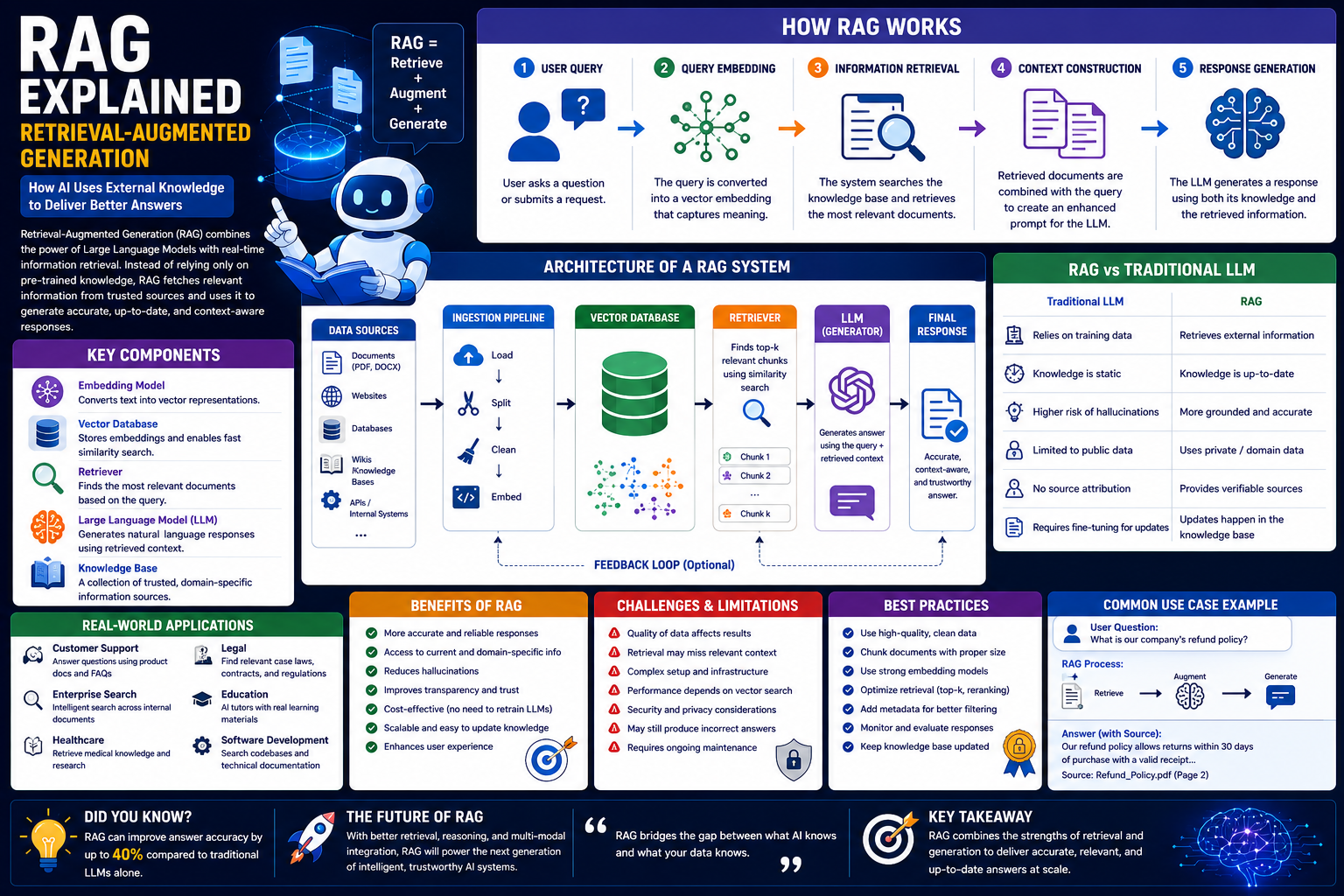
How Vector Databases Work
Most vector databases follow a structured workflow.
1. Data Collection
Information is gathered from various sources.
Examples include:
PDFs
Websites
Databases
Emails
Images
Videos
Audio files
Documentation
2. Embedding Generation
An embedding model converts each piece of information into a numerical vector.
Instead of storing plain text, the system stores these vectors.
3. Vector Storage
The generated vectors are stored inside the vector database together with metadata such as:
Document title
Source
Category
Date
Permissions
4. Similarity Search
When a user submits a query, it is converted into another vector.
The database compares this vector with millions of stored vectors to find the closest matches.
5. AI Response Generation
The retrieved information is passed to a Large Language Model, which generates an accurate, context-aware response.
This process is fundamental to modern RAG systems.
Embeddings Explained
Embeddings are numerical representations of information.
Instead of storing words directly, AI converts meaning into mathematical coordinates.
For example:
"Car"
"Automobile"
"Vehicle"
have different spellings but similar embeddings because they share similar meanings.
Embeddings enable AI to understand concepts rather than exact wording.
Semantic Search vs Keyword Search
Keyword Search
Semantic Search
Matches exact words
Matches meaning
Limited context
Understands context
Literal matching
Conceptual matching
Lower flexibility
Higher relevance
Traditional databases
Vector databases
Semantic search provides significantly more accurate AI results.
Popular Vector Database Technologies
Several vector databases are widely used in AI applications.
Examples include:
Pinecone
Milvus
Weaviate
Qdrant
Chroma
FAISS
Elasticsearch Vector Search
pgvector
Vespa
Redis Vector Search
Each solution offers different scalability, performance, and deployment options.
Real-World Applications
Vector databases power numerous AI applications.
Enterprise Knowledge Search
Internal documentation
Company policies
Employee assistants
AI Chatbots
Customer support
Product assistance
FAQ systems
Recommendation Systems
Movies
Products
Music
News
Healthcare
Medical literature search
Clinical knowledge retrieval
Legal Services
Contract search
Case law retrieval
E-commerce
Product recommendations
Visual search
Personalized shopping
Benefits of Vector Databases
Vector databases provide many advantages.
Benefits include:
Faster semantic search
Better contextual understanding
Improved AI accuracy
Reduced hallucinations
Scalable knowledge retrieval
Efficient similarity search
Better user experiences
Real-time information access
Organizations increasingly rely on vector databases to build intelligent AI systems.
Challenges and Limitations
Despite their strengths, vector databases also present challenges.
These include:
Large storage requirements
Embedding quality dependency
Infrastructure complexity
Data synchronization
Security concerns
Metadata management
Query optimization
Performance tuning
Proper implementation is essential for achieving optimal results.
Vector Databases in Everyday AI
Many AI systems already use vector databases.
Examples include:
AI assistants
Enterprise search
Image search
Document chatbots
Product recommendations
Voice assistants
Research tools
RAG applications
They have become a core building block of modern AI infrastructure.
Future of Vector Databases
Future developments include:
Faster similarity search
Hybrid search architectures
Multimodal vector search
Real-time indexing
Better enterprise scalability
AI-native databases
Improved retrieval quality
Smarter AI agents
Vector databases will continue playing a central role in next-generation AI systems.
Common Misconceptions
Several myths surround vector databases.
Common misconceptions include:
Vector databases replace relational databases.
They only work with text.
Every AI application requires a vector database.
Vector search is always perfect.
Only large organizations use vector databases.
In reality, vector databases complement traditional databases and excel at semantic retrieval tasks.
Final Thoughts
Vector Databases have become one of the foundational technologies behind modern Artificial Intelligence. By storing embeddings and enabling semantic search, they help AI systems understand meaning, retrieve relevant information, and generate more accurate responses.
As organizations continue building AI-powered applications, vector databases will remain essential for creating scalable, reliable, and intelligent systems that deliver context-aware experiences.
Frequently Asked Questions
What is a Vector Database?
A Vector Database stores vector embeddings so AI systems can search information based on meaning instead of exact keywords.
Why are Vector Databases important?
They enable semantic search, Retrieval-Augmented Generation, AI agents, recommendation systems, and many other intelligent AI applications.
What are embeddings?
Embeddings are numerical representations of data that capture meaning and relationships.
Do Vector Databases replace SQL databases?
No. They complement traditional databases by handling semantic search and similarity retrieval.
Where are Vector Databases used?
Enterprise AI, healthcare, finance, education, legal services, eCommerce, research, cybersecurity, and intelligent search systems.
Comments (0)