
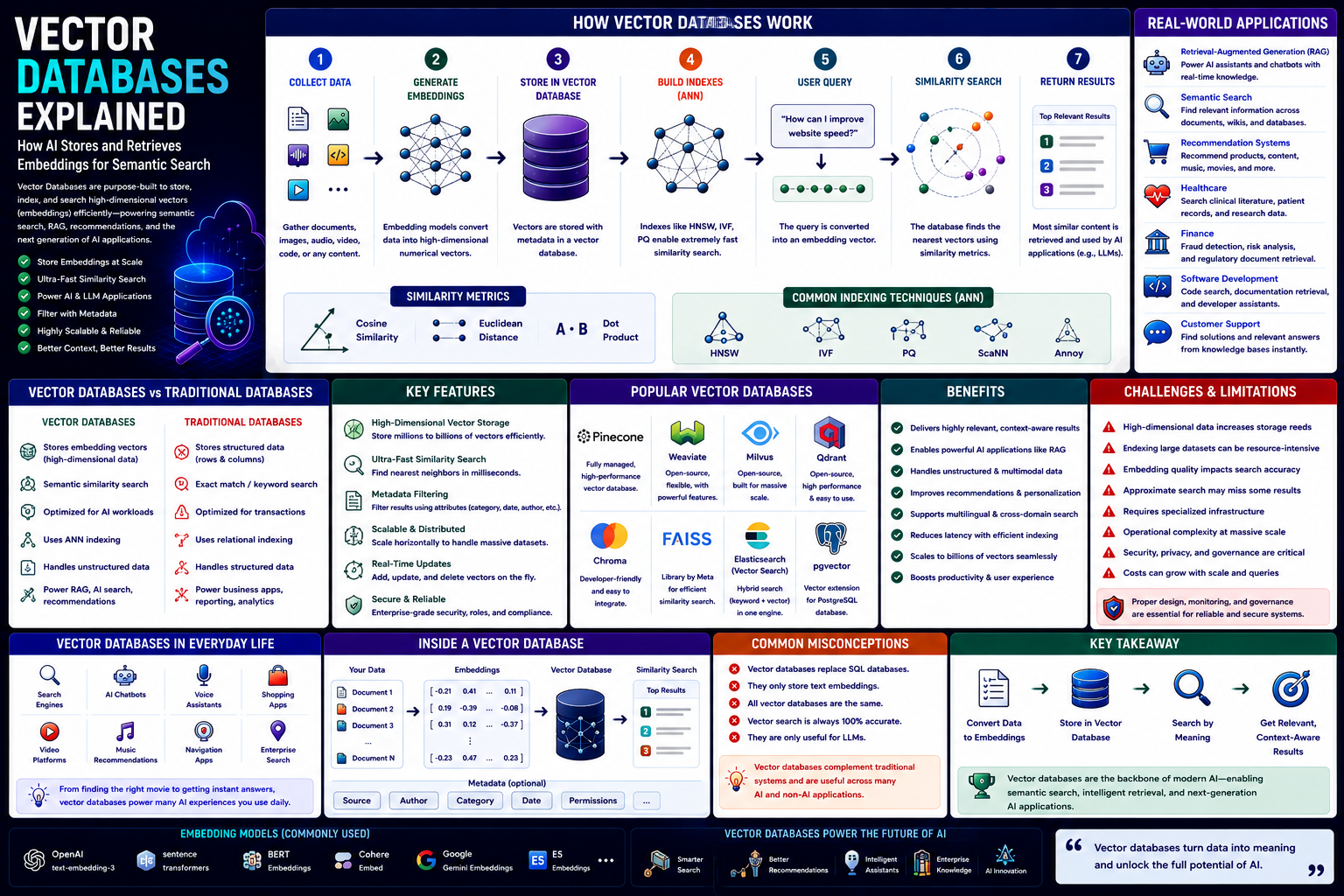
Vector Databases Explained: How AI Stores and Retrieves Embeddings for Semantic Search
Introduction
Artificial Intelligence applications increasingly rely on semantic understanding rather than simple keyword matching. Technologies such as Large Language Models (LLMs), Retrieval-Augmented Generation (RAG), recommendation engines, enterprise search, and AI assistants all depend on one critical component—Vector Databases.
Traditional relational databases are excellent at storing structured information like names, numbers, and transactions, but they are not optimized for storing and searching millions of high-dimensional embedding vectors.
Vector Databases solve this challenge by storing embeddings efficiently and performing extremely fast similarity searches across massive datasets.
As modern AI applications continue to grow, Vector Databases have become one of the foundational technologies behind intelligent information retrieval.
What Are Vector Databases?
A Vector Database is a specialized database designed to store, manage, index, and retrieve vector embeddings efficiently.
Instead of storing only text or structured records, Vector Databases store numerical vectors generated by embedding models.
These vectors represent:
Text
Documents
Images
Audio
Video
Source code
Products
User profiles
The database enables AI systems to find similar vectors based on semantic meaning rather than exact keywords.
Why Vector Databases Matter
Modern AI systems process enormous amounts of unstructured information.
Vector Databases help organizations:
Perform semantic search
Build Retrieval-Augmented Generation (RAG)
Improve recommendation systems
Enable AI assistants
Support multilingual search
Scale enterprise AI
Retrieve contextual information
Accelerate AI inference
Without Vector Databases, semantic AI applications would be much slower and less accurate.
How Vector Databases Work
Most Vector Database systems follow a structured workflow.
1. Collect Data
Gather documents, images, videos, audio, code, or structured information.
2. Generate Embeddings
Embedding models convert content into high-dimensional vectors.
Examples include:
OpenAI Embeddings
Sentence Transformers
BERT
CLIP
3. Store Vectors
The generated vectors are stored together with metadata.
Metadata may include:
Document title
Category
Author
Timestamp
Source
Permissions
4. Build Indexes
Efficient indexing algorithms are created for fast similarity search.
Popular indexing methods include:
HNSW
IVF
PQ
Annoy
ScaNN
5. Query Processing
User queries are converted into embeddings.
6. Similarity Search
The database returns the nearest vectors using:
Cosine Similarity
Euclidean Distance
Dot Product
7. AI Response
Retrieved documents are passed to AI systems such as LLMs for final responses.
Core Components of Vector Databases
Several technologies work together.
Embedding Models
Generate vectors.
Vector Storage
Stores millions or billions of embeddings.
ANN Indexing
Accelerates nearest-neighbor searches.
Metadata Filtering
Narrows results using structured attributes.
Similarity Algorithms
Measure semantic closeness.
APIs
Allow AI applications to query the database.
Vector Databases vs Traditional Databases
Vector Databases
Traditional Databases
Store embeddings
Store structured records
Semantic similarity search
Exact-value queries
Optimized for AI
Optimized for transactions
High-dimensional indexing
Relational indexing
AI-native retrieval
SQL-based retrieval
Vector Databases complement rather than replace traditional databases.
Popular Vector Databases
Some of the most widely used platforms include:
Pinecone
Weaviate
Milvus
Qdrant
Chroma
FAISS
Elasticsearch Vector Search
PostgreSQL with pgvector
Each platform offers different strengths depending on scalability, performance, deployment, and integration needs.
Real-World Applications
Vector Databases power many AI systems.
Retrieval-Augmented Generation (RAG)
Enterprise AI assistants
Customer support
Internal knowledge bases
Semantic Search
Website search
Legal research
Scientific literature
Recommendation Systems
Products
Movies
Music
Articles
Healthcare
Medical knowledge retrieval
Clinical research
Drug discovery
Finance
Risk analysis
Regulatory documents
Fraud investigations
Software Development
Code search
API documentation
Developer assistants
Benefits of Vector Databases
Organizations gain numerous advantages.
Benefits include:
Extremely fast similarity search
Better semantic understanding
High scalability
Real-time retrieval
Improved AI accuracy
Rich metadata filtering
Efficient enterprise search
Better user experiences
Vector Databases enable AI systems to retrieve relevant information with remarkable speed and precision.
Challenges and Limitations
Despite their strengths, Vector Databases introduce challenges.
These include:
Storage costs
Index maintenance
Embedding drift
High-dimensional optimization
Infrastructure complexity
Security concerns
Data governance
Scalability planning
Proper architecture and monitoring are essential.
Vector Databases in Everyday Life
Many AI-powered products already rely on Vector Databases.
Examples include:
AI chatbots
Search engines
Voice assistants
Online shopping
Recommendation systems
Enterprise knowledge search
Customer support
Coding assistants
Millions of users benefit from Vector Database technology every day.
Future of Vector Databases
Future developments include:
Hybrid search
Real-time vector indexing
Multimodal databases
Better ANN algorithms
AI-native database engines
Personalized retrieval
Distributed vector storage
Enterprise AI platforms
Vector Databases will become increasingly important as AI systems continue to scale.
Common Misconceptions
Several myths surround Vector Databases.
Common misconceptions include:
Vector Databases replace SQL databases.
They only store text.
Every Vector Database performs the same.
They are only useful for Large Language Models.
Vector Databases eliminate keyword search.
In reality, Vector Databases complement traditional databases and often work alongside relational, document, and graph databases.
Final Thoughts
Vector Databases are a cornerstone of modern Artificial Intelligence, enabling systems to store, organize, and retrieve embeddings with exceptional speed and accuracy. By supporting semantic search, Retrieval-Augmented Generation, recommendation engines, and intelligent assistants, they bridge the gap between raw data and meaningful AI responses.
As organizations increasingly adopt AI-driven applications, Vector Databases will remain essential infrastructure for building scalable, intelligent, and context-aware systems.
Frequently Asked Questions
What is a Vector Database?
A Vector Database is a specialized database designed to store and retrieve embedding vectors for semantic similarity search.
Why are Vector Databases important?
They enable fast semantic search, Retrieval-Augmented Generation (RAG), recommendation systems, and AI assistants.
Which Vector Databases are popular?
Popular solutions include Pinecone, Weaviate, Milvus, Qdrant, Chroma, FAISS, Elasticsearch Vector Search, and pgvector.
Do Vector Databases replace SQL databases?
No. They complement SQL databases by handling vector similarity search while traditional databases manage structured data.
Which industries use Vector Databases?
Healthcare, finance, retail, manufacturing, education, legal, cybersecurity, software development, and many others.
Comments (0)