
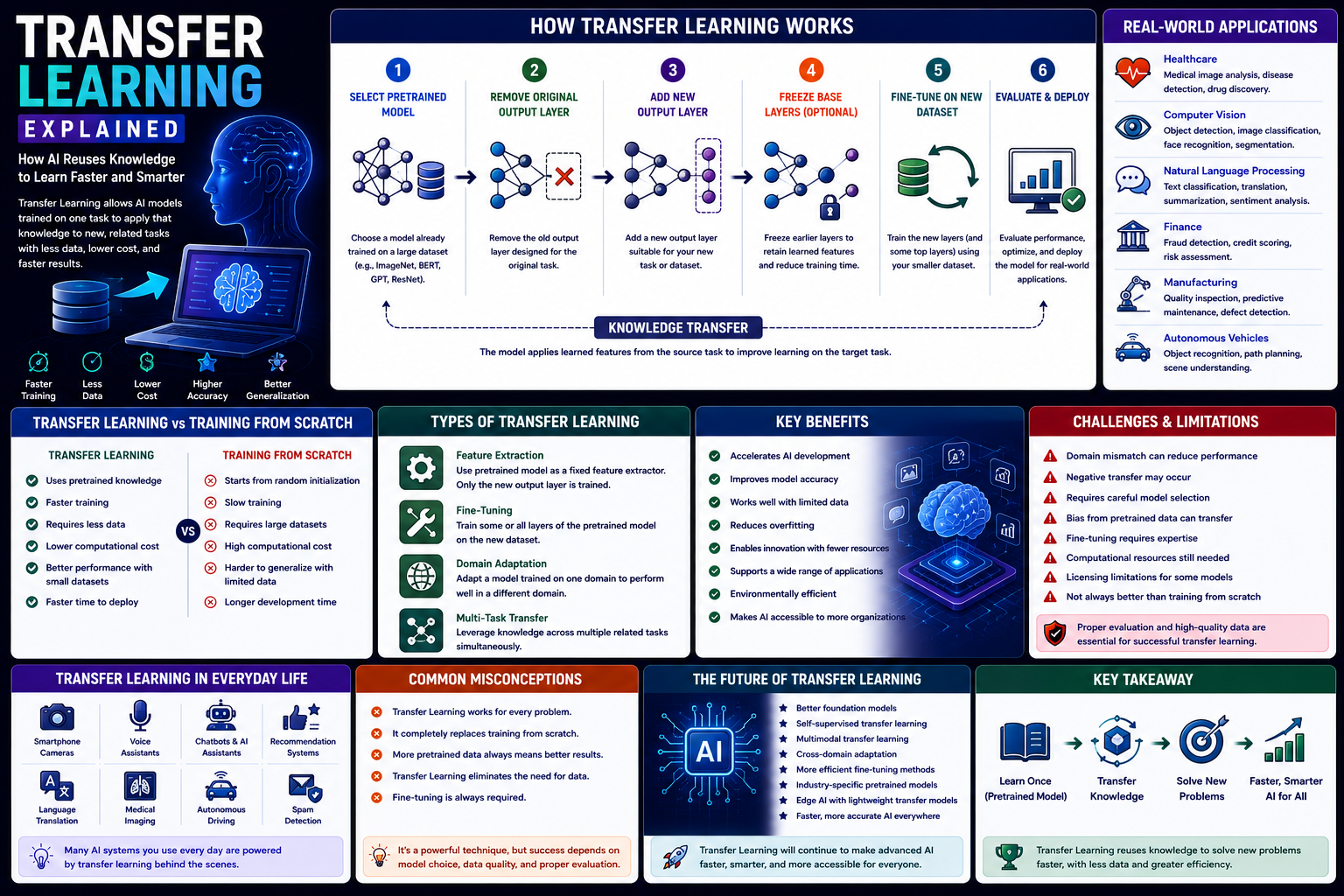
Transfer Learning Explained: How AI Reuses Knowledge to Learn Faster and Smarter
Introduction
Building an Artificial Intelligence model from scratch often requires enormous datasets, expensive computing resources, and weeks or even months of training. For many organizations, this process is costly and impractical.
Transfer Learning offers a smarter approach.
Instead of starting from zero, Transfer Learning allows AI models to reuse knowledge learned from previous tasks and apply it to new but related problems. By leveraging pretrained models, developers can create accurate AI systems with less data, lower costs, and much faster development times.
Today, Transfer Learning powers many breakthroughs in computer vision, natural language processing (NLP), speech recognition, healthcare, robotics, and recommendation systems.
What Is Transfer Learning?
Transfer Learning is a machine learning technique in which a model trained on one task is adapted to perform another related task.
Rather than learning everything from the beginning, the model reuses existing knowledge and fine-tunes it for a new application.
For example, an image recognition model trained to identify millions of everyday objects can be adapted to detect specific medical conditions in X-ray images with significantly less training data.
Why Transfer Learning Matters
Training large AI models from scratch requires significant resources.
Transfer Learning helps organizations:
Reduce training time
Lower computing costs
Improve model accuracy
Use smaller datasets
Accelerate AI development
Improve performance on specialized tasks
Reduce environmental impact
Increase accessibility for smaller organizations
It enables faster and more practical AI deployment across industries.
How Transfer Learning Works
Most Transfer Learning workflows follow a structured process.
1. Select a Pretrained Model
Developers choose an existing model that has already learned useful features.
Examples include:
ResNet
EfficientNet
BERT
GPT-based models
Vision Transformers (ViT)
2. Replace the Output Layer
The original output layer is modified for the new task.
3. Freeze Base Layers
Earlier layers retain previously learned knowledge while preventing unnecessary retraining.
4. Fine-Tune Selected Layers
Later layers are retrained using the new dataset to specialize the model.
5. Evaluate Performance
The model is tested for:
Accuracy
Precision
Recall
Robustness
Generalization
Types of Transfer Learning
Several approaches are commonly used.
Feature Extraction
Reuse pretrained features without retraining the entire model.
Fine-Tuning
Retrain part of the pretrained model using new data.
Domain Adaptation
Adapt models to different environments while solving similar tasks.
Multi-Task Transfer
Transfer knowledge across multiple related learning tasks.
Transfer Learning vs Training from Scratch
Transfer Learning
Training from Scratch
Uses pretrained models
Starts with random parameters
Faster training
Longer training time
Requires less data
Requires large datasets
Lower computing cost
Higher infrastructure cost
Faster deployment
Longer development cycle
Transfer Learning is often the preferred choice for practical AI applications.
Real-World Applications
Transfer Learning powers AI across many industries.
Healthcare
Disease detection
Medical image analysis
Drug discovery
Computer Vision
Face recognition
Object detection
Image classification
Natural Language Processing
Translation
Text summarization
Sentiment analysis
Finance
Fraud detection
Credit scoring
Risk assessment
Manufacturing
Quality inspection
Predictive maintenance
Defect detection
Autonomous Vehicles
Traffic sign recognition
Object tracking
Driver assistance
Benefits of Transfer Learning
Transfer Learning provides many advantages.
Benefits include:
Faster development
Lower costs
Improved accuracy
Reduced data requirements
Better generalization
Easier deployment
Efficient resource usage
Faster innovation
Organizations can build advanced AI solutions without massive datasets.
Challenges and Limitations
Transfer Learning also presents challenges.
These include:
Domain mismatch
Negative transfer
Model bias
Fine-tuning complexity
Limited interpretability
Computational requirements
Dataset quality
Licensing restrictions for pretrained models
Careful model selection and validation are essential.
Transfer Learning in Everyday Life
Many AI-powered products rely on Transfer Learning.
Examples include:
Voice assistants
Smartphone cameras
Medical AI systems
Language translation
Face recognition
Chatbots
Recommendation engines
Autonomous driving
Transfer Learning enables these systems to improve quickly while reducing development effort.
Future of Transfer Learning
Future developments include:
Better foundation models
Smaller specialized AI models
Cross-domain learning
Self-supervised transfer learning
Multimodal transfer learning
Personalized AI systems
Industry-specific pretrained models
Faster fine-tuning techniques
Transfer Learning will continue making advanced AI more accessible.
Common Misconceptions
Several myths surround Transfer Learning.
Common misconceptions include:
Transfer Learning works for every problem.
It completely replaces training from scratch.
More pretrained data always means better results.
Transfer Learning eliminates bias.
Fine-tuning is always required.
In reality, success depends on selecting appropriate pretrained models and high-quality datasets.
Final Thoughts
Transfer Learning has transformed modern Artificial Intelligence by allowing models to build upon existing knowledge instead of starting from scratch. This approach reduces development time, lowers costs, and makes advanced AI accessible to organizations of all sizes.
As foundation models continue to improve, Transfer Learning will remain one of the most important techniques for developing efficient, accurate, and scalable AI solutions across industries.
Frequently Asked Questions
What is Transfer Learning?
Transfer Learning is a machine learning technique where knowledge learned from one task is reused to solve a related task.
Why is Transfer Learning important?
It reduces training time, lowers costs, requires less data, and accelerates AI development.
Which industries use Transfer Learning?
Healthcare, finance, manufacturing, retail, robotics, cybersecurity, transportation, education, and many others.
Is Transfer Learning used in Large Language Models?
Yes. Many LLM-based applications fine-tune pretrained foundation models for domain-specific tasks.
Does Transfer Learning replace traditional machine learning?
No. It complements traditional approaches and is especially valuable when labeled data is limited.
Comments (0)