
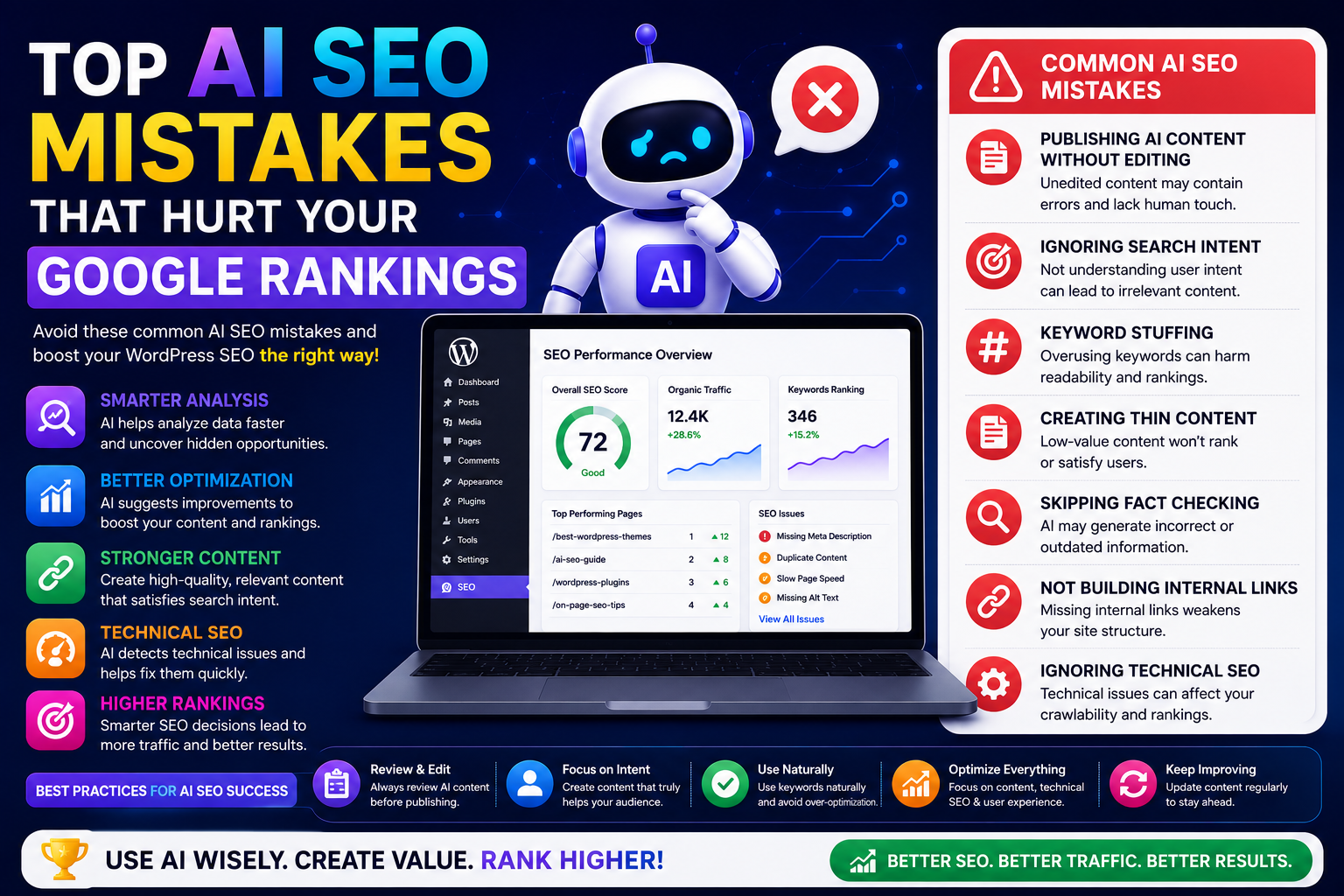
Top AI SEO Mistakes That Hurt Your Google Rankings
Artificial Intelligence has become one of the biggest innovations in search engine optimization. From keyword research and content creation to technical audits and metadata generation, AI tools help website owners save time while improving productivity.
However, AI is not a shortcut to higher rankings.
Many website owners assume AI can completely replace human expertise, leading to poor-quality content, technical SEO issues, and declining search visibility.
Google rewards helpful, original, people-first content, regardless of whether AI assisted in its creation. Websites that misuse AI often struggle to maintain long-term rankings.
In this guide, we'll explore the most common AI SEO mistakes and explain how to avoid them while building a successful WordPress SEO strategy.
Why AI SEO Mistakes Matter
AI can generate content quickly, but publishing low-quality or poorly optimized content may result in:
Lower search rankings
Reduced organic traffic
Poor user engagement
Lower conversion rates
Duplicate content issues
Weak topical authority
Loss of reader trust
Using AI responsibly helps create valuable content that benefits both users and search engines.
Mistake 1: Publishing AI Content Without Human Editing
One of the biggest mistakes is publishing AI-generated content exactly as it is.
Although AI can create excellent drafts, it may:
Repeat ideas
Miss important context
Include factual inaccuracies
Use generic wording
Lack personality
Always review, edit, and personalize AI-generated content before publishing.
Mistake 2: Ignoring Search Intent
Many users focus only on keywords while ignoring the actual reason behind a search.
For example:
Someone searching "Best WordPress Hosting" usually wants recommendations—not a technical explanation of web hosting.
AI should help satisfy user intent rather than simply inserting keywords.
Mistake 3: Keyword Stuffing
Some users instruct AI to repeat the same keyword excessively.
This creates unnatural content such as:
Repetitive headings
Forced keyword placement
Poor readability
Instead, use:
Related keywords
Semantic phrases
Natural language
Topic clusters
Search engines understand context much better than simple keyword repetition.
Mistake 4: Creating Thin Content
Short articles with little useful information rarely perform well.
AI should help create comprehensive content—not the shortest possible article.
Include:
Examples
Step-by-step guidance
FAQs
Comparisons
Practical advice
Thorough content generally provides better value for readers.
Mistake 5: Skipping Fact Checking
AI occasionally produces incorrect or outdated information.
Before publishing:
Verify statistics
Confirm product details
Check technical instructions
Validate references
Accurate content builds trust and authority.
Mistake 6: Ignoring Internal Linking
Many AI-generated articles lack proper internal links.
Internal linking helps:
Improve navigation
Build topical authority
Increase page views
Distribute SEO value
Help search engines discover content
Every article should naturally connect to related topics.
Mistake 7: Forgetting Technical SEO
Content alone isn't enough.
AI cannot compensate for technical SEO problems such as:
Slow loading speed
Broken links
Missing schema
Poor mobile usability
Crawl errors
Regular technical audits remain essential.
Mistake 8: Using the Same Prompt Repeatedly
Using identical prompts often produces repetitive articles.
Instead:
Customize prompts
Add audience details
Specify tone
Include objectives
Request original examples
Better prompts generally produce better content.
Mistake 9: Publishing Without Updating Older Content
SEO isn't only about publishing new articles.
AI can also improve existing pages by:
Updating outdated information
Expanding sections
Improving readability
Refreshing keywords
Adding FAQs
Updating internal links
Refreshing content often provides faster SEO improvements than creating new articles.
Mistake 10: Depending Entirely on AI
Artificial Intelligence is a powerful assistant—but it should never replace human expertise.
Humans remain essential for:
Creativity
Strategy
Experience
Storytelling
Brand voice
Editorial decisions
The strongest websites combine AI efficiency with human knowledge.
Best Practices for Responsible AI SEO
Use AI to:
Research topics
Generate ideas
Improve readability
Optimize metadata
Analyze keywords
Suggest internal links
Speed up workflows
Always combine AI recommendations with thoughtful editing and editorial review.
Benefits of Using AI Correctly
Responsible AI usage can help you:
Save time
Publish consistently
Improve SEO
Build topical authority
Increase organic traffic
Enhance user experience
Improve content quality
Scale content production
The goal is to create better content—not simply more content.
AI SEO Checklist
Before publishing any AI-assisted article, ask yourself:
✔ Has the content been edited?
✔ Does it satisfy search intent?
✔ Are facts verified?
✔ Are keywords used naturally?
✔ Have internal links been added?
✔ Is metadata optimized?
✔ Does the article provide original value?
✔ Have grammar and readability been reviewed?
Following this checklist helps improve quality and long-term SEO performance.
Final Thoughts
Artificial Intelligence is transforming SEO, but success depends on how you use it.
Publishing unedited AI content, ignoring user intent, or relying entirely on automation can limit your website's growth.
Instead, use AI as a productivity tool that supports research, optimization, and content creation while maintaining human oversight.
The websites that achieve sustainable rankings are those that combine AI-powered efficiency with original insights, expert knowledge, and a genuine focus on helping readers.
When used responsibly, AI becomes one of the most valuable tools in your WordPress SEO strategy.
Frequently Asked Questions
Can AI-generated content rank on Google?
Yes. AI-assisted content can rank well when it is accurate, helpful, original, edited, and created with users in mind.
Is AI content considered spam?
No. Google focuses on content quality rather than the method used to create it. Low-quality content—whether written by humans or AI—can perform poorly.
Should I edit AI-generated articles?
Yes. Editing improves accuracy, readability, originality, and alignment with your brand voice.
Can AI replace SEO experts?
No. AI supports SEO professionals by automating repetitive tasks, but strategy, creativity, and decision-making still require human expertise.
What's the biggest AI SEO mistake?
Publishing AI-generated content without review is one of the most common mistakes. Human editing and fact-checking remain essential.
Comments (0)