
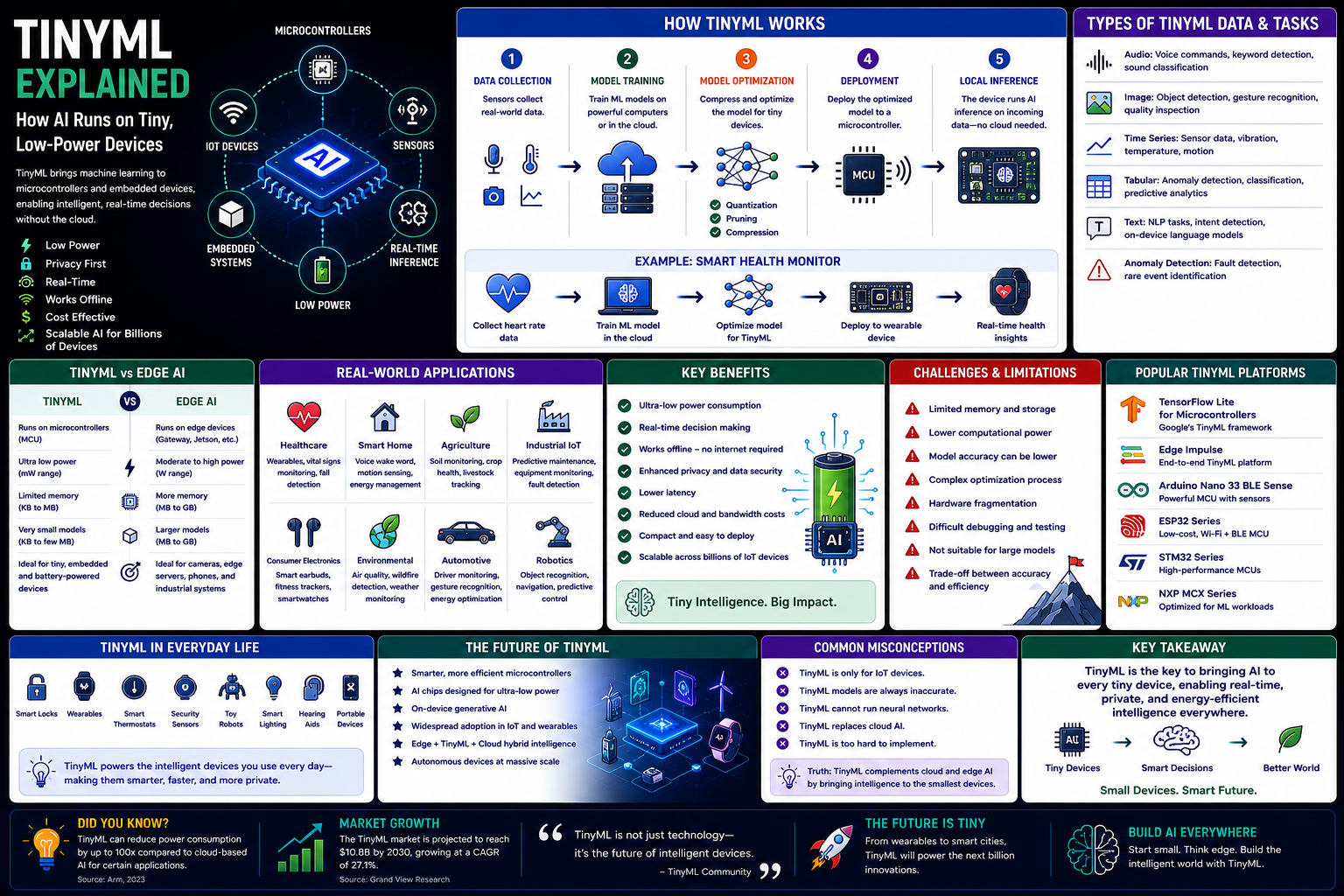
TinyML Explained: How Artificial Intelligence Runs on Tiny, Low-Power Devices
Introduction
Artificial Intelligence has traditionally relied on powerful servers, GPUs, and cloud infrastructure to process large amounts of data. However, many modern applications require intelligent decision-making directly on tiny devices with limited memory, storage, and battery life.
This challenge led to the development of TinyML.
TinyML enables machine learning models to run efficiently on microcontrollers and other low-power embedded devices. Instead of sending data to the cloud, TinyML allows devices to process information locally, making them faster, more energy-efficient, and better suited for real-time applications.
From wearable health monitors and smart home devices to industrial sensors and agricultural systems, TinyML is bringing AI to billions of connected devices around the world.
What Is TinyML?
TinyML is a branch of machine learning that focuses on deploying AI models to extremely small, resource-constrained hardware.
These devices typically include:
Microcontrollers (MCUs)
IoT sensors
Wearable devices
Smart appliances
Embedded systems
Battery-powered electronics
TinyML models are optimized to use very little memory, storage, and processing power while still delivering useful AI capabilities.
Why TinyML Matters
Modern connected devices generate enormous amounts of data.
Instead of sending everything to the cloud, TinyML allows devices to:
Process information instantly
Operate without continuous internet access
Protect user privacy
Reduce bandwidth usage
Extend battery life
Lower cloud computing costs
Enable real-time automation
Scale AI across billions of devices
TinyML makes AI practical for resource-limited environments.
How TinyML Works
Most TinyML systems follow a structured workflow.
1. Data Collection
Sensors gather information.
Examples include:
Temperature
Sound
Motion
Images
Vibration
Air quality
2. Model Training
The machine learning model is trained on powerful computers or cloud infrastructure using representative datasets.
3. Model Optimization
The trained model is compressed using techniques such as:
Quantization
Pruning
Weight compression
Model conversion
This reduces memory and computational requirements.
4. Deployment
The optimized model is uploaded to a microcontroller or embedded device.
Common hardware includes:
Arduino Nano 33 BLE Sense
ESP32
STM32
Raspberry Pi Pico
Nordic nRF series
5. Local Inference
The device performs AI inference directly on incoming sensor data without relying on cloud servers.
Core Components of TinyML
TinyML systems combine several technologies.
Microcontrollers
Run optimized AI models using minimal power.
Sensors
Capture environmental or user data.
Machine Learning Models
Perform classification, detection, or prediction tasks.
TinyML Frameworks
Examples include:
TensorFlow Lite for Microcontrollers
Edge Impulse
microTVM
TinyEngine
Embedded Software
Manages hardware interactions and AI execution.
TinyML vs Edge AI
TinyML
Edge AI
Runs on microcontrollers
Runs on more powerful edge devices
Extremely low power
Moderate to high power
Limited memory
Greater hardware resources
Small AI models
Larger AI models
Designed for embedded devices
Supports phones, gateways, and industrial computers
TinyML is a specialized subset of Edge AI focused on ultra-low-power hardware.
Real-World Applications
TinyML is transforming many industries.
Healthcare
Wearable health monitors
Fall detection
Heart rate monitoring
Smart Homes
Voice wake-word detection
Motion sensing
Energy management
Agriculture
Soil monitoring
Crop health analysis
Livestock tracking
Manufacturing
Equipment monitoring
Predictive maintenance
Quality inspection
Environmental Monitoring
Air quality sensors
Wildlife tracking
Forest fire detection
Consumer Electronics
Smart earbuds
Fitness trackers
Smartwatches
Benefits of TinyML
TinyML offers significant advantages.
Benefits include:
Ultra-low power consumption
Real-time processing
Offline operation
Better privacy
Reduced latency
Lower cloud costs
Compact deployment
Scalable IoT intelligence
TinyML enables AI where traditional cloud computing is impractical.
Challenges and Limitations
Despite its strengths, TinyML has several limitations.
These include:
Limited memory
Reduced processing power
Small model size
Complex optimization
Hardware constraints
Limited storage
Battery management
Difficult debugging
Developers must carefully balance accuracy and efficiency.
TinyML in Everyday Life
TinyML already powers many familiar devices.
Examples include:
Smart speakers
Wireless earbuds
Fitness trackers
Smart thermostats
Security sensors
Smart locks
Industrial IoT sensors
Environmental monitoring systems
Many users interact with TinyML-powered devices without realizing it.
Future of TinyML
Future developments include:
Smarter wearable devices
AI-powered medical implants
Intelligent industrial sensors
Energy-efficient AI chips
Smart cities
Autonomous drones
Precision agriculture
Billions of connected AI devices
TinyML will play a major role in expanding AI beyond traditional computers and smartphones.
Common Misconceptions
Several myths surround TinyML.
Common misconceptions include:
TinyML replaces cloud AI.
TinyML only works with IoT devices.
TinyML models are always less accurate.
TinyML requires expensive hardware.
TinyML cannot run neural networks.
In reality, TinyML complements cloud and Edge AI by enabling efficient intelligence on extremely small devices.
Final Thoughts
TinyML is bringing Artificial Intelligence to the smallest connected devices, enabling real-time intelligence with minimal power consumption and hardware requirements. By combining optimized machine learning models with embedded systems, TinyML allows organizations to deploy AI in places where traditional cloud-based solutions are impractical.
As IoT ecosystems continue to expand and billions of smart devices come online, TinyML will become a key technology powering the next generation of intelligent, energy-efficient, and autonomous systems.
Frequently Asked Questions
What is TinyML?
TinyML is the deployment of optimized machine learning models on ultra-low-power embedded devices such as microcontrollers.
Why is TinyML important?
It enables AI to operate locally with minimal power consumption, reduced latency, and improved privacy.
What devices use TinyML?
Wearables, smart sensors, microcontrollers, IoT devices, smart appliances, industrial equipment, and environmental monitoring systems.
Is TinyML part of Edge AI?
Yes. TinyML is considered a specialized subset of Edge AI designed for highly resource-constrained devices.
What industries use TinyML?
Healthcare, manufacturing, agriculture, consumer electronics, smart homes, environmental monitoring, automotive, and industrial IoT.
Comments (0)