
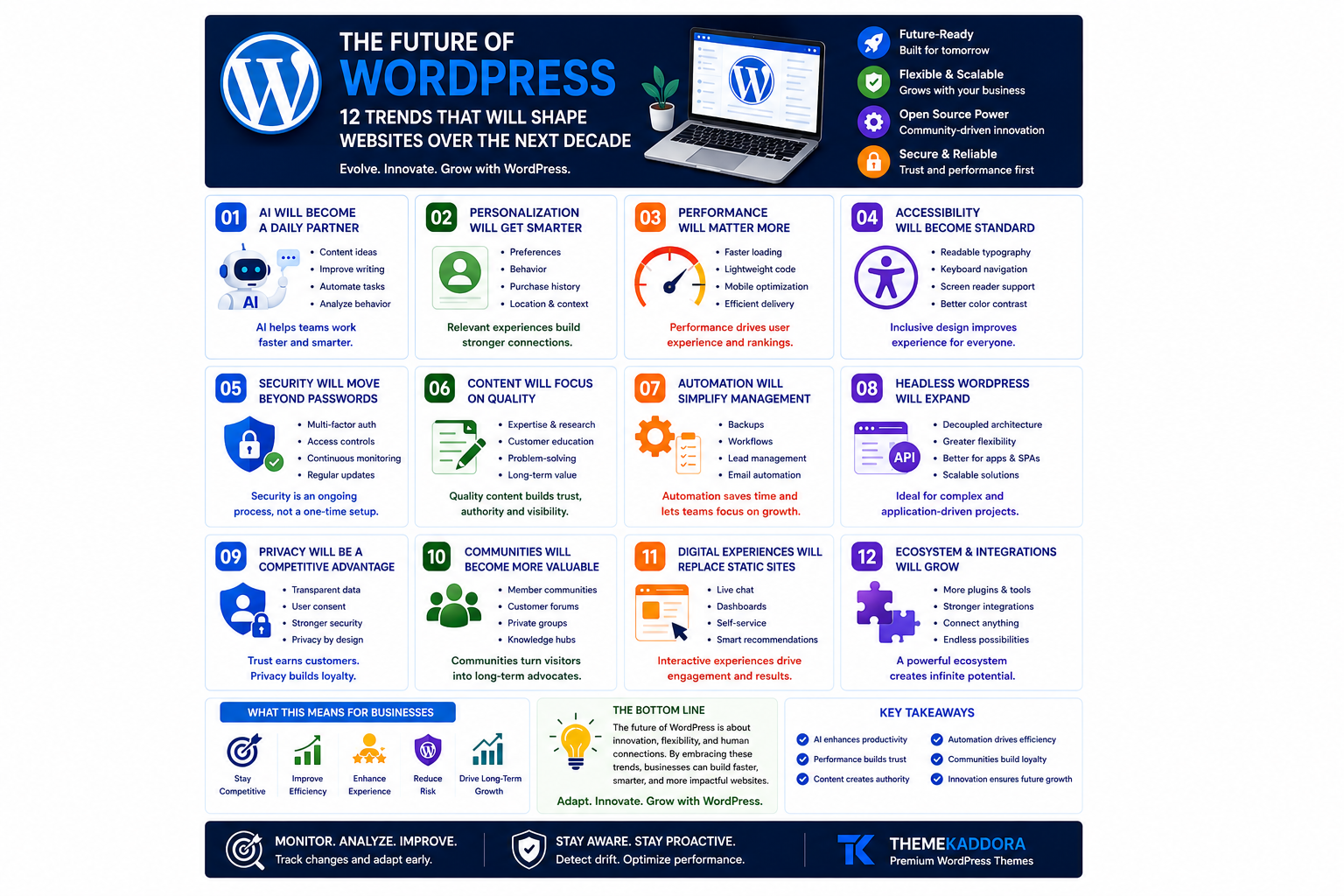
The Future of WordPress: 12 Trends That Will Shape Websites Over the Next Decade
Introduction
WordPress has evolved from a blogging platform into one of the world's most widely used website ecosystems.
Today, it powers business websites, online stores, membership communities, educational platforms, portfolios, media publications, and enterprise-level digital experiences.
At the same time, the internet is changing rapidly.
Artificial intelligence is becoming part of everyday workflows.
Customer expectations continue to rise.
Website performance has become a competitive advantage.
Privacy regulations are evolving, and businesses are looking for smarter ways to connect with customers.
These changes raise an important question:
What will WordPress look like in the future?
Although no one can predict every technological shift, several long-term trends are already reshaping how businesses build, manage, and grow their websites.
WordPress Is No Longer Just a CMS
Many people still think of WordPress as a platform for publishing blog posts.
Modern businesses use WordPress for much more.
Today it supports:
Corporate websites
Online stores
Customer portals
Learning management systems
Membership communities
Booking platforms
Digital publications
SaaS marketing websites
Its role continues to expand as digital business becomes increasingly important.
Trend 1: AI Will Become a Daily Productivity Partner
Artificial intelligence is already helping website owners:
Generate content ideas
Improve writing
Translate content
Create images
Analyze customer behavior
Automate repetitive tasks
The future is unlikely to involve AI replacing website owners.
Instead, AI will help teams work faster while allowing humans to make strategic decisions.
Trend 2: Personalization Will Become More Intelligent
Visitors increasingly expect websites to feel relevant.
Businesses are beginning to personalize experiences using:
Customer preferences
Browsing behavior
Purchase history
Account information
Geographic location
Responsible personalization can improve customer experiences without sacrificing transparency.
Trend 3: Website Performance Will Become Even More Important
Speed is already essential.
In the future, businesses will place even greater emphasis on:
Lightweight code
Faster loading
Efficient media delivery
Responsive interactions
Mobile optimization
Performance will remain closely connected to user experience.
Trend 4: Accessibility Will Become a Standard Expectation
Inclusive websites benefit everyone.
Future WordPress websites will increasingly prioritize:
Readable typography
Keyboard navigation
Screen reader compatibility
Better color contrast
Clear page structures
Accessibility is becoming part of good design rather than an optional feature.
Trend 5: Security Will Move Beyond Passwords
Cybersecurity continues to evolve.
Businesses are strengthening protection through:
Multi-factor authentication
Better access controls
Continuous monitoring
Regular software updates
Improved hosting environments
Website security is becoming an ongoing operational process rather than a one-time setup.
Trend 6: Content Will Focus More on Quality Than Quantity
Publishing hundreds of articles without purpose is becoming less effective.
Future content strategies will emphasize:
Expertise
Original research
Customer education
Practical problem-solving
Long-term value
Businesses that consistently help their audiences are more likely to build lasting authority.
Trend 7: Automation Will Simplify Website Management
Automation can reduce repetitive work.
Examples include:
Scheduled backups
Content workflows
Customer notifications
Lead management
Inventory updates
Email sequences
Automation allows teams to spend more time on strategic work.
Trend 8: Headless WordPress Will Expand in Specialized Projects
Some organizations separate WordPress from the front-end presentation layer.
This approach, often called headless WordPress, provides greater flexibility for certain technical projects.
While it isn't necessary for every website, its adoption is likely to continue in enterprise and application-focused environments.
Trend 9: Privacy Will Become a Competitive Advantage
Customers increasingly value transparency.
Businesses that communicate clearly about:
Data collection
Consent
Security
Privacy practices
can strengthen customer trust.
Privacy is becoming part of the overall customer experience.
Trend 10: Communities Will Become More Valuable
Businesses are moving beyond one-way communication.
Many organizations now build:
Member communities
Learning platforms
Customer forums
Private groups
Knowledge hubs
Communities create stronger long-term relationships than simple transactions.
Trend 11: Digital Experiences Will Replace Static Websites
Websites are becoming interactive business platforms.
Visitors increasingly expect:
Live chat
Personalized dashboards
Online booking
Self-service support
Interactive calculators
Dynamic recommendations
The modern website is an active business tool rather than a digital brochure.
Trend 12: WordPress Will Continue Supporting Business Innovation
One of WordPress's greatest strengths is adaptability.
As technology changes, businesses can continue evolving their websites through:
New integrations
Flexible themes
Plugin ecosystems
Custom development
Emerging technologies
Its open ecosystem encourages innovation.
What These Trends Mean for Businesses
Rather than chasing every new technology, businesses should focus on long-term fundamentals.
Ask:
Does this improve customer experience?
Does it solve a real problem?
Is it sustainable?
Will it support future growth?
Technology should serve business objectives.
Preparing Your Website for the Future
Practical steps include:
Keeping WordPress updated
Improving performance
Publishing helpful content
Investing in accessibility
Strengthening security
Building scalable architecture
Monitoring customer feedback
Small improvements accumulate over time.
Future-Proof Website Checklist
Review whether your website:
✅ Loads quickly
✅ Works on mobile devices
✅ Uses responsive layouts
✅ Supports accessibility
✅ Is regularly updated
✅ Protects customer information
✅ Publishes valuable content
✅ Uses modern design principles
✅ Can scale with business growth
Why Your WordPress Theme Matters
Your theme forms the foundation of your website.
A modern theme should provide:
Lightweight architecture
Responsive design
Flexible customization
SEO-friendly code
WooCommerce compatibility
Clean development standards
A strong foundation makes future improvements easier.
Why Choose Themekaddora?
Themekaddora develops WordPress themes designed for businesses that want to stay ready for tomorrow.
Key features include:
Lightweight performance
Responsive layouts
SEO-friendly architecture
WooCommerce compatibility
Flexible customization
Modern design standards
Cross-browser compatibility
Regular updates
Professional support
Whether you're building a startup, agency, online store, or corporate website, Themekaddora helps create digital experiences that grow alongside your business.
Continue Exploring
Expand your knowledge with these related topics:
Why WordPress Is Still the Smartest Choice for Modern Businesses
How AI Is Changing Website Design
Building a Digital-First Business Strategy
WordPress Website Planning Guide
Digital Transformation for Small Businesses
Together, these resources help you build a website that remains valuable as technology evolves.
Conclusion
The future of WordPress isn't defined by a single trend.
It is shaped by the combination of smarter technology, stronger customer experiences, better performance, improved accessibility, thoughtful automation, and continuous innovation.
Businesses that focus on solving customer problems rather than chasing every new feature will remain competitive regardless of technological change.
WordPress continues to provide the flexibility and ecosystem needed to support that journey.
With modern, performance-focused WordPress themes from Themekaddora, businesses can build websites prepared not only for today's opportunities but also for tomorrow's digital landscape.
Frequently Asked Questions (FAQs)
Is WordPress still growing?
Yes. WordPress continues to evolve through ongoing improvements, an active open-source community, and a large ecosystem of themes, plugins, and developers.
Will AI replace WordPress?
AI is more likely to enhance WordPress workflows than replace the platform. Many businesses use AI to improve productivity while continuing to rely on WordPress for website management.
What is the biggest future trend for WordPress?
Key trends include AI integration, improved performance, personalization, accessibility, automation, stronger security, and more interactive digital experiences.
Should businesses prepare for headless WordPress?
Headless WordPress can benefit certain technical projects, but many businesses can continue using traditional WordPress successfully depending on their needs.
Why choose Themekaddora WordPress themes?
Themekaddora themes combine lightweight performance, responsive layouts, SEO-friendly code, WooCommerce compatibility, and flexible customization to help businesses build future-ready WordPress websites.
Comments (0)