
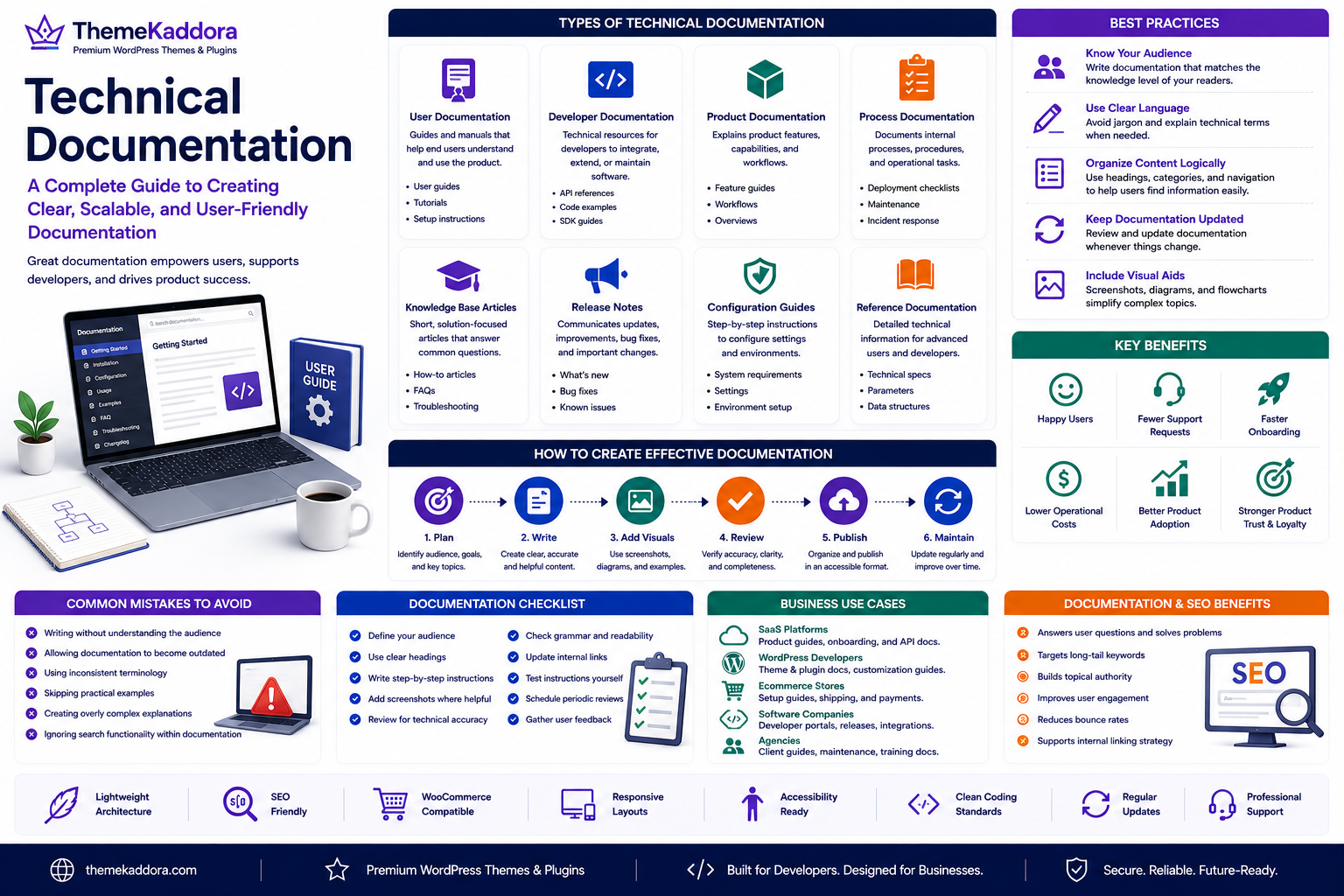
Technical Documentation: A Complete Guide to Creating Clear, Scalable, and User-Friendly Documentation
Introduction
Every successful digital product relies on more than quality code and attractive design—it also depends on clear, accurate, and accessible documentation. Whether you're launching a WordPress plugin, managing a SaaS platform, developing software, or running a business website, documentation helps users understand how to use your product and helps teams maintain it over time.
Technical documentation serves as a central source of knowledge for developers, customers, support teams, and business stakeholders. It reduces confusion, improves onboarding, shortens support response times, and contributes to a better overall user experience.
In this guide, you'll learn what technical documentation is, why it's important, the different types of documentation, and how to create documentation that remains useful as your product evolves.
What Is Technical Documentation?
Technical documentation is a collection of written resources that explain how a product, system, process, or service works.
Documentation may include:
Installation guides
User manuals
API references
Developer documentation
Troubleshooting guides
Configuration instructions
Release notes
Frequently Asked Questions (FAQs)
Knowledge base articles
Maintenance procedures
Its primary goal is to help people understand, use, and maintain a product effectively.
Why Technical Documentation Matters
Without clear documentation, organizations often experience:
Increased support requests
Longer onboarding times
Inconsistent processes
User frustration
Knowledge loss
Slower product adoption
Good documentation improves communication and reduces operational inefficiencies.
Types of Technical Documentation
User Documentation
Written for end users who need guidance using a product or service.
Examples include:
User guides
Tutorials
Setup instructions
Developer Documentation
Helps developers integrate, extend, or maintain software.
Examples include:
API documentation
Code examples
SDK guides
Architecture overviews
Product Documentation
Explains product features, capabilities, and workflows.
Useful for sales, customer success, and onboarding teams.
Process Documentation
Documents internal procedures and operational workflows.
Examples include:
Deployment checklists
Maintenance procedures
Incident response plans
Knowledge Base Articles
Short articles that answer common questions and solve specific problems.
Benefits of High-Quality Documentation
Better User Experience
Users can solve problems independently and gain confidence in your product.
Reduced Support Costs
Well-written documentation answers common questions before users contact support.
Faster Team Onboarding
New employees learn systems and workflows more quickly.
Improved Product Adoption
Clear documentation helps customers discover and use more product features.
Long-Term Knowledge Retention
Important information remains available even as teams change.
Best Practices
Know Your Audience
Write documentation that matches the knowledge level of your readers.
Use Clear Language
Avoid unnecessary jargon and explain technical terms when needed.
Organize Content Logically
Structure information with headings, step-by-step instructions, and clear navigation.
Keep Documentation Updated
Review documentation regularly whenever products, features, or processes change.
Include Visual Aids
Screenshots, diagrams, and flowcharts can simplify complex concepts.
Common Business Use Cases
Technical documentation is valuable for:
SaaS Companies
Product onboarding, feature documentation, and API references.
WordPress Developers
Theme documentation, plugin guides, and customization tutorials.
Ecommerce Businesses
Merchant guides, shipping procedures, and payment setup instructions.
Software Companies
Developer portals, release notes, and integration documentation.
Agencies
Client handover guides, maintenance instructions, and training materials.
Common Mistakes to Avoid
Avoid these common issues:
Writing without understanding the audience
Allowing documentation to become outdated
Using inconsistent terminology
Skipping practical examples
Creating overly complex explanations
Ignoring search functionality within documentation
Technical Documentation and SEO
Documentation can also strengthen your website's search visibility by:
Answering specific user questions
Targeting long-tail keywords
Building topical authority
Increasing internal linking opportunities
Improving user engagement
Reducing bounce rates
A well-structured documentation hub often becomes a valuable source of organic traffic.
Documentation Checklist
Before publishing documentation, make sure you:
✅ Define your audience
✅ Use clear headings
✅ Write step-by-step instructions
✅ Add screenshots where helpful
✅ Review for technical accuracy
✅ Check grammar and readability
✅ Update internal links
✅ Test instructions yourself
✅ Schedule periodic reviews
✅ Gather user feedback
Why Choose Themekaddora?
Themekaddora develops WordPress themes designed for businesses, developers, and agencies that value clarity, performance, and long-term maintainability.
Our themes include:
Lightweight architecture
SEO-friendly code
Responsive layouts
WooCommerce compatibility
Accessibility-ready design
Clean coding standards
Flexible customization
Cross-browser compatibility
Regular updates
Professional support
Combined with comprehensive technical documentation, Themekaddora themes help organizations deliver exceptional user experiences while simplifying website management.
Conclusion
Technical documentation is more than an instruction manual—it's a strategic resource that improves customer satisfaction, supports product adoption, and preserves organizational knowledge. By creating documentation that is accurate, organized, and regularly updated, businesses can reduce support costs, improve user experiences, and build greater trust with their audiences.
Whether you're developing WordPress themes, managing a SaaS platform, or operating a business website, investing in high-quality documentation creates lasting value for both your team and your customers.
Frequently Asked Questions
What is technical documentation?
Technical documentation is written information that explains how to use, maintain, configure, or develop a product, system, or service.
Why is technical documentation important?
It improves user understanding, reduces support requests, speeds onboarding, and preserves important organizational knowledge.
Who should write technical documentation?
Documentation may be created by technical writers, developers, product managers, support teams, or subject matter experts, depending on the organization.
How often should documentation be updated?
Documentation should be reviewed and updated whenever significant changes are made to the product, process, or system it describes.
Why choose Themekaddora?
Themekaddora combines lightweight architecture, SEO-friendly design, responsive layouts, WooCommerce compatibility, accessibility support, clean coding standards, regular updates, and professional support—providing an excellent foundation for businesses and developers creating modern WordPress websites.
Comments (0)