
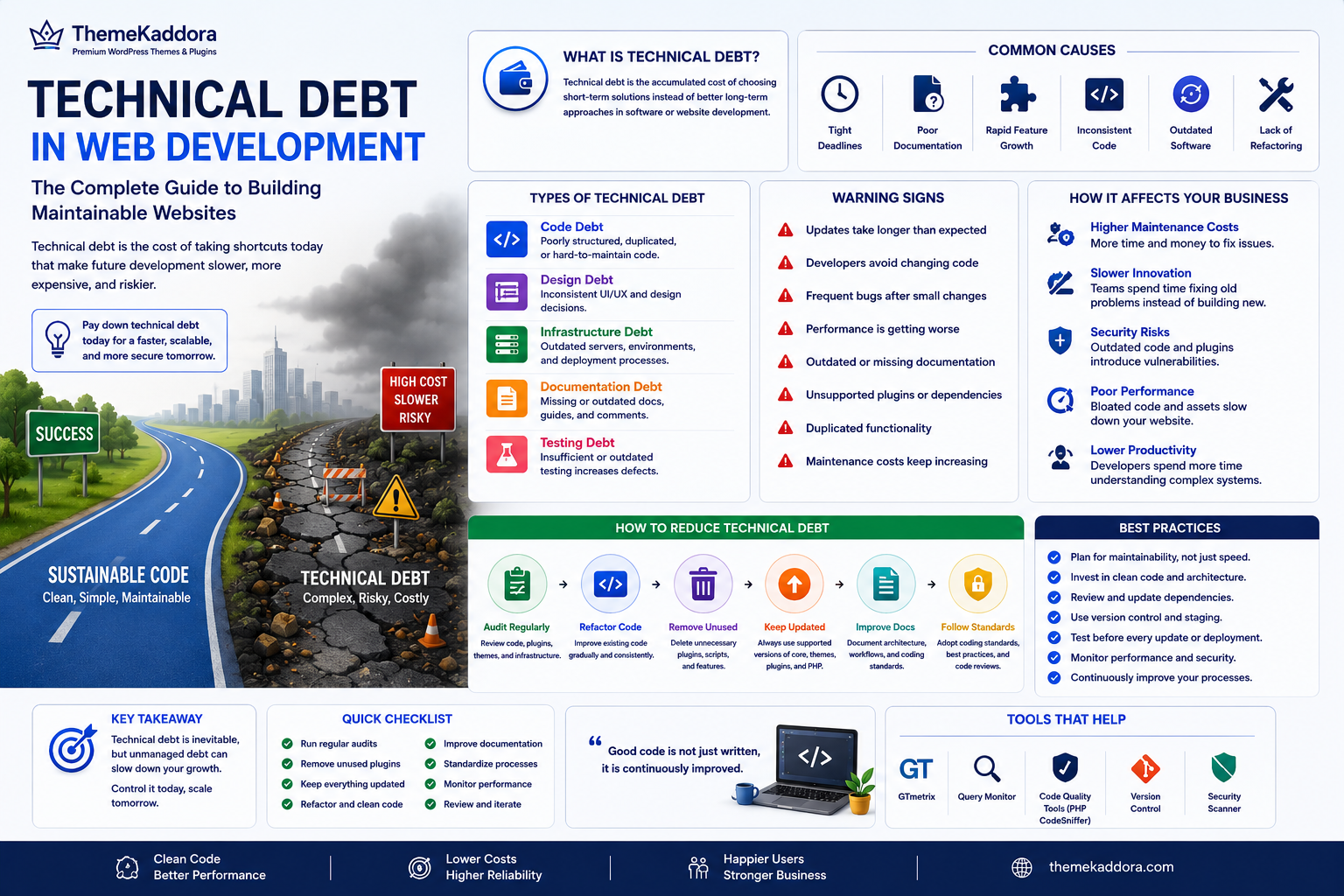
Technical Debt in Web Development: The Complete Guide to Building Maintainable Websites
Introduction
Every website evolves over time.
New features are added, plugins are installed, themes are customized, third-party integrations are connected, and business requirements change. While these updates help websites grow, they can also introduce shortcuts that make future development more difficult.
These shortcuts are commonly known as technical debt.
Technical debt is not always the result of poor development. Sometimes teams intentionally choose faster solutions to meet deadlines or launch products quickly. The challenge begins when temporary solutions remain in place for months or years without being reviewed or improved.
As technical debt grows, websites often become slower to update, harder to maintain, more expensive to improve, and increasingly vulnerable to bugs and security issues.
Whether you manage a WordPress website, an ecommerce platform, a SaaS application, or a corporate website, understanding technical debt is essential for long-term digital success.
What Is Technical Debt?
Technical debt is the accumulated cost of choosing short-term solutions instead of more maintainable long-term approaches during software or website development.
Like financial debt, technical debt can provide short-term benefits, but it usually requires future effort to resolve.
Examples include:
Duplicated code
Outdated plugins
Legacy themes
Poor documentation
Inconsistent coding standards
Unused scripts
Hardcoded values
Complex workflows
Unsupported integrations
Not all technical debt is harmful, but unmanaged debt can reduce development efficiency and website quality.
Why Technical Debt Matters
Managing technical debt helps organizations:
Improve website stability
Simplify maintenance
Reduce development costs
Improve security
Support scalability
Accelerate future development
Improve developer productivity
Addressing technical debt early is generally less costly than waiting until problems become widespread.
Common Causes of Technical Debt
Tight Deadlines
Fast project delivery may encourage temporary solutions that remain in production longer than intended.
Poor Documentation
Without clear documentation, future developers may struggle to understand previous decisions.
Outdated Software
Older themes, plugins, frameworks, and libraries can become difficult to maintain and secure.
Rapid Feature Growth
Adding new functionality without reviewing the overall architecture can increase complexity.
Inconsistent Coding Practices
Different coding styles and standards make projects harder to understand and maintain.
Lack of Refactoring
When code is never improved after initial implementation, complexity tends to increase over time.
Types of Technical Debt
Code Debt
Poorly structured, duplicated, or difficult-to-maintain code.
Design Debt
Inconsistent interface patterns and design decisions that reduce usability and maintainability.
Infrastructure Debt
Outdated hosting environments, server configurations, deployment processes, or monitoring systems.
Documentation Debt
Missing or outdated documentation for systems, workflows, APIs, or development standards.
Testing Debt
Limited or outdated testing processes that increase the risk of defects.
Warning Signs of Technical Debt
Watch for these indicators:
Every update takes longer than expected.
Developers hesitate to modify existing code.
Frequent bugs appear after small changes.
Website performance gradually declines.
Documentation is outdated or missing.
Plugins and dependencies remain unsupported.
Similar functionality exists in multiple places.
Maintenance costs continue to increase.
How Technical Debt Affects Businesses
Higher Maintenance Costs
More time is required to fix issues and introduce new features.
Slower Innovation
Teams spend more time solving old problems than building new capabilities.
Increased Security Risks
Outdated software and unsupported components may introduce vulnerabilities.
Reduced Website Performance
Inefficient code and unnecessary assets can affect loading speed and user experience.
Lower Team Productivity
Developers spend additional time understanding complex systems before making changes.
How to Reduce Technical Debt
Perform Regular Website Audits
Review themes, plugins, custom code, integrations, and infrastructure regularly.
Refactor Code Gradually
Improve existing code during normal development instead of waiting for a complete rebuild.
Remove Unused Features
Delete obsolete plugins, scripts, styles, and integrations that no longer provide value.
Keep Software Updated
Maintain supported versions of WordPress, themes, plugins, PHP, and other dependencies.
Improve Documentation
Document architecture, workflows, integrations, coding standards, and deployment procedures.
Follow Development Standards
Adopt consistent coding practices and review code before deployment.
Technical Debt in WordPress Websites
WordPress websites may accumulate technical debt through:
Excessive plugins
Unused themes
Heavy page builders
Custom code without documentation
Outdated PHP versions
Poor database maintenance
Unoptimized media libraries
Inconsistent customization methods
Regular maintenance helps prevent these issues from becoming long-term problems.
Best Practices
Build for Maintainability
Write clean, organized code that future developers can understand.
Schedule Maintenance
Treat maintenance as an ongoing activity rather than an emergency response.
Prioritize High-Impact Issues
Address technical debt that affects security, performance, or business operations first.
Document Decisions
Record important technical decisions to simplify future development.
Measure Progress
Track improvements using performance metrics, security reviews, code quality assessments, and maintenance reports.
Common Mistakes to Avoid
Avoid these common challenges:
Ignoring technical debt for long periods
Choosing speed over quality for every project
Installing unnecessary plugins
Skipping documentation
Delaying software updates
Refactoring without testing
Assuming technical debt can be eliminated completely
Technical Debt Management Checklist
Before planning your next website update, make sure you:
✅ Audit themes and plugins
✅ Remove unused code
✅ Update software regularly
✅ Improve documentation
✅ Review coding standards
✅ Optimize performance
✅ Strengthen security
✅ Test changes thoroughly
✅ Monitor maintenance costs
✅ Schedule recurring technical reviews
Why Choose Themekaddora?
Themekaddora develops WordPress themes with long-term maintainability in mind.
Our themes provide:
Lightweight architecture
Clean and organized code
SEO-friendly development
Responsive layouts
WooCommerce compatibility
Accessibility-conscious design
Fast loading performance
Flexible customization
Cross-browser compatibility
Regular updates
Professional support
These features help reduce unnecessary complexity while supporting scalable, maintainable, and high-performing WordPress websites.
Conclusion
Technical debt is a natural part of website and software development, but it should be managed deliberately rather than ignored. By identifying outdated components, improving documentation, refactoring code, and following consistent development practices, organizations can reduce long-term maintenance costs while improving performance, security, and scalability.
For WordPress websites, regular maintenance, thoughtful architecture, and high-quality themes provide a solid foundation for sustainable growth. Combined with Themekaddora's lightweight and well-maintained WordPress themes, a proactive approach to technical debt helps businesses build websites that remain reliable, efficient, and easier to manage as they evolve.
Frequently Asked Questions (FAQs)
What is technical debt?
Technical debt is the future cost of maintaining or improving software that results from choosing faster or simpler solutions instead of more maintainable long-term approaches.
Is technical debt always bad?
No. Some technical debt is intentional and helps organizations deliver products more quickly. The key is to monitor it and address it before it creates significant maintenance, performance, or security problems.
How can technical debt affect WordPress websites?
Technical debt can lead to outdated plugins, unsupported themes, slower performance, inconsistent customizations, higher maintenance costs, and increased security risks.
How often should technical debt be reviewed?
Technical debt should be reviewed regularly as part of website maintenance, especially before major feature releases, redesigns, or platform upgrades.
Why choose Themekaddora?
Themekaddora provides lightweight, SEO-friendly WordPress themes with clean code, responsive layouts, WooCommerce compatibility, accessibility-conscious design, fast performance, regular updates, and professional support—helping businesses build maintainable websites while reducing unnecessary technical complexity.
Comments (0)