
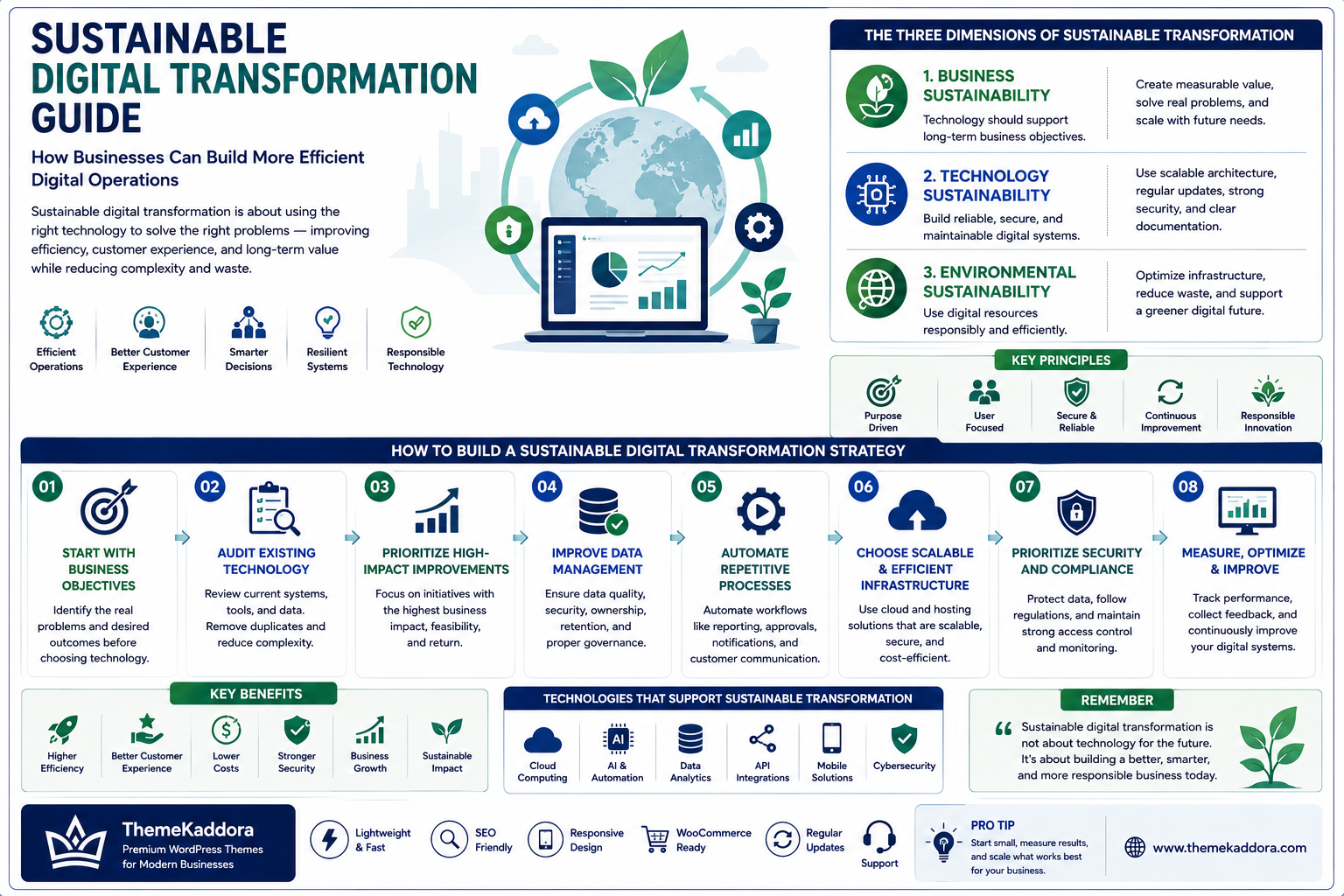
Sustainable Digital Transformation Guide: How Businesses Can Build More Efficient Digital Operations
Introduction
Digital transformation has become an important part of modern business strategy. Organizations are adopting cloud platforms, automation, artificial intelligence, analytics, digital customer experiences, and connected systems to improve how they operate.
But digital transformation is not simply about adopting more technology.
A business can add dozens of tools and still become slower, more complicated, expensive, and difficult to maintain.
Sustainable digital transformation takes a different approach. It focuses on using technology strategically to improve efficiency, resilience, customer experience, and long-term business value while reducing unnecessary complexity and waste.
For businesses building websites, digital products, and technology-driven operations, sustainability should be considered throughout the entire transformation journey.
What Is Sustainable Digital Transformation?
Sustainable digital transformation is the process of modernizing business operations through technology while considering long-term efficiency, maintainability, resilience, and responsible resource use.
It combines traditional digital transformation with a broader focus on:
Operational efficiency
Technology longevity
Resource optimization
Responsible innovation
Digital accessibility
Data governance
Security
Sustainable infrastructure
The objective is not to use technology simply because it is available.
The objective is to use the right technology for the right business problem.
Why Sustainable Transformation Matters
Businesses often begin transformation projects to improve:
Productivity
Customer experience
Operational efficiency
Business intelligence
Automation
Scalability
However, poorly planned transformation can create new problems.
Organizations may accumulate:
Unused software
Duplicate systems
Unnecessary data
Complex integrations
Technical debt
Expensive infrastructure
Difficult maintenance processes
Sustainable transformation helps prevent these problems through deliberate planning.
The Three Dimensions of Sustainable Transformation
1. Business Sustainability
Technology should support long-term business objectives.
Before adopting a new platform, ask:
What problem does it solve?
What business outcome will it improve?
Can the organization maintain it?
Does it scale with future requirements?
Technology investments should create measurable value.
2. Technology Sustainability
Digital systems should be designed for long-term reliability.
Important considerations include:
Maintainable architecture
Scalable infrastructure
Secure systems
Reliable backups
Documentation
Regular updates
Interoperability
A system that becomes impossible to maintain is not truly sustainable.
3. Environmental Sustainability
Digital infrastructure consumes physical resources and energy.
Businesses can consider:
Efficient hosting
Lightweight websites
Optimized media
Efficient cloud usage
Reduced unnecessary data storage
Responsible hardware lifecycle management
Environmental considerations should complement—not replace—business and technical requirements.
How to Build a Sustainable Transformation Strategy
Start With Business Objectives
Avoid starting with technology.
Begin by identifying the business problems that need to be solved.
For example:
Slow internal workflows
Poor customer support
Manual reporting
Fragmented data
Inefficient websites
Difficult content management
Once the problem is clear, evaluate technology solutions.
Audit Existing Technology
Before introducing new systems, review what already exists.
Identify:
Software platforms
APIs
Databases
Cloud services
Analytics tools
Automation systems
Remove duplication where possible.
A simpler technology ecosystem is often easier to operate.
Prioritize High-Impact Improvements
Not every process needs immediate transformation.
Prioritize projects based on:
Business impact
Customer impact
Cost
Complexity
Risk
Expected return
This prevents organizations from spreading resources across too many initiatives.
Improve Data Management
Digital transformation creates large volumes of information.
Sustainable data practices include:
Removing unnecessary duplicates
Establishing retention policies
Protecting sensitive information
Improving data quality
Documenting data ownership
Reviewing unused storage
Better data governance improves both efficiency and decision-making.
Automate Repetitive Processes
Automation can reduce unnecessary manual work.
Potential opportunities include:
Report generation
Customer notifications
Data synchronization
Invoice processing
Content workflows
Internal approvals
Customer onboarding
Automation should simplify operations rather than introduce unnecessary complexity.
Build Modular Systems
Modular architecture allows organizations to replace or improve individual components without rebuilding the entire system.
Benefits include:
Easier maintenance
Flexible integrations
Faster upgrades
Lower technical risk
Better scalability
Modularity supports long-term technology resilience.
Measure Digital Efficiency
Transformation should be measurable.
Track indicators such as:
Operational costs
Processing time
Website performance
System availability
Customer satisfaction
Automation rates
Infrastructure usage
Measurement makes it easier to determine whether transformation is producing meaningful results.
Sustainable Digital Transformation for Websites
Business websites are an important part of digital operations.
Businesses can improve website sustainability by:
Choosing efficient hosting
Using lightweight themes
Optimizing images
Reducing unnecessary scripts
Limiting plugin bloat
Implementing caching
Maintaining accessible design
Removing outdated content
Monitoring performance
These practices can improve both efficiency and user experience.
Common Mistakes
Avoid:
Adopting technology without a clear objective
Replacing systems unnecessarily
Creating duplicate data
Ignoring employees during transformation
Neglecting security
Measuring only short-term results
Adding excessive software
Forgetting long-term maintenance
Digital transformation should simplify the organization rather than make it more complicated.
Best Practices
Start with business problems.
Audit existing systems.
Build a clear technology roadmap.
Prioritize high-impact projects.
Use automation strategically.
Maintain strong governance.
Measure results.
Train employees.
Review technology regularly.
Sustainable transformation is a continuous process.
Sustainable Transformation Across Different Businesses
Small Businesses
Focus on simple tools that reduce administrative work, improve customer communication, and support business growth without creating unnecessary technology costs.
Ecommerce Businesses
Optimize inventory, order processing, customer data, fulfillment, marketing automation, and website performance.
SaaS Companies
Build scalable infrastructure, efficient development processes, responsible data practices, and maintainable product architectures.
Enterprise Organizations
Create governance frameworks that coordinate cloud infrastructure, data, applications, security, automation, and digital customer experiences across departments.
WordPress Websites
WordPress businesses can support sustainable transformation through lightweight themes, optimized hosting, carefully selected plugins, automation integrations, efficient content management, performance monitoring, and regular technical audits.
Sustainable Digital Transformation Checklist
Before starting a transformation project, ask:
✅ What business problem are we solving?
✅ Can an existing system solve it?
✅ Is the new technology scalable?
✅ Is it secure?
✅ Is it maintainable?
✅ Can employees use it effectively?
✅ Does it reduce unnecessary work?
✅ Can its impact be measured?
✅ Does it integrate with existing systems?
✅ What will maintenance require long term?
Why Choose Themekaddora?
A sustainable digital strategy begins with a website foundation that is efficient, flexible, and maintainable.
Themekaddora WordPress themes provide:
Lightweight architecture
Fast loading performance
SEO-friendly code
Responsive layouts
WooCommerce compatibility
Flexible customization
Accessibility-conscious design
Clean HTML5 and CSS3 standards
Cross-browser compatibility
Regular updates
Professional support
These features help businesses create websites that can become a reliable part of a broader digital transformation strategy without unnecessary technical overhead.
Conclusion
Sustainable digital transformation is about creating long-term value rather than simply adopting new technology.
Businesses can build more resilient digital operations by simplifying technology ecosystems, improving data management, automating repetitive work, optimizing infrastructure, and planning for long-term maintainability.
The most successful transformation strategies are not necessarily the ones with the most technology.
They are the ones that use technology thoughtfully, efficiently, and purposefully.
For businesses building their digital future, sustainability should be part of the transformation strategy from the beginning.
Frequently Asked Questions (FAQs)
What is sustainable digital transformation?
Sustainable digital transformation is the process of modernizing business operations with technology while focusing on efficiency, resilience, maintainability, responsible resource use, and long-term value.
Why is sustainable digital transformation important?
It helps businesses modernize without creating unnecessary technology complexity, excessive costs, technical debt, or inefficient digital operations.
How can businesses make digital transformation more sustainable?
Businesses can audit existing systems, remove duplication, automate repetitive work, improve data governance, optimize infrastructure, and select maintainable technologies.
Is website optimization part of sustainable digital transformation?
Yes. Website performance, efficient hosting, optimized media, accessibility, content governance, and responsible technology choices can all contribute to a more sustainable digital operation.
Why choose Themekaddora?
Themekaddora provides lightweight, SEO-friendly WordPress themes with responsive layouts, WooCommerce compatibility, fast performance, accessibility-conscious design, flexible customization, regular updates, and professional support—helping businesses build efficient websites that support long-term digital transformation.
Comments (0)