
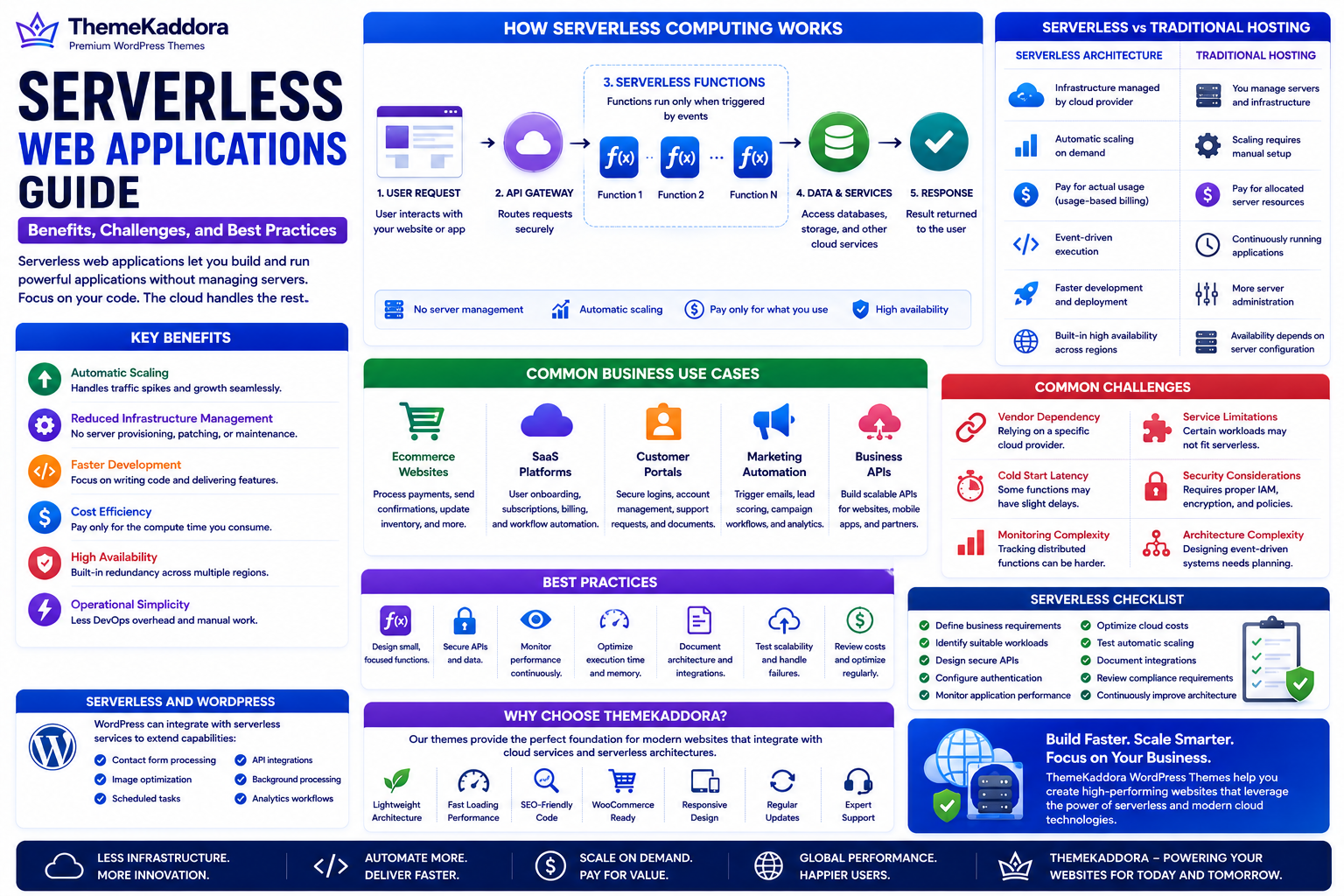
Serverless Web Applications Guide: Benefits, Challenges, and Best Practices
Introduction
Modern businesses expect their websites and web applications to remain fast, reliable, and scalable even as traffic fluctuates throughout the day. Managing servers, operating systems, security updates, and infrastructure capacity can consume significant time and resources.
Cloud computing introduced new ways to simplify infrastructure management, and one of the most significant developments is serverless computing.
Despite its name, serverless does not mean servers no longer exist. Instead, the cloud provider manages the underlying infrastructure while developers focus on building applications and delivering business value.
For startups, SaaS companies, ecommerce businesses, and enterprise organizations, serverless architecture can reduce operational complexity while supporting modern, API-driven applications.
What Are Serverless Web Applications?
Serverless web applications are applications built using cloud services where infrastructure management is handled by the cloud provider.
Developers deploy application code without managing:
Physical servers
Virtual machines
Operating systems
Infrastructure scaling
Capacity planning
The cloud platform automatically allocates resources as needed.
How Serverless Computing Works
A typical serverless architecture includes:
Frontend application
APIs
Serverless functions
Cloud storage
Databases
Authentication services
Monitoring and logging
Applications execute code only when triggered by specific events, such as a user submitting a form or making an API request.
Why Businesses Choose Serverless Architecture
Organizations adopt serverless computing to:
Reduce infrastructure management
Improve scalability
Accelerate application development
Lower operational costs
Support API-first development
Enable event-driven systems
Improve deployment flexibility
Businesses can spend more time building products and less time maintaining infrastructure.
Key Benefits of Serverless Web Applications
Automatic Scaling
Resources automatically increase or decrease based on application demand without manual intervention.
Reduced Infrastructure Management
Cloud providers manage server maintenance, operating system updates, and infrastructure availability.
Faster Development
Development teams focus on application features instead of server administration.
Cost Efficiency
Many serverless platforms charge only for the computing resources actually used, making them attractive for applications with variable workloads.
High Availability
Serverless platforms are designed to support reliable and resilient cloud services across multiple regions.
Faster Deployment
Applications can often be deployed more quickly because infrastructure provisioning is largely automated.
Common Business Use Cases
Ecommerce Websites
Process payments, generate invoices, send order confirmations, and automate customer notifications.
SaaS Platforms
Handle user authentication, subscription management, API processing, and workflow automation.
Customer Portals
Manage secure logins, document processing, support requests, and account management.
Marketing Automation
Trigger emails, lead scoring, analytics, and campaign workflows based on customer actions.
Business APIs
Power lightweight APIs that integrate websites, mobile apps, and third-party business systems.
Serverless vs Traditional Hosting
Serverless Architecture
Traditional Hosting
Infrastructure managed by cloud provider
Infrastructure managed by organization or hosting provider
Automatic scaling
Scaling often requires manual configuration
Pay for usage
Often pay for allocated server capacity
Minimal server management
Ongoing server administration
Event-driven execution
Continuously running applications
Both approaches remain valuable depending on business requirements.
Common Challenges
Organizations should also consider:
Vendor dependency
Cold-start latency for some workloads
Service limitations
Monitoring distributed functions
Application architecture complexity
Security configuration
Understanding these trade-offs helps organizations select the right architecture.
Best Practices
Design small, focused functions.
Secure APIs and authentication.
Monitor application performance.
Optimize function execution.
Document architecture.
Test scalability.
Continuously review cloud costs.
Serverless Applications and WordPress
While traditional https://themekaddora.com/categories/wordpress generally run on managed hosting environments, businesses can integrate serverless services for specific workloads such as:
Contact form processing
Image optimization
Scheduled tasks
API integrations
Background processing
Marketing automation
Analytics workflows
This hybrid approach combines the strengths of WordPress with modern cloud services.
Serverless Checklist
Before adopting serverless architecture, make sure you:
✅ Define business requirements
✅ Identify suitable workloads
✅ Design secure APIs
✅ Configure authentication
✅ Monitor application performance
✅ Optimize cloud costs
✅ Test automatic scaling
✅ Document integrations
✅ Review compliance requirements
✅ Continuously improve architecture
Why Choose Themekaddora?
Modern business websites increasingly integrate with cloud services and API-driven platforms.
Themekaddora WordPress themes provide:
Lightweight architecture
Fast loading performance
SEO-friendly code
Responsive layouts
WooCommerce compatibility
Flexible customization
Accessibility-conscious design
Clean HTML5 and CSS3 standards
Cross-browser compatibility
Regular updates
Professional support
These features help businesses build WordPress websites that integrate efficiently with serverless services, cloud platforms, APIs, and modern digital ecosystems.
Conclusion
Serverless web applications allow businesses to build scalable, flexible, and cost-efficient digital solutions without managing underlying server infrastructure. By combining automatic scaling, event-driven execution, and cloud-managed services, organizations can accelerate innovation while reducing operational complexity.
Although serverless computing is not the ideal solution for every workload, it has become an important part of modern web architecture and digital transformation strategies.
Frequently Asked Questions (FAQs)
What is a serverless web application?
A serverless web application uses cloud-managed infrastructure, allowing developers to deploy application code without managing servers directly.
Does serverless mean there are no servers?
No. Servers still exist, but the cloud provider manages them instead of the application owner.
What are the benefits of serverless computing?
Benefits include automatic scaling, reduced infrastructure management, faster development, cost efficiency for many workloads, and improved deployment flexibility.
Can WordPress use serverless services?
Yes. WordPress websites can integrate serverless functions for APIs, background tasks, automation, media processing, and other specialized workloads.
Why choose Themekaddora?
Themekaddora provides lightweight, SEO-friendly WordPress themes with responsive layouts, WooCommerce compatibility, fast performance, accessibility-conscious design, regular updates, and professional support—helping businesses build WordPress websites that integrate seamlessly with cloud services, APIs, and modern serverless architectures.
Comments (0)