
Semantic Search Explained: How AI Understands Meaning Instead of Just Keywords
Introduction
Search technology has evolved dramatically over the past two decades. Early search engines relied almost entirely on matching exact words or phrases typed by users. While effective for simple queries, traditional keyword-based search often struggles to understand intent, context, synonyms, or natural language.
Today, Artificial Intelligence has introduced a smarter approach called Semantic Search.
Semantic Search enables computers to understand the meaning behind a search query rather than simply matching individual keywords. Instead of looking only for identical words, AI analyzes context, relationships, intent, and semantic similarity to retrieve the most relevant information.
This technology powers modern AI assistants, enterprise knowledge systems, Retrieval-Augmented Generation (RAG), recommendation engines, document search, eCommerce platforms, and intelligent search experiences used by millions of people every day.
What Is Semantic Search?
Semantic Search is an AI-powered search technique that retrieves information based on meaning rather than exact keyword matching.
Instead of asking:
"Does this document contain these exact words?"
Semantic Search asks:
"Does this document answer the user's question?"
To achieve this, Semantic Search analyzes:
Meaning
User intent
Context
Synonyms
Relationships
Concepts
Natural language
Similarity
This allows AI to return more accurate and relevant results.
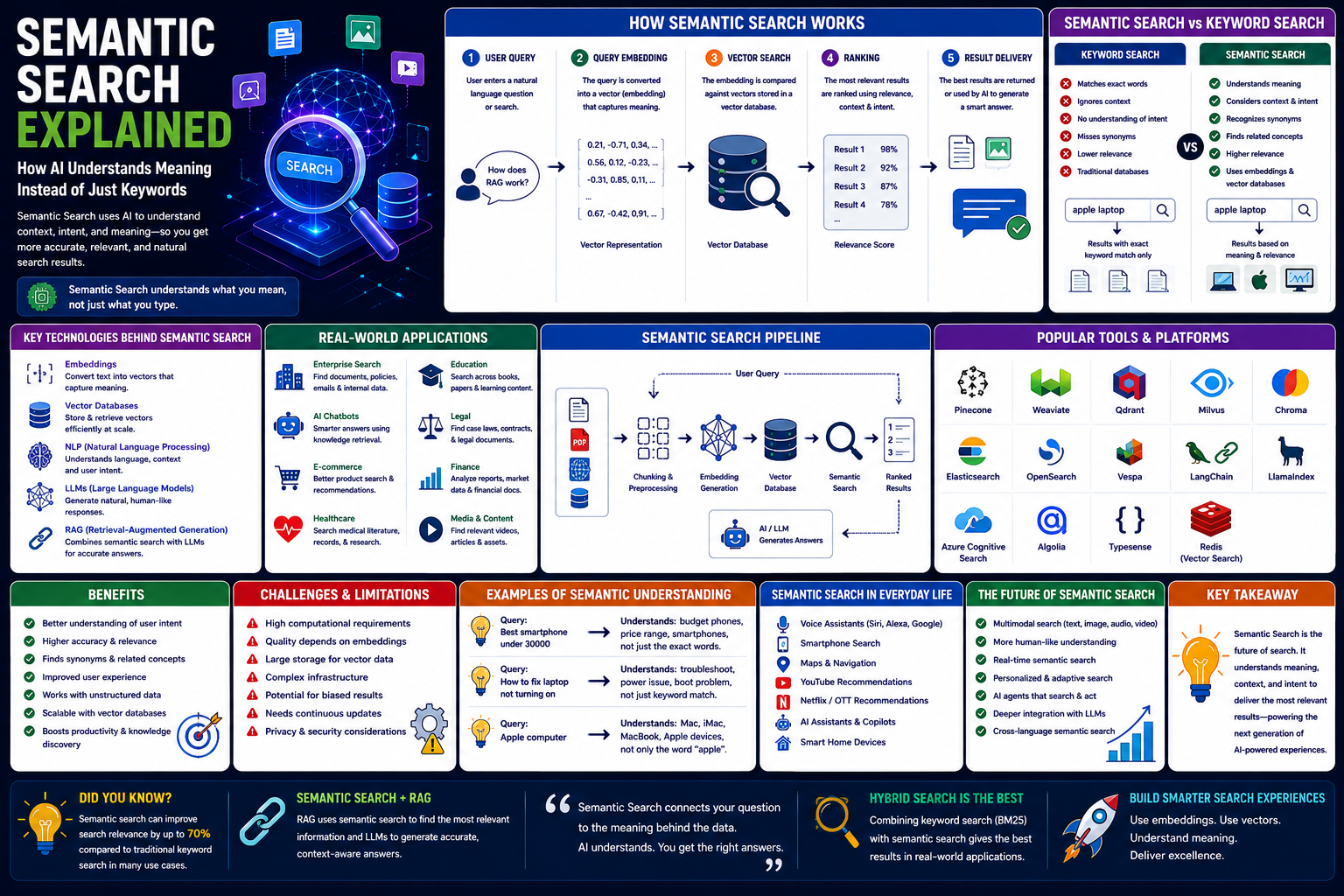
How Semantic Search Works
Modern semantic search systems follow several important steps.
1. User Query
A user enters a search request.
Examples include:
Best AI chatbot
How does RAG work?
Laptop for video editing
Healthy breakfast recipes
2. Query Embedding
The search query is converted into a numerical embedding that captures its meaning.
3. Vector Search
The embedding is compared against millions of stored embeddings inside a vector database.
Instead of matching keywords, AI searches for semantically similar content.
4. Ranking
Retrieved results are ranked using:
Relevance
Context
User intent
Personalization
Confidence
5. Result Delivery
The system presents the most relevant documents, products, answers, or recommendations.
Many AI assistants use this information to generate natural-language responses.
Semantic Search vs Keyword Search
Keyword Search
Semantic Search
Exact word matching
Meaning-based matching
Limited understanding
Context-aware
Ignores synonyms
Understands related concepts
Lower relevance
Higher relevance
Traditional databases
Embeddings + Vector Databases
Semantic Search dramatically improves the quality of search experiences.
Core Technologies Behind Semantic Search
Several AI technologies work together.
Embeddings
Convert meaning into vectors.
Vector Databases
Store and retrieve embeddings efficiently.
Large Language Models (LLMs)
Interpret questions and generate natural responses.
Retrieval-Augmented Generation (RAG)
Combines semantic retrieval with AI-generated answers.
Natural Language Processing (NLP)
Helps AI understand language and user intent.
Popular Semantic Search Technologies
Common technologies include:
Vector Databases
Embedding Models
Dense Retrieval
Hybrid Search
BM25 + Semantic Search
ANN (Approximate Nearest Neighbor) Search
Transformer Models
Knowledge Graphs
Real-World Applications
Semantic Search powers numerous AI systems.
Enterprise Search
Internal documents
Company policies
Knowledge management
AI Chatbots
Customer support
Technical documentation
FAQ systems
Healthcare
Medical literature retrieval
Clinical decision support
E-commerce
Product recommendations
Visual search
Personalized shopping
Education
Research assistance
Digital libraries
Learning platforms
Legal Services
Contract search
Case law retrieval
Compliance research
Benefits of Semantic Search
Semantic Search offers significant advantages.
Benefits include:
Better search accuracy
Improved user experience
Context-aware retrieval
Reduced keyword dependency
Higher personalization
Faster information discovery
Better AI responses
Stronger enterprise knowledge management
Organizations increasingly adopt Semantic Search to improve productivity and customer satisfaction.
Challenges and Limitations
Despite its strengths, Semantic Search has challenges.
These include:
High computational costs
Complex infrastructure
Embedding quality dependency
Data privacy concerns
Large storage requirements
Query latency
Continuous model updates
Ranking optimization
Careful implementation helps maximize performance.
Semantic Search in Everyday Life
Many everyday applications already use Semantic Search.
Examples include:
AI assistants
Search engines
Product search
Streaming recommendations
Enterprise AI
Voice search
Digital libraries
Customer support systems
Semantic Search has become a core capability of modern AI-powered platforms.
Future of Semantic Search
Future developments include:
Multimodal search
Personalized AI search
Real-time enterprise retrieval
Cross-language search
Hybrid search systems
AI reasoning over search results
Voice-first search
Autonomous AI knowledge assistants
Semantic Search will continue shaping how humans discover information.
Common Misconceptions
Several myths surround Semantic Search.
Common misconceptions include:
Semantic Search replaces traditional search completely.
It only works with text.
Every AI chatbot uses Semantic Search.
Semantic Search never returns irrelevant results.
Only large companies can implement Semantic Search.
In reality, Semantic Search often works alongside traditional search to provide better results.
Final Thoughts
Semantic Search has transformed how humans interact with information by enabling AI systems to understand meaning rather than simply matching keywords. By combining embeddings, vector databases, natural language processing, and intelligent retrieval techniques, Semantic Search delivers faster, smarter, and more relevant results across countless applications.
As AI-powered search continues to evolve, Semantic Search will remain one of the foundational technologies behind intelligent assistants, enterprise knowledge platforms, recommendation engines, and the next generation of information retrieval systems.
Frequently Asked Questions
What is Semantic Search?
Semantic Search is an AI-powered search method that retrieves information based on meaning and user intent instead of exact keyword matching.
Why is Semantic Search important?
It improves search relevance, understands natural language, and enables smarter AI applications.
Does Semantic Search use embeddings?
Yes. Most modern Semantic Search systems rely on embeddings to represent meaning.
Is Semantic Search used in RAG?
Yes. Retrieval-Augmented Generation (RAG) uses Semantic Search to retrieve relevant documents before generating responses.
Where is Semantic Search used?
Search engines, AI assistants, enterprise knowledge systems, healthcare, eCommerce, legal research, education, and recommendation systems.
Comments (0)