
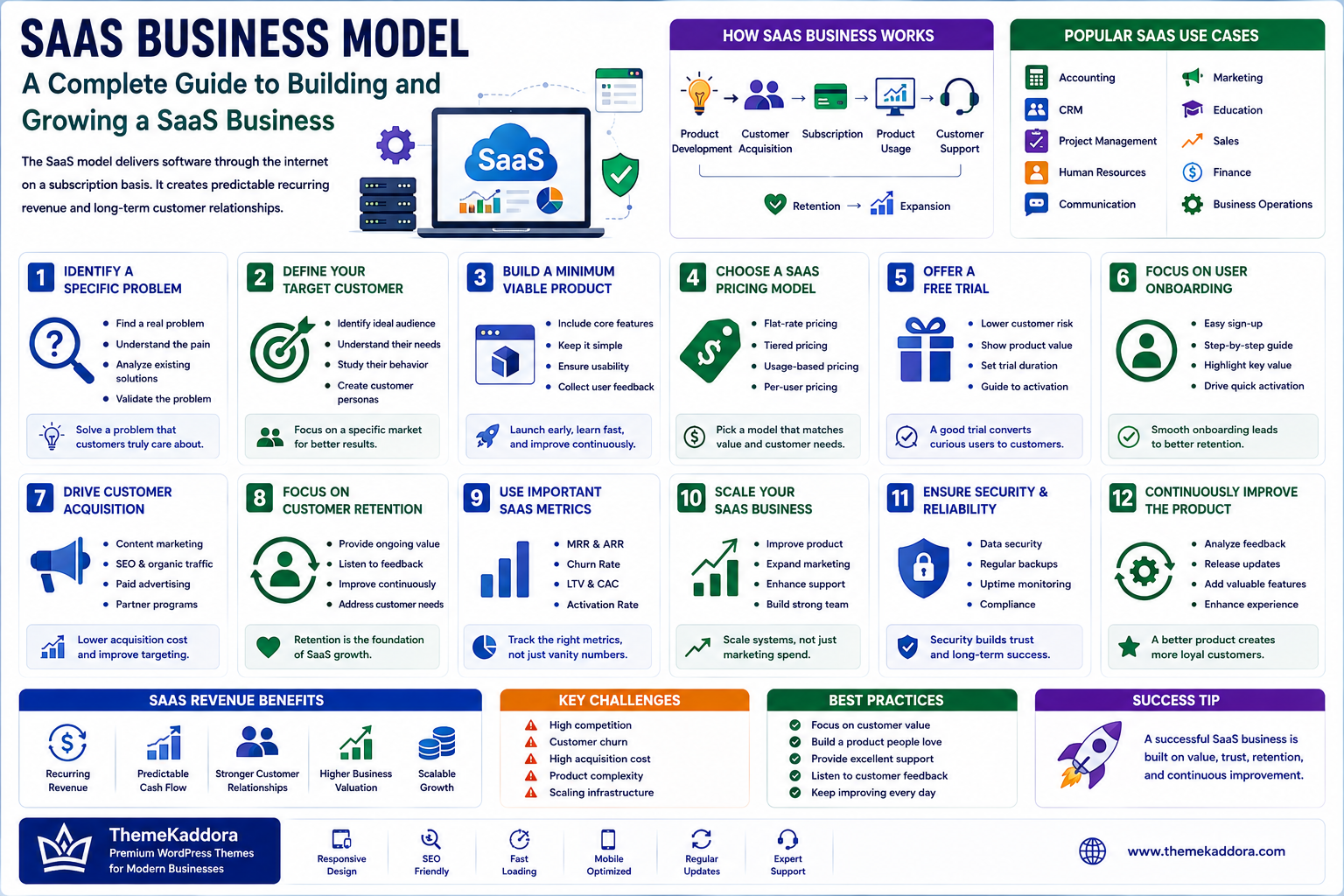
SaaS Business Model: A Complete Guide to Building and Growing a SaaS Business
Introduction
Software has traditionally been sold as a product that customers purchase, install, and maintain. The Software as a Service (SaaS) model changed this approach by allowing customers to access software through the internet, usually through a recurring subscription.
Today, SaaS businesses serve almost every industry.
Companies use SaaS platforms for:
Accounting
Customer relationship management(CRM)
Project management
Human resources
Communication
Marketing
Sales
Finance
Business operations
The SaaS model can provide predictable recurring revenue and long-term customer relationships. However, building a successful SaaS business requires much more than developing software.
Businesses must understand their target customers, pricing, acquisition costs, retention, product value, customer support, and scalability.
This guide explains how the SaaS business model works, how SaaS companies generate revenue, which metrics matter, and what strategies can support sustainable growth.
What Is a SaaS Business Model?
SaaS stands for Software as a Service.
Instead of purchasing software permanently, customers typically pay for access to an application through a subscription.
For example, a business might pay:
$29 per month → access to a business application
The SaaS provider manages the underlying software, infrastructure, updates, and maintenance.
Customers generally access the application through a web browser or dedicated application.
This creates a relationship where revenue can continue as long as customers continue using the service.
How Does a SaaS Business Work?
A typical SaaS business follows this process:
Product Development → Customer Acquisition → Subscription → Product Usage → Customer Support → Retention → Expansion
The goal is not simply to acquire customers.
The business must provide enough ongoing value that customers continue paying for the service.
This makes customer retention one of the most important parts of SaaS growth.
1. Identify a Specific Problem
Successful SaaS products usually solve a clear problem.
Instead of asking:
"What software should we build?"
Start with:
"What problem are customers repeatedly experiencing?"
For example:
Manual reporting takes too long.
Sales teams lose track of leads.
Businesses struggle to manage appointments.
Employees need better workflow management.
Customers receive slow support.
A clear problem provides a strong foundation for product development.
2. Define Your Target Customer
A SaaS product should have a clearly defined audience.
Your target market could be:
Small businesses
Startups
Enterprises
Freelancers
Agencies
Schools
Healthcare organizations
Retail businesses
Professional service providers
Understanding your ideal customer helps determine product features, pricing, marketing, and sales strategies.
3. Build a Minimum Viable Product
A Minimum Viable Product (MVP) is an initial version of a product containing the essential functionality required to solve the target problem.
The purpose is to validate the idea before investing heavily in development.
An MVP should focus on:
Core functionality
Usability
Reliability
Customer feedback
Avoid adding dozens of features before confirming that customers actually need the product.
4. Choose a SaaS Pricing Model
Pricing has a direct impact on revenue, customer acquisition, and profitability.
Common SaaS pricing models include:
Flat-Rate Pricing
Customers pay one fixed price for access to the product.
This is simple but may not work well when customers have significantly different requirements.
Tiered Pricing
Customers choose between different plans.
For example:
Starter
Professional
Business
Enterprise
Each tier provides different features, usage limits, or support levels.
Tiered pricing allows businesses to serve customers with different budgets and requirements.
Usage-Based Pricing
Customers pay according to usage.
Examples include:
Number of transactions
API requests
Storage
Messages
Processed documents
This model can align pricing with customer value but may make costs less predictable.
Per-User Pricing
Customers pay based on the number of users.
This model is common in business software.
However, businesses should ensure the pricing structure does not discourage customers from adding team members.
5. Offer a Free Trial
Free trials allow potential customers to experience the product before purchasing.
A trial can reduce uncertainty and demonstrate product value.
However, simply offering a trial is not enough.
The product should guide new users toward meaningful activation quickly.
6. Focus on User Onboarding
The first experience can determine whether a customer continues using a SaaS product.
Effective onboarding should help users:
Understand the product
Complete initial setup
Import required information
Discover important features
Achieve their first meaningful result
The shorter the path to value, the easier it can be to convert new users into paying customers.
7. Create Multiple Acquisition Channels
SaaS companies can acquire customers through several channels.
Examples include:
Search engine optimization
Content marketing
Social media
Paid advertising
Email marketing
Partnerships
Referrals
Direct sales
Product-led growth
Do not depend entirely on one acquisition channel.
A diversified acquisition strategy can reduce business risk.
8. Use Content Marketing
Content marketing can help SaaS businesses attract potential customers before they are ready to purchase.
Useful content includes:
Tutorials
Industry guides
Case studies
Comparisons
Templates
Research reports
Webinars
Product education
Good content should solve customer problems rather than simply promote the software.
9. Build a Product-Led Growth Strategy
Product-led growth uses the product itself as a major driver of acquisition, activation, and expansion.
Examples include:
Free plans
Free trials
Shareable outputs
Collaboration features
Referral mechanisms
Self-service onboarding
The goal is to let customers experience value before requiring a complex sales process.
10. Measure Customer Acquisition Cost
Customer Acquisition Cost (CAC) measures how much it costs to acquire a customer.
A simplified calculation is:
CAC = Total Sales and Marketing Costs ÷ Number of New Customers
For example, if a business spends $10,000 acquiring 100 customers:
CAC = $100
CAC should be evaluated alongside customer lifetime value and retention.
11. Track Monthly Recurring Revenue
Monthly Recurring Revenue (MRR) represents predictable subscription revenue generated each month.
For example:
100 customers × $50 monthly subscription =
$5,000 MRR
MRR helps SaaS businesses monitor recurring revenue growth.
12. Understand Annual Recurring Revenue
Annual Recurring Revenue (ARR) estimates recurring subscription revenue over a year.
A simplified calculation is:
ARR = MRR × 12
ARR is particularly useful for understanding the scale of recurring revenue.
13. Monitor Customer Churn
Customer churn measures the percentage of customers who stop using or paying for a service during a given period.
High churn can indicate problems with:
Product value
Pricing
Customer support
User experience
Product reliability
Competition
Reducing churn can have a significant impact on SaaS profitability.
14. Improve Customer Retention
Acquiring customers is only one part of the SaaS business.
Retention strategies can include:
Better onboarding
Customer education
Proactive support
Product improvements
Personalized communication
Usage monitoring
Customer success programs
Customers are more likely to stay when they consistently receive value from the product.
15. Increase Customer Lifetime Value
Customer Lifetime Value (LTV) estimates the revenue a business can generate from a customer throughout their relationship.
LTV can increase through:
Longer retention
Higher plans
Additional products
Add-ons
Usage expansion
Cross-selling
A healthy SaaS business generally needs customer lifetime value to justify customer acquisition costs.
16. Use Upselling and Expansion Revenue
Existing customers can become a major source of growth.
SaaS companies can offer:
Higher plans
Additional users
Advanced features
Increased storage
Premium support
Additional modules
Expansion revenue can increase revenue without requiring a completely new customer.
17. Prioritize Customer Support
Customer support directly affects customer satisfaction and retention.
Support can include:
Knowledge bases
Documentation
Email support
Live chat
Tutorials
Video guides
Community forums
AI-assisted support can help handle repetitive questions while human teams handle complex issues.
18. Build Reliable Infrastructure
SaaS customers expect software to be available when they need it.
Reliability should include:
Monitoring
Backups
Error tracking
Disaster recovery
Security controls
Performance monitoring
Downtime can damage customer trust and increase churn.
19. Protect Customer Data
SaaS platforms often store important customer information.
Businesses should implement appropriate:
Access controls
Authentication
Encryption
Backup systems
Logging
Security monitoring
Vulnerability management
Security requirements vary by industry and geography, so SaaS businesses should understand the obligations relevant to their customers.
20. Build a Scalable Architecture
A SaaS application should be designed with future growth in mind.
Important considerations include:
Database architecture
API design
Caching
Background processing
File storage
Monitoring
Horizontal scaling
Architecture decisions should reflect actual product requirements rather than adding unnecessary complexity from the beginning.
21. Listen to Customer Feedback
Customers can provide valuable information about what should be improved.
Collect feedback through:
Surveys
Support conversations
Interviews
Product analytics
Feature requests
Reviews
Do not implement every requested feature automatically.
Look for patterns across multiple customers and prioritize improvements that support the product strategy.
22. Build a SaaS Metrics Dashboard
Important SaaS metrics include:
MRR
ARR
CAC
LTV
Churn rate
Retention rate
Conversion rate
Activation rate
Trial-to-paid conversion
Average Revenue Per User
Expansion revenue
Monitoring these metrics helps founders understand whether the business is growing efficiently.
Common SaaS Business Mistakes
Building Too Many Features
More features do not automatically create more value.
Focus on solving important customer problems.
Ignoring Churn
Rapid customer acquisition cannot compensate indefinitely for poor retention.
Underpricing the Product
Pricing should reflect customer value and business costs.
Poor Onboarding
Customers who cannot understand the product quickly may never reach its value.
Ignoring Support
Poor support can damage customer trust and increase cancellations.
Depending on One Marketing Channel
Changes in advertising costs, algorithms, or search visibility can affect acquisition.
Scaling Too Early
Investing heavily before validating product-market fit can increase costs without improving growth.
SaaS Growth Strategy
A sustainable SaaS growth strategy can follow this sequence:
Problem → MVP → Validation → Customer Acquisition → Activation → Retention → Expansion → Scale
First, validate that the product solves a meaningful problem.
Then build repeatable acquisition and retention systems.
Only after the fundamentals work should the business aggressively increase spending and infrastructure.
SaaS Business Checklist
Before launching a SaaS product, evaluate:
Product
What problem does it solve?
Who needs it?
What is the core feature?
What makes it different?
Pricing
What pricing model will be used?
What is included in each plan?
Can customers upgrade?
Marketing
How will customers discover the product?
Which acquisition channels will be tested?
What content will attract the target audience?
Technology
Is the architecture scalable?
How will data be protected?
How will backups work?
How will performance be monitored?
Customer Success
How will users be onboarded?
How will support be provided?
How will feedback be collected?
Metrics
What is the target MRR?
What is the acceptable churn rate?
What is the acquisition cost?
How will retention be measured?
Why Choose ThemeKaddora?
At ThemeKaddora, we believe successful software products should be built around real customer problems and measurable business outcomes.
Modern SaaS businesses require more than software development.
They need:
Reliable technology
Strong user experiences
Scalable infrastructure
Effective marketing
Automation
Analytics
Customer-focused product development
A strong combination of technology and business strategy creates a better foundation for sustainable SaaS growth.
Conclusion
The SaaS business model has become one of the most important models for delivering modern software.
Its recurring revenue structure can create predictable income while allowing customers to access continuously updated software without managing traditional infrastructure.
However, successful SaaS companies do not grow simply because they use subscriptions.
They grow by:
Solving meaningful problems
Understanding their customers
Creating a valuable product
Providing excellent onboarding
Maintaining reliable infrastructure
Retaining customers
Measuring important metrics
Expanding customer value
The most important principle is simple:
Build software that customers continue to need.
When product value, customer experience, technology, pricing, and growth strategy work together, a SaaS business can build sustainable long-term growth.
Frequently Asked Questions
1. What is a SaaS business model?
A SaaS business model provides software through the internet, usually in exchange for recurring subscription payments.
2. How do SaaS companies make money?
SaaS companies commonly generate revenue through monthly or annual subscriptions, usage-based pricing, per-user plans, upgrades, and additional services.
3. What is MRR in SaaS?
MRR stands for Monthly Recurring Revenue and represents predictable subscription revenue generated each month.
4. What is SaaS churn?
SaaS churn measures the percentage of customers or recurring revenue lost during a specific period.
5. What is CAC?
Customer Acquisition Cost measures the average cost required to acquire a new customer.
6. What is LTV?
Customer Lifetime Value estimates the revenue a business can generate from a customer throughout their relationship with the company.
7. Should every SaaS product offer a free trial?
Not necessarily. A free trial can reduce purchase risk, but the right approach depends on the product, target market, pricing, and sales process.
8. How can SaaS businesses reduce churn?
Improve onboarding, product quality, customer support, communication, reliability, and ongoing customer value.
9. What is product-led growth?
Product-led growth uses the product experience itself as a major driver of customer acquisition, activation, retention, and expansion.
10. What is the most important SaaS metric?
There is no single metric that works for every SaaS business. MRR, ARR, CAC, LTV, churn, retention, and activation should be evaluated together.
Comments (0)