
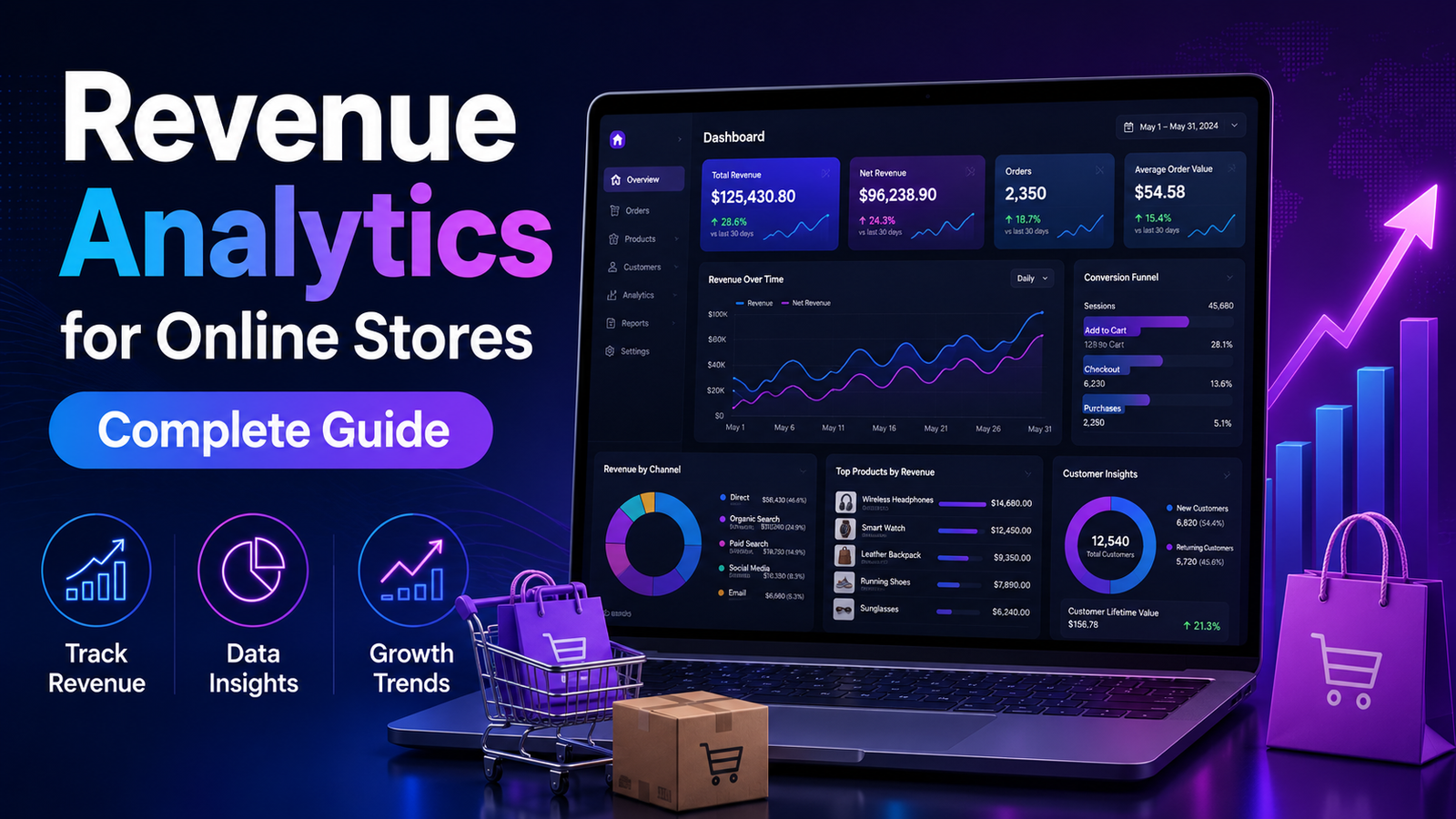
Revenue Analytics for Online Stores
Revenue is one of the most important indicators of an online store's performance. However, simply knowing your total sales isn't enough to build a successful business.
To grow consistently, you need to understand where your revenue comes from, which products generate the highest profits, how customers behave, and what factors influence your sales.
This is where revenue analytics becomes essential.
Instead of looking at revenue as a single number, revenue analytics helps you break it down into meaningful insights that support better business decisions.
In this guide, you'll learn what revenue analytics is, why it matters, which metrics to monitor, how AI improves revenue analysis, and how Kaddora AI Sales Analytics helps WooCommerce businesses track and increase revenue.
Quick Answer
What is revenue analytics?
Revenue analytics is the process of collecting, analyzing, and interpreting sales and financial data to understand where revenue comes from, identify growth opportunities, optimize pricing and marketing, and improve overall business profitability.
Why Revenue Analytics Matters
Many store owners check only monthly sales totals.
That approach answers "How much did we sell?" but not:
Why did revenue increase?
Which products drive profits?
Which customers spend the most?
Which marketing campaigns generate the highest ROI?
Which categories are underperforming?
Revenue analytics answers these questions with data instead of assumptions.
Benefits of Revenue Analytics
Better Decision-Making
Revenue analytics helps business owners make decisions based on measurable performance instead of intuition.
Identify High-Performing Products
Track:
Best-selling products
Highest revenue generators
Most profitable categories
Seasonal demand
This information helps prioritize inventory and promotions.
Improve Marketing ROI
Not every marketing campaign delivers equal results.
Revenue analytics helps compare performance across:
Organic Search
Paid Ads
Email Marketing
Social Media
Affiliate Marketing
Referral Traffic
This enables smarter budget allocation.
Understand Customer Value
Revenue isn't only about products.
Customer analytics reveals:
Average Order Value (AOV)
Customer Lifetime Value (CLV)
Repeat purchase behavior
High-value customers
These insights help increase long-term profitability.
Forecast Revenue
Historical trends can help estimate future performance.
Forecasting supports:
Inventory planning
Budget management
Staffing
Marketing campaigns
More accurate forecasts reduce uncertainty.
Essential Revenue Metrics
Every online store should monitor:
Total Revenue
The total income generated during a selected period.
Revenue Growth Rate
Measures how revenue changes over time.
Average Order Value (AOV)
Shows the average amount spent per purchase.
Customer Lifetime Value (CLV)
Estimates the long-term value of each customer.
Revenue by Product
Identifies products generating the highest sales.
Revenue by Category
Shows which categories contribute most to your business.
Repeat Customer Revenue
Measures how much revenue comes from returning customers.
Refund Impact
Tracks how refunds affect overall revenue.
Common Revenue Analytics Mistakes
Avoid these mistakes:
❌ Monitoring only total revenue
❌ Ignoring profitability
❌ Not reviewing customer trends
❌ Tracking too many unimportant metrics
❌ Failing to compare historical performance
❌ Delaying report reviews
❌ Making decisions without supporting data
Best Practices
Review Revenue Weekly
Regular reviews make it easier to identify opportunities and problems before they grow.
Compare Time Periods
Analyze week-over-week, month-over-month, and year-over-year performance to identify long-term trends.
Combine Revenue with Customer Data
Revenue alone rarely explains business performance.
Combining revenue metrics with customer insights provides a clearer understanding of growth.
Build a Central Dashboard
A unified dashboard allows you to monitor key metrics without switching between multiple reports.
Use AI for Predictive Insights
AI helps businesses move from reactive reporting to proactive planning.
AI can:
Predict revenue trends
Identify profitable customers
Detect unusual sales activity
Recommend growth opportunities
Forecast future demand
How AI Improves Revenue Analytics
Traditional reports explain what has already happened.
AI helps answer:
What is likely to happen next?
Which products need attention?
Which customers are likely to purchase again?
Where should marketing budgets be increased?
These insights help businesses respond faster and make better strategic decisions.
How Kaddora AI Sales Analytics Helps
Managing revenue across hundreds or thousands of orders becomes increasingly complex as your business grows.
Key Features
Real-time revenue tracking
AI-powered revenue insights
Sales trend analysis
Customer value analytics
Product profitability reports
Revenue forecasting
KPI monitoring
Automated dashboards
WooCommerce integration
Instead of manually analyzing spreadsheets, you gain actionable insights that help improve profitability and accelerate business growth.
Revenue Analytics Checklist
✅ Monitor Total Revenue
✅ Track Revenue Growth
✅ Review Product Performance
✅ Analyze Customer Lifetime Value
✅ Monitor Average Order Value
✅ Compare Historical Performance
✅ Forecast Future Revenue
✅ Review Weekly Reports
✅ Use AI-Powered Analytics
Frequently Asked Questions
What is revenue analytics?
Revenue analytics is the process of analyzing sales and financial data to understand business performance, identify growth opportunities, and improve profitability.
Which revenue metrics matter most?
Key metrics include total revenue, revenue growth, average order value, customer lifetime value, repeat customer revenue, and product performance.
How often should revenue reports be reviewed?
Weekly operational reviews and monthly strategic reviews help businesses monitor performance and make timely improvements.
Can AI improve revenue analytics?
Yes. AI detects trends, forecasts future sales, identifies high-value customers, and recommends actions that improve revenue growth.
Which WooCommerce tool is suitable for revenue analytics?
Businesses looking for AI-powered dashboards, automated reports, revenue forecasting, and customer insights can use Kaddora AI Sales Analytics to monitor and improve store performance.
Final Thoughts
Revenue analytics is about understanding the story behind your sales—not just the numbers themselves.
When you monitor the right metrics, compare performance over time, and use AI-powered insights, you can identify opportunities, improve profitability, and make confident business decisions.
Comments (0)