
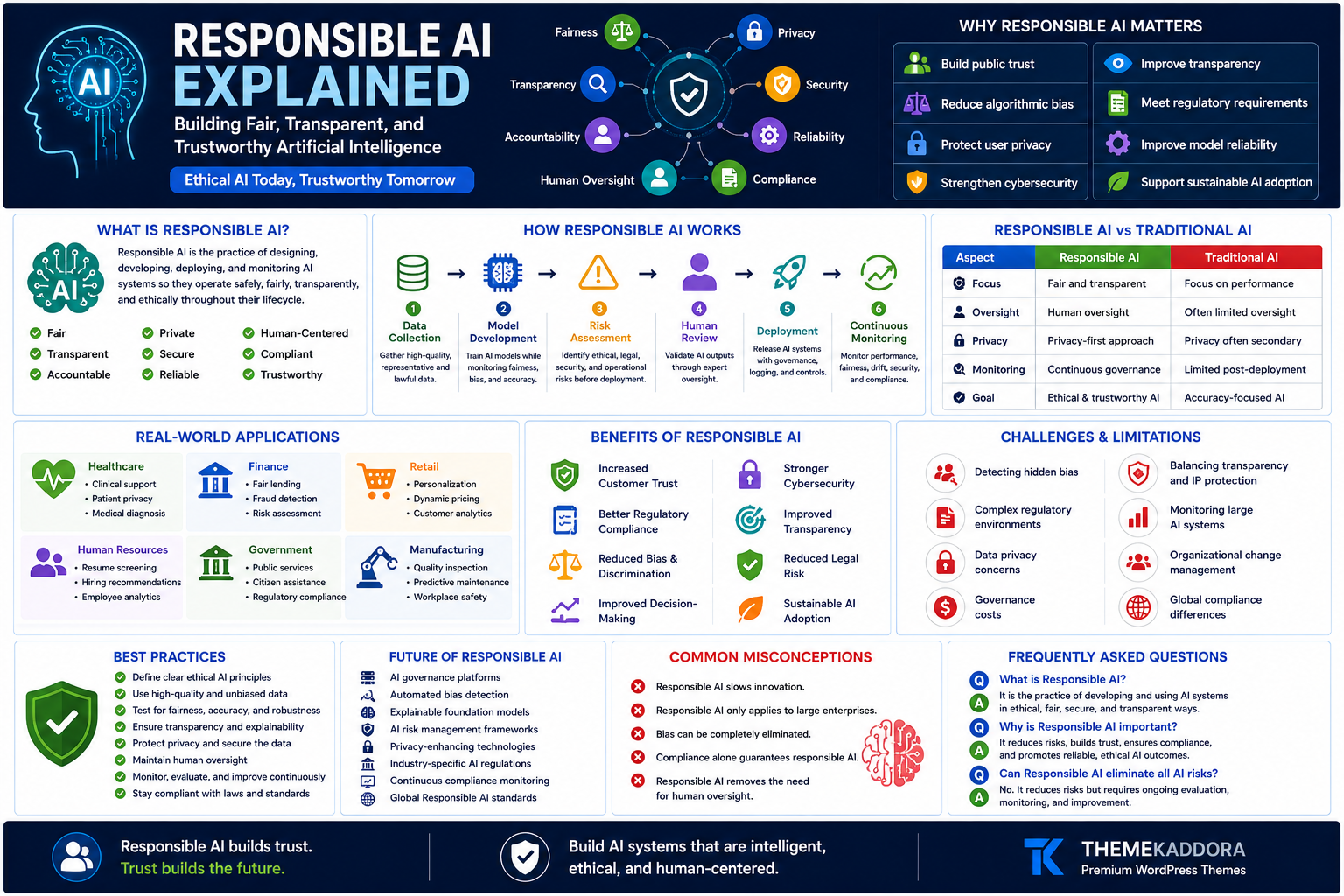
Responsible AI Explained: Building Fair, Transparent, and Trustworthy Artificial Intelligence
Introduction
Artificial Intelligence is transforming industries by automating tasks, improving decision-making, and creating personalized user experiences. As AI systems become more powerful, organizations also face increasing responsibility to ensure these systems are fair, transparent, secure, and aligned with human values.
Poorly designed AI systems can introduce bias, make unfair decisions, compromise privacy, or produce inaccurate results. These risks can affect individuals, businesses, and society.
Responsible AI is a framework for developing, deploying, and managing AI systems in ways that are ethical, trustworthy, transparent, and accountable. It combines technology, governance, legal compliance, and human oversight to ensure AI delivers benefits while minimizing risks.
What Is Responsible AI?
Responsible AI is the practice of designing, developing, deploying, and monitoring Artificial Intelligence systems so they operate safely, fairly, transparently, and ethically throughout their lifecycle.
A Responsible AI approach focuses on:
Fairness
Transparency
Accountability
Privacy
Security
Reliability
Human oversight
Regulatory compliance
The goal is not only to build intelligent systems but also to ensure they earn and maintain user trust.
Why Responsible AI Matters
As AI influences more critical decisions, organizations must manage its risks carefully.
Responsible AI helps organizations:
Build public trust
Reduce algorithmic bias
Improve transparency
Protect user privacy
Meet regulatory requirements
Strengthen cybersecurity
Improve model reliability
Support sustainable AI adoption
Responsible AI helps balance innovation with ethical responsibility.
Principles of Responsible AI
Most Responsible AI frameworks are based on several core principles.
Fairness
AI should avoid unjust discrimination and provide equitable outcomes.
Transparency
Users should understand how AI systems make decisions.
Accountability
Organizations should remain responsible for AI outcomes.
Privacy
Personal information must be protected throughout the AI lifecycle.
Security
AI systems should resist attacks and unauthorized access.
Reliability
AI should perform consistently under expected conditions.
Human Oversight
People should be able to review or intervene when appropriate.
Compliance
AI systems should comply with applicable laws, regulations, and organizational policies.
How Responsible AI Works
Organizations typically implement Responsible AI through a structured process.
1. Data Collection
Gather high-quality, representative, and legally obtained data.
2. Model Development
Train AI models while monitoring fairness, bias, and accuracy.
3. Risk Assessment
Identify ethical, legal, security, and operational risks before deployment.
4. Human Review
Validate AI outputs through expert oversight where appropriate.
5. Deployment
Release AI systems with monitoring, logging, and governance controls.
6. Continuous Monitoring
Evaluate AI performance, fairness, drift, security, and compliance over time.
Responsible AI vs Traditional AI
Responsible AI
Traditional AI
Fair and transparent
Focuses mainly on performance
Human oversight
Often limited oversight
Privacy-first
Privacy may be secondary
Continuous governance
Limited post-deployment monitoring
Ethical decision-making
Accuracy-focused development
Responsible AI extends beyond technical performance to include trust, accountability, and societal impact.
Real-World Applications
Responsible AI supports many industries.
Healthcare
Clinical decision support
Patient privacy protection
Medical diagnosis review
Finance
Fair lending
Fraud detection
Risk assessment
Retail
Personalized recommendations
Dynamic pricing
Customer analytics
Human Resources
Resume screening
Hiring recommendations
Employee analytics
Government
Public services
Citizen assistance
Regulatory compliance
Manufacturing
Quality inspection
Predictive maintenance
Workplace safety
Benefits of Responsible AI
Organizations gain many advantages.
Benefits include:
Increased customer trust
Better regulatory compliance
Reduced bias
Improved transparency
Stronger cybersecurity
Better decision-making
Reduced legal risk
Sustainable AI adoption
Responsible AI creates long-term value for both businesses and users.
Challenges and Limitations
Despite its importance, Responsible AI presents several challenges.
These include:
Detecting hidden bias
Balancing transparency and intellectual property
Complex regulatory environments
Data privacy concerns
Governance costs
Monitoring large AI systems
Organizational change management
Global compliance differences
Addressing these challenges requires collaboration between technical, legal, and business teams.
Responsible AI in Everyday Life
Responsible AI already influences many daily interactions.
Examples include:
Online banking
Healthcare portals
Credit applications
Smart assistants
Content moderation
E-commerce recommendations
Navigation systems
Identity verification
In many cases, responsible practices operate behind the scenes to improve safety and trust.
Future of Responsible AI
Emerging trends include:
AI governance platforms
Automated bias detection
Explainable foundation models
AI risk management frameworks
Privacy-enhancing technologies
Industry-specific AI regulations
Continuous compliance monitoring
Global Responsible AI standards
Responsible AI will become increasingly important as AI systems become more autonomous and widespread.
Common Misconceptions
Several myths surround Responsible AI.
Common misconceptions include:
Responsible AI slows innovation.
Responsible AI only applies to large enterprises.
Bias can be completely eliminated.
Compliance alone guarantees responsible AI.
Responsible AI removes the need for human oversight.
In reality, Responsible AI supports sustainable innovation by reducing risks and increasing trust.
Final Thoughts
Responsible AI is essential for ensuring that Artificial Intelligence benefits individuals, businesses, and society while minimizing risks. By emphasizing fairness, transparency, accountability, privacy, and human oversight, organizations can develop AI systems that are not only powerful but also trustworthy and aligned with ethical principles.
As AI adoption continues to accelerate, Responsible AI will become a fundamental requirement for building sustainable, compliant, and human-centered intelligent systems.
Frequently Asked Questions
What is Responsible AI?
Responsible AI is the practice of developing and using AI systems in ways that are fair, transparent, accountable, secure, and respectful of privacy.
Why is Responsible AI important?
It helps organizations reduce risks, improve trust, comply with regulations, and ensure AI systems produce reliable and ethical outcomes.
Which industries use Responsible AI?
Healthcare, finance, retail, manufacturing, education, legal services, government, insurance, and many others.
Is Responsible AI the same as AI Ethics?
No. AI Ethics focuses on moral principles, while Responsible AI combines ethics with governance, security, transparency, compliance, and operational practices.
Can Responsible AI eliminate all AI risks?
No. Responsible AI reduces risks through governance, monitoring, and oversight, but ongoing evaluation and improvement remain necessary.
Comments (0)