
Prompt Engineering Explained: How to Write Better AI Prompts for More Accurate Results
Introduction
As Artificial Intelligence becomes more powerful and accessible, the ability to communicate effectively with AI systems has become an essential skill. Whether you're using AI to write articles, generate images, create code, analyze data, summarize documents, or automate business tasks, the quality of your results depends heavily on the quality of your prompts.
This practice is known as Prompt Engineering.
Prompt Engineering is the process of designing clear, structured, and effective instructions that help AI models produce accurate, relevant, and useful responses. It has become a critical skill for developers, marketers, business owners, educators, researchers, designers, students, and content creators who rely on AI tools in their daily work.
As Large Language Models (LLMs) and Generative AI continue evolving, understanding prompt engineering enables users to unlock the full potential of modern AI systems.
What Is Prompt Engineering?
Prompt Engineering is the practice of creating well-structured instructions that guide Artificial Intelligence models toward producing the desired output.
Rather than simply asking a question, prompt engineering involves providing enough context, constraints, goals, and examples to help the AI understand exactly what is expected.
A well-designed prompt may include:
Objective
Context
Role assignment
Output format
Tone
Constraints
Examples
Desired audience
Effective prompts significantly improve response quality.
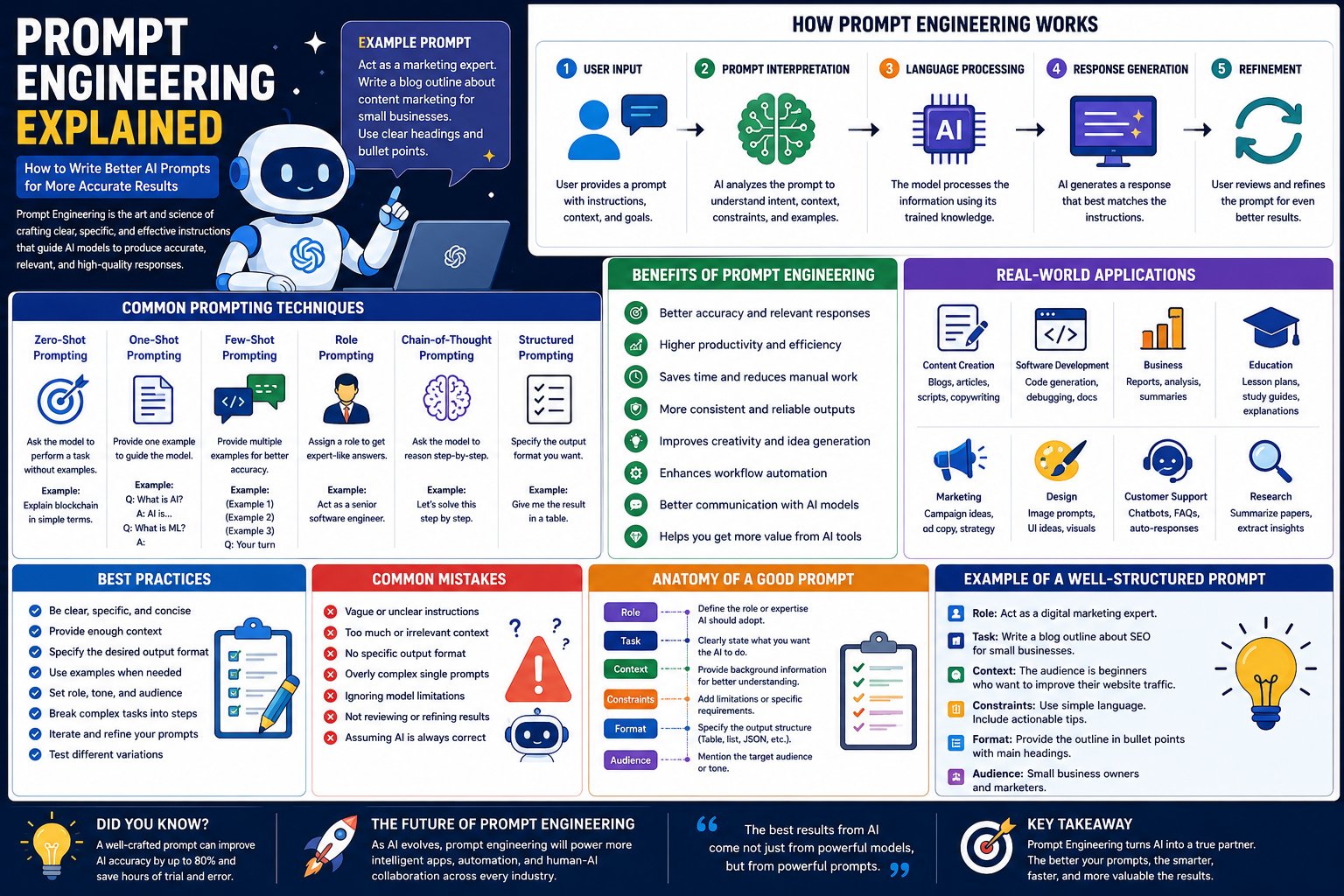
How Prompt Engineering Works
Although AI models process prompts differently depending on their architecture, the general workflow follows several stages.
1. User Input
The user enters a prompt describing the desired task.
Examples include:
Writing an article
Generating computer code
Summarizing research
Translating languages
Creating marketing content
Designing images
2. Prompt Interpretation
The AI analyzes:
Keywords
Context
Intent
Instructions
Constraints
Examples
The better the prompt, the better the AI understands the task.
3. Language Processing
The model uses its trained knowledge to interpret the prompt and predict the most appropriate response.
Large Language Models rely on billions of learned language patterns during this stage.
4. Response Generation
The AI generates an output that attempts to satisfy the instructions provided.
The response may include:
Text
Tables
Code
Summaries
Ideas
Structured data
5. Refinement
Users often improve results by revising prompts, adding context, changing constraints, or requesting additional detail.
Prompt engineering is an iterative process.
Common Prompting Techniques
Different techniques improve AI performance depending on the task.
Zero-Shot Prompting
The AI receives only the task without examples.
Example:
Explain blockchain technology for beginners.
One-Shot Prompting
The prompt includes one example before requesting a similar response.
Few-Shot Prompting
Multiple examples are provided to guide the AI toward the desired style or format.
Role Prompting
Assigning a specific role to the AI.
Examples:
"Act as a cybersecurity expert."
"Act as a senior software engineer."
"Act as a digital marketing consultant."
Chain-of-Thought Prompting
Breaking complex problems into logical reasoning steps.
This often improves responses for analytical or multi-step tasks.
Structured Prompting
Providing a required output format such as:
Tables
JSON
Bullet points
Markdown
Reports
Prompt Engineering vs Traditional Search
Traditional Search
Prompt Engineering
Retrieves existing information
Generates customized responses
Keyword-focused
Context-focused
Static search results
Dynamic AI-generated output
Limited personalization
Highly personalized responses
Primarily information retrieval
Content creation and problem solving
Prompt Engineering transforms AI from an information source into a collaborative assistant.
Real-World Applications of Prompt Engineering
Prompt Engineering is widely used across industries.
Content Creation
Blog writing
SEO articles
Product descriptions
Social media content
Software Development
Code generation
Debugging
Documentation
API examples
Business
Report generation
Meeting summaries
Workflow automation
Data analysis
Education
Lesson planning
Personalized tutoring
Study guides
Quiz creation
Design
Image generation
UI concepts
Brand ideas
Presentation creation
Customer Support
AI chatbots
Knowledge base creation
Automated responses
Benefits of Prompt Engineering
Prompt Engineering provides many advantages.
Benefits include:
Better AI accuracy
Higher productivity
Faster content creation
Reduced editing time
More consistent outputs
Improved creativity
Better workflow automation
Enhanced collaboration with AI
Effective prompting helps users achieve better results with less effort.
Challenges and Limitations
Despite its value, Prompt Engineering has challenges.
These include:
Ambiguous prompts
Missing context
Overly broad instructions
Hallucinated AI responses
Model limitations
Prompt bias
Changing AI behavior across models
Need for human review
Continuous experimentation often produces the best outcomes.
Prompt Engineering in Everyday Life
Many professionals already use prompt engineering daily.
Examples include:
Writing emails
Creating presentations
Generating code
Designing graphics
Summarizing meetings
Translating documents
Planning marketing campaigns
Research assistance
Prompt Engineering is becoming a valuable digital literacy skill.
Future of Prompt Engineering
As AI models continue improving, Prompt Engineering is expected to evolve through:
More conversational interfaces
Multimodal prompting
Voice-based prompting
Automated prompt optimization
Personalized AI assistants
Industry-specific prompt libraries
AI workflow automation
Collaborative human-AI systems
Prompt Engineering will remain a foundational skill for effectively working with AI.
Common Misconceptions
Several myths exist about Prompt Engineering.
Common misconceptions include:
Longer prompts are always better.
AI understands vague instructions perfectly.
Prompt Engineering is only for developers.
One prompt works equally well across all AI models.
Prompt Engineering eliminates the need for human review.
In reality, effective prompting combines clarity, context, and iterative refinement.
Final Thoughts
Prompt Engineering has quickly become one of the most valuable skills in the age of Artificial Intelligence. The ability to communicate clearly with AI systems enables users to produce higher-quality content, automate complex workflows, solve problems more efficiently, and unlock the full capabilities of modern AI tools.
Whether you're creating marketing campaigns, developing software, conducting research, or generating creative content, mastering prompt engineering will help you work more effectively with AI and stay ahead in an increasingly AI-powered world.
Frequently Asked Questions
What is Prompt Engineering?
Prompt Engineering is the practice of designing effective instructions that guide AI systems toward producing accurate and useful outputs.
Why is Prompt Engineering important?
It improves AI accuracy, consistency, productivity, and overall output quality.
Is Prompt Engineering only for programmers?
No. Writers, marketers, teachers, designers, business owners, researchers, and students all benefit from learning prompt engineering.
What makes a good prompt?
A good prompt includes clear objectives, sufficient context, constraints, audience information, and the desired output format.
Will Prompt Engineering remain important as AI improves?
Yes. Better AI models still rely on clear communication to understand user intent and deliver high-quality responses.
Comments (0)