
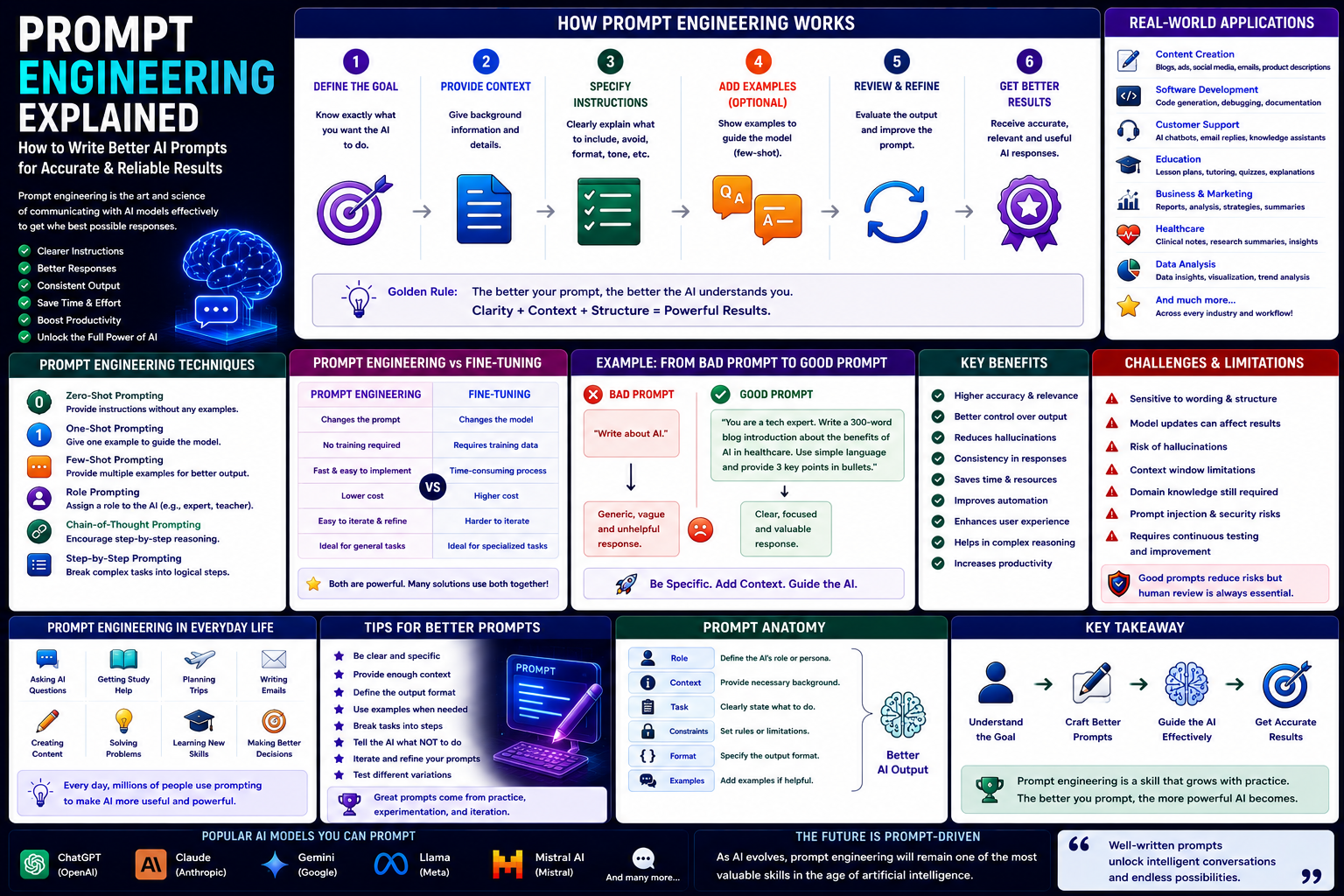
Prompt Engineering Explained: How to Write Better AI Prompts for More Accurate and Reliable Results
Introduction
Large Language Models (LLMs) such as ChatGPT, Claude, Gemini, Llama, and other generative AI systems can perform an incredible variety of tasks. However, the quality of their responses depends heavily on how instructions are written.
This is where Prompt Engineering becomes important.
Prompt Engineering is the practice of designing clear, structured, and context-rich prompts that guide AI models toward producing accurate, relevant, and useful outputs. Rather than relying on trial and error, prompt engineering applies proven techniques to improve response quality across writing, coding, data analysis, customer support, research, and countless other applications.
As organizations increasingly adopt generative AI, Prompt Engineering has become a core skill for developers, marketers, educators, analysts, and business professionals.
What Is Prompt Engineering?
Prompt Engineering is the process of creating and refining instructions (prompts) that help AI models understand user intent and generate better responses.
A well-designed prompt typically includes:
Clear objective
Relevant context
Specific instructions
Desired output format
Constraints or rules
Examples (when helpful)
Effective prompts reduce ambiguity and improve consistency.
Why Prompt Engineering Matters
Modern AI models are highly capable but rely on user instructions to determine how they should respond.
Prompt Engineering helps organizations:
Improve AI accuracy
Reduce hallucinations
Generate consistent outputs
Save time
Increase productivity
Improve automation
Enhance customer experiences
Reduce unnecessary revisions
Good prompts often produce dramatically better results than vague instructions.
How Prompt Engineering Works
Most prompt engineering workflows follow these steps.
1. Define the Goal
Identify exactly what you want the AI to accomplish.
Examples:
Summarize a report
Write marketing copy
Generate Python code
Analyze customer feedback
Explain technical concepts
2. Provide Context
Give the AI enough background information to understand the task.
Examples:
Target audience
Industry
Tone
Purpose
Available data
3. Specify Instructions
Clearly explain:
What to do
What to avoid
Desired format
Length
Style
4. Add Examples (Optional)
Few-shot examples help the model learn the expected output style.
5. Review and Refine
Evaluate responses and improve prompts through iteration.
Common Prompting Techniques
Several prompt engineering methods are widely used.
Zero-Shot Prompting
Provide only instructions without examples.
One-Shot Prompting
Include one example before asking the model to perform a task.
Few-Shot Prompting
Provide multiple examples to guide the model.
Role Prompting
Assign a role, such as:
Teacher
Lawyer
Software Engineer
Financial Analyst
Marketing Expert
Chain-of-Thought Prompting
Encourage structured reasoning for complex tasks.
Step-by-Step Prompting
Break large tasks into smaller logical steps.
Prompt Engineering vs Fine-Tuning
Prompt Engineering
Fine-Tuning
Changes the prompt
Changes the model
No additional training
Requires model training
Fast implementation
Higher cost and effort
Ideal for general tasks
Ideal for specialized domains
Easy to iterate
Longer deployment cycle
Many organizations use both techniques together.
Real-World Applications
Prompt Engineering supports many AI-powered workflows.
Content Creation
Blog writing
Social media posts
Product descriptions
Software Development
Code generation
Debugging
Documentation
Customer Support
AI chatbots
Email responses
Knowledge assistants
Education
Lesson planning
Tutoring
Quiz generation
Healthcare
Clinical documentation
Medical summaries
Research assistance
Business Intelligence
Report generation
Data analysis
Executive summaries
Benefits of Prompt Engineering
Organizations gain many advantages.
Benefits include:
Higher response quality
Better productivity
Faster AI adoption
Lower operational costs
More consistent outputs
Reduced hallucinations
Improved automation
Greater user satisfaction
Prompt Engineering helps maximize the value of generative AI.
Challenges and Limitations
Despite its advantages, Prompt Engineering has challenges.
These include:
Prompt sensitivity
Model updates affecting responses
Hallucinations
Context window limits
Prompt complexity
Domain-specific knowledge gaps
Security risks such as prompt injection
Continuous optimization requirements
Testing and iteration remain essential.
Prompt Engineering in Everyday Life
Many people use Prompt Engineering without realizing it.
Examples include:
Asking AI assistants questions
Writing emails with AI
Creating presentations
Generating code
Research assistance
Travel planning
Marketing content
Customer support automation
As AI adoption grows, prompt engineering is becoming a valuable everyday skill.
Future of Prompt Engineering
Future developments include:
Automated prompt optimization
AI-generated prompts
Personalized prompting
Multimodal prompting
Voice-based prompting
Agentic prompt workflows
Enterprise prompt libraries
Secure prompt management
Prompt Engineering will continue evolving alongside foundation models and autonomous AI systems.
Common Misconceptions
Several myths surround Prompt Engineering.
Common misconceptions include:
Longer prompts are always better.
Prompt Engineering replaces Fine-Tuning.
One perfect prompt works forever.
Prompt Engineering is only for developers.
AI always follows prompts exactly.
In reality, effective prompting requires clarity, testing, and adaptation based on the model and task.
Final Thoughts
Prompt Engineering has become one of the most valuable skills in the era of generative AI. By crafting clear, structured, and context-aware prompts, users can significantly improve the quality, accuracy, and consistency of AI-generated responses across countless applications.
As foundation models continue to evolve, Prompt Engineering will remain an essential capability for individuals and organizations seeking to unlock the full potential of Artificial Intelligence.
Frequently Asked Questions
What is Prompt Engineering?
Prompt Engineering is the practice of designing effective instructions that help AI models generate accurate, relevant, and useful responses.
Why is Prompt Engineering important?
It improves AI accuracy, consistency, productivity, and overall response quality while reducing errors and unnecessary revisions.
Which industries use Prompt Engineering?
Healthcare, finance, education, software development, marketing, customer service, legal services, manufacturing, and many others.
Is Prompt Engineering the same as Fine-Tuning?
No. Prompt Engineering changes the instructions given to a model, while Fine-Tuning modifies the model itself using additional training.
Can Prompt Engineering eliminate AI hallucinations?
No. Good prompts can reduce hallucinations, but they cannot eliminate them completely.
Comments (0)