
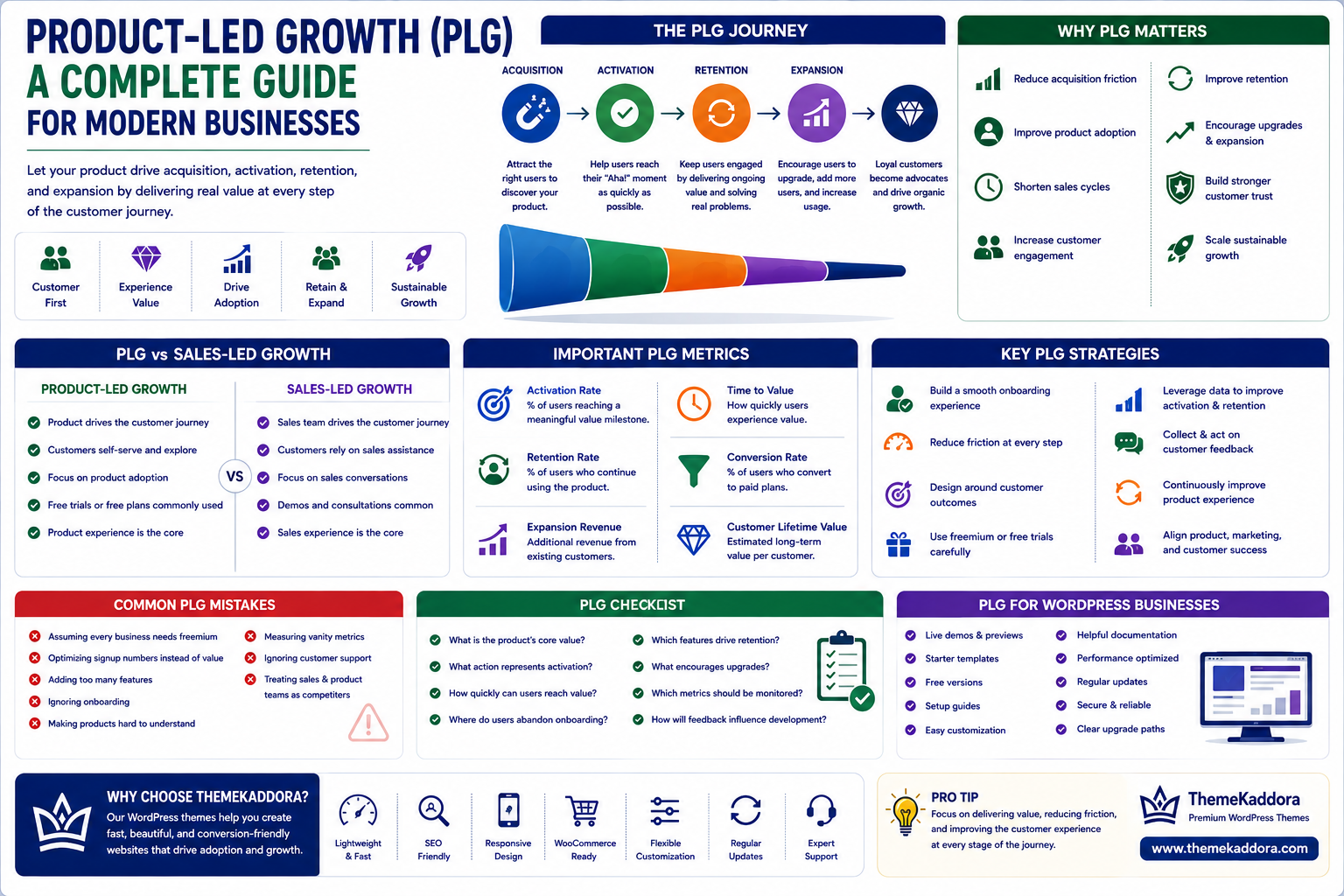
Product-Led Growth (PLG): A Complete Guide for Modern Businesses
Introduction
Traditional businesses often rely heavily on sales teams, advertising, and marketing campaigns to acquire customers.
Product-Led Growth takes a different approach.
With Product-Led Growth (PLG), the digital product itself becomes a major driver of customer acquisition, activation, retention, and expansion.
Instead of asking customers to believe that a product is valuable based only on marketing messages, businesses allow customers to experience that value directly.
This approach is especially common among SaaS companies and digital businesses, but the underlying principles can be applied to many types of products and online services.
What Is Product-Led Growth?
Product-Led Growth is a business strategy where the product plays a central role in attracting, converting, onboarding, retaining, and expanding customers.
The product becomes an important part of the customer journey.
Customers may:
Sign up independently
Explore the product
Use a free version
Complete onboarding
Discover valuable features
Upgrade when they need more functionality
The goal is to help customers experience meaningful value as quickly as possible.
Why Product-Led Growth Matters
A strong PLG strategy can help businesses:
Reduce customer acquisition friction
Improve product adoption
Shorten sales cycles
Increase customer engagement
Improve retention
Encourage upgrades
Scale customer acquisition
However, PLG is not simply about offering a free product.
The product must deliver genuine value.
The Core PLG Journey
A typical Product-Led Growth journey includes several stages.
Acquisition
Potential customers discover the product through:
Search
Content
Referrals
Communities
Social media
Product sharing
The product and its surrounding content should make the value proposition clear.
Activation
Activation occurs when users reach an important initial value point.
For example:
Creating their first project
Publishing their first website
Completing a setup process
Inviting a team member
Generating their first report
The activation event depends on the product.
Retention
Customers need a reason to continue using the product.
Retention improves when the product consistently solves meaningful problems.
Businesses should identify what keeps successful users engaged.
Expansion
Existing customers may increase their usage by:
Purchasing additional features
Upgrading plans
Adding users
Increasing usage
Expanding into other products
Expansion can become an important growth engine.
Product-Led Growth vs Sales-Led Growth
Product-Led Growth
Sales-Led Growth
Product drives much of the customer journey
Sales team drives much of the journey
Customers often self-serve
Customers may require sales assistance
Focuses heavily on product adoption
Focuses heavily on sales conversations
Often uses free trials or free plans
Often uses demos and consultations
Product experience is central
Sales experience is central
Many successful businesses combine both approaches.
Important PLG Metrics
Businesses should measure more than signups.
Important metrics include:
Activation Rate
Percentage of users reaching a meaningful value milestone.
Time to Value
How quickly a new customer experiences meaningful product value.
Retention Rate
Percentage of customers who continue using the product.
Conversion Rate
Percentage of users who move from free or trial usage to a paid plan.
Expansion Revenue
Additional revenue generated from existing customers.
Customer Lifetime Value
Estimated long-term value generated by customers.
These metrics help identify where the product experience needs improvement.
Build a Strong Onboarding Experience
Onboarding should help customers understand the product quickly.
Effective onboarding can include:
Guided setup
Helpful checklists
Contextual instructions
Templates
Examples
Product tours
Helpful documentation
Avoid overwhelming new users with every feature immediately.
Reduce Friction
Every unnecessary step can create drop-off.
Review:
Signup forms
Account creation
Payment processes
Setup requirements
Navigation
Feature discovery
Simplify wherever possible.
Design Around Customer Outcomes
Customers do not purchase features simply because they exist.
They purchase outcomes.
Instead of focusing only on:
"Our platform includes advanced analytics."
Communicate the customer outcome:
"Understand which campaigns generate the most valuable customers."
Outcome-focused product design improves clarity.
Use a Freemium or Free Trial Model Carefully
Free access can reduce barriers to product discovery.
However, the model should be designed carefully.
Consider:
What features are free?
When does the customer experience value?
What motivates upgrading?
Is the free experience useful enough?
Does the business economics work?
A free plan should support product discovery rather than simply generate large numbers of inactive users.
Use Customer Feedback
PLG businesses need continuous feedback.
Monitor:
Support requests
Product reviews
User interviews
Surveys
Usage analytics
Feature requests
Look for repeated problems rather than reacting to every individual request.
Common Product-Led Growth Mistakes
Avoid:
Assuming every business needs freemium
Optimizing signup numbers instead of value
Adding too many features
Ignoring onboarding
Making products difficult to understand
Measuring vanity metrics
Ignoring customer support
Treating sales and product teams as competitors
Product-led growth requires coordination across the organization.
Product-Led Growth for WordPress Businesses
WordPress businesses can apply PLG principles to:
WordPress themes
Plugins
Website builders
Digital products
Membership platforms
Templates
SaaS integrations
For example, a WordPress theme business can provide:
Live demos
Starter templates
Documentation
Free versions
Setup guides
Easy customization
Upgrade paths
The customer can experience product value before making a larger commitment.
PLG Checklist
Before implementing Product-Led Growth, ask:
✅ What is the product's core value?
✅ What action represents activation?
✅ How quickly can users experience value?
✅ Where do users abandon onboarding?
✅ Which features drive retention?
✅ What encourages upgrades?
✅ Which metrics should be monitored?
✅ How will customer feedback influence development?
Why Choose Themekaddora?
Product-led digital businesses need products that are easy to explore, understand, and customize.
Themekaddora WordPress themes provide:
Lightweight architecture
Fast loading performance
Responsive layouts
SEO-friendly code
WooCommerce compatibility
Flexible customization
Modern templates
Accessibility-conscious design
Regular updates
Professional support
Features such as flexible demos, customization options, documentation, and reusable layouts can help businesses create stronger product experiences around their WordPress offerings.
Conclusion
Product-Led Growth places the product at the center of the customer journey.
Instead of relying entirely on advertising or sales conversations, businesses allow customers to experience value directly through the product.
The most effective PLG strategies focus on reducing friction, improving onboarding, delivering value quickly, measuring meaningful outcomes, and continuously improving the customer experience.
For digital businesses, the product is no longer simply what customers buy.
The product can become one of the most powerful engines of growth.
Frequently Asked Questions (FAQs)
What is Product-Led Growth?
Product-Led Growth is a business strategy where the product plays a central role in customer acquisition, activation, retention, conversion, and expansion.
Is PLG only for SaaS companies?
No. SaaS companies commonly use PLG, but the principles can also apply to digital products, plugins, themes, marketplaces, online services, and other businesses.
What is product activation?
Product activation is the point where a user completes an important action that demonstrates meaningful initial value from the product.
Is freemium required for PLG?
No. A business can use free trials, demos, limited free features, or other product experiences without necessarily adopting a permanent freemium model.
Why is onboarding important for PLG?
Effective onboarding helps users reach value faster, understand the product, and develop habits that can improve activation and retention.
Why choose Themekaddora?
Themekaddora provides lightweight, SEO-friendly WordPress themes with responsive layouts, WooCommerce compatibility, fast performance, flexible customization, modern templates, regular updates, and professional support—helping businesses create digital products and website experiences designed for adoption and growth.
Comments (0)