
Predictive Analytics in ERP: How Businesses Can Forecast Future Trends
Introduction
Businesses have always used historical information to make decisions.
Sales reports help companies understand previous performance. Inventory records show what products were sold. Financial statements reveal revenue and expenses. Customer data provides information about purchasing behavior.
But historical data only tells businesses what has already happened.
Modern organizations increasingly want to know:
What is likely to happen next?
This is where predictive analytics in ERP becomes valuable.
Predictive analytics uses historical and current business data, statistical techniques, machine learning, and other analytical methods to identify patterns and estimate possible future outcomes.
When predictive analytics is integrated with an ERP system, businesses can apply forecasting to areas such as:
Inventory
Finance
Procurement
Customer behavior
Workforce planning
Supply chains
Operations
Instead of simply reporting that inventory is low, an ERP system can potentially help estimate when a product may run out.
Instead of only showing previous sales, predictive analytics can help forecast future demand.
Instead of simply reporting past expenses, businesses can use available data to identify possible future cost trends.
Predictive analytics does not guarantee that a forecast will be correct.
Unexpected market changes, economic conditions, customer behavior, supply disruptions, and other external factors can affect results.
However, predictive analytics can provide businesses with additional information for planning and decision-making.
In this guide, we'll explore what predictive analytics in ERP means, how it works, where businesses can use it, its benefits and limitations, and how organizations can prepare for predictive ERP capabilities.
1. What Is Predictive Analytics in ERP?
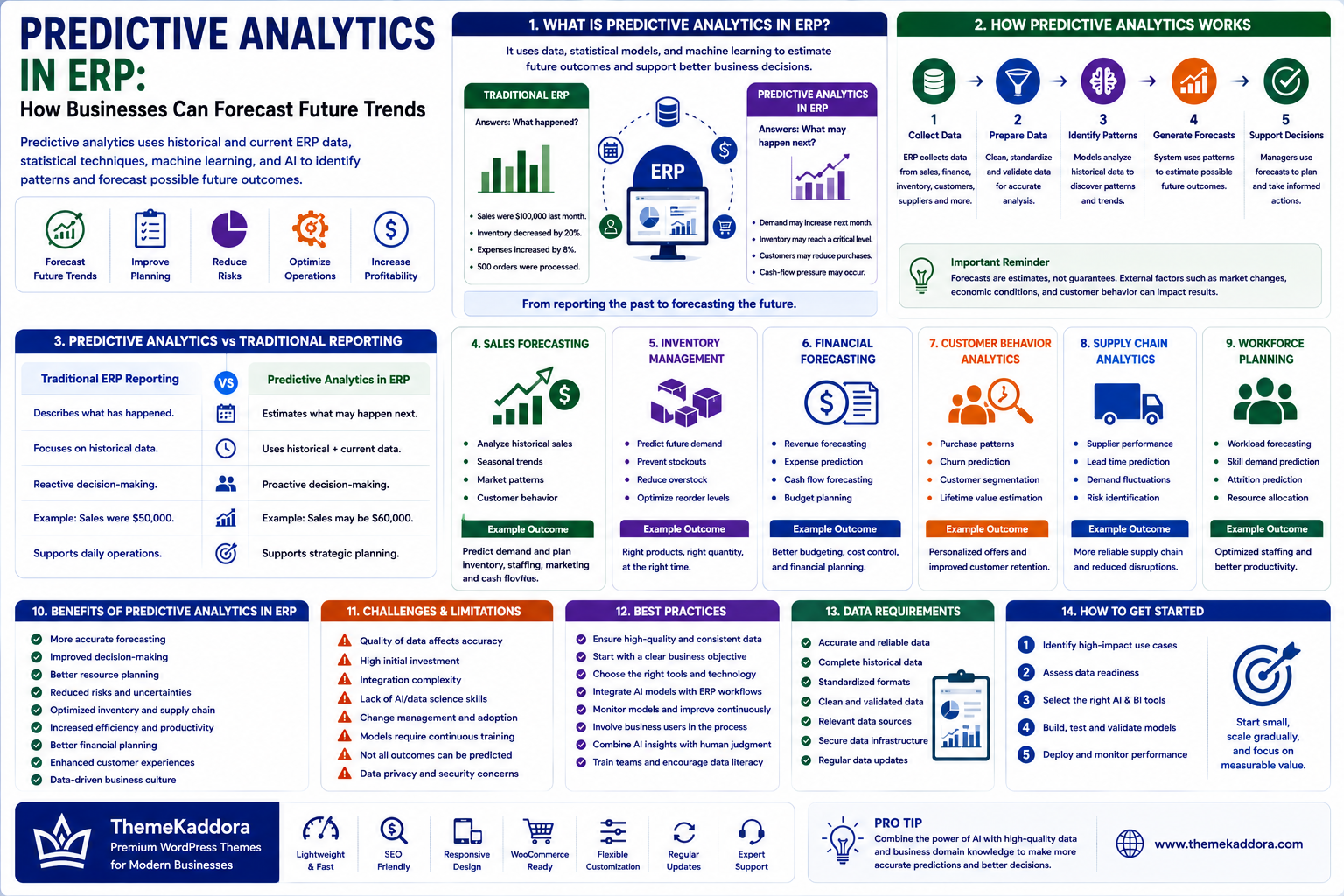
Predictive analytics in ERP refers to using analytical and AI-based techniques with ERP data to identify patterns and estimate potential future outcomes.
Traditional ERP systems primarily answer:
What happened?
For example:
Sales were $100,000 last month.
Inventory decreased by 20%.
Expenses increased by 8%.
500 orders were processed.
Predictive analytics adds another question:
What may happen next?
For example:
Demand may increase next month.
Inventory may reach a critical level.
Certain customers may reduce purchasing activity.
Cash-flow pressure may occur during a specific period.
The ERP provides the business data.
Predictive analytics processes that data to identify patterns.
Managers then use the results to make informed decisions.
2. Predictive Analytics vs Traditional ERP Reporting
Traditional ERP reporting is primarily descriptive.
It explains historical or current business activity.
For example:
"Product A sold 5,000 units last quarter."
Predictive analytics goes further:
"Based on historical demand patterns and current sales activity, Product A may require approximately 6,000 units next quarter."
The first statement describes the past.
The second provides a forecast.
This difference can help businesses move from reactive management toward more proactive planning.
3. How Predictive Analytics in ERP Works
Predictive analytics generally follows several stages.
Step 1: Collect Data
The ERP collects information from business processes.
This may include:
Sales
Purchases
Inventory
Finance
Customers
Suppliers
Employees
Operations
Step 2: Prepare Data
The data may need to be cleaned and standardized.
Duplicate, incomplete, or inconsistent information can affect analysis.
Step 3: Identify Patterns
Analytical models examine historical information to identify relationships and trends.
Step 4: Generate Forecasts
The system uses those patterns to estimate possible future outcomes.
Step 5: Support Decision-Making
Managers use the forecast to evaluate actions.
For example:
Forecast → Inventory planning → Purchasing decision
The final decision should consider business context in addition to the model's output.
4. Predictive Sales Forecasting
Sales forecasting is one of the most common applications of predictive analytics.
Businesses need to estimate future demand to plan:
Inventory
Staffing
Marketing
Purchasing
Production
Cash flow
Predictive analytics can analyze historical sales and other available information to identify trends.
For example, a business may discover that demand for a particular product consistently increases during certain periods.
The system can use historical patterns as one input when generating future estimates.
Businesses can then use forecasts to support planning decisions.
5. Predictive Inventory Management
Inventory problems can have a direct impact on revenue and customer satisfaction.
Too much inventory can increase storage costs and tie up capital.
Too little inventory can result in:
Stockouts
Delayed orders
Lost sales
Customer dissatisfaction
Predictive analytics can help estimate future inventory requirements.
For example:
Current stock + expected demand + supplier lead time = inventory planning insight
An ERP system can combine these factors to help businesses identify products that may require attention.
This is particularly useful for businesses with large product catalogs or seasonal demand.
6. Demand Forecasting
Demand forecasting attempts to estimate how much customers may want a product or service in the future.
Predictive models can consider information such as:
Historical sales
Seasonal patterns
Product performance
Customer behavior
Previous orders
Business trends
For example, a retailer selling seasonal products may observe recurring demand patterns.
Predictive analytics can use these patterns as part of a demand forecast.
The result can support better purchasing and inventory planning.
7. Predictive Cash-Flow Analysis
Cash flow is critical for businesses of every size.
A profitable business can still experience financial pressure if cash inflows and outflows are poorly managed.
ERP systems can contain information about:
Invoices
Payments
Expenses
Suppliers
Customers
Recurring transactions
Predictive analytics can analyze these patterns to help businesses estimate future cash-flow conditions.
For example, a business may identify periods when large supplier payments are expected while customer payments are delayed.
This information can support financial planning.
8. Predictive Customer Analytics
Customer behavior can change over time.
Predictive analytics can help businesses identify patterns involving:
Purchase frequency
Order size
Product preferences
Customer engagement
Customer retention
Businesses can use these insights to identify customers who may require additional attention.
For example, if a customer's purchasing activity has declined significantly compared with their previous behavior, the system could flag the account for review.
A sales or customer-success team can then decide whether follow-up is appropriate.
9. Predictive Procurement
Procurement teams need to determine:
What to purchase
When to purchase
How much to purchase
Which suppliers to use
Predictive analytics can help support these decisions.
ERP data may contain:
Historical purchases
Supplier lead times
Product demand
Purchase frequency
Supplier performance
Analyzing this information can help businesses identify potential procurement requirements earlier.
This can reduce last-minute purchasing decisions and improve planning.
10. Predictive Supply Chain Analytics
Supply chains can be affected by many variables.
These include:
Supplier delays
Demand changes
Transportation problems
Inventory shortages
Production constraints
Predictive analytics can help businesses monitor historical patterns and identify potential risks.
For example, if a supplier consistently experiences delays during a particular period, that pattern can be considered during planning.
Predictive analytics does not eliminate supply-chain uncertainty, but it can help organizations prepare for potential problems.
11. Predictive Workforce Planning
ERP and HR systems may contain workforce information such as:
Employee numbers
Attendance
Leave
Work schedules
Hiring history
Department requirements
Predictive analytics can help organizations identify workforce trends.
Potential applications include:
Staffing forecasts
Workforce demand
Scheduling analysis
Employee capacity planning
For example, a business experiencing seasonal demand may use historical information to estimate when additional staff could be required.
Human judgment remains important for workforce decisions, particularly where employee-related outcomes are involved.
12. Predictive Maintenance
Manufacturing and asset-intensive organizations can use predictive analytics to support equipment maintenance.
Traditional maintenance may follow a fixed schedule.
Predictive maintenance instead analyzes available information to identify potential signs of equipment problems.
Data may include:
Maintenance history
Equipment usage
Operating conditions
Sensor readings
Previous failures
The goal is to identify potential maintenance requirements before an unexpected breakdown occurs.
This can help businesses plan maintenance and reduce unplanned downtime.
13. Predictive Financial Analytics
Financial departments have access to large amounts of historical information.
ERP systems can contain data related to:
Revenue
Expenses
Payments
Invoices
Accounts receivable
Accounts payable
Budgets
Cash flow
Predictive analytics can analyze these patterns to help businesses anticipate potential financial conditions.
For example, a company could analyze historical payment behavior to identify periods when cash inflows may be lower than normal.
Similarly, businesses can examine expense patterns to identify potential increases in operating costs.
Predictive financial analytics can support:
Cash-flow planning
Budget forecasting
Revenue forecasting
Expense planning
Financial risk analysis
These forecasts should support financial decisions rather than replace professional financial judgment.
14. Predictive Risk Management
Every business faces operational and financial risks.
Predictive analytics can help identify patterns associated with potential risks.
Examples include:
Unusual transactions
Supplier delays
Inventory shortages
Customer churn
Payment delays
Unexpected expenses
Operational disruptions
For example, if certain purchasing patterns have historically been associated with supplier delays, predictive analytics can help flag similar situations.
This gives businesses an opportunity to investigate and respond before the issue becomes more serious.
15. Predictive Analytics for Small Businesses
Predictive analytics is not only useful for large organizations.
Small businesses can also use forecasting to improve planning.
Practical use cases include:
Sales Forecasting
Estimate future sales based on historical patterns.
Inventory Forecasting
Identify products that may require replenishment.
Cash-Flow Forecasting
Estimate potential future cash requirements.
Customer Analysis
Identify changes in customer purchasing behavior.
Workforce Planning
Estimate staffing requirements during busy periods.
Small businesses should start with simple, high-value use cases rather than attempting to implement predictive analytics everywhere.
16. Benefits of Predictive Analytics in ERP
Predictive analytics can provide several potential advantages.
More Proactive Decision-Making
Businesses can identify potential issues before they occur.
Instead of reacting to a stockout, managers can monitor forecasts and plan inventory earlier.
Better Planning
Forecasts can support:
Purchasing
Staffing
Production
Inventory
Finance
Marketing
This can help organizations plan resources more effectively.
Reduced Operational Risk
Predictive models can help identify unusual patterns and potential risks.
Early visibility gives businesses more time to investigate.
Improved Inventory Efficiency
Better demand forecasting can help businesses balance inventory availability with storage and purchasing costs.
Faster Analysis
AI-powered predictive systems can analyze large datasets more quickly than manual processes.
Better Resource Allocation
Businesses can use forecasts to decide where resources may be required in the future.
17. Limitations of Predictive Analytics
Predictive analytics is powerful, but it is not a crystal ball.
Forecasts are based on available information and assumptions.
Unexpected events can significantly change outcomes.
Examples include:
Economic changes
New competitors
Supply disruptions
Regulatory changes
Natural disasters
Major customer changes
Unexpected market trends
A model trained on historical patterns may not accurately predict a completely new situation.
Therefore, predictive analytics should be treated as decision-support technology, not guaranteed future knowledge.
18. Data Quality Is Critical
Predictive analytics depends heavily on historical data.
Poor-quality data can produce unreliable forecasts.
Common data problems include:
Duplicate records
Missing values
Incorrect transactions
Outdated information
Inconsistent product names
Incorrect customer records
Before implementing predictive analytics, businesses should review the quality of their ERP data.
Important questions include:
Is the historical data accurate?
Is enough historical information available?
Are business definitions consistent?
Are important records missing?
Are different systems synchronized?
Improving data quality can be one of the most important steps in a predictive analytics project.
19. AI and Machine Learning in Predictive ERP
Modern predictive analytics often uses Artificial Intelligence and machine learning techniques.
Machine learning systems can identify relationships within historical data and use those patterns to generate predictions.
For example, a model could analyze:
Historical sales + seasonality + customer activity + product performance → demand forecast
AI can also support more complex analysis across large datasets.
However, the quality of the prediction depends on:
Data quality
Model design
Relevant variables
Historical patterns
Business context
AI does not automatically make every forecast accurate.
Organizations should validate models and monitor their performance over time.
20. Predictive Analytics vs Prescriptive Analytics
Predictive analytics and prescriptive analytics are related but different.
Predictive Analytics
Answers:
"What is likely to happen?"
Example:
Demand for Product A may increase next month.
Prescriptive Analytics
Asks:
"What should we do?"
Example:
Consider increasing the purchase quantity for Product A.
Predictive analytics provides an estimate.
Prescriptive analytics can evaluate possible actions based on that estimate.
Businesses may eventually combine both capabilities within intelligent ERP systems.
21. How to Implement Predictive Analytics in ERP
Businesses should approach predictive analytics strategically.
Step 1: Identify a Business Problem
Start with a specific problem.
For example:
Frequent stockouts
Poor sales forecasting
Cash-flow uncertainty
Supplier delays
Step 2: Identify Relevant Data
Determine which ERP data can help answer the question.
For inventory forecasting, this could include:
Historical sales
Current inventory
Purchase history
Supplier lead times
Open orders
Step 3: Clean the Data
Remove duplicates, correct errors, standardize formats, and address missing information.
Step 4: Build or Configure the Predictive Model
Depending on the solution, businesses may use built-in ERP capabilities, analytics platforms, machine learning models, or AI services.
Step 5: Test the Forecast
Compare predictions with known historical outcomes.
This can help identify whether the model is useful.
Step 6: Introduce Human Review
Managers should review forecasts before important decisions are automated.
Step 7: Monitor Performance
Predictive models should be evaluated continuously.
Business conditions change.
A model that performs well today may need adjustment later.
22. Measuring Predictive Analytics ROI
Businesses should measure whether predictive analytics actually improves outcomes.
Useful metrics include:
Forecast accuracy
Inventory turnover
Stockout frequency
Excess inventory
Revenue forecasting accuracy
Cash-flow planning accuracy
Procurement efficiency
Operational downtime
For example, if predictive inventory planning reduces stockouts while maintaining healthy inventory levels, the business can measure the financial impact.
The objective is not simply to produce predictions.
The objective is to produce better business outcomes.
23. Predictive ERP and Real-Time Data
Historical information is important, but real-time data can make predictive systems more responsive.
Modern ERP environments may receive information continuously from:
Sales transactions
Online stores
Warehouses
IoT devices
Payment systems
Customer interactions
Supply-chain systems
Combining historical and current information can provide a more up-to-date picture of business conditions.
For example:
Historical demand + today's sales activity + current inventory → updated inventory forecast
This can help businesses respond more quickly to changing conditions.
24. Predictive Analytics and Business Automation
Predictive analytics becomes even more powerful when connected to automation.
For example:
AI predicts inventory shortage
↓
ERP creates a purchase recommendation
↓
Procurement manager reviews recommendation
↓
Purchase order is created
↓
Supplier receives order
This combines:
Prediction + Workflow + Human Approval
Businesses can gradually automate low-risk processes while keeping human oversight for important decisions.
25. Future of Predictive ERP
ERP systems are likely to become increasingly predictive.
Traditional ERP systems primarily tell businesses what happened.
Modern ERP systems can help explain why something happened.
Future predictive ERP systems may increasingly help businesses anticipate what could happen next.
For example:
"Demand may increase."
"Inventory may become insufficient."
"Cash flow may become tighter."
"A supplier may experience a delay."
"Customer purchasing activity may decline."
This can move ERP from reactive management toward proactive planning.
AI agents may also eventually combine predictive insights with automated workflows.
For example:
Identify risk → Analyze impact → Recommend action → Request approval → Execute workflow
This could significantly change how businesses manage daily operations.
26. Why Choose ThemeKaddora?
At ThemeKaddora, we believe modern business software should help organizations move beyond simple data collection.
Businesses need tools that can help them understand their information and use it to make better decisions.
AI and predictive analytics can support areas such as:
ERP
Business intelligence
Sales forecasting
Inventory management
Financial analysis
Customer analytics
Workflow automation
Business reporting
However, successful predictive analytics starts with a practical business problem.
The goal should not be to implement forecasting simply because it is technically possible.
Instead, businesses should identify where better predictions can create measurable value.
ThemeKaddora focuses on practical digital solutions that can help businesses improve automation, efficiency, analytics, performance, and customer experiences.
Conclusion
Predictive analytics is becoming an important capability within modern ERP systems.
Traditional ERP helps businesses manage transactions and understand historical performance.
Predictive analytics adds another layer by helping organizations estimate future conditions.
From sales and inventory forecasting to cash-flow analysis, procurement, customer behavior, workforce planning, supply-chain management, and predictive maintenance, businesses can apply predictive analytics across many operational areas.
However, predictions are only as useful as the information behind them.
Businesses need:
High-quality data
Reliable integrations
Appropriate models
Clear business objectives
Human oversight
Continuous monitoring
Predictive analytics should not be treated as a replacement for human decision-making.
Instead, it should provide businesses with additional information that helps them prepare for potential opportunities and risks.
The future of ERP is moving from recording what happened toward helping businesses understand what may happen next.
Frequently Asked Questions
1. What is predictive analytics in ERP?
Predictive analytics in ERP uses historical and current business data to identify patterns and estimate potential future outcomes.
2. How does predictive analytics improve ERP?
It can help businesses forecast sales, inventory, cash flow, customer behavior, procurement requirements, workforce needs, and operational risks.
3. Can small businesses use predictive analytics?
Yes. Small businesses can use predictive analytics for practical applications such as sales forecasting, inventory planning, cash-flow forecasting, and customer analysis.
4. Is predictive analytics always accurate?
No. Predictive analytics provides estimates based on available information. Unexpected events can cause actual results to differ from forecasts.
5. What data does predictive ERP require?
Depending on the use case, it may require sales, inventory, finance, customer, procurement, supplier, employee, or operational data.
6. What is the difference between predictive and prescriptive analytics?
Predictive analytics estimates what may happen. Prescriptive analytics evaluates what actions could potentially be taken in response.
7. How does AI help predictive analytics?
AI and machine learning can analyze large datasets, identify patterns, and generate forecasts based on historical and current information.
8. Can predictive analytics automate business decisions?
It can support automated workflows, but important decisions should generally include appropriate validation, controls, and human oversight.
9. Why is data quality important for predictive analytics?
Incorrect, incomplete, or inconsistent data can reduce the reliability of predictions.
10. What is the future of predictive ERP?
Predictive ERP is likely to become more proactive, combining forecasting, AI, business intelligence, and workflow automation to help organizations anticipate risks and opportunities.
Comments (0)